
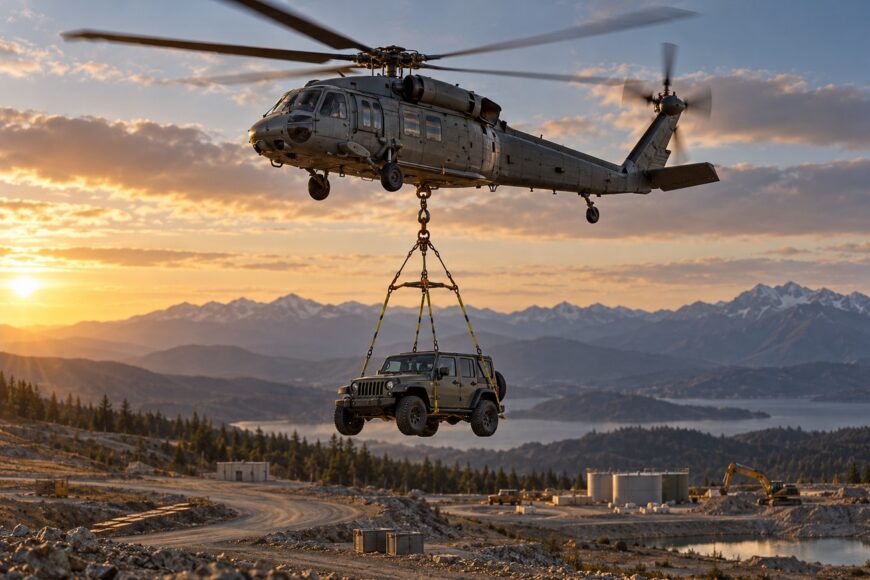
Lifting a Jeep Wrangler by helicopter appears simple: attach slings, lift the vehicle, and set it down elsewhere. In practice, a Wrangler’s mass, relatively high center of gravity, legal exposure, and dynamic loads make this a specialized external-load operation rather than a routine recovery.
A four-door Jeep Wrangler JL weighs approximately 1,900–2,100 kg at curb weight, depending on configuration. With passengers, luggage, bumpers, winches, larger wheels, roof equipment, and other modifications, the vehicle may approach its approximately 2,500–2,700 kg gross vehicle weight rating, depending on configuration.
The relevant question is therefore broader than whether a helicopter can briefly hover with the load. The job must also be safe, certified, legal, insurable, structurally acceptable, and financially sensible. A viral demonstration may prove that a particular aircraft lifted a particular vehicle under controlled conditions; it does not establish a repeatable recovery method for an ordinary Wrangler.
- Can a Helicopter Actually Lift a Jeep Wrangler?
- Helicopter Options for an External Wrangler Lift
- How the Wrangler Must Be Rigged
- Why YouTube Jeep Lifts Look Easier Than They Are
- Permits, Airspace, Insurance, and Liability
- The Real Cost—and Why It Often Makes No Sense
- Common Failure Points and Possible Damage
- A Safer Decision Process for a Proposed Lift
- Frequently asked questions
- What is the best way to lift a Jeep Wrangler?
- How much does it cost to lift a Jeep Wrangler by helicopter?
- What is Jeep death wobble, and can a lift cause it?
- How do you lift a Jeep Wrangler 2 inches safely?
Can a Helicopter Actually Lift a Jeep Wrangler?
Technically, some helicopters can lift a Wrangler externally, but the answer depends on the exact vehicle mass, aircraft configuration, approved external-load system, weather, altitude, fuel state, and operating location. A stock four-door JL is already a substantial external load. A modified vehicle can exceed the useful margin of an aircraft that appears suitable on paper.
Most light civilian helicopters, including the Robinson R44, R66, and Bell 206, commonly lack a certified external-load hook or are limited to approximately 450–600 kg. They are therefore unsuitable for a full Wrangler. The presence of lifting equipment on an aircraft does not mean that the aircraft is approved to carry this particular load.
The AS350 B3/H125 may offer up to approximately 1,400 kg of external-load capability, making a full Wrangler a marginal case with significant aircraft- and condition-specific restrictions. A Bell 412 is commonly associated with approximately 2,000–2,100 kg of external-load capability, while a Mi-8 may be rated for approximately 3,000–4,000 kg, subject to the specific aircraft and operation.
Those figures are approximate and do not represent a guaranteed payload. Heat, elevation, wind, turbulence, fuel requirements, route, and the need for reserve performance can reduce usable capacity. A helicopter’s technical ability to lift a load does not by itself prove that the operation is safe, certified, legal, or insured.
Helicopter Options for an External Wrangler Lift
The following comparison uses approximate figures only. Actual limits depend on aircraft configuration, temperature, altitude, fuel, certification, and the complete rigging system, including the Jeep and all attached equipment.
| Aircraft category | Approximate external-load capability | Suitability for a Wrangler | Main operational limitation |
|---|---|---|---|
| Light civilian helicopters, such as Robinson R44, R66, and Bell 206 | Often no certified external-load hook, or approximately 450–600 kg where approved | Unsuitable for a full Wrangler | Insufficient certified capacity and limited external-load approval |
| Airbus AS350 B3/H125 | Up to approximately 1,400 kg | A full Wrangler is a marginal case | Vehicle mass, altitude, heat, fuel, and aircraft-specific restrictions leave little usable margin |
| Bell 412 | Approximately 2,000–2,100 kg | Potentially suitable for some lightly configured Wranglers | Gross vehicle mass may exceed the usable external-load limit under operating conditions |
| Mi-8 | Approximately 3,000–4,000 kg | Generally more appropriate for a heavy Wrangler operation | Specific aircraft approval, access, site requirements, and operating cost remain decisive |
The Jeep’s actual lift mass includes fuel, accessories, recovery equipment, luggage, and modifications. A quote based on a stock specification can become invalid as soon as a roof rack, winch, spare wheel, tools, or recovery gear is included.
A larger helicopter also does not remove the need for a certified external-load operation. The operator still has to confirm the aircraft’s performance, approved hook and sling system, route, site, weather, crew, and legal conditions. In many cases, the practical challenge is finding an operator willing and authorized to perform the work.
How the Wrangler Must Be Rigged
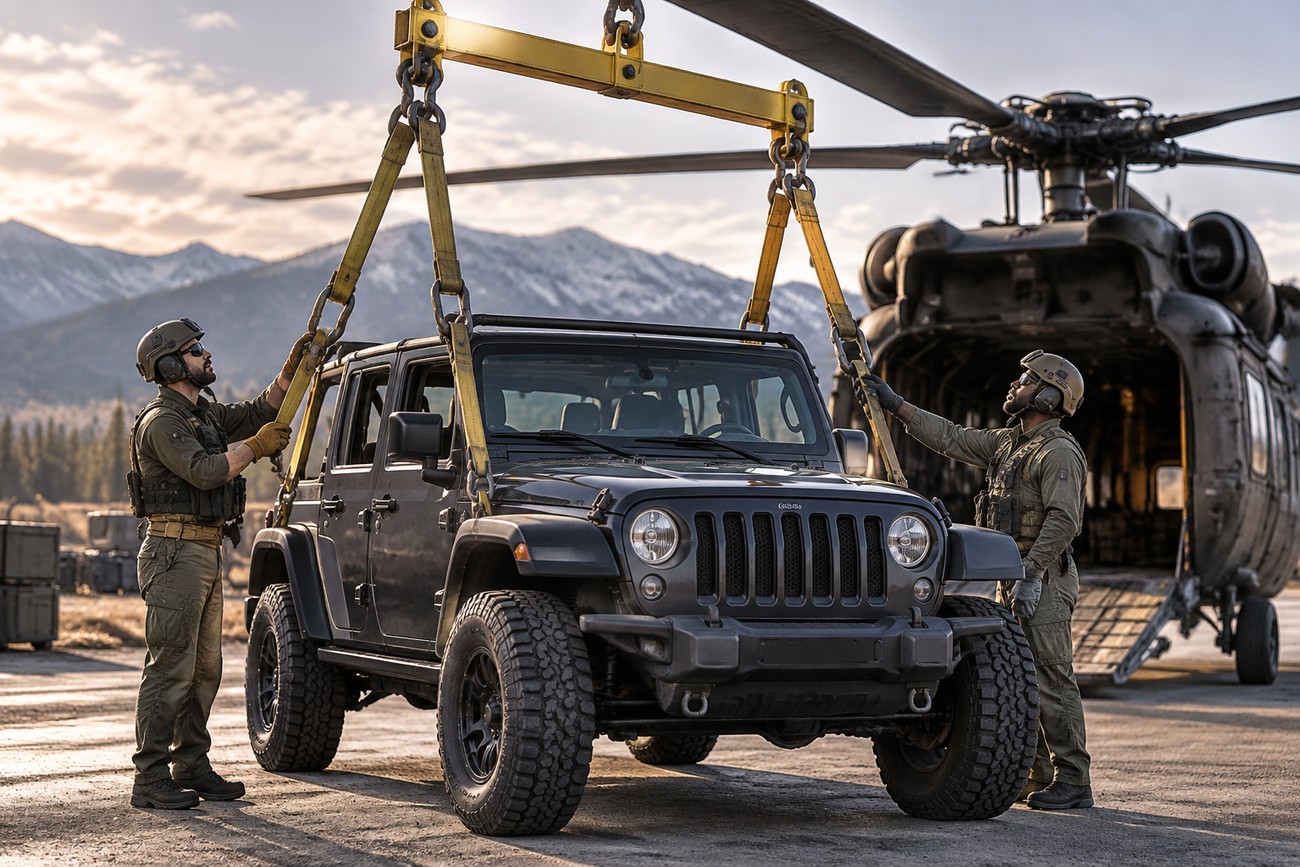
Rigging begins with an accurate weighing of the complete vehicle. The team should record fuel, cargo, recovery equipment, roof accessories, bumpers, winches, spare wheels, and any modifications. The Wrangler should usually be unloaded as far as the operation allows, both to reduce mass and to make the center-of-gravity assessment reliable.
The attachment system must follow a verified structural load path. Professional riggers favor structural frame points or purpose-built lifting points, sometimes using a lifting frame to distribute forces across the vehicle. Tow eyes, bumpers, and winches are generally designed for horizontal or diagonal recovery forces; they are not automatically rated for the full vertical weight of the vehicle.
The Wrangler’s relatively high center of gravity, compared with a low passenger car, increases the risk of swing, pitch, and uncontrolled rotation when suspended. Sling angles, connection geometry, clearance from bodywork, and the position of the lifting point all affect how the Jeep hangs. A lifting frame may be necessary where individual attachment points cannot safely distribute the load.
Static weight is only the starting point. Swing, rotation, turbulence, abrupt tension, and contact during lift-off or landing create dynamic loads that can exceed the apparent weight of the Jeep. FAA- and EASA-aligned external-load work requires certified equipment, inspection, suitable attachment points, and safety margins commonly described as 3–5 times the working load for relevant rigging components, subject to applicable local requirements.
Guide lines may help the ground team control rotation and positioning, especially during lift-off and placement. They require trained personnel, clear communication, and a site that allows the team to remain clear of the load’s path and other identified hazards. Improvised ropes, uncoordinated hand signals, or untested attachment hardware are poor substitutes for a written rigging plan.
Why YouTube Jeep Lifts Look Easier Than They Are
Promotional footage often omits the engineering work that makes the lift possible. The vehicle may be lightweight, stripped of accessories, specially reinforced, or fitted with purpose-built lifting points. The weather, aircraft configuration, load calculation, ground crew, and approvals may also be outside the frame.
Real operations are often limited to very low altitudes and short distances measured in tens to hundreds of meters. A short move from an inaccessible recovery site to a prepared landing area can be operationally reasonable; a dramatic flight over a valley or populated area introduces additional performance, airspace, and liability problems.
Heat and high elevation reduce helicopter performance, while wind and turbulence increase workload and dynamic loading. Sling length also involves a compromise: a shorter sling can reduce swing amplitude, while an excessively short sling can transmit more helicopter motion to the vehicle.
Guide lines and a ground crew may control the Wrangler during lift-off, positioning, and landing. Their presence is a sign of a managed operation, not evidence that the procedure is simple. A video that shows only the airborne seconds leaves out the controls that determine whether the lift is repeatable and defensible.
Permits, Airspace, Insurance, and Liability
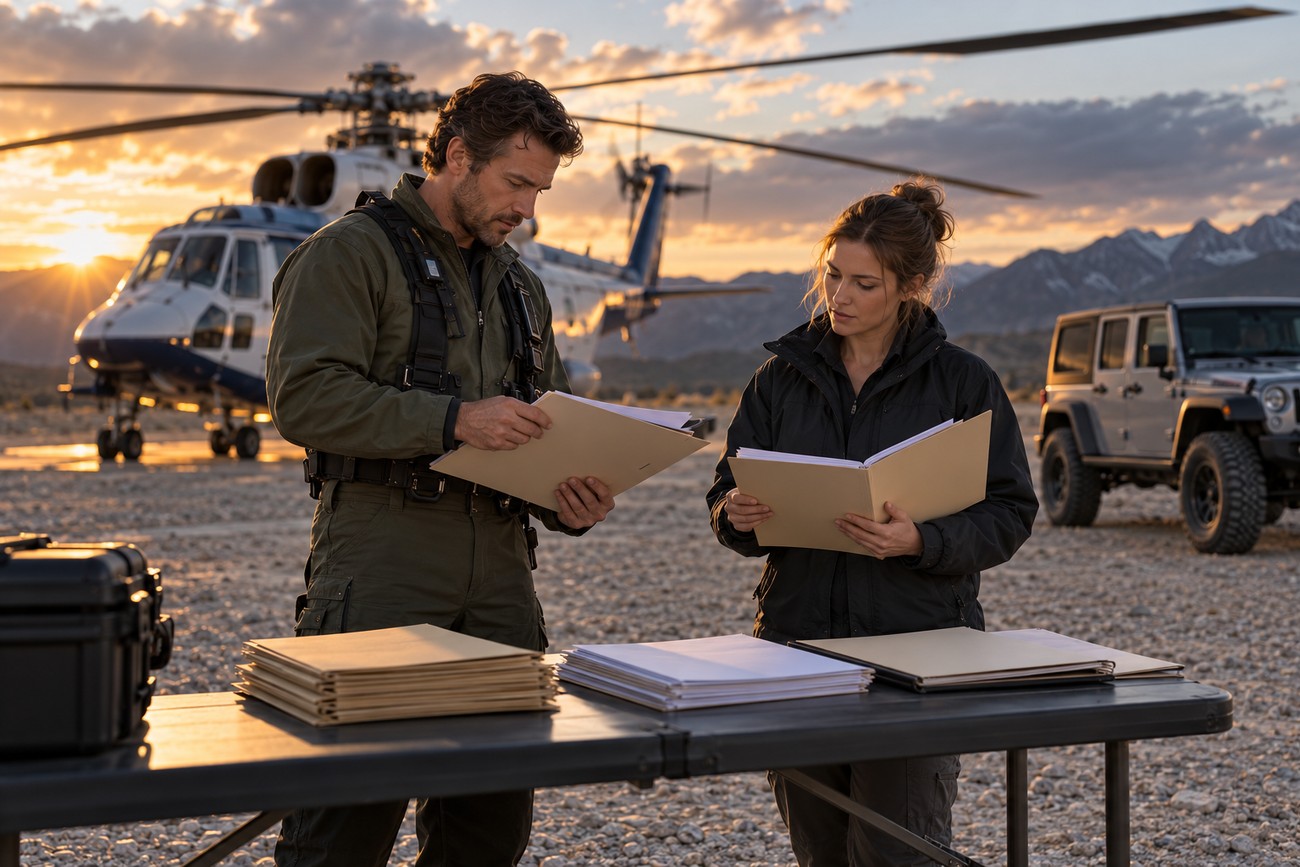
There is no single universal permit that covers every vehicle lift. The approval chain depends on the country, aviation authority, aircraft category, operating company, land ownership, airspace, and location. The operator may need coordination with aviation authorities, local administrations, landowners, and a qualified ground team before the aircraft arrives.
External-load flights over populated areas or gatherings of people are prohibited or heavily restricted in many jurisdictions. A roadside, city, event, or residential site can therefore be unsuitable even when the helicopter has enough lifting performance. The landing and loading areas must also be assessed for obstacles, rotor wash, loose materials, public access, and emergency procedures.
Operators commonly require a separate contract and expanded liability coverage for lifting a vehicle. Ordinary vehicle or helicopter policies may exclude an external vehicle lift, leaving gaps for damage to the Jeep, aircraft, property, or third parties. Responsibility for dropped cargo and recovery costs should be stated in writing before mobilization.
A verbal agreement with a private pilot does not resolve those issues. A documented commercial operation should identify the operator, aircraft, rigger, approvals, insurance, attachment system, site controls, cancellation terms, and responsibility for damage or failed recovery.
The Real Cost—and Why It Often Makes No Sense
The invoice includes more than helicopter flight time. Aircraft positioning, fuel, planning, engineering review, permits, insurance, certified rigging, ground personnel, site preparation, standby, and possible weather-related cancellation can all appear in the final cost.
Helicopter time plus preparation can cost several times more than a conventional tow or recovery. That comparison is especially unfavorable when a road-accessible route, winch recovery, heavy wrecker, or low-loader can solve the problem without aviation approvals.
Terrain, urgency, and lack of road access can change the calculation. A helicopter lift may be economically defensible where ground recovery would require major site construction, prolonged equipment mobilization, or unacceptable environmental and safety risks. The decision should account for the entire recovery plan rather than the advertised hourly aircraft rate.
A credible quote should identify aircraft limits, rigging scope, engineering review, approvals, insurance, ground support, site work, standby, cancellation terms, and responsibility for vehicle damage. If those items are absent, the apparent price is unlikely to represent the complete operation.
Common Failure Points and Possible Damage
Under-weighing is one of the most consequential errors. Modified Wranglers can exceed 2,500 kg once fuel, bumpers, winches, larger wheels, roof equipment, and cargo are included. A capacity calculation based on a stock specification can therefore produce an unsafe or unworkable result.
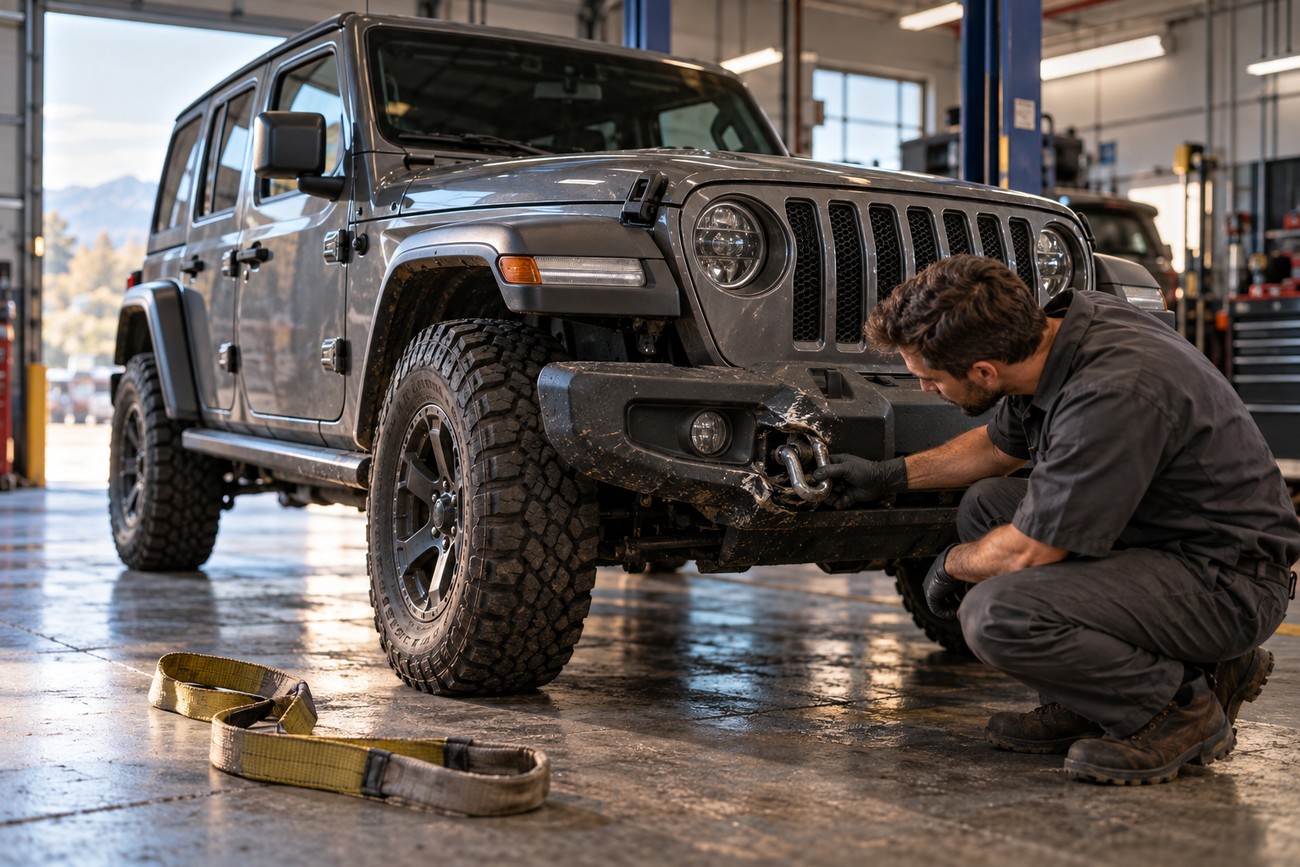
Improvised attachment points create a separate risk. A tow eye, bumper, or winch may tolerate a brief recovery pull while failing under full vertical loading or an abrupt dynamic event. Nonstandard forces can bend attachment points, stretch or damage the frame, deform the body, and tear bumper or suspension mounts.
Unqualified rigging compounds the problem. Incorrect sling angles, poor load distribution, unverified hardware, or an unrecognized center-of-gravity shift can cause the vehicle to pitch, rotate, or contact the ground. Dynamic loads from swing, rotation, turbulence, and abrupt tension may exceed the apparent static weight.
Weather is another common failure point. Wind and turbulence can turn a controlled lift into a moving suspended load, while heat and elevation reduce available aircraft performance. Starting before approvals, insurance confirmation, and site controls are complete can create cancellation, liability, and financial problems even when no physical accident occurs.
Damage may also have consequences after the aircraft leaves. Manufacturers, dealers, and insurers may treat damage from an external lift as abnormal use and may not cover it. A post-lift inspection should include the frame, body, suspension, bumpers, mounting hardware, and any engineered lifting points.
A Safer Decision Process for a Proposed Lift
Begin with the reason for lifting the Jeep. If the objective is off-road clearance, the issue is suspension design; if the vehicle is stranded, ground recovery should be assessed first. An external helicopter lift belongs in the plan only when terrain, urgency, or access makes conventional recovery impractical.
The first control is an accurate total mass from a weighbridge or suitable scale. The figure must include fuel, accessories, cargo, recovery equipment, and modifications. The operator and rigger should then confirm aircraft performance, attachment points, center of gravity, sling configuration, guide-line use, and site conditions.
Require an operator experienced with external loads and a written rigging plan using certified attachment hardware. The plan should be supported by the required inspections, approvals, appropriate insurance, a weather assessment, an exclusion zone, and a clear ground-team procedure.
The operation should not proceed without written responsibility, suitable coverage, required approvals, and a contingency plan. A conventional ground recovery should remain the default alternative whenever it can solve the problem safely.
Frequently asked questions
“Lifting a Jeep” can mean raising its suspension or moving the entire vehicle. Those are separate jobs with different equipment and safety requirements. The answers below distinguish suspension work from helicopter recovery where needed.
What is the best way to lift a Jeep Wrangler?
First distinguish a suspension lift from physically moving the vehicle. For more ground clearance, choose a matched suspension system based on intended use, alignment, suspension geometry, and tire setup. For a stranded Jeep, use conventional recovery when access allows; consider an external helicopter lift only after a qualified operator confirms the mass, site, approvals, insurance, and rigging plan.
How much does it cost to lift a Jeep Wrangler by helicopter?
There is no reliable universal price because the total includes aircraft time, positioning, fuel, planning, permits, insurance, certified rigging, ground personnel, site preparation, standby, and possible cancellation costs. Request an itemized quote that separates each category.
Check who pays for weather standby, aborted work, site preparation, additional engineering, vehicle damage, and permit delays. A conventional recovery may cost substantially less, while remote terrain or a lack of road access can change the economic decision.
What is Jeep death wobble, and can a lift cause it?
Death wobble is a severe front-end steering vibration or oscillation, usually associated with a problem in the steering, suspension, alignment, wheel and tire condition, or component wear. A suspension modification can expose poor geometry, looseness, or incorrect setup, so the entire front end should be inspected before continued driving.
Death wobble is a vehicle handling problem, not evidence that a helicopter lift is appropriate. The suspension and steering diagnosis should be completed separately from any decision to move the Jeep by air.
How do you lift a Jeep Wrangler 2 inches safely?
Use a matched suspension kit selected for the Jeep’s intended use, tire size, load, and driving conditions. After installation, check alignment, caster, steering clearance, driveline angles, brake-line routing, bump-stop engagement, and suspension geometry. A two-inch height increase should not be judged by spacer height alone.
Have the vehicle inspected and test-driven for abnormal vibration, steering changes, and component interference. This suspension work has no direct connection to suspending the complete Wrangler under a helicopter, which requires a separate engineered lifting system.







