
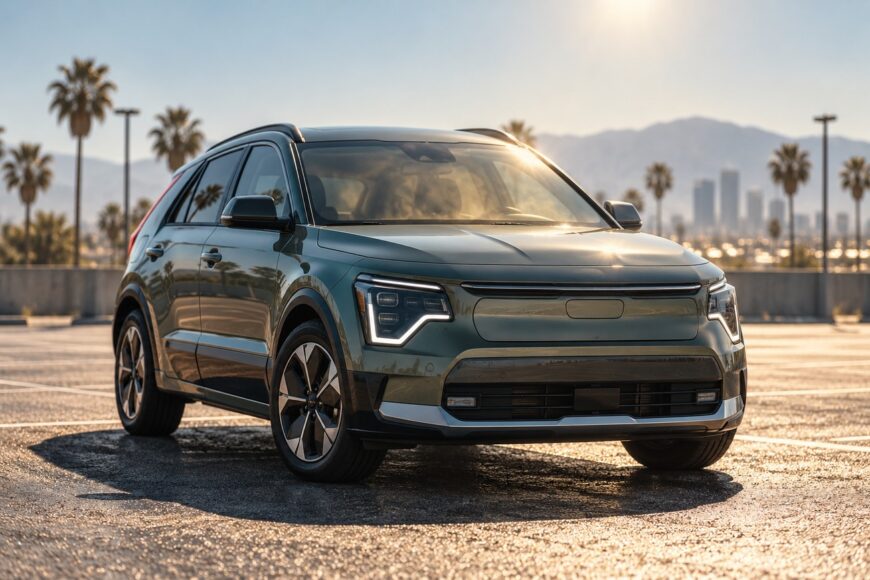
Leaving a Kia Niro EV in a hot parking lot will not usually cause immediate battery damage. The more practical concerns are a sweltering cabin, extra energy used for cooling, and faster battery aging if the car repeatedly sits in intense heat—especially near a full charge. Charging and driving immediately after a hot stop can add to the thermal load.
A battery’s allowable operating temperature is different from the temperature that best preserves it during storage. That distinction matters more than any fixed rule about how long the car may sit outside. The right choice depends on the available shade, your next trip, and whether you need the range that a higher charge provides.
- What Happens to a Kia Niro EV in Direct Sun
- Heat, State of Charge, and Long-Term Battery Aging
- The Niro EV’s Thermal Protection: What It Can and Cannot Do
- How to Park and Charge the Niro EV in Hot Weather
- Warnings, Slow Charging, and the High-Voltage Fuse-Connector Recall
- Common Hot-Weather Mistakes and the Myths Behind Them
- Frequently asked questions
- How long can a Kia Niro EV safely sit in a hot parking lot?
- Why is the Kia Niro EV being discontinued?
- What are some common problems with the Kia e-Niro and Niro EV?
What Happens to a Kia Niro EV in Direct Sun
The cabin is usually the first part of the Niro EV you notice after a sunny stop. Sunlight through the glass heats seats, trim, and other interior surfaces, so the air conditioner has more work to do when you leave. A reflective windshield shade and a shaded space can reduce that load, even though they do not directly control battery temperature.
The traction battery sits away from the cabin, and its temperature does not simply match the air inside the car. Sun and hot pavement can still warm vehicle components, including the underbody and electronics. That is why an electric car is not unaffected by a hot parking lot, even if its battery remains well within its operating limits.
Lithium-ion traction batteries are designed to operate across roughly -20 to +60 °C, while the preferred range for battery life and performance is approximately +15 to +35 °C. The upper operating figure is a limit for use, not an invitation to store the car at that temperature. A hot day can be tolerable for a trip while still being unfavorable as a repeated parking pattern.
Kia documentation associates lithium-ion battery damage and electrolyte leakage with temperatures above approximately 150 °C, far above normal hot-parking temperatures. That figure should not be read as a target or as the threshold for every kind of battery aging. Ordinary heat is primarily a long-term care issue; a serious battery fault is a separate matter that needs prompt attention.
Heat, State of Charge, and Long-Term Battery Aging
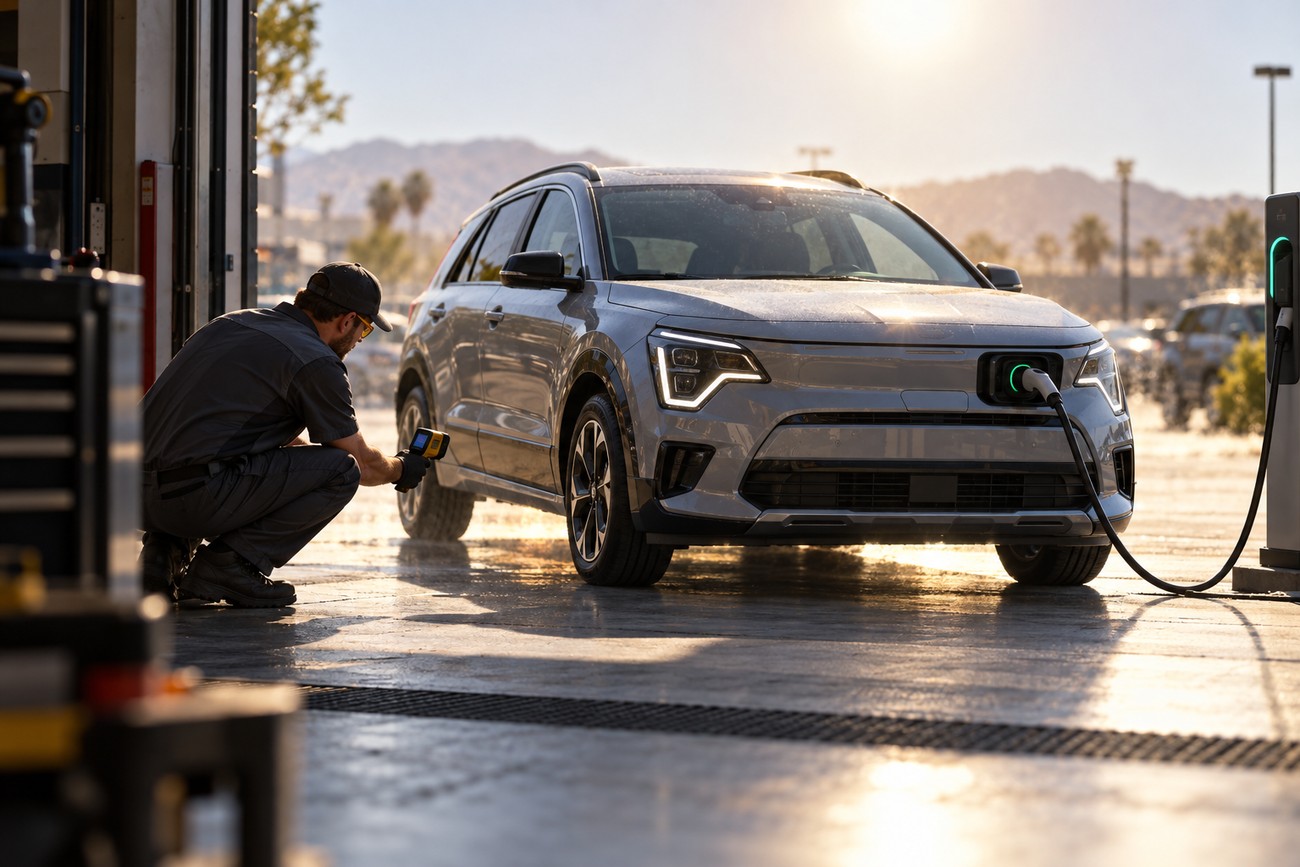
Heat affects lithium-ion cells over time rather than necessarily producing an obvious problem after one afternoon. Prolonged storage above roughly +35 to +40 °C is generally unfavorable for minimizing degradation. Repeated exposure can contribute to higher internal resistance and a gradual loss of usable capacity, although an individual car’s rate of change cannot be predicted from parking temperature alone.
State of charge changes the decision. Leaving the Niro EV at 90–100% through a long, hot stop combines elevated temperature with a high charge level, increasing chemical stress on the cells. If the next trip is short, there is little benefit in reaching full charge hours before departure and then parking in direct sun.
For a longer hot stop, approximately 40–60% state of charge is a practical owner compromise when the available range is sufficient. Some owners use an approximately 70–80% summer charge limit for routine driving. Neither figure is a universal Kia requirement: a longer journey may justify charging higher, preferably with charging timed near departure.
Summer range can also fall for reasons other than permanent battery aging. Cooling the cabin and managing battery temperature consume energy, while conditions during or after a hot stop may affect charging performance. A lower range estimate after a hot day is worth putting in context before treating it as proof of lost battery capacity.
The Niro EV’s Thermal Protection: What It Can and Cannot Do
The Niro EV monitors high-voltage battery temperature and can issue a warning or limit operation to protect the battery and electronics. If the battery is hot, the vehicle or charger may also reduce DC fast-charging power. Those responses can be inconvenient on a journey, but they are protective behavior rather than evidence that heat has already destroyed the battery.
Thermal management is especially relevant while the car is driving or charging, when the battery may generate additional heat. It should not be treated as an unlimited cooler for a car parked for hours, switched off, and disconnected. Protection against an immediate operating problem does not make prolonged hot storage equivalent to parking at a moderate temperature.
An overheating warning is intended to prompt protective limits before the extreme temperatures associated with severe battery damage. It is not automatic proof of imminent fire. Give the car time to cool, avoid demanding maximum power, and follow the warning and owner’s manual guidance rather than repeatedly clearing the message and carrying on.
Context helps when charging slows. A hot battery can be one cause, but charging power also depends on the vehicle’s state of charge and the charger’s conditions. If the limitation is marked, recurs in moderate weather, or appears alongside warnings, arrange an inspection instead of assuming every slow session is normal summer behavior.
How to Park and Charge the Niro EV in Hot Weather
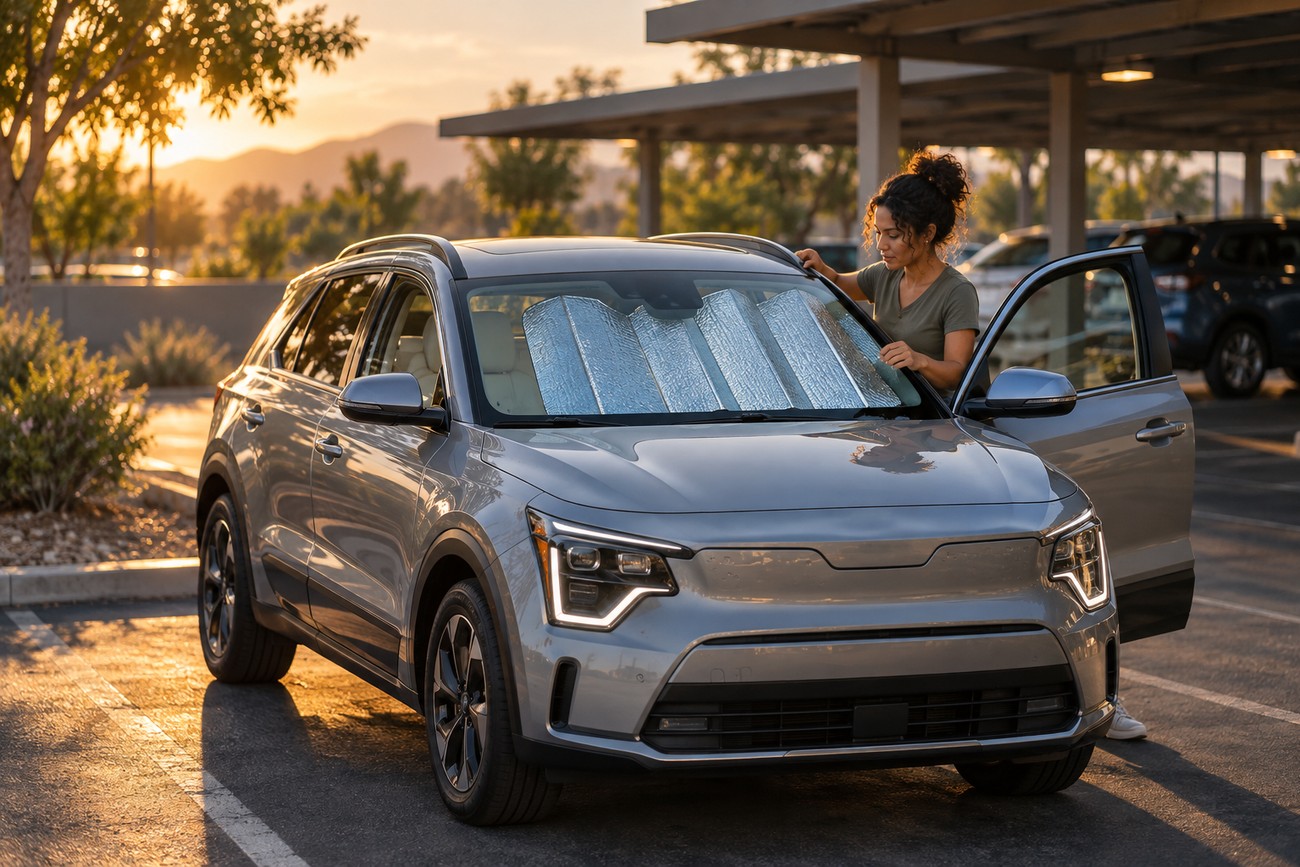
Choose shade or covered parking when you can, particularly for an all-day stop. Consider where the shade will fall later, rather than only where it sits when you arrive. If open parking is unavoidable, reducing sun through the windshield with a reflective shade can make the cabin easier to cool when you return.
Light-colored seat protection can keep surfaces more comfortable to touch, provided it fits safely and does not interfere with seat features. Leaving windows partly open may help ventilation in some settings, but security, rain, local rules, and the risk of leaving the car unattended take priority. It is not a universal parking recommendation.
Finishing a necessary high charge close to departure avoids leaving the car hot and near full for longer than needed. Before a long sun-exposed stop, a moderate charge may be the better choice if it still covers the next drive.
If your car and charging arrangement support scheduled charging, set the finish time around when you expect to leave. Cabin preconditioning while connected to external power can also reduce the initial load on the traction battery. Check the settings rather than assuming a cabin climate schedule will cool the battery throughout a disconnected parking session.
After a particularly hot stop, start with moderate driving and let the vehicle respond to its temperatures before asking for sustained high power. If you are heading to a DC fast charger, allow for the possibility of a slower session when the battery is already hot. A warning or persistent power limit takes priority over the charging schedule.
Warnings, Slow Charging, and the High-Voltage Fuse-Connector Recall
A brief increase in air-conditioning use or a slower-than-expected fast charge can have an ordinary heat-related explanation. A battery-temperature warning, repeated power limitation, or charging behavior that remains abnormal deserves more attention. Move to a safe place, follow the vehicle’s displayed instructions, and avoid hard driving or another fast-charge attempt while the warning persists.
Do not dismiss a burning smell, visible damage, smoke, or signs of abnormal heating as a routine consequence of summer parking. Stop using the vehicle where it is safe to do so and seek professional help. An interior odor after a hot stop has several possible causes, but a persistent or electrical-smelling odor should be checked rather than masked by ventilation.
Some Kia Niro EV vehicles from the 2022–2024 period were affected by a high-voltage safety fuse connector that could overheat and melt. Kia temporarily restricted charging in enclosed spaces for affected vehicles until the component was replaced. This is a specific recall concern, separate from the ordinary fact that a vehicle warms up in direct sun.
Check your vehicle identification number against Kia’s official recall information for your market, then confirm whether any applicable campaign has been completed. Model year alone does not establish that your car is affected or repaired. If a campaign remains open, follow its current instructions and arrange the remedy through an authorized service channel.
For a service visit, record the exact warning text, when it appeared, whether the car was charging, and whether the limitation cleared after cooling. These details help distinguish a repeatable vehicle fault from a single hot-weather event. They are more useful than trying to diagnose the high-voltage system from an online report.
Common Hot-Weather Mistakes and the Myths Behind Them
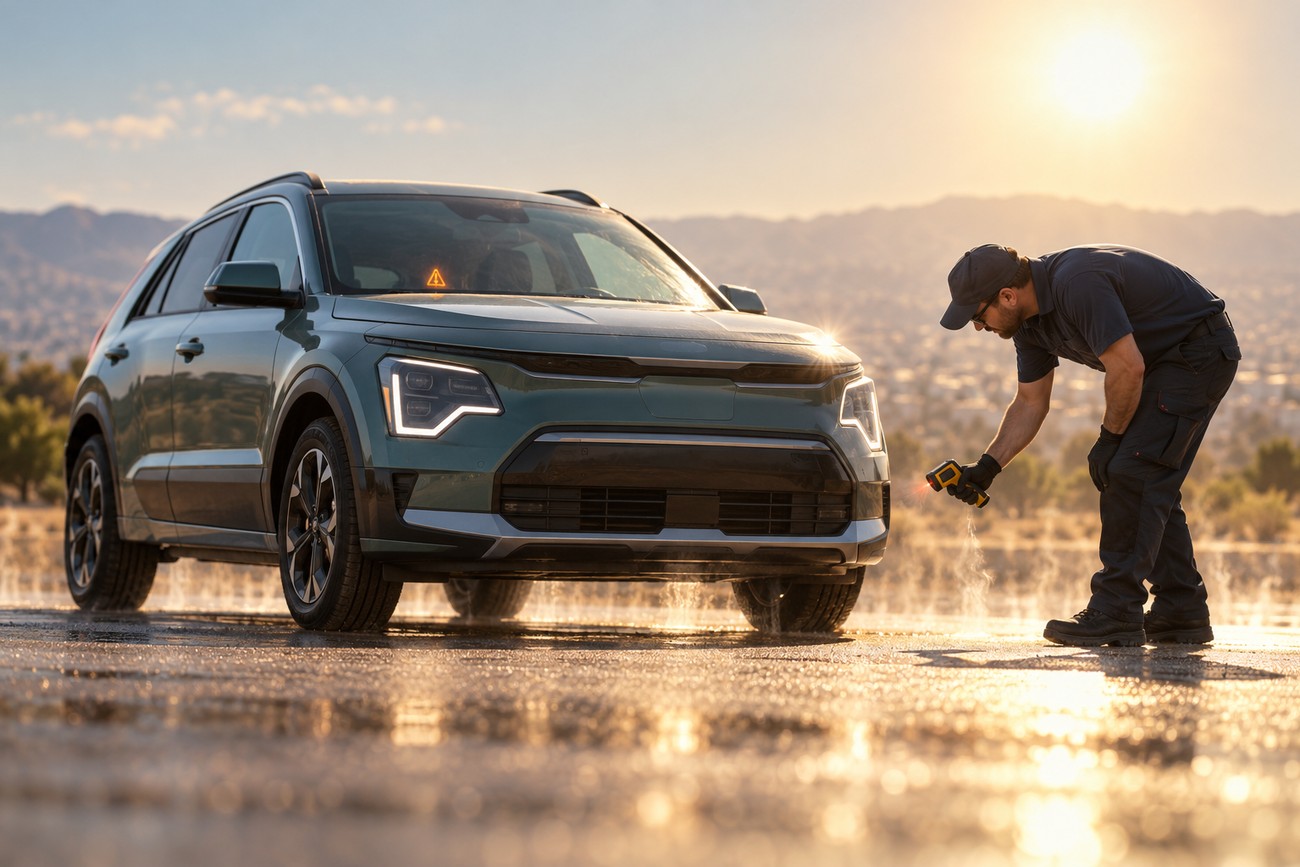
One misleading claim treats the roughly -20 to +60 °C operating range as permission for unlimited hot storage. Battery life and performance are better served at approximately +15 to +35 °C, and long storage above roughly +35 to +40 °C is unfavorable. Repeatedly parking hot at 90–100% charge is therefore worth avoiding when your travel needs allow it.
Another assumption is that thermal management removes all heat risk while the car is parked. The system offers protection during use and charging, but it does not turn a disconnected car in direct sun into moderate-temperature storage. Choosing shade and timing a high charge near departure remain worthwhile even in a vehicle with temperature monitoring.
Heat affects more than cabin comfort. Air conditioning and battery cooling can use energy that would otherwise support driving, and a hot battery may charge more slowly. Reports of reduced range, odors, warnings, or slow charging are useful prompts to check the circumstances, not measurements that predict what every Niro EV will do.
Finally, a protective overheating warning and a serious thermal-runaway event are distinct situations. Treat the warning seriously because continued heat or repeated limits need investigation, without assuming it means a fire is imminent. Any smoke, visible damage, or burning smell calls for a more urgent response.
Frequently asked questions
Hot parking decisions depend on the intensity of the heat, available shade, charge level, and what the car will do next. The answers below help with those choices; none replaces the vehicle’s warnings or instructions for an applicable recall.
How long can a Kia Niro EV safely sit in a hot parking lot?
There is no single number of hours that makes every hot parking stop unsafe. A brief stop at a moderate charge is different from repeated all-day exposure in intense sun with the battery near full. For longer stops, seek shade when practical, avoid an unnecessarily high charge, and check for warnings when you return.
Why is the Kia Niro EV being discontinued?
A local change in Niro EV availability does not, by itself, establish a battery-safety problem. Lineups and replacement decisions can differ by country and model year, so check Kia’s current information for your market. For a car you already own, confirm recalls separately by vehicle identification number.
What are some common problems with the Kia e-Niro and Niro EV?
In hot conditions, owners may notice higher cooling-related energy use, slower DC charging, or temporary power limits. Those symptoms have more than one possible cause and are not a diagnosis of battery failure. Repeated overheating warnings, persistent charging problems, or an unusual burning odor warrant service; recall applicability must be checked against official records for the individual vehicle.







