
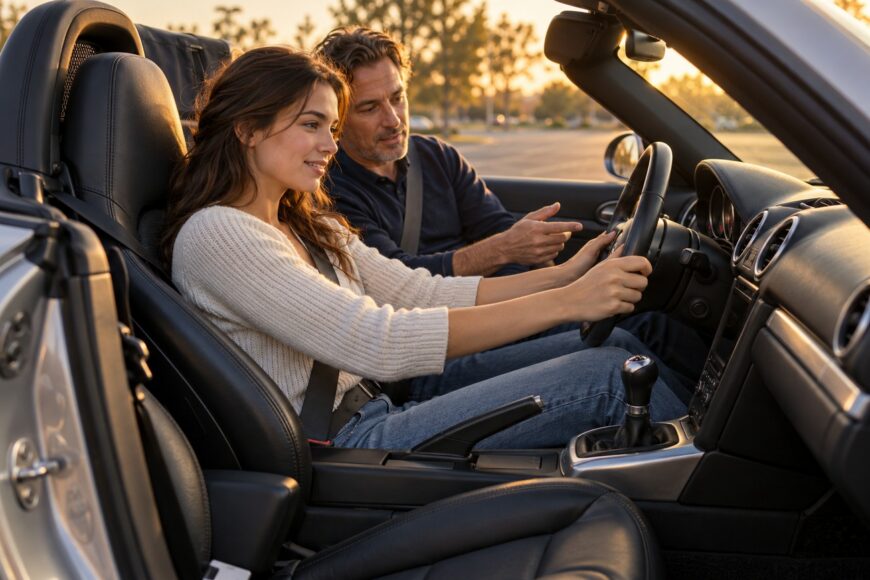
Learning to drive a manual car in Dad’s Porsche Boxster has an obvious appeal: you get to learn a valuable skill in a memorable car. The anxiety is just as real. Every stall, jerk, or scrape can feel like evidence that you are damaging something expensive, and that pressure can make your feet tense and your decisions hurried.
A carefully controlled first lesson can work if the car, location, and supervision are suitable. For many beginners, though, a less costly manual car is the better place to discover clutch control. The Boxster can then become a car for refining an existing skill rather than a test of whether you can learn under pressure.
- Should Dad’s Boxster Be Your First Manual Car?
- Agree on the Ground Rules Before Taking the Keys
- The First Lesson: Find the Bite Point Without Rushing
- Shifts, Hills, and Corners: Three Different Challenges
- When the Lesson Starts Costing More Than It Teaches
- Keep Practicing in the Boxster—or Change Cars?
- Frequently Asked Questions
- What should you do if you stall the Boxster in traffic?
- Can you teach yourself how to drive stick shift?
- Which Boxster year should you avoid?
- What is called the poor man’s Porsche?
- Which Porsche model has the best manual transmission?
Should Dad’s Boxster Be Your First Manual Car?
A manual Porsche Boxster offers precise control and direct feedback, which can make learning rewarding once the basics are familiar. Its controls may also feel demanding to someone who has only driven an automatic. A responsive accelerator can turn a small pedal movement into a noticeable change in engine speed, making smooth starts harder to judge.
Manual Boxsters are mid-engine and rear-wheel drive. That layout does not make an ordinary low-speed stall inherently dangerous, but it does mean that abrupt throttle or clutch inputs deserve respect, particularly on a slippery surface or during a turn. A novice has fewer distractions and lower financial pressure in a simpler, less costly manual car.
Basic practice in another car can teach the essential sequence: select first gear, find the clutch bite point, add modest throttle, and release the pedal progressively. Once those actions are consistent, the Boxster’s more responsive controls become easier to interpret. You can concentrate on adapting to its seating position, pedal feel, and gear selector instead of learning every manual-driving task at once.
Starting in the Porsche may still be reasonable for a short, carefully managed session if both people accept the risks. The owner should be ready to stop the lesson without frustration, and the learner should not feel obliged to prove anything. A borrowed sports car is a poor classroom if fear of making a mistake prevents calm repetition.
Agree on the Ground Rules Before Taking the Keys
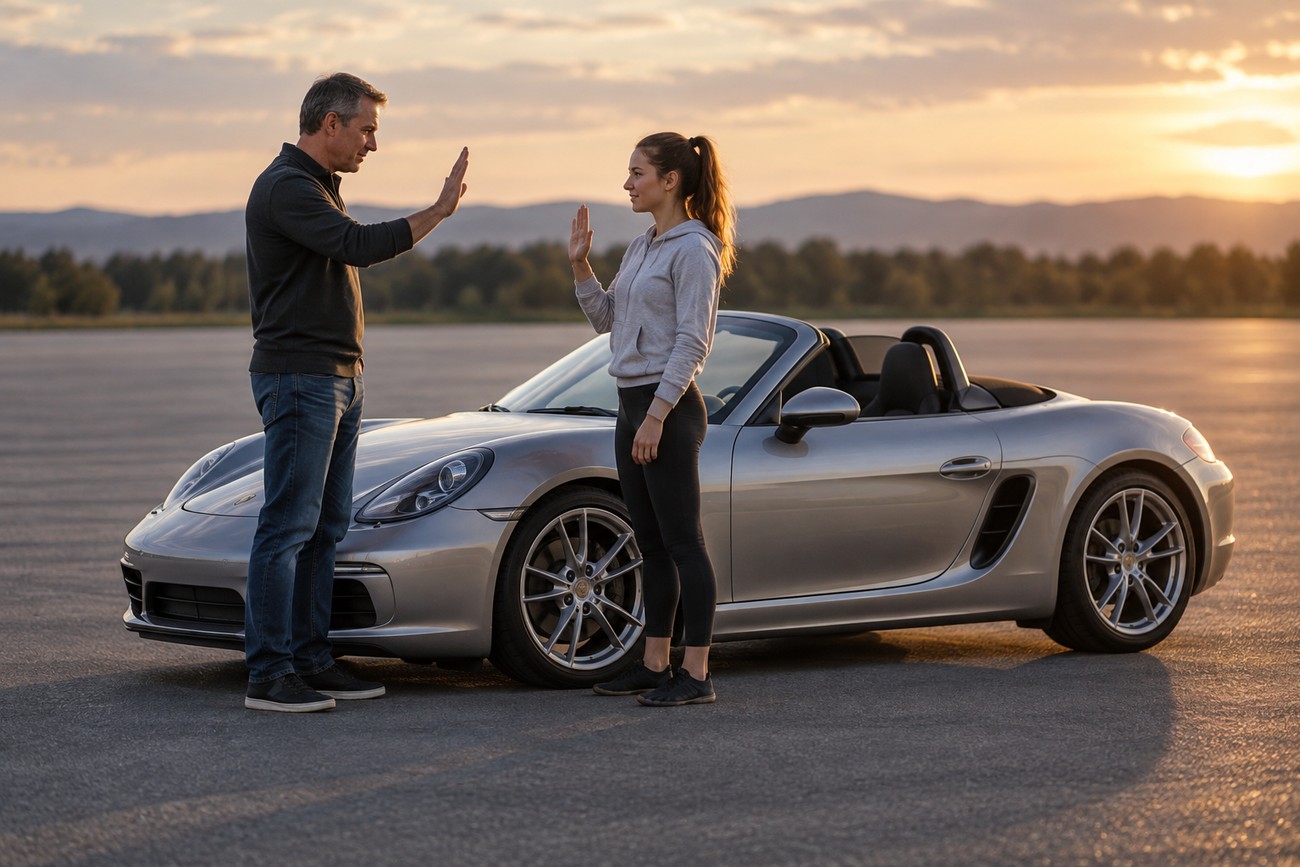
Choose an empty, level practice area away from traffic, pedestrians, steep slopes, and tight obstacles. A smooth surface reduces the number of things the learner must process while finding the bite point. The Boxster’s low clearance also makes curbs, potholes, and uneven practice areas avoidable risks.
Wear shoes with thin, stable soles so you can feel the clutch and brake pedals without catching the edge of a bulky shoe. Agree on a clear stop signal before moving. Either person should be able to end the exercise immediately, without an argument or a demand to complete one more attempt.
Dad should give one calm instruction at a time. A stream of corrections can make a learner look down, rush the pedals, or freeze after a stall. The owner’s role is to create enough space for the learner to process each action while remaining ready to call for a stop if the car begins to move unexpectedly.
Check local license, supervision, and insurance requirements before practice. Rules depend on the location and the policy, and a family lesson is not automatically covered in the same way as ordinary use. Use normal road settings with PSM enabled, and avoid Sport settings during beginner practice.
The First Lesson: Find the Bite Point Without Rushing
Begin with the seat and pedal setup. You should be able to press the clutch fully without stretching while keeping a comfortable bend in your knee and a stable seating position. Confirm that the gear is in neutral, apply the brake, and rehearse pressing and releasing the clutch slowly before attempting to move.
On level ground, select first gear and bring the clutch up gradually until you feel and hear the engine respond. Keep the throttle modest. The goal is to recognize the engagement point, then let the car move a short distance under control rather than launch quickly.
Make a few low-speed starts followed by deliberate stops. Release the clutch progressively as the car moves, then brake smoothly and reset for the next attempt. If the engine stalls, press the brake, secure the car, return the transmission to neutral, and try again without rushing.
A clutch that engages unusually high can make a beginner’s starts inconsistent even when the pedal technique is improving. The owner should have the clutch condition assessed before treating every stall as a learner’s fault.
Use engine sound and the feel through the pedals alongside the tachometer. The instruments can confirm what is happening, but learning to notice the change in engine note often helps you react sooner. Repeated high-rev launches and prolonged clutch slip add unnecessary wear, so keep the exercise slow and brief.
Shifts, Hills, and Corners: Three Different Challenges
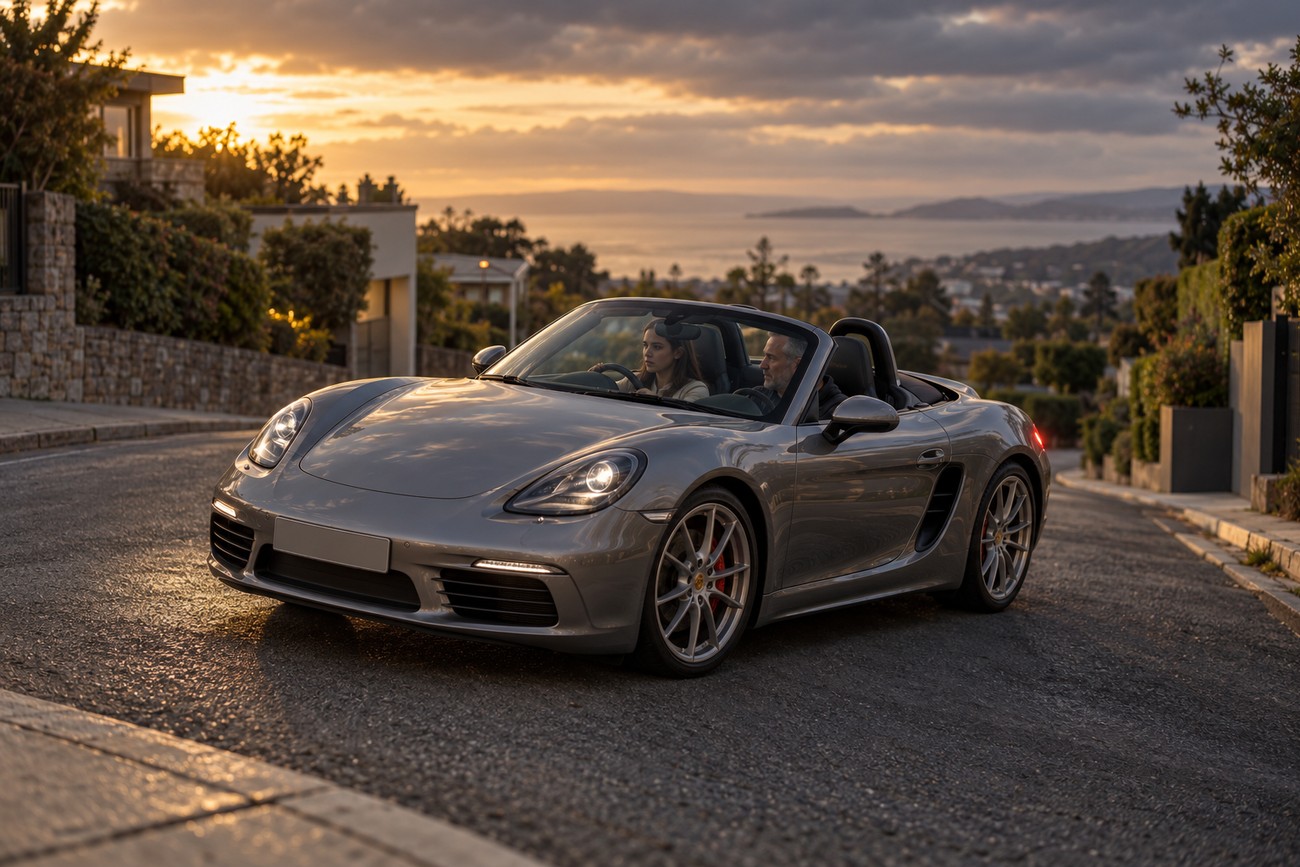
Straight-line upshifts should come after starts and stops feel predictable. Accelerate gently, lift the throttle, press the clutch fully, select the next gear, and release the clutch smoothly. Practice on a straight, open section so you are not combining a gear change with steering, traffic, or a sudden hazard.
Hill starts require a separate technique. Hold the car with the brake or parking brake, then coordinate the clutch and throttle as you prepare to move. Do not hold the car in place through prolonged clutch slip, because that creates heat and accelerates wear.
Cornering introduces a different risk because a manual Boxster is rear-wheel drive. Complete the gear change before the turn when possible, approach at an appropriate speed, and make smooth steering, throttle, and clutch inputs. Adding power while the clutch is still engaging can upset the rear of the car, especially on a slippery surface.
PSM can help manage a loss of traction, but it cannot guarantee a safe outcome or compensate for excessive speed and abrupt controls. Keep the system enabled, avoid experimental driving modes, and leave advanced cornering practice for a qualified setting after the basic skill is established.
When the Lesson Starts Costing More Than It Teaches
The clutch is a wear item, and repeated slipping can shorten its life. An occasional stall is different from repeated high-rev launches, persistent clutch slip, or a strong burning smell after each session. If those symptoms appear, stop practicing, allow the car to cool, and seek mechanical advice if they continue.
Clutch lifespan varies with the car, its condition, and how it has been driven. Replacement can also be expensive because access to the transmission is labor-intensive. Owner reports describe wide differences in service life and repair bills, so no single mileage or cost should be treated as a guarantee.
Physical damage is another reason to keep early practice simple. A low bumper, underbody panel, wheel, or suspension component can meet a curb or pothole during a nervous maneuver. An empty, level area removes many of those hazards before the learner has developed accurate clutch and brake control.
The owner’s behavior matters as much as the car’s condition. If Dad tries to intervene suddenly, gives conflicting instructions, or reacts sharply to every mistake, the learner may rush and repeat the very errors everyone is trying to avoid. A pause, a calm review, or a move to another car can protect both the relationship and the Porsche.
Keep Practicing in the Boxster—or Change Cars?
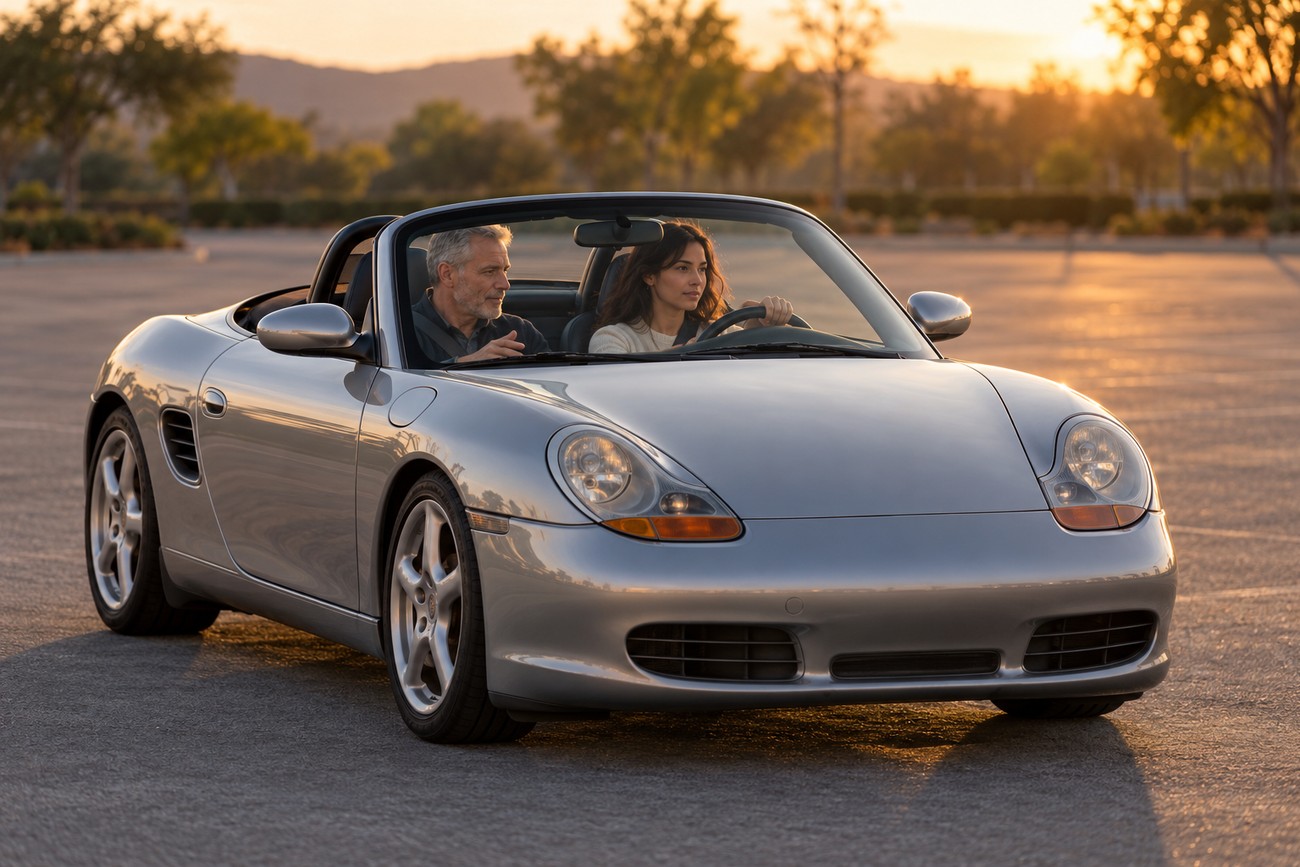
After a short, calm session, assess the result rather than the number of attempts. Continue in the Boxster only if starts and stops are becoming controlled, the car shows no concerning symptoms, and both people remain comfortable. Progress should look like less pedal correction and less tension, not simply a willingness to try again.
Move to a less costly manual car if fear dominates the lesson, clutch abuse continues, or disagreements between learner and owner are becoming the main feature. A qualified instructor can also provide structured feedback without the emotional pressure attached to a family-owned sports car.
The Boxster becomes a better training car once basic starts, stops, and straight-line shifts are consistent. At that stage, its responsive controls can teach useful precision without forcing you to solve every problem at once. The skill transfers to other manual vehicles, even though each car will have its own clutch and throttle feel.
Learning to drive stick shift is not a test of whether you can master a Porsche immediately. A slower, lower-pressure route usually protects the car, improves confidence, and gives the learner a stronger foundation for enjoying the Boxster later.
Frequently Asked Questions
What should you do if you stall the Boxster in traffic?
Press the brake, keep the car secured, and switch the transmission to neutral before restarting. Check the surroundings, restart calmly, select first gear, and move only when there is enough space. Do not rush because vehicles are waiting behind you; a hurried restart can create a second stall or an abrupt launch.
If the situation feels unsafe, keep the brake applied and use hazard lights where appropriate under local rules. After reaching a safe location, take a break before continuing. Repeated stalls in traffic are a sign that more practice in a controlled area would be sensible.
Can you teach yourself how to drive stick shift?
You can learn the basic sequence independently, but supervised practice is safer and usually more efficient. A second person can help monitor surroundings and explain what happened after a stall, while a qualified instructor can provide a calmer structure than a worried family member.
Self-teaching works best in a legal, empty, level area with a car you can afford to operate and maintain. Read the owner’s manual, keep speeds low, and move to traffic only after starts, stops, and straight-line shifts are repeatable.
Which Boxster year should you avoid?
There is no universally unsuitable Boxster year based on the information available here. Condition, maintenance history, clutch condition, and inspection results matter more than declaring an entire generation off-limits.
For learning, choose the healthiest example you can verify rather than one with an attractive price and uncertain service history. A clutch that is already worn or difficult to modulate can make teaching harder, regardless of model year.
What is called the poor man’s Porsche?
“Poor man’s Porsche” is an informal nickname sometimes applied to the Boxster itself and to less expensive sports cars such as the Mazda MX-5 Miata. The phrase can refer to a lower purchase price than a Porsche 911 or to similar sports-car appeal, although these cars are not mechanically identical.
Which Porsche model has the best manual transmission?
There is no objective single winner because the preferred manual transmission depends on the driver, model generation, gearing, clutch condition, and intended use. A Boxster manual can provide precise control, while another Porsche may feel more suitable because of its pedal layout, shift action, or power delivery.
For a used car, condition and service history should outweigh reputation alone. A well-maintained example with a clutch and gearbox that operate correctly is a safer choice for learning than a supposedly ideal model with unknown maintenance or difficult controls.







