
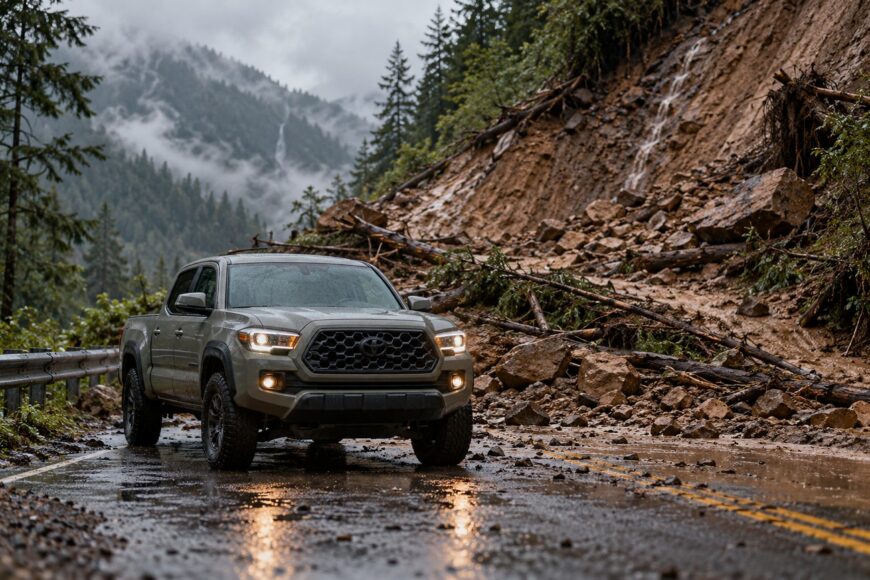
A Toyota Tacoma’s frame, four-wheel drive, and ground clearance can create confidence on rough roads. A fresh landslide is a different problem. The surface may be moving, waterlogged, or hollow beneath a firm-looking crust, and the slope above can release more material without warning.
The decision at a blocked road is therefore about retreating, verifying conditions, or taking a controlled detour—not forcing a passage. Visible debris may be only the front edge of the hazard; hidden rocks, washouts, broken utilities, and unstable ground can extend beyond what you can see.
- Why a Toyota Tacoma Is Not Safe to Drive Through a Fresh Landslide
- What to Do When the Road Is Blocked
- Why Tacoma Capability Depends on More Than Ground Clearance
- The Safer Detour May Be Much Longer
- Why Cleanup Times and Reopening Decisions Change
- Frequently asked questions
- What should you do when local posts and official closure notices disagree?
Why a Toyota Tacoma Is Not Safe to Drive Through a Fresh Landslide
A Tacoma is built for difficult roads, but its capability has limits that matter immediately after a slide. Typical curb weight is approximately 2.0–2.3 metric tons, with total vehicle weight varying by version and load. That mass can help maintain contact on some rough surfaces, while also increasing the load placed on weak, saturated ground.
Four-wheel drive can distribute engine torque to the wheels, and high ground clearance can help with ruts or smaller obstacles. Neither feature confirms that the soil will support the truck. Wet clay and loose gravel can offer little usable traction, while a washout can undermine a wheel or drop one side of the vehicle into a void.
Fresh slide material may conceal rocks, voids, washouts, or broken utilities. A crust that looks firm can cover a weaker layer of mud, water, and loose debris. If the truck breaks through, recovery may require people and equipment to enter the same unstable area that caused the danger.
The slope itself remains part of the hazard. A second movement can come from above, from the road edge, or from material already accumulated below. A Tacoma’s construction may reduce damage in some impacts, but it does not make an unstable landslide safe or turn the vehicle into a rescue machine.
What to Do When the Road Is Blocked
Stop well before the debris zone and leave enough distance to avoid the immediate fall area. Do not park beneath the slope, at its toe, or beside a narrow channel where mud and rocks could be redirected. Keep occupants inside the vehicle only if the location is clearly safer than moving; otherwise, follow local emergency instructions and move away from the slope without approaching the debris.
Look for people who may need urgent help, damaged guardrails, downed lines, leaking pipes, and signs of water running through the road. Treat any damaged utility as live or hazardous until the responsible service confirms otherwise. Road agencies commonly keep the affected section closed until a geologist or engineer has inspected it.
Access decisions should account for both sides of the slide: material can continue moving from above, while the road below may be undermined or carrying hidden water. A safe-looking surface viewed from the vehicle does not provide that assessment.
Field responders commonly avoid entering a fresh slide until it has been assessed from above and below; this is a procedural field practice, not a single universal international standard. Do not drive around the edge, climb onto the pile for photographs, or test the surface with a wheel. Those actions can disturb the margin and place the vehicle or people in the path of renewed movement.
The first hours and days after a slide can remain especially hazardous, with risk increasing during and after rain. A road that appears quiet may still be draining water through the slope. If official instructions are unavailable, retreat to a stable location, contact local emergency or road authorities, and wait for verified guidance rather than treating silence as permission.
Why Tacoma Capability Depends on More Than Ground Clearance
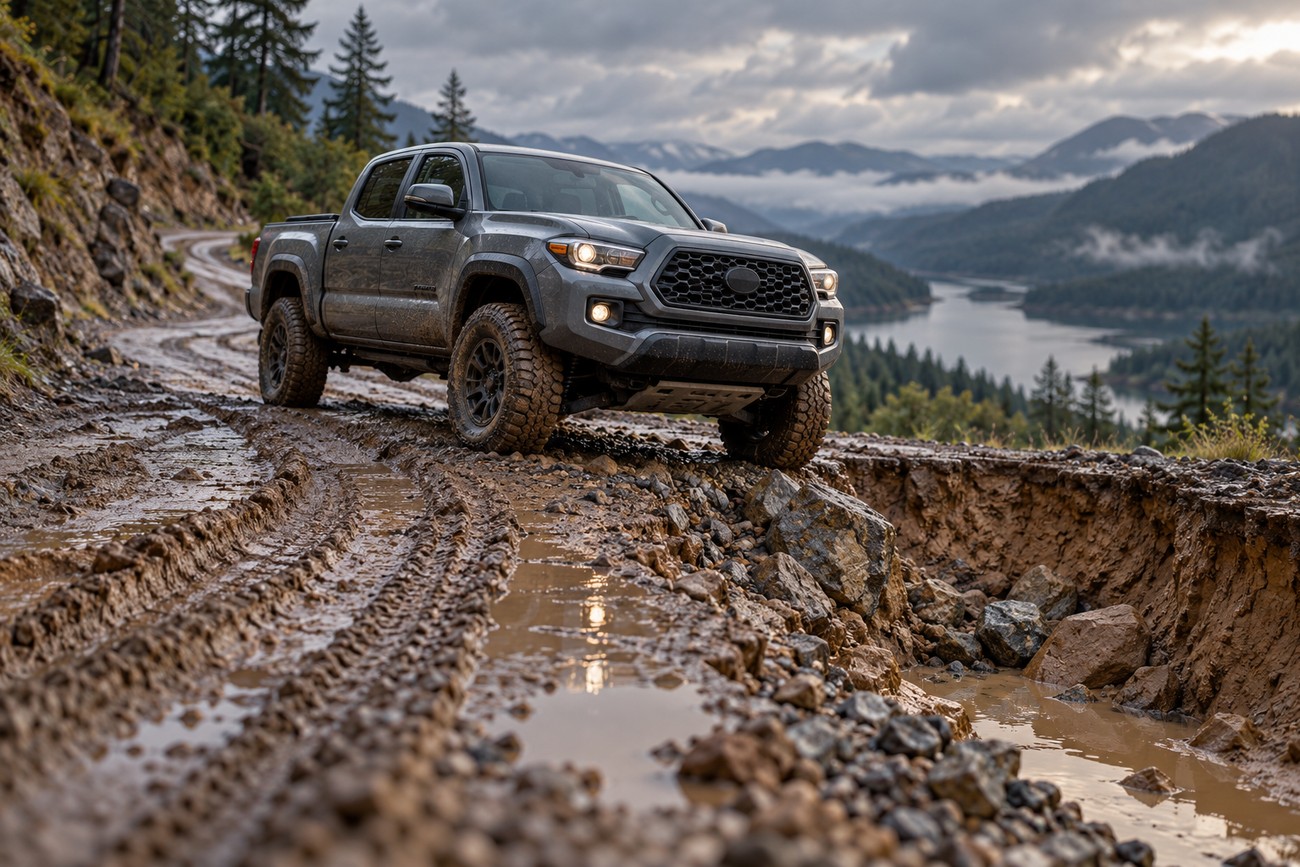
Ground clearance helps when the problem is a shallow rut, a small rock, or an uneven road surface. It does not solve a deep mud pocket, a washout, or soil with poor bearing capacity. A Tacoma can clear an obstacle while its tires lose support or its underbody settles into material that cannot carry the truck.
On wet clay and gravel, four-wheel drive does not guarantee usable traction. Tire type and condition, tire pressure, vehicle loading, wheel slip, and slope geometry all affect whether the truck moves predictably. Spinning the wheels can polish wet clay, dig holes, and increase the chance of sliding sideways.
Vehicle geometry matters as well. A long wheelbase can bridge one depression and then load the center of the truck against the ground, while approach and departure angles determine whether the front or rear overhang catches on a broken road edge. High clearance is useful, but it cannot compensate for a missing section of road.
A typical Tacoma weighs about 2.0–2.3 metric tons before version and load differences. On a weak surface, that mass can cause a sudden failure beneath a tire. A hard-looking crust may be only a thin layer over waterlogged soil, so judging the route by appearance or by the truck’s advertised capability is unreliable.
The Safer Detour May Be Much Longer
An official detour is selected for more than travel time. After a slide, authorities prioritize routes suitable for heavy equipment and evacuation, with enough width, drainage, and stability for changing conditions. That route may be tens of kilometers longer than the apparent shortest path on a navigation app.
Ordinary map applications may still direct drivers toward a closure, a road that has just failed, or a rough track unsuitable for the Tacoma’s load and condition. Road-closure information may also update more slowly than conditions on the ground. Check road-agency notices, police or emergency-service instructions, and local closure signs before accepting a route.
A forest road or mountain track that looks like a shortcut can expose the truck to narrow edges, poor drainage, fallen material, and no reliable turnaround point. Improvising around the closure can also place you on private or restricted land and make later evacuation harder. If official sources disagree, use the more restrictive instruction until the responsible authority confirms a change.
Long mountain detours have mechanical costs. Repeated descents can build brake heat, rough surfaces can damage suspension components, and rain can close the alternative route after you have committed to it. Use controlled speeds, preserve braking capacity, and stop before a questionable section rather than treating the Tacoma’s four-wheel drive as permission to continue.
Why Cleanup Times and Reopening Decisions Change
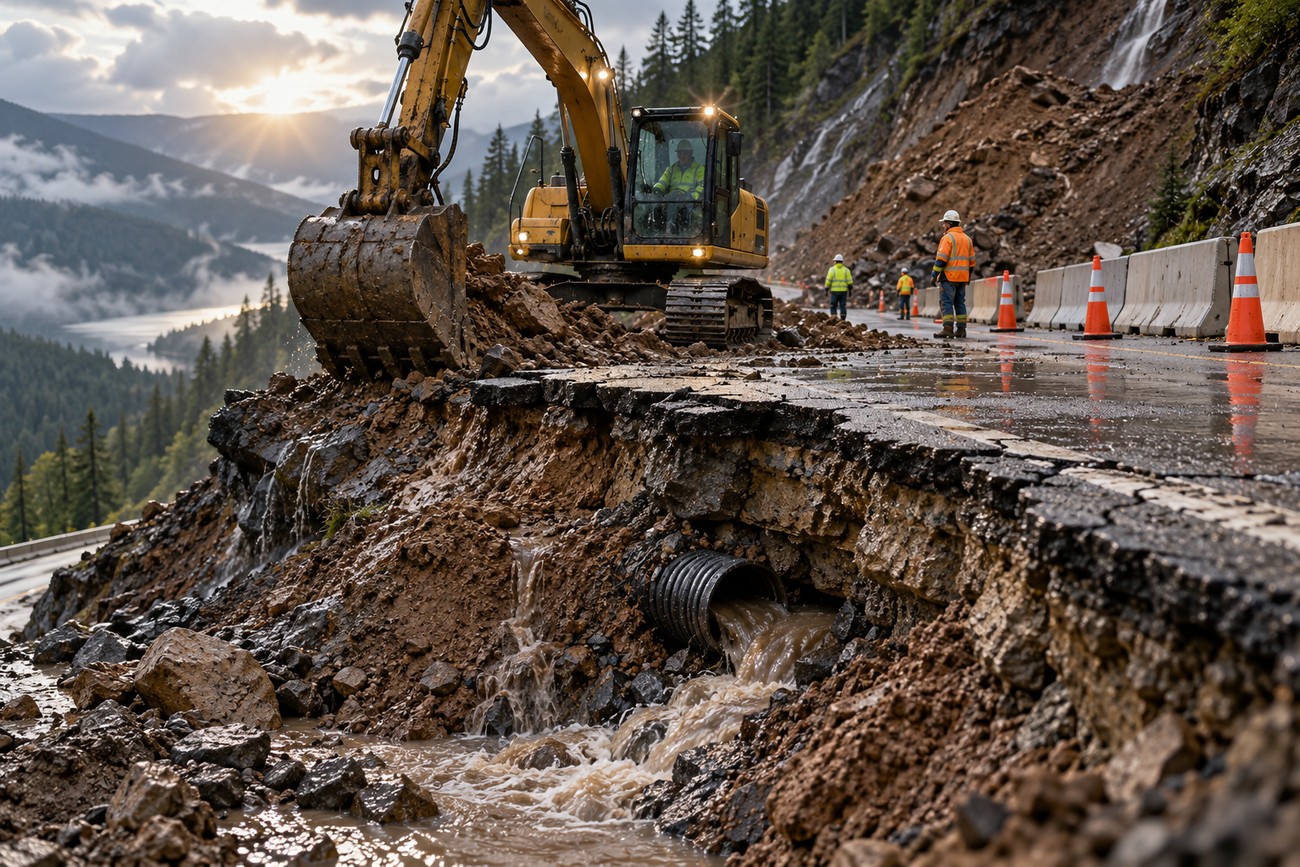
A statement that a road may reopen in a few hours may be based on the visible debris and the equipment initially available. Crews may then find damage beneath the pile, blocked drainage, an undermined roadbed, or a slope that continues to shed material. Those findings can extend the closure to a day or longer.
Secondary movement is more likely while the slope remains unstable, especially during or after rain. Water can enter cracks, soften clay, and redirect runoff behind the cleared area. A second slide may cover the road again or damage the temporary access lane before traffic can use it safely.
Heavy equipment can create a lane through the debris without confirming that the whole road is open. A temporarily cleared lane can deteriorate quickly under rain or another slide. A visible open lane does not prove that the roadbed, slope, or utilities are safe.
Conservative closures are often justified because the risk extends beyond traffic obstruction. A road agency must consider workers, drivers, utility damage, drainage, and the possibility of renewed movement. Waiting for inspection and stabilization may feel excessive from the queue, but it reduces the chance that a vehicle enters a failure zone while conditions are still changing.
Frequently asked questions
What should you do when local posts and official closure notices disagree?
Use a verification hierarchy: follow an active closure from the road agency, police, emergency management, or signed control point, then confirm through the responsible agency’s latest channel. Treat local posts, map pins, and photos as useful leads rather than permission to pass, because they may show an earlier condition or a different location.
Record the road name, direction of travel, nearest mile marker or landmark, time, and the wording of the official notice without approaching the debris. Share that information with the relevant authority if asked. Do not resolve conflicting reports by driving closer, testing the surface, or lowering tire pressure at the roadside; tire-pressure changes should follow the vehicle and tire manufacturer’s guidance and should never be used to justify entry onto unstable ground. Recovery equipment can move a truck, but it cannot remove the risk of weak soil, broken utilities, or a renewed slide.







