
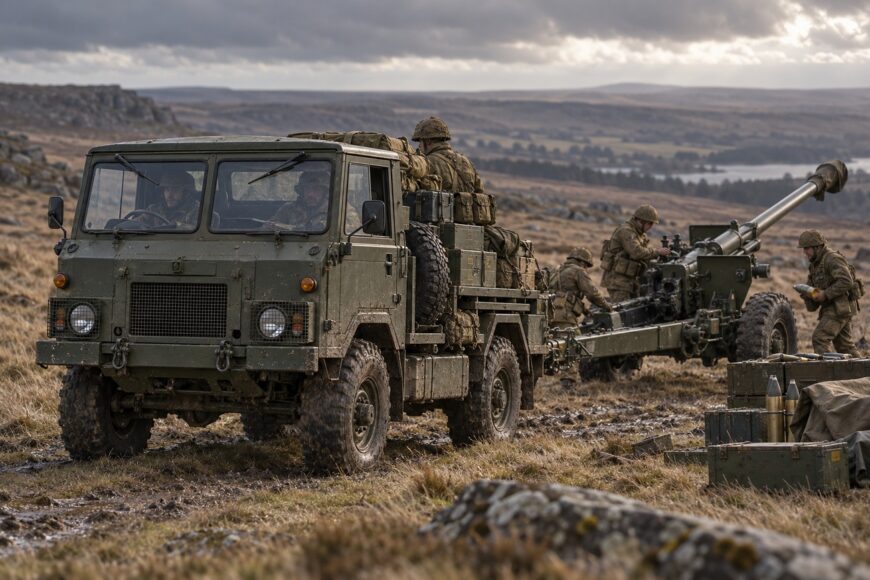
The Land Rover 101 Forward Control looks purposeful because it was purposeful. It was built to move a gun, its crew, ammunition, and field equipment across difficult ground, then arrive by military transport when required. That brief created a useful load platform, but it also produced a short, tall, noisy vehicle with little interest in civilian comfort.
Its appearance can make a surviving example seem like a simple, enlarged Series Land Rover. That is a misleading starting point. The 101 has a cab-forward layout, permanent four-wheel drive, a V8, an integrated LT95 transmission, and distinctive military running gear. Those features make it capable and unusual, while also making condition, originality, and parts supply more important than the rugged bodywork suggests.
- Why the British Army needed the 101
- Forward-control layout and the machinery underneath
- What the gun-tractor load rating really meant
- Driving a 101: capability with real compromises
- Original gun tractor or later conversion?
- What to inspect before buying or restoring one
- Frequently asked questions
- How much does a Land Rover 101 Forward Control weigh?
- What does a claimed 74:1 low-gear ratio mean on a 101?
- How can I verify the history of a radio or ambulance conversion?
- How do I assess whether a surviving 101 can tow a particular trailer?
Why the British Army needed the 101
The 101 Forward Control was developed as a gun tractor for the L118 105 mm light gun. It was expected to tow the gun while carrying its crew, ammunition, and roughly one tonne of equipment. The “101” refers to the vehicle’s 101-inch wheelbase, while the forward-control arrangement placed the cab over the front part of the chassis to preserve useful space behind it.
Production ran from 1972 to 1978, with approximately 2,660–2,669 vehicles built depending on the counting method. That limited total explains why the model is less familiar and why some specialized components are harder to source than ordinary Series or Defender parts. It also means that surviving examples deserve individual examination rather than assumptions based on a common civilian specification.
Air transport strongly influenced the design. The vehicle had to be carried in aircraft and suspended beneath heavy helicopters, so mass, dimensions, and the arrangement of equipment mattered alongside off-road traction. Those requirements shaped a compact military tool; they do not prove that every surviving 101 still has its original body, equipment, or approved modern transport status.
Forward-control layout and the machinery underneath
The cab-forward layout gives the 101 a relatively open load area for its wheelbase, but the engine sits close to and partly behind the occupants. That arrangement helps explain the cabin’s heat, noise, and awkward service access. It is a packaging compromise made for military utility, rather than a larger version of the conventional bonneted Land Rover.
The standard powertrain used a 3.5-litre aluminum Rover V8 and an LT95 manual gearbox with an integrated transfer case. Drive is permanent four-wheel drive, with a lockable center differential. The combined gearbox and transfer assembly should therefore be understood as one related system during diagnosis, even though its functions resemble separate units on many modern vehicles.
Standard military tires were 9.00×16, fitted to reinforced six-stud wheels unlike those used on most civilian Land Rovers. Substituting civilian components without checking fitment, load capacity, and clearance can create problems that are easy to miss when a vehicle is stationary. Wide modern tires may reduce steering lock or contact the frame if their offset is unsuitable.
What the gun-tractor load rating really meant
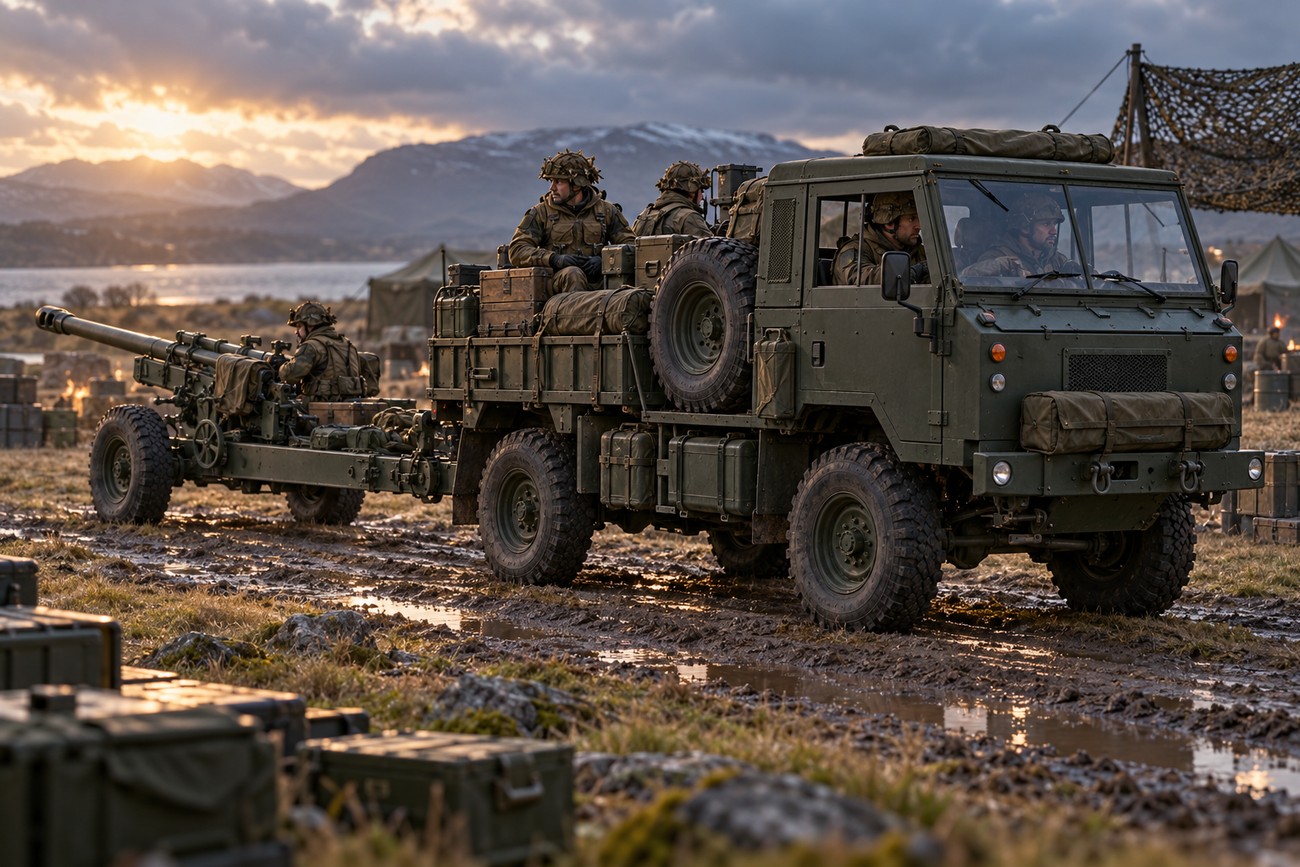
The 101’s working role combined towing with carrying. Its intended load included the L118 light gun, crew, ammunition, and roughly one tonne of equipment, so the military description referred to a complete operational task rather than an empty chassis waiting for a full payload.
That distinction matters with civilian survivors. Occupants, fuel, tools, canvas, spare equipment, radio installations, ambulance bodies, and other additions all consume permitted mass. A converted vehicle can therefore have substantially less available payload than the phrase “one tonne” might suggest.
There is no verified universal weight that safely represents every 101. The relevant figure is the individual vehicle’s recorded limit and measured condition, including its body and equipment. A weighbridge reading is more useful than a brochure description when planning a restoration, expedition load, or replacement body.
Air-transport suitability should be treated in the same practical way. It was a military design requirement, not a guarantee of easy civilian transport, current road compliance, or compatibility with modern towing equipment. Present use depends on the vehicle’s documentation, condition, local rules, and actual fitted configuration.
Driving a 101: capability with real compromises
The 101 can feel effective on rough ground, where its permanent four-wheel drive and military traction matter more than refinement. On pavement, the compromises are immediate: steering is heavy, the turning circle is wide, and the short, tall body demands care. The V8 also brings fuel consumption that makes cheap long-distance running unrealistic for many owners.
Heat and noise are structural features of the layout. With the engine close to the cab, the soft-top body offers limited isolation, and a long drive can be tiring. Commercial descriptions cite around 60–70 mph maximum, but owners report that an unloaded vehicle may feel unsettled at speeds below that figure. A claimed maximum is therefore not the same measurement as a sensible, safe-feeling cruising pace.
The front propshaft should be judged by inspection rather than sound alone. Its joints, flanges, supports, and operating angles can distinguish load-dependent vibration from excessive play before attention is directed toward the differential.
The pronounced front propshaft operating angle can produce characteristic noise or vibration, particularly on the overrun. Because the 101 uses permanent four-wheel drive, the front propshaft continues to rotate while the vehicle is moving, including during periods of reduced throttle. That makes operating conditions relevant when reproducing and diagnosing a complaint.
Original gun tractor or later conversion?
Factory-built 101s were soft-top General Service machines. Their basic appearance reflected the gun-tractor role, with an open military body and canvas cover. Radio and ambulance bodies appeared later through conversion work, even when the finished vehicle looks convincingly period-correct.
A closed body can change more than the silhouette. Additional structure, equipment, wiring, and interior fittings affect mass, weight distribution, available payload, and sometimes service access. A radio installation may also leave extensive electrical changes that are difficult to assess from a brief visual inspection.
Originality should be checked against the chassis identity, surviving records, construction details, and the condition of the wiring and body mounts. A present V8 does not establish factory specification. Engines, carburetors, ignition systems, and gearboxes may have been replaced during military or civilian service.
For a buyer, configuration matters because it changes how the vehicle should be used and valued. A well-executed conversion can be useful, but it should be described as a conversion, with its additional mass and altered systems accounted for, rather than treated automatically as an untouched military example.
What to inspect before buying or restoring one
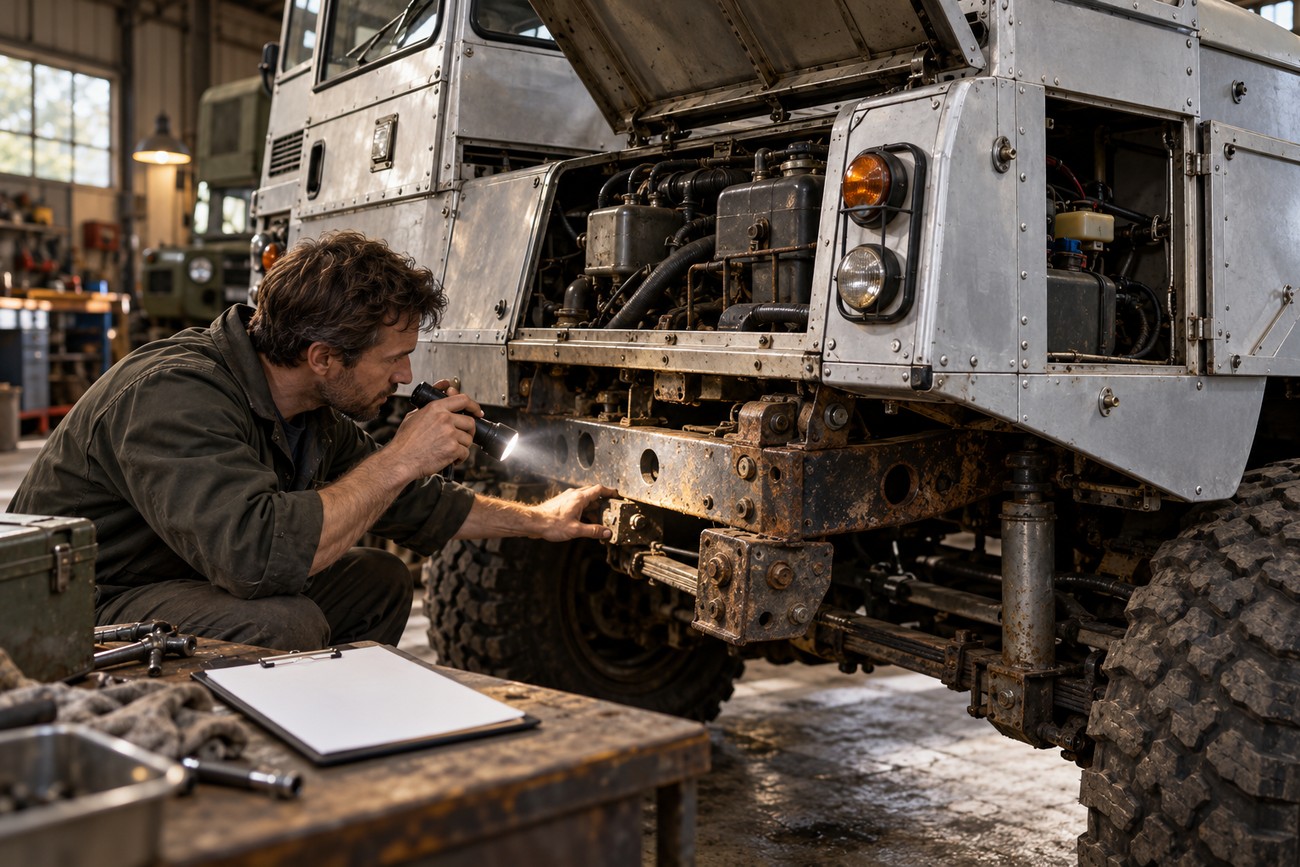
Begin with identity and configuration. Confirm the chassis details, body type, engine, gearbox, wheel fitment, and any evidence of conversion work. Check whether the vehicle’s present layout matches its records, since a familiar-looking soft top or a surviving Rover V8 cannot by itself prove that the major assemblies are original.
Inspect the steel chassis, crossmembers, suspension mounts, and body fixings separately from the aluminum panels. Clean aluminum can coexist with corrosion in the frame or steel brackets, while a tired body can distract from more serious structural deterioration. Look closely at areas where dissimilar metals, moisture, and old repairs meet.
Next examine the driveline under load and during overrun. Check propshaft joints, flanges, supports, and operating angles, then assess the gearbox, transfer case, axles, and differential for play or leakage. A characteristic front-shaft noise deserves investigation, but diagnosing it by sound alone can lead either to unnecessary major work or to a missed worn component.
Finish with steering, brakes, tires, wheels, and maintenance history. Confirm that the six-stud military fitment is correct and that tire width and wheel offset do not restrict steering or cause frame contact. Use documentation applicable to the 101FC and LT95 for oils, cooling requirements, adjustments, and fastener specifications. Assuming that every ordinary Land Rover part or generic service procedure will fit can turn a seemingly simple repair into an expensive one.
Frequently asked questions
The 101’s weight, gearing, conversion history, and towing ability all depend on the individual vehicle’s configuration. Factory specifications provide useful context, but they do not replace inspection, documentation, or measured data.
The following answers focus on the checks that matter when assessing a surviving 101 for ownership, restoration, or use.
How much does a Land Rover 101 Forward Control weigh?
There is no single safe weight for every 101. A factory soft-top General Service vehicle, a radio conversion, and an ambulance-bodied example can differ because of bodywork, equipment, wiring, and carried stores.
Use the individual vehicle’s identification plate and records, then obtain an actual weighbridge reading with the equipment normally carried. That approach also shows how much capacity remains after accounting for passengers, fuel, tools, and the intended load.
What does a claimed 74:1 low-gear ratio mean on a 101?
The figure is uninterpretable without identifying the selected gearbox gear and the transfer and axle ratios used to calculate it. It is sometimes advertised as an overall low ratio, rather than as a standalone specification applying to every driving situation.
Ask for the complete calculation and compare it with the installed LT95 and axle components. This matters when evaluating crawl speed, engine speed, or a replacement transmission, because changing one ratio changes the meaning of the quoted total.
How can I verify the history of a radio or ambulance conversion?
Compare the chassis identity, service or conversion records, and period photographs with the body, mounting points, and wiring now present. Look for evidence of when the enclosed body, electrical equipment, and interior fittings were installed rather than relying on appearance.
Where records are incomplete, describe the vehicle as an undocumented or partially documented conversion. That is more useful than assuming that a period-style body represents a factory-built variant, since radio and ambulance configurations were later conversions.
How do I assess whether a surviving 101 can tow a particular trailer?
Check the individual vehicle’s documented limits, hitch type, braking equipment, tires, and mechanical condition before considering a specific trailer. The historical ability to tow the L118 gun does not automatically approve a present-day trailer combination.
Then account for local road rules and the trailer’s loaded mass, brakes, coupling, and stability. A vehicle-specific inspection and, where required, professional or regulatory confirmation are safer than transferring an old military role directly to modern civilian towing.







