
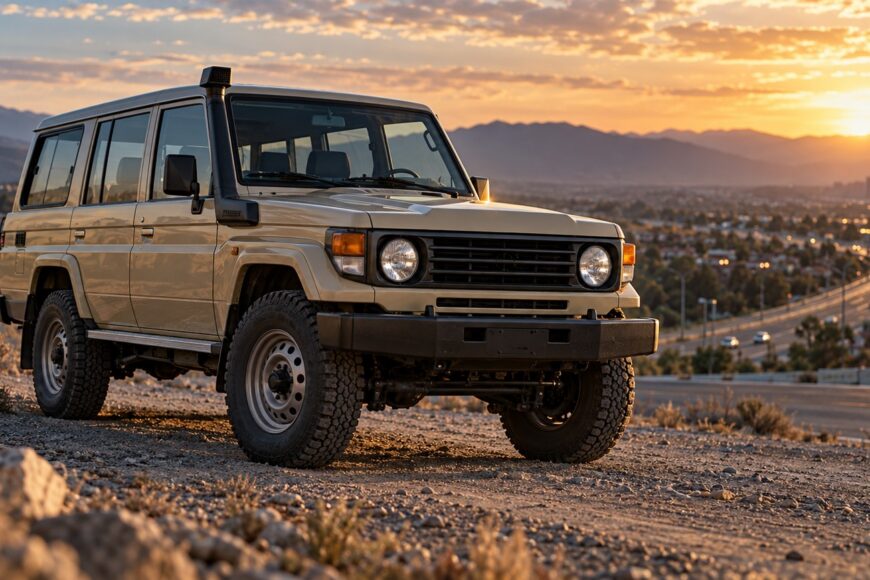
The Land Cruiser 70 became one of Toyota’s longest-lived workhorse platforms, yet America never received it as a new factory model. Toyota has produced the J70 line since 1984, adapting it for commercial, agricultural, military, and off-road duties in different markets.
The explanation is broader than a single regulation or engineering weakness. A new vehicle would need to satisfy U. S. FMVSS and EPA requirements, while Toyota would also have to judge whether a specialized, relatively austere 4WD justified the cost of certification and support in a market increasingly focused on comfortable SUVs. The result is a vehicle that attracts American buyers precisely because it was designed for a different job.
- Why Toyota Never Sold the Land Cruiser 70 New in America
- There Is No Single Global-Spec Land Cruiser 70
- The 25-Year Rule Opens a Door, Not Every Door
- What Owning a J70 in America Is Really Like
- The Inspection Mistakes That Turn a J70 Into a Money Pit
- Is the Land Cruiser 70 Worth Importing Instead of Buying a Modern SUV?
- Frequently asked questions
- How can I identify the correct parts for an imported Land Cruiser 70?
- Why is the Land Cruiser 70 not sold in the USA?
Why Toyota Never Sold the Land Cruiser 70 New in America
The J70 was not sold new in the United States as a certified model. A new import would need to comply with FMVSS and EPA requirements, including the safety and emissions framework applied to vehicles entering the U. S. market as new products.
Certification is only part of the explanation. Toyota developed the J70 around regional work requirements, including durable chassis layouts, commercial body styles, simple controls, and off-road use. Those priorities made sense in markets where buyers valued payload, field repairability, and long service life more than quiet highway travel or a car-like ride.
The model line also lacks one universal specification that Toyota could have certified once and sold everywhere. Body styles, engines, equipment, controls, and emissions systems vary by market and year. A U. S. version would have required a defined configuration, testing, parts support, and a sales strategy for a vehicle with limited overlap with mainstream American SUVs.
That combination helps explain the apparent contradiction. The J70 was globally successful as a specialized tool, while its stiffness, narrow cabin, limited comfort, and market-specific engineering made it a difficult fit for a broad American showroom range.
There Is No Single Global-Spec Land Cruiser 70
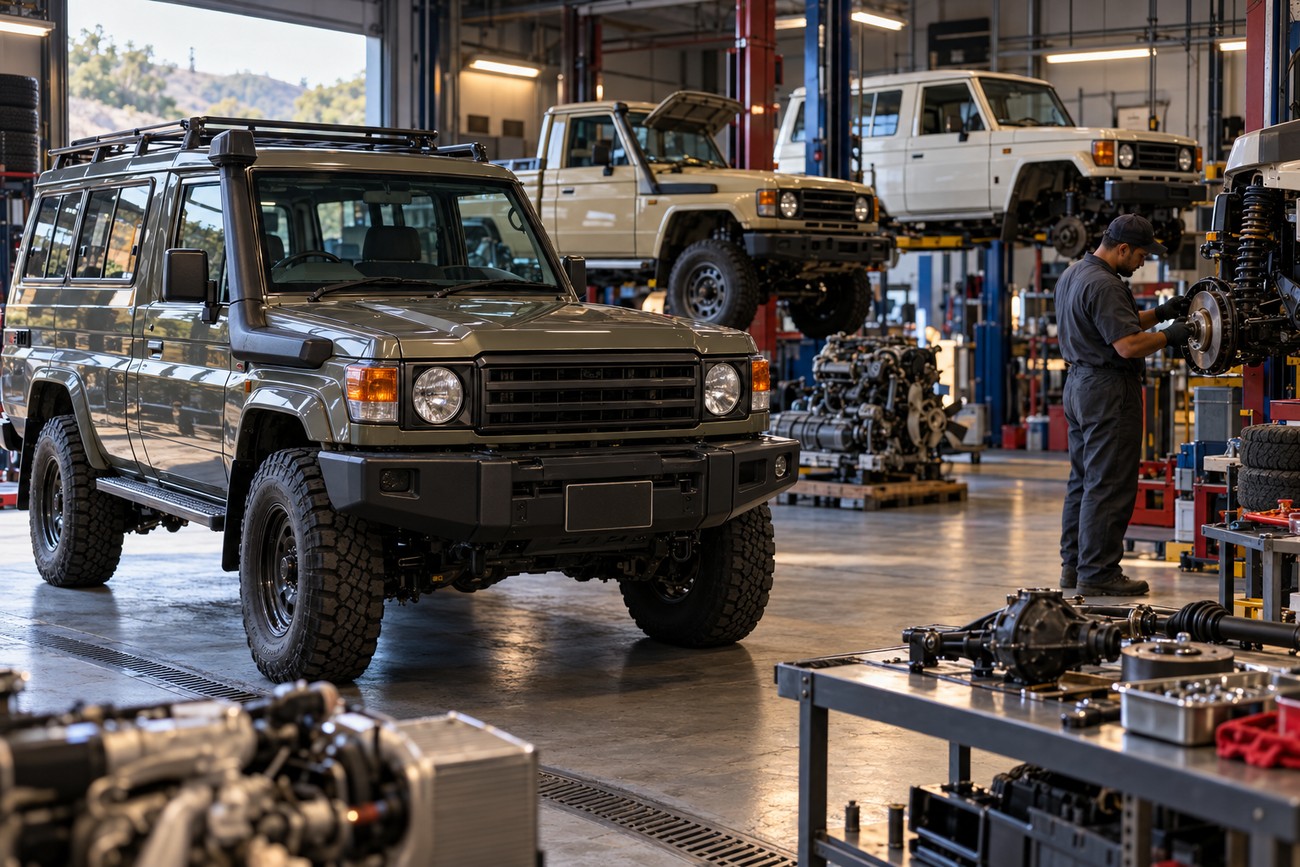
The J70 name identifies a family, not a single worldwide build. The market and year can change the body, engine, axles, brakes, wiring, controls, emissions equipment, and drivetrain calibration. Two vehicles that look similar in photographs may require different service procedures and parts.
The current Japanese version uses a 2.8-liter 1GD-FTV diesel with 150 kW and 500 N·m. It has a six-speed automatic, selectable four-wheel drive, a 130-liter fuel tank, and a 2,300 kg mass. Those figures describe that Japanese-market configuration and should not be treated as universal specifications for every J70.
An earlier gasoline version used the 4.0-liter 1GR-FE with 170 kW, 360 N·m, and a five-speed manual. The advertised 6.6 km/L figure for that version comes from Japan’s JC08 cycle, not an EPA rating or a universal real-world result. Driving conditions, gearing, tires, payload, and maintenance can produce a substantially different outcome.
Even the basic driving experience depends on the exact variant. Short- and long-wheelbase models distribute weight differently, carry cargo in different ways, and respond differently on steep or uneven ground. Checking the model code and component specification is more useful than relying on the Land Cruiser name alone.
The 25-Year Rule Opens a Door, Not Every Door
NHTSA’s FMVSS exemption begins after 25 years from the vehicle’s actual date of manufacture, not its model year. The manufacturer’s plate or reliable documentation is central to proving that date. An advertisement describing a vehicle as a particular model year is insufficient by itself.
Eligibility arrives month by month. In October 2026, qualifying 2001 vehicles become eligible according to their actual manufacture month; there is no universal date for every 2001 vehicle. A vehicle manufactured later that year may remain below the threshold until the corresponding month.
The 25-year rule concerns FMVSS treatment. It is not an automatic exemption from EPA requirements, customs processing, state registration, insurance conditions, title procedures, or proof-of-date requirements. Federal import eligibility and the ability to obtain road registration in a particular state are separate decisions.
Customs clearance therefore should not be treated as proof that the vehicle can be registered for ordinary road use everywhere. State agencies may apply their own requirements to title documents, inspections, equipment, or emissions status. Confirm the process with the relevant authorities before committing funds to shipping or restoration.
A cautious buyer obtains clear photographs of the manufacturer’s plate, checks the chassis and identity markings, and keeps the supporting documentation with the import file. If the date is unclear, the legal risk can remain even when the vehicle appears old enough from its advertised model year.
What Owning a J70 in America Is Really Like
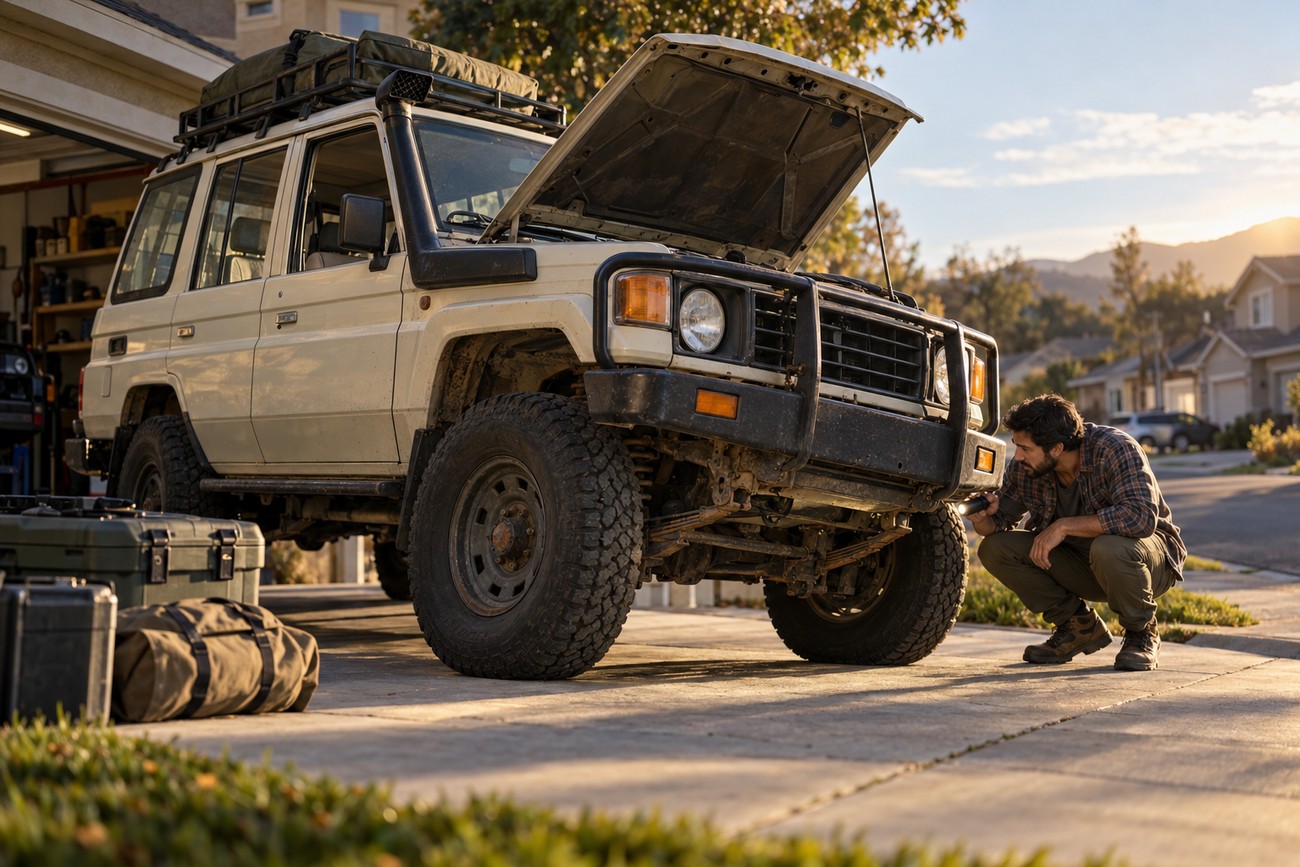
An older J70 can be highly durable, yet durability does not prevent corrosion or deferred maintenance. Rust commonly affects the frame, body, floor, and concealed cavities. A truck that starts easily and engages four-wheel drive may still need substantial structural work underneath.
On leaf-sprung versions, the suspension gives the platform useful load-carrying and off-road characteristics, but it can be tiring on paved-road trips. Narrow seats, cabin noise, and limited refinement matter more when the vehicle is used for long highway distances than during a short trail outing.
Older diesel engines may be slow and noisy, and their condition depends heavily on the fuel system, injectors, and cooling system. Steering, brakes, seals, and electrical systems also require continuing maintenance. The mechanical layout reduces electronic complexity while leaving expensive work on axles, gearboxes, transfer cases, and body corrosion.
Right-hand drive changes daily use as well as steering position: overtaking sightlines, toll access, parking-lot interaction, and the availability of locally compliant lamps, mirrors, and controls all deserve a practical test before purchase.
Parts support is another ownership variable. Components for Japanese, Australian, or other export versions may differ, and rare body or drivetrain parts can cost more than parts for common Toyota models in the United States. The vehicle may be simple to understand, yet costly to keep correct.
The Inspection Mistakes That Turn a J70 Into a Money Pit
Begin underneath the vehicle, not with a cold-start video. Lift it safely and inspect the frame, spring hangers, crossmembers, floor, body mounts, and concealed cavities for corrosion, cracks, distortion, and poor repairs. Pay particular attention to areas covered by undercoating, mud, or expedition equipment.
Engine and transmission operation cannot establish the condition of the complete truck. Test steering and braking behavior, inspect axle and transfer-case leaks, and look for driveline vibration. A smooth drive can coexist with weakened spring mounts, damaged wiring, or structural corrosion.
Match the manufacturer’s data plate and chassis markings to the engine, axle, brake, and wiring specification before ordering parts or evaluating the import. This step can prevent an apparently correct catalog listing from sending the restoration in the wrong direction.
Identity checks should cover the VIN, model code, frame markings, engine identity, data plate, and import documents. One VIN does not guarantee simple parts identification across Japanese, Australian, and other export specifications. The model code and component markings often provide the detail needed to identify the correct brakes, axles, wiring, and service parts.
Inspect modifications with the same skepticism as the factory hardware. Non-factory winches, lifts, lockers, heavy bumpers, and frame welding can affect safety, repairability, value, and component life. Large accessories add load to the brakes, springs, and driveline, especially when combined with a large fuel tank or expedition cargo.
Is the Land Cruiser 70 Worth Importing Instead of Buying a Modern SUV?
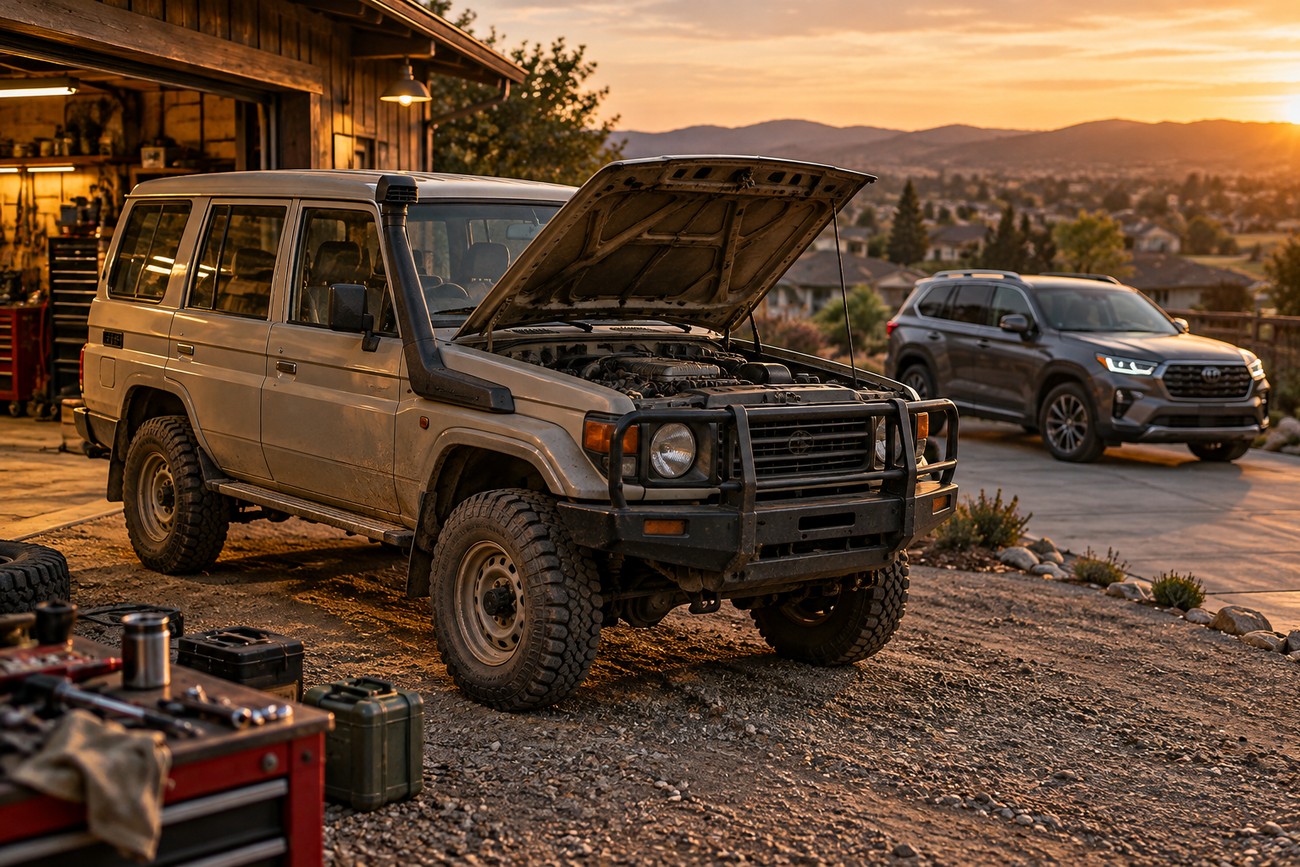
The J70 makes sense as a work tool or specialized off-road vehicle. Its appeal lies in durable chassis designs, mechanical simplicity, useful body choices, and expedition capability. Those advantages matter to an owner who accepts regular inspection and maintenance as part of using the vehicle.
A modern SUV will usually provide better ride quality, cabin comfort, safety equipment, road manners, and local parts availability. The J70 asks you to accept more noise, a harsher ride, older crash protection, and greater uncertainty over market-specific components. Its age and design should set realistic expectations before the purchase.
Short- and long-wheelbase versions differ in more than exterior length. Wheelbase, weight distribution, cargo behavior, and off-road response all change. A short vehicle may suit tighter trails, while a long version can offer different stability and carrying behavior; the right choice depends on the intended load and terrain.
Modifications can also undermine the original balance. Heavy bumpers, winches, oversize tires, lift kits, and expedition equipment increase loads on springs, brakes, axles, and transmission components. Mechanical simplicity reduces electronics, but it does not remove the cost of major axle, gearbox, transfer-case, or body repairs.
Frequently asked questions
The J70 requires model-specific research because its age, market origin, and modifications can affect both legality and serviceability.
How can I identify the correct parts for an imported Land Cruiser 70?
Start with the model code, chassis markings, manufacturer’s data plate, engine identity, and component markings. Confirm the axle, brake, and wiring specification before ordering. Use the VIN as one reference rather than relying on a generic VIN search, because export, Japanese, and Australian versions can use different components under the same J70 family name.
Photographs of the data plate, frame number, engine markings, and the old component can help a specialist match the part accurately. Check whether the vehicle has received an engine swap, axle change, brake conversion, or wiring modification, since the installed parts may no longer correspond to the original build.
Why is the Land Cruiser 70 not sold in the USA?
The J70 was not sold new in the United States as a certified model because Toyota would have needed to certify a market-specific configuration for U. S. safety and emissions requirements. Its regional body styles, engines, equipment, and commercial focus also offered a weaker fit for the mainstream American SUV market.
That explanation does not make every imported J70 illegal. A qualifying vehicle may receive FMVSS treatment under the 25-year rule, measured from its actual manufacture date, while EPA, customs, state registration, insurance, and documentation requirements remain separate matters.







