
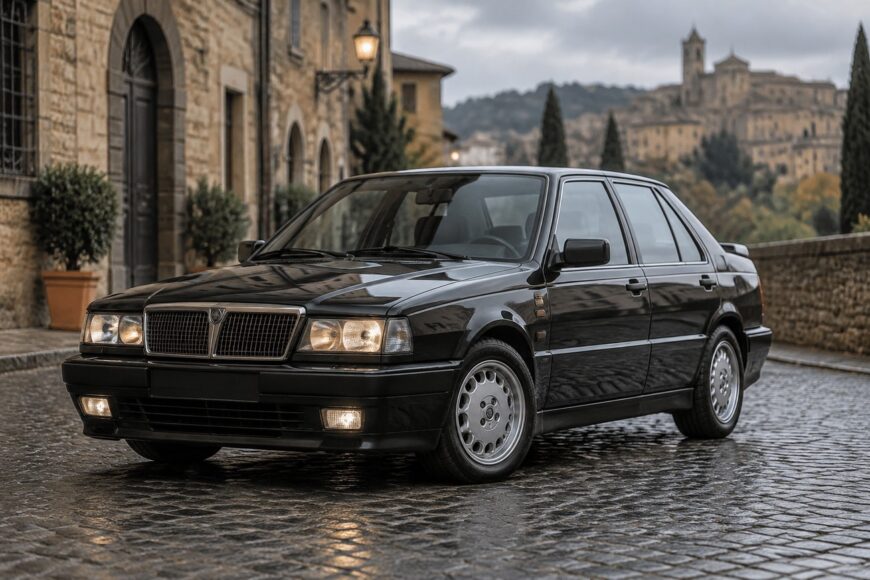
The Lancia Thema 8.32 is an executive sedan with an unlikely contradiction at its center: a Ferrari-derived V8 installed in a front-wheel-drive family-car layout. It offered quiet travel, leather, wood, powered seats, and a retractable spoiler, yet its mechanical character was closer to an exotic car than to an ordinary Thema.
That contradiction defines the buying decision. You are choosing between an extraordinary piece of engineering and Ferrari-level maintenance, difficult engine access, aging electrics, corrosion, and limited specialist support. The badge does not make ownership glamorous; the condition and service history do.
What makes the Thema 8.32 special
The 8.32 was the performance flagship of the Thema range, built in two series: Series 1 from 1986–1988 and Series 2 from 1988–1992. A single-source estimate puts production at about 3,500–3,800 cars. That makes surviving examples uncommon, although rarity alone does not make a neglected car desirable.
Its naturally aspirated 3.0-liter Tipo F105L V8 is based on the Ferrari 308/Mondial engine family. It has 32 valves and a 90-degree bank angle, giving the sedan a distinctive high-revving voice and very different service requirements from the regular four-cylinder and V6 Thema models.
This is not simply a Ferrari 308 engine dropped into a sedan. The Thema unit uses model-specific camshafts, calibration, and adaptations for the front-wheel-drive layout and the car’s heavier, more comfort-focused mission. Ferrari ancestry explains the architecture; it does not mean every Ferrari component fits directly.
Ferrari power, front-wheel-drive compromises
Series 1 produced about 215 hp at approximately 6,750 rpm. Series 2 produced about 205 hp because of the catalytic converter and emissions requirements. Factory figures for the non-catalyst version quote approximately 0–100 km/h in 6.8–7.0 seconds and about 240 km/h.
The drivetrain remains unusual: a five-speed manual transmission sends power to the front wheels, with no differential lock and no electronic stability-control system. Hard acceleration can bring wheelspin and torque steer, especially on imperfect surfaces. The car feels quick and dramatic, but its front-drive chassis does not offer the neutral balance suggested by the engine’s pedigree.
MacPherson struts are used at the front, with independent rear suspension. Some cars have electronically controlled adjustable dampers, while braking is by discs all around with ventilated fronts. ABS was absent on early cars and fitted to some later examples.
Those specifications suit rapid road use better than prolonged track or mountain driving. Stock cooling and brakes can struggle with sustained intensity, producing overheating or fade. The 8.32 is best treated as a fast grand-touring sedan rather than a disguised Ferrari sports car.
Where the Ferrari bill appears
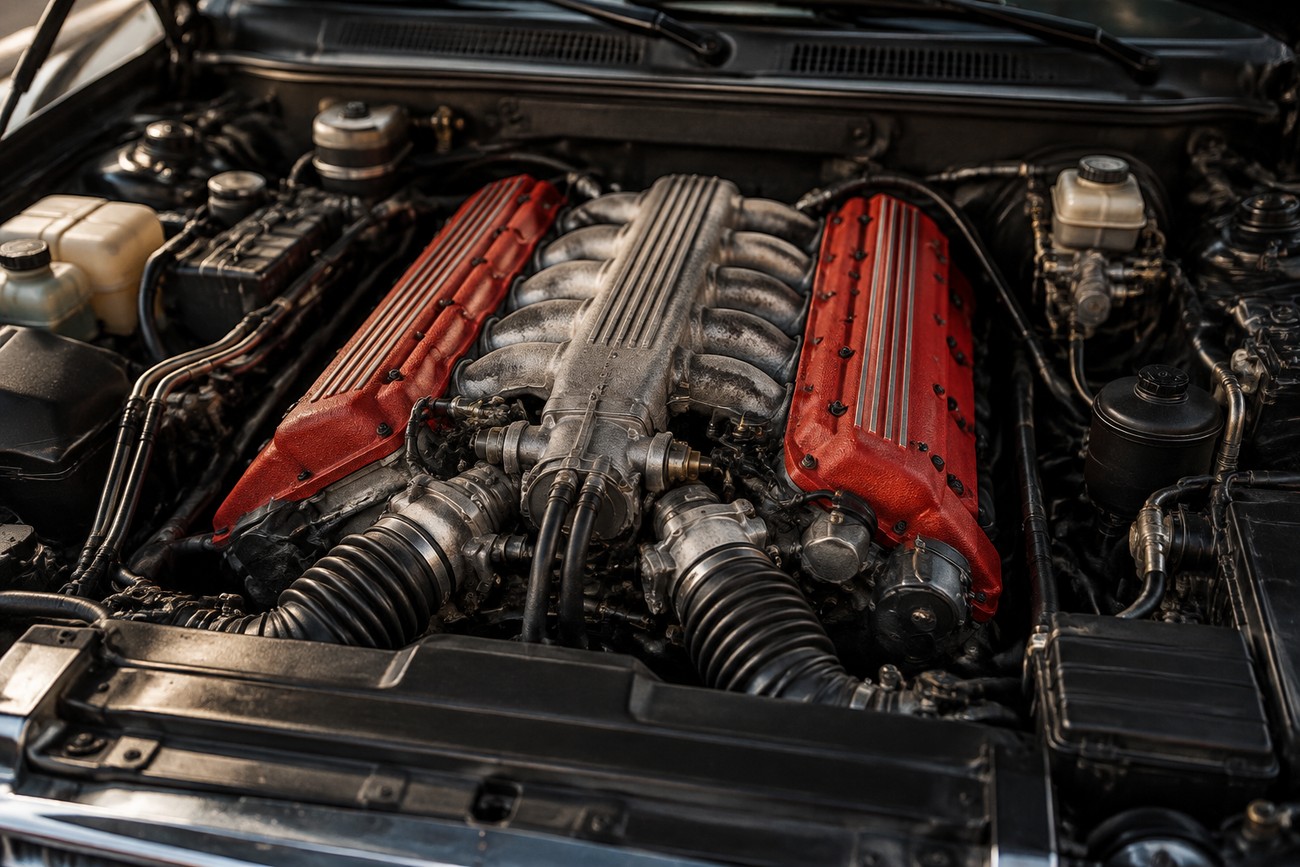
The largest cost is often labor. Front-wheel-drive packaging leaves restricted access to the V8, so routine work can require substantial disassembly. Original camshafts, valves, and timing components may be difficult and expensive to source, and a cheap repair can become a second repair if adjacent aging parts are left untouched.
Leaks are familiar ownership territory: gaskets, seals, oil hoses, and coolant hoses all deserve inspection. Cooling-system condition matters because an old hose or neglected component can turn a pleasant drive into a major engine event. Urban fuel consumption can reach approximately 18–25 L/100 km or more with enthusiastic driving.
Electrical faults may affect the instruments, central locking, climate control, or electronically adjustable suspension. The retractable rear spoiler is an appealing feature, yet its mechanism is another costly failure point. Corrosion in body panels and sills is especially concerning on cars from wet regions or with poor accident repairs.
The ownership profile is therefore closer to a Ferrari than to a mass-market executive sedan. Specialist knowledge is scarce, parts support varies by country, and resale demand is narrow. A beautiful interior and a convincing V8 sound cannot compensate for an undocumented timing system.
How to buy one without buying a project
Start with records, not mileage. A complete history for the engine and timing system matters more than a low odometer reading, and you should budget for preventive work on the timing, cooling, and fuel systems before regular driving. A cold start, hot restart, and extended running check can reveal faults that a brief viewing hides.
Inspect oil pressure, leaks, cooling behavior, hose condition, and fuel delivery with a specialist who understands this engine in Thema packaging. Listen for abnormal top-end noise, but do not choose a car on engine sound alone. The most impressive-running example may still hide weak electrics, corrosion, or overdue timing work.
Test every electrical function, including the instruments, central locking, climate control, spoiler, and suspension adjustment. Examine sills, floor areas, panel seams, and previous repair zones. Universal suspension or brake parts can alter handling, accelerate wear, and create noise, even when they appear cheaper and easier to obtain.
Before buying, identify a competent specialist and check parts access in your country. The resale market depends heavily on local collector demand, so a quick profitable exit is unlikely. A well-supported, enthusiast-owned car is usually safer than a cheaper example with an impressive specification sheet and no maintenance network behind it.
Frequently asked questions
The designation describes the engine’s configuration rather than its horsepower.
What does “8.32” mean on the Lancia Thema?
“8” refers to the V8 engine, while “32” refers to its 32 valves. It does not mean 832 horsepower, an 8.32-liter engine, or a Ferrari model number. The name identifies the mechanical configuration of the Thema’s flagship version.
The engine is Ferrari-derived, based on the 308/Mondial family, but it was adapted for the Thema with model-specific camshafts, calibration, and front-wheel-drive installation. Period specifications should therefore be read as Thema 8.32 specifications, not as a promise that every 308 part or driving characteristic transfers unchanged.







