
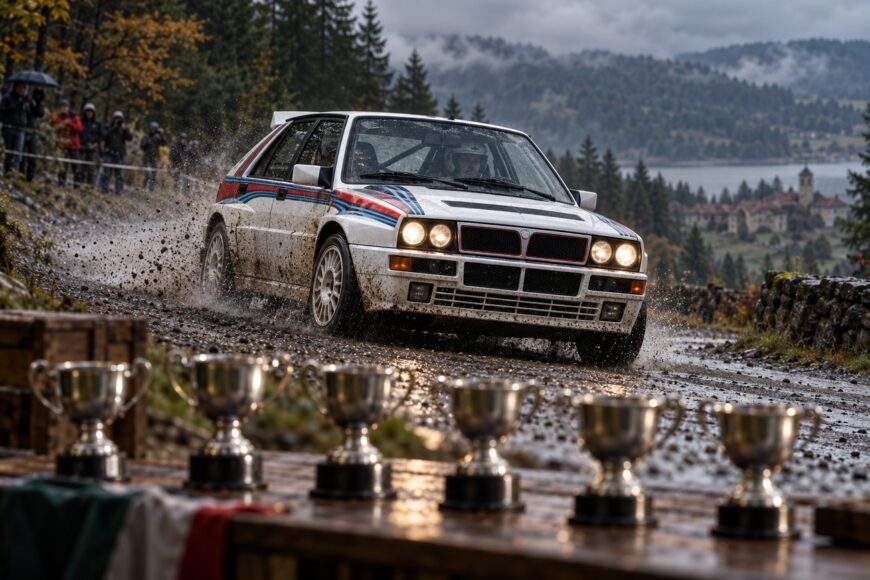
Lancia’s Delta won six consecutive WRC manufacturers’ titles from 1987 through 1992, a record that gives the Integrale Evoluzione an unusually powerful halo. Ownership brings a less romantic calculation: this is an aging, highly stressed turbocharged four-wheel-drive car whose hard use can affect its shell, transmission, suspension, and cooling system.
The Evo deserves more careful treatment than a specification sheet or a polished body kit can provide. The following separates Lancia’s competition record from the road car’s verified specification, explains why power claims vary, and identifies the expensive inspection points that glossy histories often leave out.
- Six WRC titles, but not six drivers’ championships
- What the Integrale Evoluzione actually changed
- Performance figures: useful numbers, unreliable certainty
- The ownership reality behind the rally image
- How to inspect an Integrale Evo before buying
- The myths that distort the Evo’s value
- Frequently asked questions
- How much is a Lancia Delta Integrale Evo worth?
- What car went 0–60 in 2.5 seconds on gravel?
- How much is a Lancia Delta Integrale worth?
- What was the fastest rally car ever built?
Six WRC titles, but not six drivers’ championships
Lancia won six consecutive WRC manufacturers’ titles from 1987 through 1992. The achievement covered the Delta’s competition program as a manufacturer, with results accumulated across a season by the works team and its drivers. It is therefore more accurate to call the headline six constructors’ championships rather than six drivers’ championships.
Four drivers’ titles came during this period. Juha Kankkunen won in 1987 and 1991, while Miki Biasion won in 1988 and 1989. The distinction matters because the Delta’s dominance was broad and sustained, although the number of drivers’ championships was four.
Lancia Delta models achieved 46 WRC event wins, a figure that places the family among the most successful rally cars ever fielded. Those victories reflect purpose-built competition cars, specialist preparation, changing regulations, and professional crews. A road-going Integrale Evo benefits from the same engineering direction and competition reputation, while retaining compromises that a rally car designed for a specific stage does not.
The road car’s appeal comes from that connection rather than from a claim that every component is directly interchangeable with a works rally solution. Its permanent four-wheel drive, turbocharged engine, compact dimensions, and chassis revisions create a convincing fast-road package. They also expose the owner to loads that accumulate quickly when maintenance or previous repairs have been inadequate.
What the Integrale Evoluzione actually changed
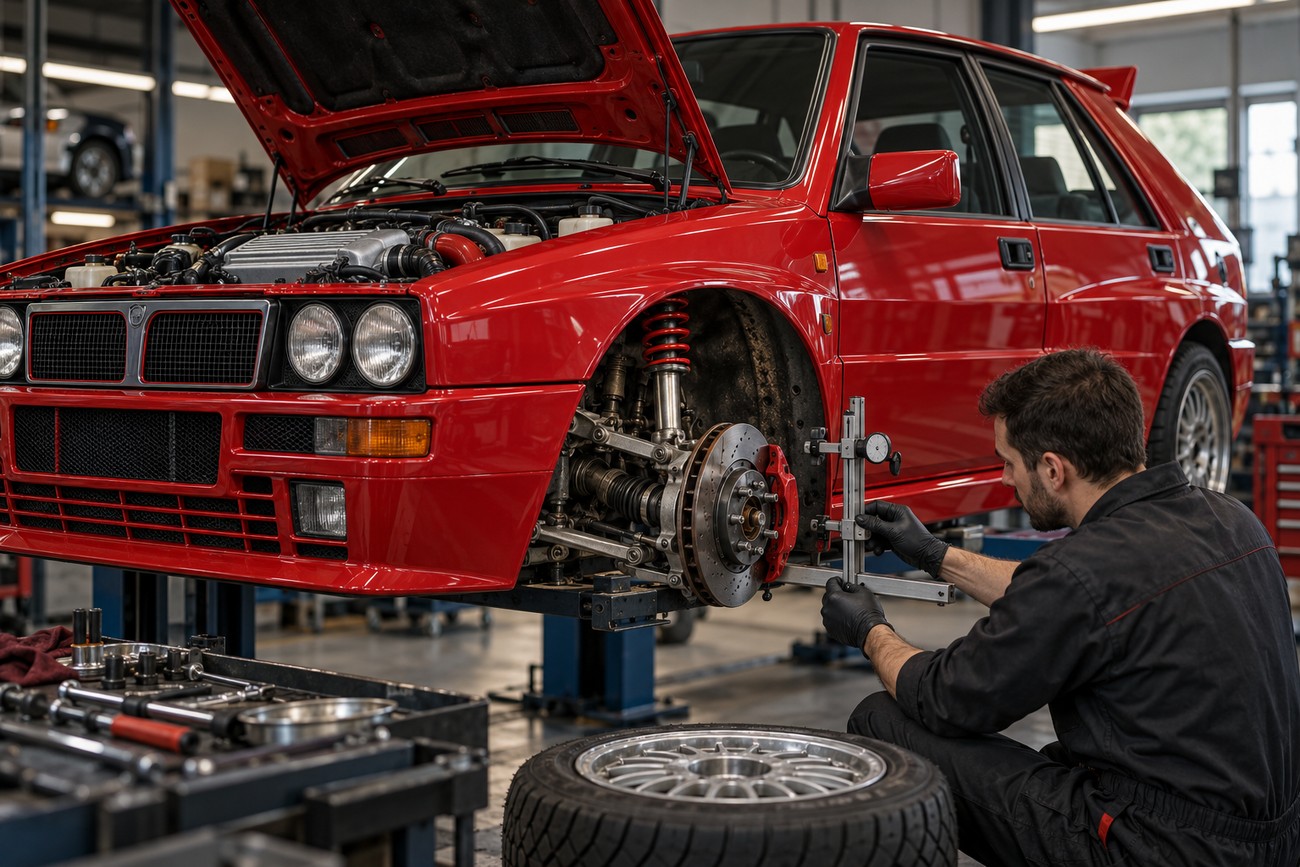
The Evoluzione was more than a 16-valve Delta wearing wider trim. Its development included a wider track, revised front struts, wider bodywork, and revised aerodynamics. These changes altered the car’s stance, suspension geometry, and ability to manage the forces generated by its engine and four-wheel-drive system.
The Evo I used a 2.0-liter, 16-valve turbocharged four-cylinder engine. Power reached the wheels through permanent four-wheel drive and a five-speed manual transmission. That basic mechanical identity remained central to the car, which is why describing the Evoluzione as an entirely new rally machine or an all-new engine design gives the wrong impression.
Wider arches are visually obvious, yet they also create areas that require close inspection. Their edges and the panels behind them can conceal corrosion, cracks, poor repairs, or replaced metal. The wider track and revised front-end hardware matter more dynamically than the presence of expensive seats, aftermarket wheels, or a louder exhaust.
A sound Evo feels coherent through a corner: steering response, suspension movement, drivetrain loading, and traction should work together. A car with impressive trim and incorrect geometry can feel nervous, wear tires unevenly, and require substantial remedial work. Chassis condition is therefore part of the specification, even though it rarely appears in a sales advertisement.
Performance figures: useful numbers, unreliable certainty
The commonly stated Evoluzione output is 210 PS at 5,750 rpm, with 300 N·m at 3,500 rpm. References also quote approximately 207 hp or 215 hp, depending on the version, market, and measurement convention. These figures should be treated as related references rather than interchangeable labels for every Evo.
Common road-car reference figures are approximately 1,340 kg, 0–62 mph in 5.7 seconds, and a 137 mph top speed. They provide useful scale for the car’s performance, although a decades-old example may differ substantially because of engine condition, turbocharger health, gearing, tires, modifications, and test method.
The torque figure is especially useful for understanding the driving experience. Peak torque arrives at 3,500 rpm, rather than at minimum engine speed, so the car’s response depends on keeping the turbocharged engine in its effective operating range. A dyno headline cannot explain boost behavior, throttle response, oil pressure, compression, or how the engine performs once fully warm.
Power discrepancies often become a sales tool. A seller quoting 215 hp may be repeating a market reference, while another source may use 207 hp or the factory-style 210 PS figure. Identify the exact version and measurement convention first, then judge the individual car through documentation and mechanical testing.
The ownership reality behind the rally image
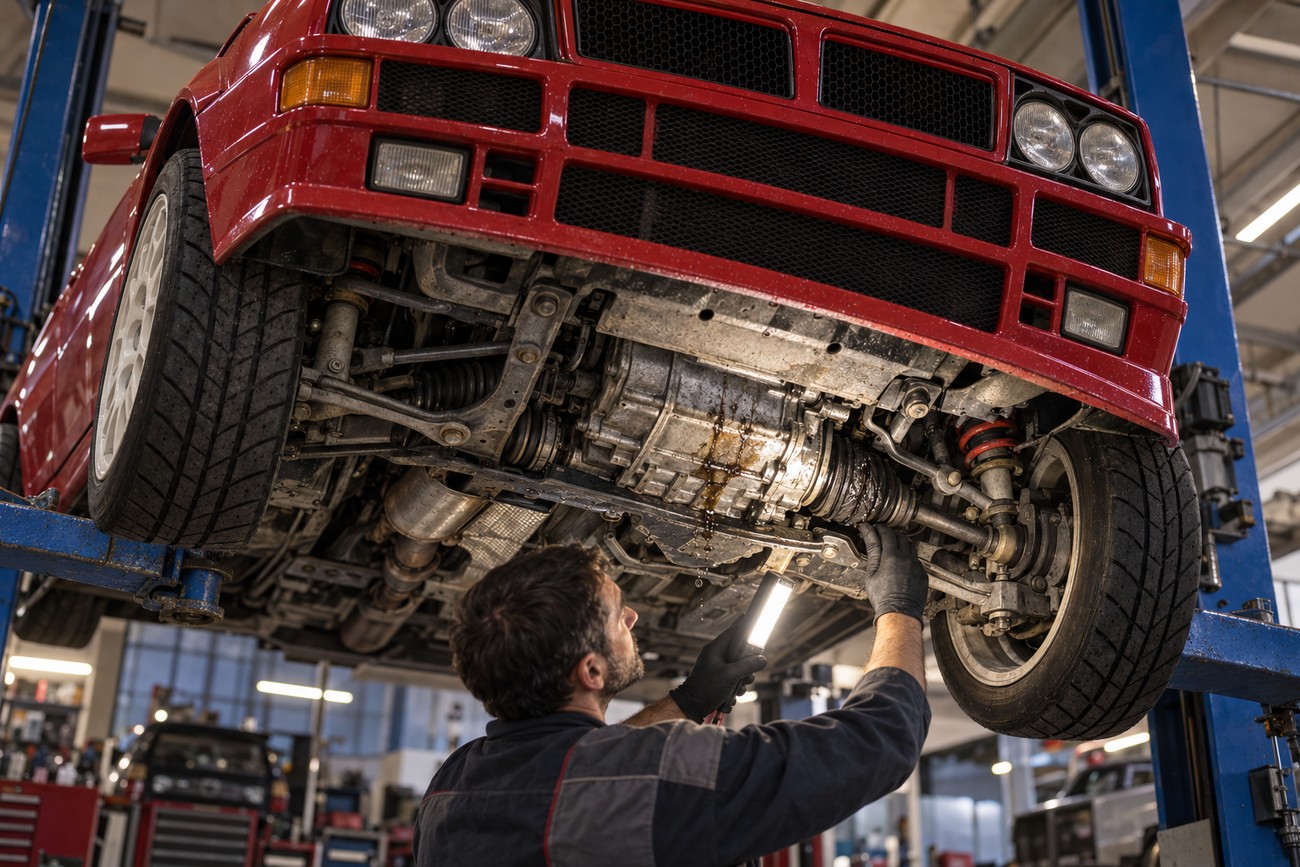
Oil leaks are widely reported as a near-universal practical issue on these cars. A damp engine or transmission does not identify the source by itself, since oil can travel across casings and subframes before appearing at the lowest point. Cleaning the area and checking it after a proper warm drive gives a more useful answer than accepting a vague statement that an old turbo engine “always sweats.”
The firm suspension that helps the Evo respond on smooth, demanding roads can accelerate wear on CV joints, suspension components, and wheels when the surface is broken. Repeated impacts also stress body mounts and attachment points. A heavily used example may gradually loosen or distort in ways that are difficult to detect from a photograph.
Second- and third-gear synchronize wear can produce crunching during shifts, particularly after aggressive driving. A short stationary demonstration may reveal nothing. The gearbox needs to be tested under load, both during upshifts and downshifts, after the oil and components have reached operating temperature.
Drivetrain noise is diagnostic information, not character. A persistent whine from a differential, backlash through the shafts, or a sharp shift crunch should be priced as a repair requirement rather than accepted as part of the Integrale experience.
Cardan shafts, CV joints, differentials, and gearbox components all deserve inspection. Permanent four-wheel drive distributes traction effectively, yet it also gives several rotating assemblies opportunities to develop play and noise. Poor roads make the problem more expensive by adding suspension and wheel damage to the drivetrain workload.
Parts availability and specialist labor can materially increase ownership costs. Original components may be difficult to source, and an inexperienced repair can create fresh alignment, cooling, or driveline problems. Budgeting for diagnosis and corrective work is safer than spending the entire purchase budget on the cleanest-looking car.
How to inspect an Integrale Evo before buying
Begin with the shell, geometry, and structural mounting points. Check the floor, suspension pickup areas, inner arches, seams, and repaired sections for corrosion, cracks, distortion, and signs of impact. The car should sit correctly, with consistent panel gaps and no evidence that cosmetic parts are compensating for a bent or weakened structure.
Remove or inspect behind the arch extensions wherever possible. Wider arches can hide corrosion, replaced panels, filler, and repairs that do not match the original construction. Measure alignment and inspect suspension condition before discussing wheels, seats, paint, or exhaust systems; those items have little value if the basic shell is compromised.
Drive the car until it is warm and load the gearbox progressively. Check second and third gears during firm acceleration, quick but controlled upshifts, and downshifts. Listen for differential whine, cardin-shaft vibration, CV-joint clicking, driveline backlash, and noises that change with throttle position or cornering load.
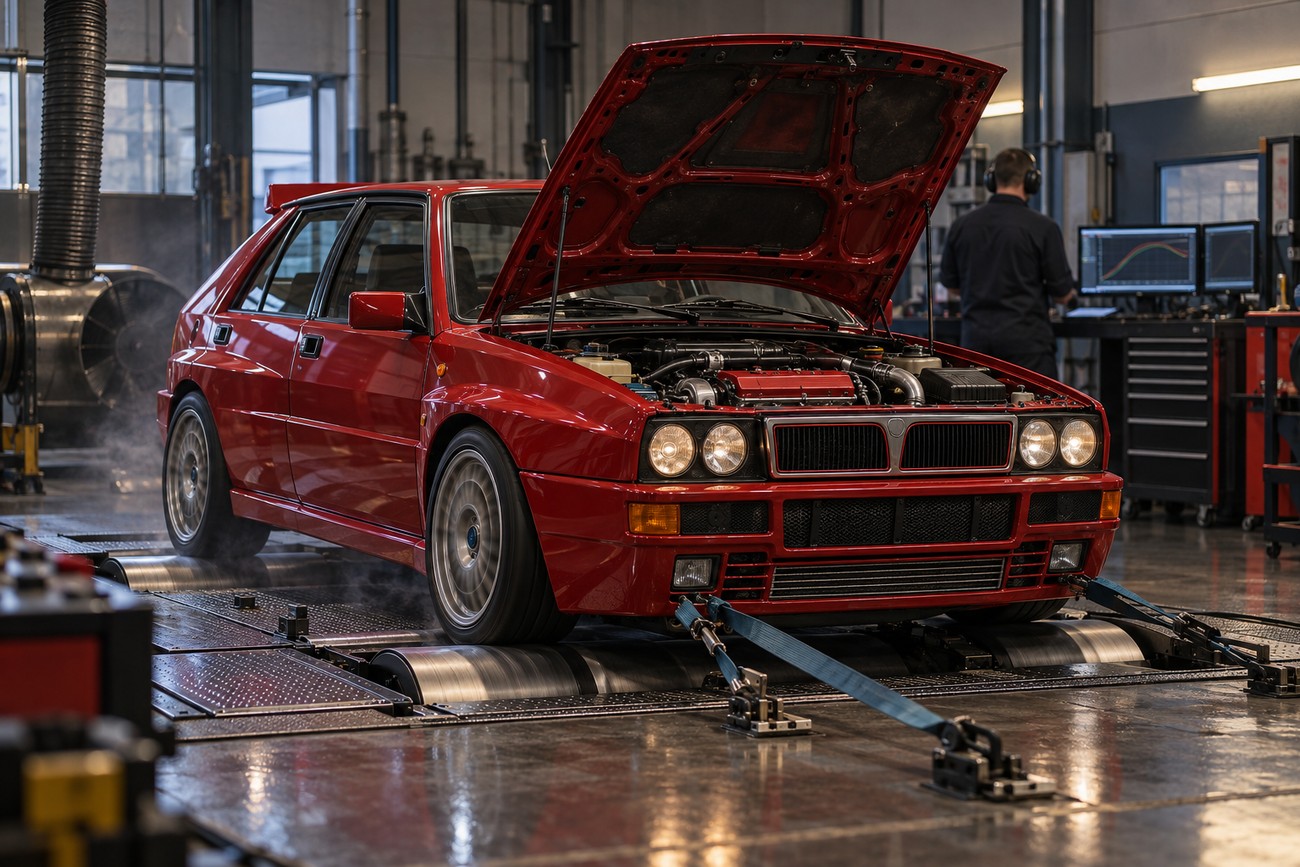
The engine assessment should include turbocharger operation, compression, oil pressure, and cooling performance. Look for stable temperatures, clean boost delivery, evidence of overheating, and a cooling system that remains controlled after the test drive. A single dyno power figure cannot compensate for weak oil pressure, poor compression, an unhealthy turbocharger, or an unresolved cooling fault.
Confirm the condition of the permanent four-wheel-drive system and review service records for gearbox, differential, shaft, and CV-joint work. Some 16-valve configurations are reported to risk loosened differential pins and subsequent final-drive damage, so the specific modification and car history should be checked. Original parts and qualified specialist service can be costly or difficult to source, which makes documented maintenance a major part of the purchase decision.
The myths that distort the Evo’s value
The Evoluzione was not a completely new rally machine in road-car form. It retained the basic 2.0-liter, 16-valve turbocharged engine architecture and the permanent four-wheel-drive concept. Its important advances were concentrated in track width, front suspension, bodywork, and aerodynamics, with those changes producing real dynamic consequences.
Power figures require context. Approximately 207 hp, 210 PS, and 215 hp may appear in references, yet the units, market, version, and measurement standard may differ. The most useful canonical reference for the Evoluzione is 210 PS at 5,750 rpm, accompanied by 300 N·m at 3,500 rpm, while the individual car still requires mechanical verification.
Permanent four-wheel drive does not make the drivetrain indestructible. Synchronizers, cardin shafts, CV joints, differentials, and other gearbox components experience wear, especially when the car has been driven hard or used on poor roads. Whine, backlash, and crunching are faults to investigate, rather than personality traits that justify a higher price.
Rarity claims also need restraint. Exact production totals for Evo I and Evo II are inconsistently documented across commonly used references, so one unverified figure should not define value. Condition, originality, service history, specification, and structural integrity provide a more defensible basis for judging a car than an unsupported production number.
Frequently asked questions
The Integrale Evo’s value and reputation depend on details that headline specifications cannot capture. These answers focus on how to interpret the car in the market and in the wider rally context.
How much is a Lancia Delta Integrale Evo worth?
There is no reliable single value without inspecting the individual car. Structural condition, correct geometry, originality, service history, drivetrain health, specification, and the quality of previous repairs should determine the assessment.
A sound, documented example can justify a substantial premium over a cosmetically attractive car with rust, gearbox wear, or unresolved four-wheel-drive faults. Treat expensive trim, wheels, seats, and exhaust parts as secondary until the shell, engine, transmission, and suspension have been verified.
What car went 0–60 in 2.5 seconds on gravel?
The Lancia Delta S4 is commonly associated with claims of approximately 0–60 mph in 2.5 seconds on gravel. That was a Group B rally car, separate from the road-going Integrale Evoluzione, and period performance claims vary with surface, tires, gearing, and test method.
How much is a Lancia Delta Integrale worth?
“Integrale” covers several versions, so the badge alone does not establish a price. A less valuable car with incomplete history may require more money to make reliable than a higher-priced example with documented maintenance and an unmodified, structurally sound shell.
For an Evo, examine corrosion behind the arches, suspension geometry, oil leaks, synchronizes, differentials, shafts, CV joints, turbocharging, oil pressure, and cooling. Those findings should carry more weight than a claimed power figure or an unverified rarity statement.
What was the fastest rally car ever built?
There is no universally accepted single answer because “fastest” can mean acceleration, top speed, stage time, or performance on a particular surface. Group B cars such as the Lancia Delta S4, Audi Sport quattro S1, and Peugeot 205 T16 are often cited among the most extreme rally machines.
The comparison also separates competition specification from road-car behavior. A purpose-built rally car can deliver extraordinary acceleration on loose surfaces while imposing maintenance demands and operating compromises that do not describe a road-going Integrale Evo.







