
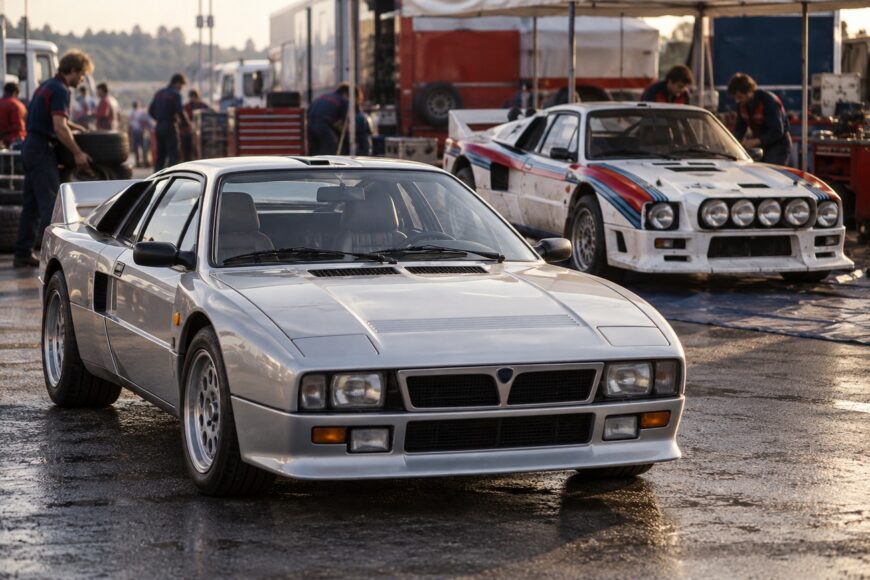
In 1983, a rear-wheel-drive Lancia beat Audi’s all-wheel-drive Quattro to the World Rally Championship manufacturers’ title. That result gives the road-going Lancia 037 Stradale its place in rally history, but it was the competition Rally 037 that won the championship. The Stradale existed so that car could qualify for Group B.
The distinction matters beyond a caption or auction listing. A Stradale shares the rally car’s layout and unmistakable shape, while carrying a milder engine tune and suspension setup. Its rarity and connection to the 1983 title make it compelling to collectors; the same limited-run construction can make servicing, parts sourcing, and an ill-judged restoration unusually consequential.
- What the 037 Actually Won in 1983
- Why the Stradale Existed—and How Many Were Built
- The Road Car’s Rear-Drive, Supercharged Character
- 037 Stradale vs Rally Car: What the Shared Shape Conceals
- How Lancia Won Without All-Wheel Drive
- The Less Romantic Side of Owning a Stradale
- Frequently asked questions
- How much does a Lancia 037 Stradale cost?
- How can a buyer verify that a 037 Stradale is genuine?
- Was the Lancia 037 banned from rallying?
What the 037 Actually Won in 1983
The competition Lancia Rally 037 won the 1983 WRC manufacturers’ title and was the last rear-wheel-drive car to win that title. It achieved that result as all-wheel drive was becoming a defining force in top-level rallying. The achievement is precise enough without extending it to every championship awarded that season.
Hannu Mikkola won the 1983 WRC drivers’ title in an all-wheel-drive Audi Quattro. Manufacturers’ and drivers’ championships recognize different results, so Lancia’s manufacturers’ victory does not make a 037 driver the season’s drivers’ champion. Saying Lancia won both titles erases an important part of the contest with Audi.
Nor did a showroom Stradale take part in the title campaign. It was the limited-run road car built for homologation; the competition 037 was the WRC entry. For collectors, that relationship explains the Stradale’s historical importance without assigning it a racing record it did not earn.
Why the Stradale Existed—and How Many Were Built
Group B required a road-going production basis for a competition car. Lancia built the 037 Stradale to homologate the Rally 037, making the street car part of the racing program’s foundation. It was a limited-run homologation special rather than an ordinary production coupe with a motorsport-inspired body.
Production totals deserve careful wording. The figure of 200 is commonly cited in connection with Group B homologation, while 207 appears as an alternative reported Stradale build total. The available figures do not settle the discrepancy, and neither establishes how many cars survive.
Abarth and Pininfarina were involved in the 037’s development and design. Their involvement helps explain why the car has both a competition-led structure and a coherent road-car shape, but it does not make the Stradale mechanically identical to the rally entry. Anyone assessing an individual car should rely on its identity and records rather than a production figure repeated without qualification.
The Road Car’s Rear-Drive, Supercharged Character
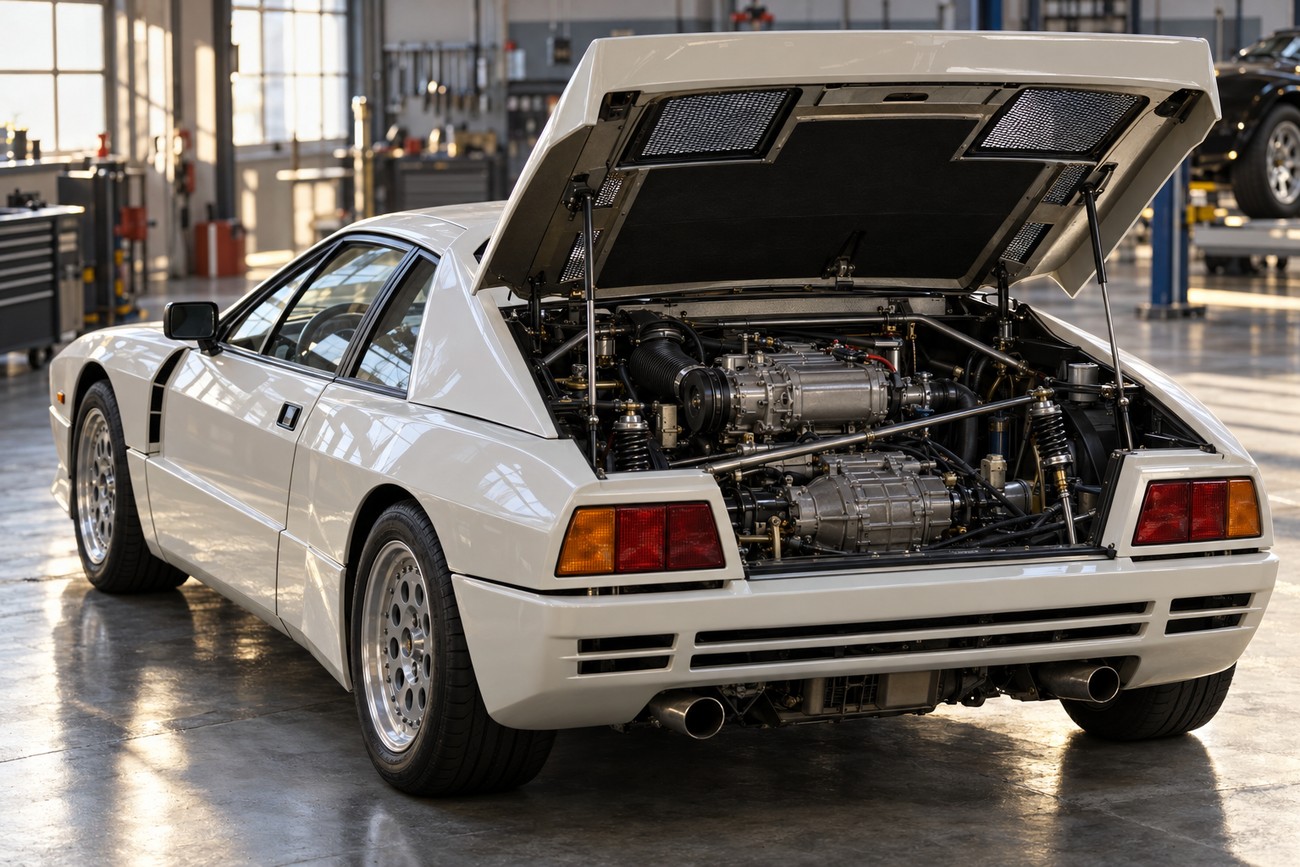
The Stradale uses a longitudinal mid-mounted, mechanically supercharged 2.0-liter DOHC inline-four, rear-wheel drive, and a five-speed manual gearbox. Those are road-car specifications. They place the engine near the center of the chassis and leave the rear tires to transmit its power, giving the car a different underlying layout from Audi’s all-wheel-drive Quattro.
Road-car output is approximately 205 hp at 7,000 rpm and 234 Nm at 5,000 rpm. A mechanically driven supercharger provides boost without waiting for exhaust flow to build, an important distinction from a turbocharged engine. That mechanical characteristic helps explain reports of prompt throttle response, though the feel of a particular car remains an owner or driver impression rather than a measured specification.
Reported Stradale figures are approximately 1,170 kg, a 220 km/h top speed, and 0–100 km/h in about 7 seconds. The numbers describe a purposeful road car, not the much more extreme output or pace of a competition 037. Reading them as rally-car figures would give a false picture of both machines.
Under the familiar silhouette sits a tubular spaceframe with composite and thin steel panels. This construction served the homologation concept, yet it also makes condition and repair history central to a collector’s assessment. A tidy outer panel alone cannot establish the state of the structure beneath it.
037 Stradale vs Rally Car: What the Shared Shape Conceals
The two versions share a basic concept, but their intended uses led to materially different specifications.
| Feature | 037 Stradale | Competition Rally 037 |
|---|---|---|
| Purpose | Limited-run road car built for Group B homologation | WRC competition entry that won the 1983 manufacturers’ title |
| Basic layout | Longitudinal mid-mounted engine and rear-wheel drive | Same basic mid-engine, rear-wheel-drive concept |
| Engine tune | Mechanically supercharged 2.0-liter four-cylinder, approximately 205 hp | More extreme competition tune; the road car’s output does not describe it |
| Suspension | Road-car setup, less extreme than the rally specification | Competition setup developed for rally use |
How Lancia Won Without All-Wheel Drive
The competition 037 took the 1983 WRC manufacturers’ title despite having only rear-wheel drive. That result stands out because Audi had demonstrated the value of all-wheel-drive traction in rallying. It does not prove rear-wheel drive was the better solution on every surface or that Lancia had defeated the direction in which the sport was moving.
The 037’s mid-engine balance and responsive, mechanically supercharged engine were relevant strengths. Mechanical supercharging gives a different response from turbocharging, while the layout concentrates major mechanical mass within the car’s wheelbase. Neither trait, on its own, explains a season-long championship result, and the road Stradale’s approximate output should not be used to characterize the competition engine.
The split titles provide the clearest perspective: Lancia’s competition 037 won the manufacturers’ championship, and Hannu Mikkola’s all-wheel-drive Audi Quattro won the drivers’ championship. The story is more interesting with both results intact. It captures a successful rear-drive campaign during all-wheel drive’s rise, rather than a simple verdict on one drivetrain.
The Less Romantic Side of Owning a Stradale
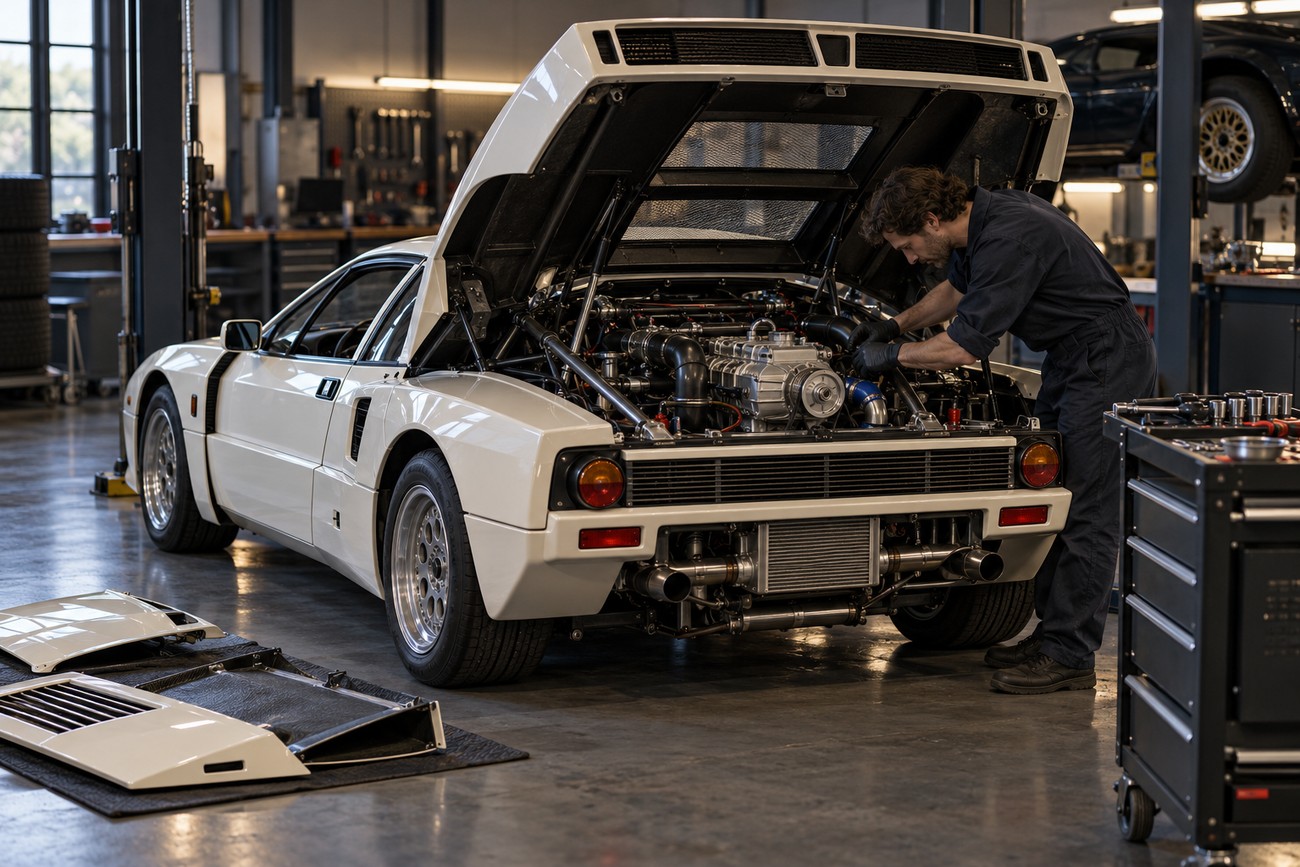
A Stradale’s homologation purpose shaped a car that demands more careful ownership planning than its road registration might suggest. Original parts can be difficult to source, and the mid-mounted engine complicates access for some work. Reports of long waits and costly repairs exist, but their limited sourcing makes them cautions to investigate on a specific car, not costs every owner will face.
Specialist knowledge matters around the supercharged engine and its supporting systems. Before commissioning restoration or extra power, a buyer needs an assessment of what is fitted, how it has been maintained, and which components can be repaired or replaced correctly. A general workshop’s familiarity with conventional road cars is no substitute for evidence that it understands this layout.
Have a marque specialist inspect the supercharger installation, cooling system, and hard-to-access rear components before approving tuning or restoration. The aim is to establish the condition and configuration of this car, not to assume those areas fail on every Stradale.
Comfort is another area where the rally association can distort expectations. Owner reports describe a low car with firm suspension, awkward access, and limited rearward visibility; those impressions warrant a proper drive and fit check. Likewise, heat-management and corrosion concerns are useful inspection prompts, especially when a car’s storage and maintenance history is unclear, rather than established defects across the entire run.
Originality affects the decision as much as mechanical condition. Changes intended to make a Stradale resemble a competition 037 may obscure its road-car specification, including its approximately 205 hp tune and less extreme suspension setup. Documented, sympathetic repairs give a prospective buyer a clearer account of what the car is than an undocumented collection of rally-style modifications.
The 1983 manufacturers’ title explains the desire to own one; it cannot price the work needed to preserve one. An attractive body or a compelling story should therefore lead to a specialist inspection and a review of records before it leads to a purchase. That scrutiny protects the historical identity that makes a genuine Stradale worth seeking.
Frequently asked questions
For a prospective buyer, the championship record is only the starting point. Price, identity, and rally eligibility each require a different kind of evidence. The answers below separate those practical questions from the Stradale’s historical appeal.
How much does a Lancia 037 Stradale cost?
An asking price alone is a poor estimate of a Stradale’s value. Use dated comparable sales, then account for the particular car’s originality, condition, documentation, and likely restoration needs. A car offered with incomplete records or unresolved mechanical work may require a substantially different budget from a well-documented example, even if their advertised prices look similar.
How can a buyer verify that a 037 Stradale is genuine?
Start by matching the car’s chassis identity to its registration, period records, and ownership history. Review restoration invoices and photographs for evidence of what has changed, then commission a specialist inspection of the structure, mechanical specification, and identifying details. The reported production totals alone cannot authenticate an individual car.
Was the Lancia 037 banned from rallying?
The 037 was not singled out by a car-specific ban. Group B’s eligibility at the top level of the WRC ended after the 1986 season, changing where cars built to those rules could compete. Whether an individual 037 can enter a present-day event depends on that event’s regulations and the car’s specification, rather than on a blanket prohibition against the model.







