
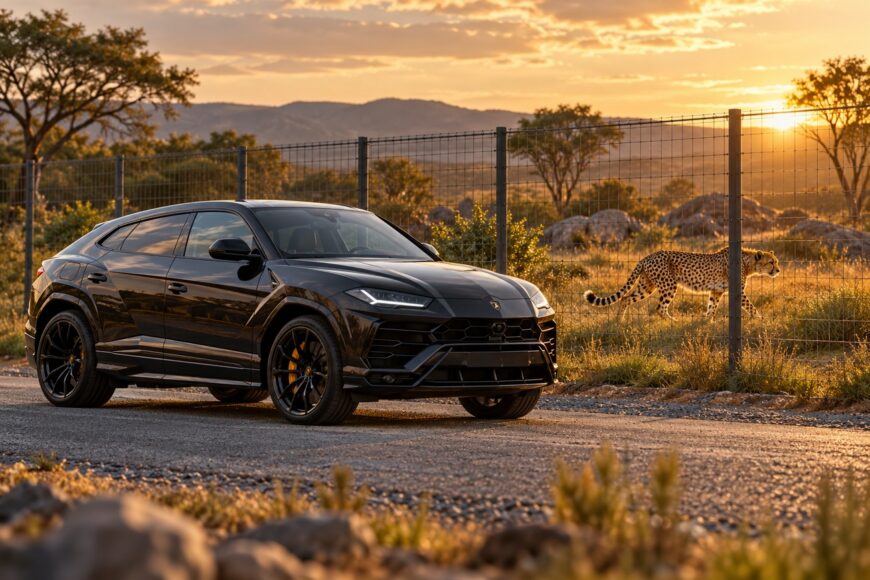
A Lamborghini Urus with a claimed top speed of approximately 305 km/h appears to leave any animal comparison behind. A cheetah, however, is built for an explosive hunting sprint rather than a sustained run, and reported peak speeds of roughly 90–110 km/h apply only briefly.
The answer therefore depends on distance. A short sprint of 200–300 m cannot be settled by comparing top speeds, because the cheetah reaches its peak rapidly. On a long, suitable straight, the Urus gains the advantage once the cat can no longer sustain its sprint. No verified, standardized Urus–cheetah head-to-head result establishes an exact winning distance.
- The verdict changes with the length of the race
- Urus vs cheetah: speed, acceleration, and staying power
- Why the cheetah is formidable off the line
- How the Urus turns acceleration into a lasting advantage
- What the Urus’s headline numbers leave out
- Why a real Urus–cheetah race would prove little
- Frequently asked questions
- Which SUV is faster than the Lamborghini Urus?
- Which SUV is faster than Urus?
- Which car can outrun a cheetah?
- Cheetah vs car: who is faster?
The verdict changes with the length of the race
From a standing start, the cheetah has the more dramatic launch. Its reported acceleration to approximately 80–90 km/h in 2–3 seconds is an estimate with limited sourcing, not a standardized 0–100 km/h vehicle test. Even so, the animal’s compact body, flexible spine, powerful hindquarters, and traction-focused stride make it highly effective in the first seconds.
The base Urus is also exceptionally quick for a vehicle weighing roughly 2,200 kg. Its manufacturer-claimed figures are approximately 3.6 seconds from 0–100 km/h and 12.8 seconds from 0–200 km/h, with a claimed top speed of approximately 305 km/h. Those numbers describe a controlled vehicle benchmark, not a promise that every road launch will reproduce it.
Over 200–300 m, peak speed alone proves little. A cheetah may be highly competitive during the initial sprint, while the Urus is still gaining speed. Individual animals, surface grip, motivation, and the exact start would all affect the outcome, so a precise winner over that distance cannot be stated responsibly.
The balance changes after the cheetah’s peak effort fades. A cheetah cannot sustain peak sprint speed over 1–2 km, whereas the Urus can continue accelerating and maintain a high speed on an appropriate closed course. That gives the SUV the decisive long-straight advantage without establishing a verified passing point.
Urus vs cheetah: speed, acceleration, and staying power
The figures below separate factory specifications from reported animal observations. They help explain the comparison, but they do not represent a timed race between the two.
| Measure | Base Lamborghini Urus | Cheetah | What it means |
|---|---|---|---|
| Top speed | Approximately 305 km/h, manufacturer-claimed | Roughly 90–110 km/h in a brief sprint; the upper end requires cautious attribution | The Urus has the much higher stated peak, but the cheetah reaches its peak in a very different way |
| Acceleration | Approximately 3.6 seconds from 0–100 km/h; approximately 12.8 seconds from 0–200 km/h under specified test conditions | Reported estimate of approximately 80–90 km/h in 2–3 seconds; not a standardized 0–100 km/h result | The figures are not directly comparable measurements |
| Sprint duration | Can continue accelerating beyond the animal’s short sprint, subject to conditions and available space | Peak effort is brief and often described over about 200–300 m | Distance and fatigue matter as much as peak speed |
| Longer-distance comparison | Has the advantage on a suitable longer straight | Cannot sustain peak sprint speed over 1–2 km | No exact passing distance has been established |
| Faster Urus versions | Urus S and Performante: similar claimed top speeds of approximately 305 km/h and manufacturer-claimed 0–100 km/h times of approximately 3.3–3.5 seconds | Not applicable | Independent launch results may differ from factory claims |
Why the cheetah is formidable off the line
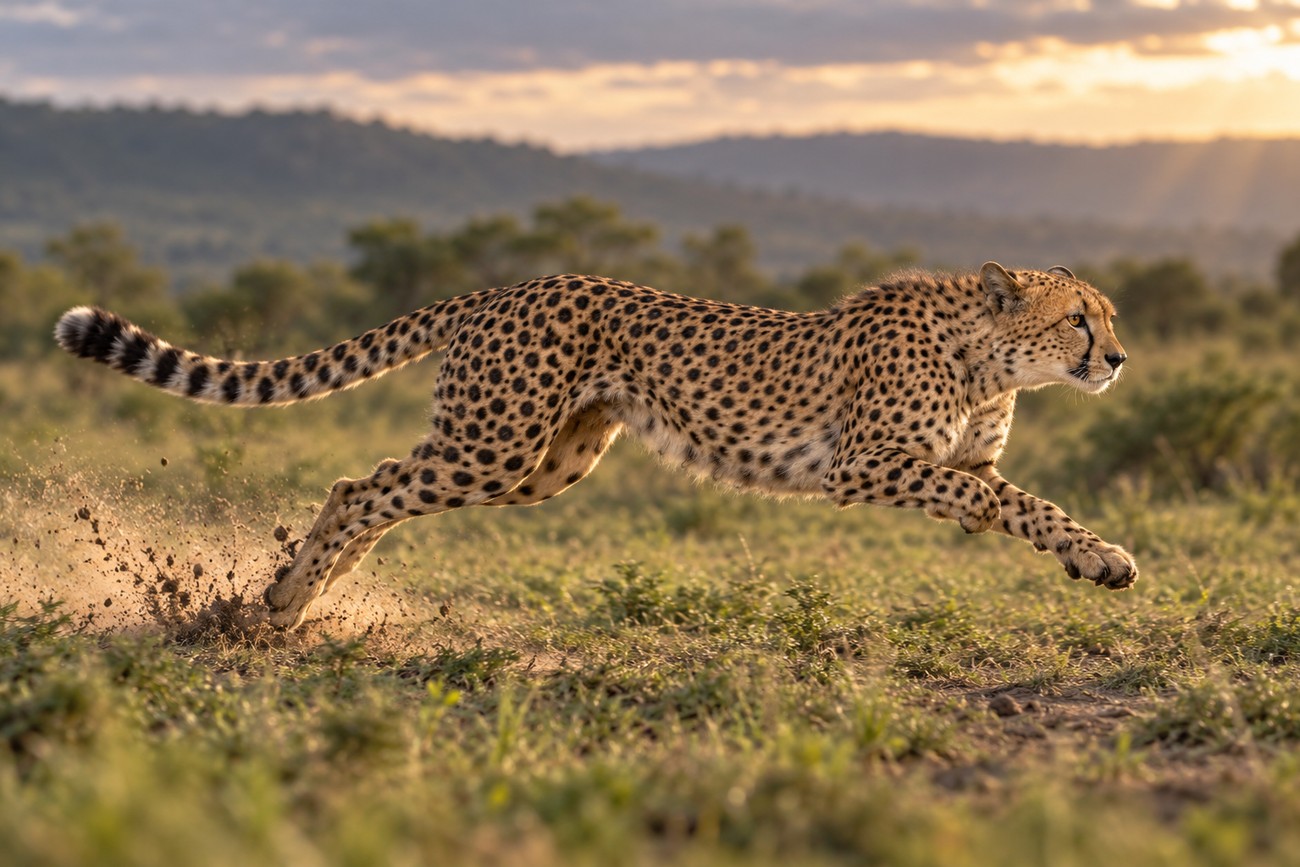
A cheetah’s advantage comes from acceleration, traction, and rapid control of its body. Its long limbs and flexible spine help extend its stride, while its claws provide grip during the launch. The animal is also built to change direction quickly while pursuing prey, a task with different demands from accelerating a heavy vehicle in a straight line.
The commonly cited estimate of 80–90 km/h in 2–3 seconds should be treated carefully. It has limited sourcing, and it does not describe a repeatable, instrumented 0–100 km/h test. A particular cheetah’s performance may vary with age, health, motivation, terrain, temperature, and whether the run resembles a natural hunt.
Reported peak speeds of roughly 90–110 km/h also describe a brief effort rather than a cruising speed. Claims above 100 km/h deserve cautious attribution because the available measurements are not as standardized as automotive testing. Individual variation further weakens any attempt to assign one universal cheetah performance figure.
Video makes the comparison even less reliable. Camera angle, lens choice, background scale, and frame rate can make an animal appear slower or faster than it is. A vehicle filmed from a low, moving camera can create the same distortion, so footage should not replace measured speed data.
How the Urus turns acceleration into a lasting advantage
The base Urus combines approximately 3.6 seconds from 0–100 km/h with approximately 12.8 seconds from 0–200 km/h under specified test conditions. Its claimed top speed of approximately 305 km/h gives the vehicle a large speed advantage after the cheetah’s brief peak has passed. The important feature is its ability to keep gaining and holding speed, rather than its highest quoted number alone.
That does not mean the Urus reaches 305 km/h during a cheetah’s sprint distance. A 200–300 m run is short, and a vehicle’s acceleration depends on gearing, traction, surface, and available room. The SUV’s advantage becomes clearer as the straight extends beyond the animal’s sustainable sprint.
Over 1–2 km, the cheetah cannot maintain peak sprint speed. It may slow substantially or end the pursuit, while the Urus remains capable of traveling at a high, steady pace on a suitable closed course. This is why the longer-distance result favors the vehicle even though the opening seconds are more complicated.
A responsible high-speed comparison would require a closed course, appropriate safety measures, and a controlled vehicle test. Public roads do not provide the space, surface, or legal conditions needed for such speeds. The comparison is therefore about capability, not a recommendation to reproduce it in traffic.
What the Urus’s headline numbers leave out
The Urus’s approximately 3.6-second 0–100 km/h figure is an ideal-condition benchmark. Tire temperature, road surface, ambient temperature, launch settings, electronic stability-control calibration, and the driver’s technique can all change a real-world result. A launch from an ordinary road may be slower even when the vehicle is mechanically healthy.
The powertrain explains why the SUV can perform at this level. Depending on version, its 4.0-liter twin-turbo V8 produces approximately 650–666 hp and 850 N·m, moving roughly 2,200 kg. That mass can help with stability and traction in some situations, but it also increases the energy that must be managed during braking and cornering.
Hard track use exposes the costs of that performance. Owners report fuel consumption rising toward roughly 30–40 L/100 km during aggressive driving, while repeated sessions can bring brake smell, noise, or signs of heat strain. These reports indicate practical concerns, not universal measured results for every Urus or every driver.
Stopping also deserves attention. A heavy SUV traveling above 200 km/h needs substantial distance, suitable tires, and a clean surface to slow safely. Road legality, brake and tire wear, and the cost of repeated high-speed running are separate from the vehicle’s technical ability to reach its claimed maximum.
Why a real Urus–cheetah race would prove little
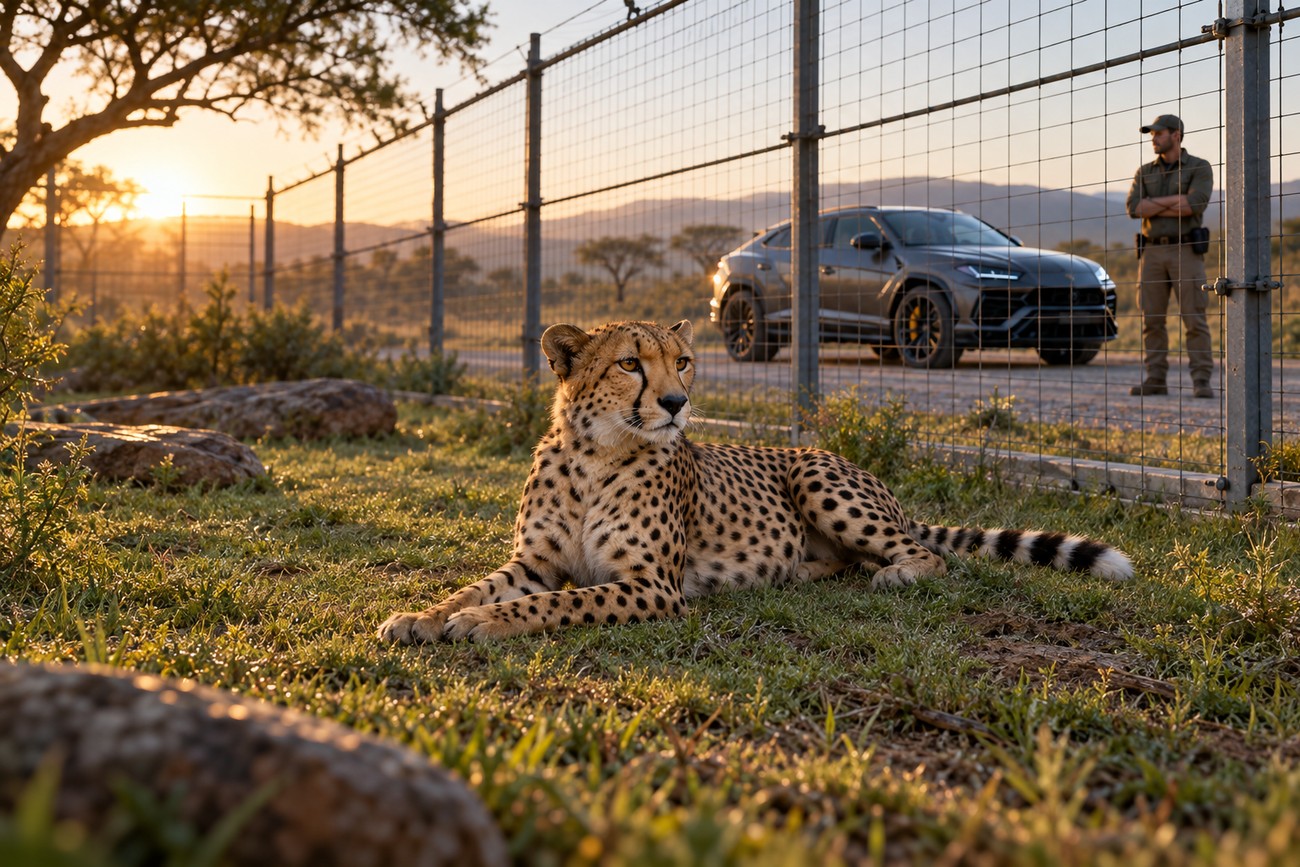
A car test seeks repeatable starts, measured distances, consistent surfaces, and instrumented timing. A cheetah sprint is brief and variable. The animal may choose a different line, hesitate, accelerate in stages, or stop early. Those behaviors are part of its natural performance rather than errors in a laboratory procedure.
Animal welfare creates a more fundamental limit. An ethically acceptable comparison cannot require forcing a cheetah to sprint for entertainment or repeatedly exposing it to stress and heat. Wildlife and captive-animal care place the animal’s health ahead of producing a video or a clean result.
Terrain also changes the contest. A vehicle needs a prepared, sufficiently long surface with room for braking, while a cheetah’s natural advantage includes maneuverability over uneven ground and rapid changes of direction. A straight-line run removes some of the animal’s hunting strengths while introducing conditions that are difficult to standardize without compromising welfare.
The result is best treated as a comparison of capabilities. The Urus has the long-straight advantage, while a cheetah can be exceptionally competitive during the opening sprint. No verified head-to-head time or precise winning distance has been established, and naming a universal winner over every distance would be misleading.
Frequently asked questions
The answers depend on what “faster” means: top speed, acceleration, or performance over a given distance. Urus rankings also depend on the version and whether the figures are manufacturer claims or independent test results. A cheetah comparison adds a brief sprint and an animal whose performance varies from run to run.
Which SUV is faster than the Lamborghini Urus?
There is no permanent answer without specifying the Urus version, model year, and measurement standard. The base Urus has a manufacturer-claimed top speed of approximately 305 km/h, while the Urus S and Performante have similar claimed top speeds and quicker claimed 0–100 km/h times.
Before declaring another SUV faster, check that vehicle’s exact version and verified top-speed test. Manufacturer claims, limited-production derivatives, electronic speed limiters, and independent test conditions can produce different rankings.
Which SUV is faster than Urus?
Some SUV rankings may place another model ahead, depending on whether the comparison uses top speed, acceleration, or a specific production version. A meaningful answer requires comparing the Urus and the other SUV using the same measure and test method.
The Urus belongs among the fastest production SUVs, but “fastest” is a time-sensitive classification rather than a universal title. Check claimed and independently tested figures before treating a model-by-model ranking as settled.
Which car can outrun a cheetah?
Many performance cars can exceed a cheetah’s reported peak speed of roughly 90–110 km/h, provided the comparison uses a sufficiently long, suitable straight. The launch is harder to judge: a cheetah may be highly competitive during the first seconds because its sprint acceleration is so intense.
A car’s advantage becomes clearer as distance increases, since the cheetah cannot sustain peak sprint speed over 1–2 km. That conclusion describes different endurance profiles, not a verified race between a particular car and a particular animal.
Cheetah vs car: who is faster?
At peak speed and over a long straight, a suitable performance car is faster. During a short sprint, top-speed figures alone cannot determine the answer because the cheetah accelerates rapidly and may be near its peak before the car has used its full performance.
There is no standardized Urus–cheetah result that supplies a universal passing distance. Surface, start, individual animal, vehicle setup, and ethical limits all prevent a simple race verdict that applies to every comparison.







