
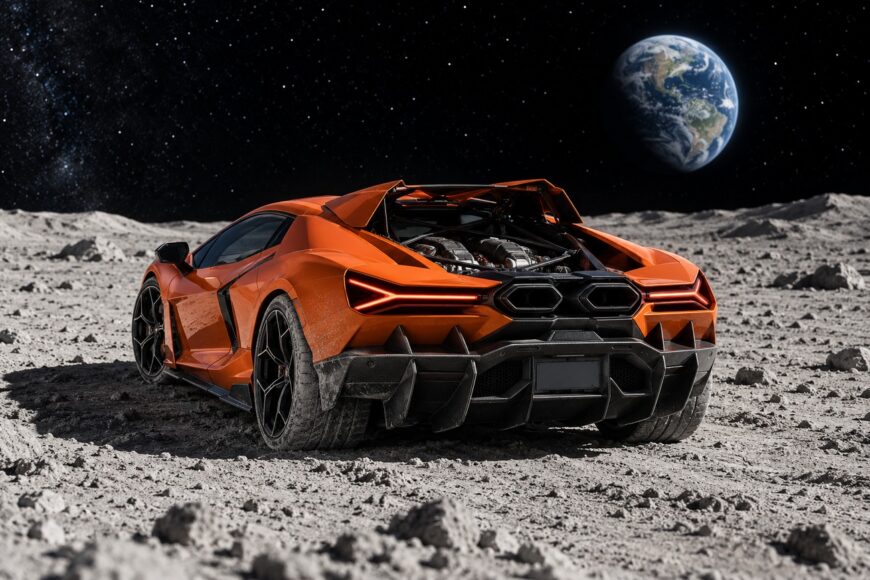
A 1,015-CV hybrid supercar would seem to have enough performance for almost any surface. The Moon removes the assumptions that make that number meaningful. Its near-vacuum offers no normal intake air, no useful aerodynamic environment, and no ordinary convective cooling.
The first failure would therefore be neither traction nor top speed. The Revuelto’s naturally aspirated gasoline V12 needs oxygen to burn fuel, and the Moon provides practically none. The electric motors could turn the wheels without atmospheric oxygen, but that would be a limited electric-driving scenario, not a stock Revuelto operating normally on the lunar surface.
- The First Failure Is Not Traction—it Is Combustion
- What the Revuelto’s 1,015 CV Actually Represents
- Why Lunar Gravity Changes Driving Before Speed Does
- Revuelto Systems: Earth Assumption vs. Lunar Failure Point
- Cooling Is the Second Wall: Vacuum, Heat, and Lunar Day
- The Hidden Hardware Problem: Oxygen Tanks Are Not a Simple Fix
- Frequently asked questions
- Which car is called a “poor man’s Lamborghini”?
- Why is the Murciélago SV illegal?
- What is the fastest V12 car in the world?
The First Failure Is Not Traction—it Is Combustion
The Revuelto uses a naturally aspirated gasoline V12 with a displacement of 6,498.5 cm³. The V12 produces 825 CV at 9,250 rpm and 725 N·m at 6,750 rpm under its intended Earth operating conditions. It draws in oxygen-bearing air, mixes it with fuel, and expels the resulting exhaust gases.
The Moon has practically no atmosphere, so the normal intake supply is absent. Fuel could be present in the tank, and the engine could still be mechanically intact, yet the cylinders would not receive the oxidizer required to sustain ordinary combustion. A gasoline engine cannot run on fuel alone.
Vacuum would remove aerodynamic drag, reducing one resistance acting on a moving vehicle. That effect has no chemical value inside the combustion chamber. Less resistance may help an already functioning propulsion system accelerate, while the missing oxidizer prevents the V12 from producing its rated power in the first place.
A combustion conversion would require a separately stored oxidizer and redesigned intake, combustion, exhaust, and cooling systems. The result would be an engineered lunar power unit derived from the car, rather than an unmodified production Revuelto. The published V12 figures cannot be transferred directly to that hypothetical configuration.
What the Revuelto’s 1,015 CV Actually Represents
The 1,015-CV figure describes the total hybrid-system output. It combines the 825-CV V12 and three electric motors; the hybrid system also has a lithium-ion battery. Treating 1,015 CV as the output of the V12 alone confuses the combustion engine with the complete propulsion system.
Electric motors do not need atmospheric oxygen to create torque. In principle, the battery could supply energy to the motors, allowing the wheels to turn in vacuum. That makes electric drive the only immediately plausible propulsion mode in the lunar scenario, at least from the standpoint of oxygen-free torque production.
Electric operation still leaves major systems exposed. The battery generates heat during acceleration and regenerative braking, while power electronics also dissipate heat. Vacuum removes the surrounding air that a conventional vehicle uses to reject heat, so electric operation would require a different thermal design.
Lubrication, seals, materials, tires, suspension components, and electronics would also face conditions for which the production car was not designed. A battery can supply energy for wheel torque, but it cannot automatically make the rest of the vehicle compatible with vacuum, lunar temperatures, and abrasive dust.
Why Lunar Gravity Changes Driving Before Speed Does
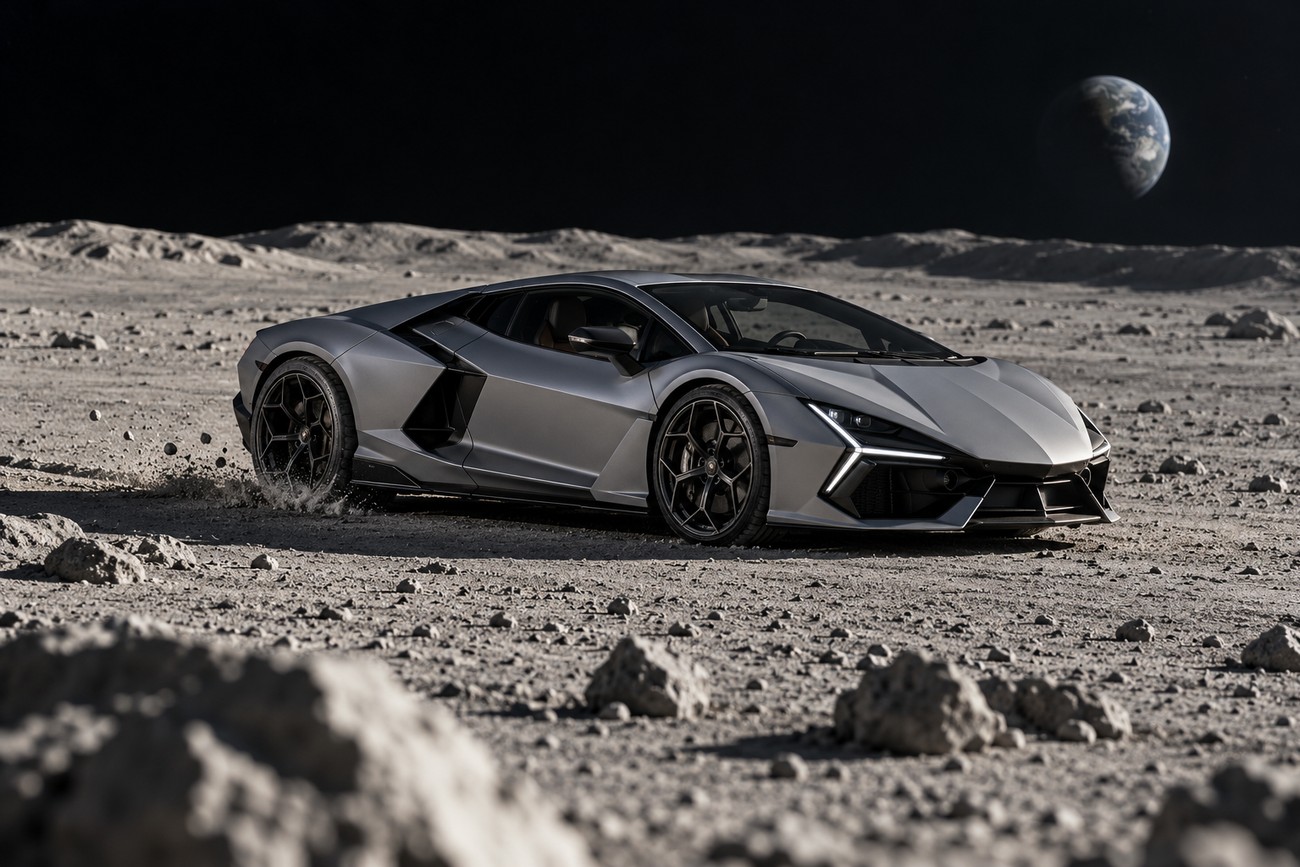
Lunar gravity is approximately one-sixth of Earth’s gravity. The vehicle’s mass would remain the same, while its weight and the normal force pressing the tires against the surface would decrease. That reduces available tire grip and changes how the suspension responds to terrain.
The effect would be especially important during an electric launch. Electric motors can deliver torque immediately, while the available tire force would be lower under lunar gravity. Wheel slip could therefore occur at low speed, long before aerodynamic drag became a significant consideration.
Lower gravity would also reduce suspension loading, but that does not make rough ground harmless. A wheel leaving the surface, landing on a ridge, or encountering a rut would alter the vehicle’s stability in a way its Earth-oriented chassis control systems were not designed to manage. Regolith would add an uncertain, abrasive surface rather than a dependable road.
Without atmospheric aerodynamic load, a published maximum speed would say little about useful lunar performance. Stability, wheel contact, traction control, suspension travel, and the ability to survive uneven terrain would matter more than the speed at which the car could theoretically travel in a straight line.
Revuelto Systems: Earth Assumption vs. Lunar Failure Point
The production car is engineered around Earth’s atmosphere, temperatures, surfaces, and service materials. The table separates those assumptions from the problems created by the lunar environment.
| System | Earth operating assumption | Lunar failure point |
|---|---|---|
| V12 combustion | The naturally aspirated engine receives oxygen-bearing intake air and expels exhaust into an atmosphere. | The Moon has practically no atmosphere. Normal intake oxygen is absent, so the V12 cannot sustain ordinary combustion without a separately stored oxidizer and a redesigned system. |
| Cooling | A conventional radiator transfers heat to moving air through convection, supported by conduction within the cooling system. | Vacuum removes ordinary convective heat transfer. Heat rejection must rely mainly on conduction and radiation, while the stock thermal system assumes Earth-like conditions. |
| Traction | Earth gravity supplies normal tire loading and contact with a prepared surface. | Approximately one-sixth Earth gravity reduces tire loading and available grip. Electric torque may overcome traction at low speed, while loose regolith changes the contact surface. |
| Battery and power electronics | Electrical components operate with a vehicle thermal system designed for terrestrial heat rejection. | Battery heating during acceleration and regenerative braking remains. Power electronics also need a path to reject heat, which vacuum makes substantially harder. |
| Seals and materials | Lubricants, plastics, seals, and other materials function within terrestrial pressure and temperature ranges. | Vacuum, lunar temperature extremes, and material outgassing can degrade seals, contaminate nearby components, or disrupt mechanical operation. |
| Exhaust system | Exhaust gases flow into an atmosphere, and engine sound propagates through surrounding air. | A converted combustion system would need an exhaust path designed for its combustion products. External engine and exhaust sound would not propagate through vacuum as it does through an atmosphere. |
| Moving hardware | Road debris and dust are managed within ordinary automotive design limits. | Abrasive lunar regolith can damage seals, joints, brake components, and exposed cooling surfaces. |
Cooling Is the Second Wall: Vacuum, Heat, and Lunar Day
A cold-looking vacuum is not a large air conditioner. In vacuum, a conventional radiator cannot reject heat through ordinary convection because there is no surrounding air to carry it away. Thermal energy can move through the cooling system and solid components, then leave exposed surfaces mainly through radiation.
The lunar surface also has a severe thermal range: approximately +127°C in sunlight to −173°C in darkness. Each lunar day and lunar night lasts approximately two Earth weeks. A vehicle parked in sunlight would face intense external heating, while a vehicle in darkness would face deep cold and long-duration thermal soak.
These conditions create competing design problems. Surface temperature, internal heat generation, insulation, and radiator exposure to space would all matter at once. A component can be surrounded by a cold environment and still overheat internally if its heat has no effective path to a radiating surface.
The electric motors may avoid the V12’s oxygen requirement, yet the battery and power electronics remain thermal bottlenecks. Acceleration and regenerative braking generate heat in those components, and the stock system cannot rely on surrounding air to remove it. Electric mode would therefore provide a possible source of motion, not unrestricted lunar operation.
The Revuelto’s stock cooling hardware is designed for an Earth atmosphere and an Earth service cycle. Sustained lunar driving would require thermal radiators, conductive interfaces, insulation, and control strategies developed for vacuum and long exposure to sunlight or darkness. Without those changes, the vehicle could reach a thermal limit even while producing far less power than its advertised maximum.
The Hidden Hardware Problem: Oxygen Tanks Are Not a Simple Fix
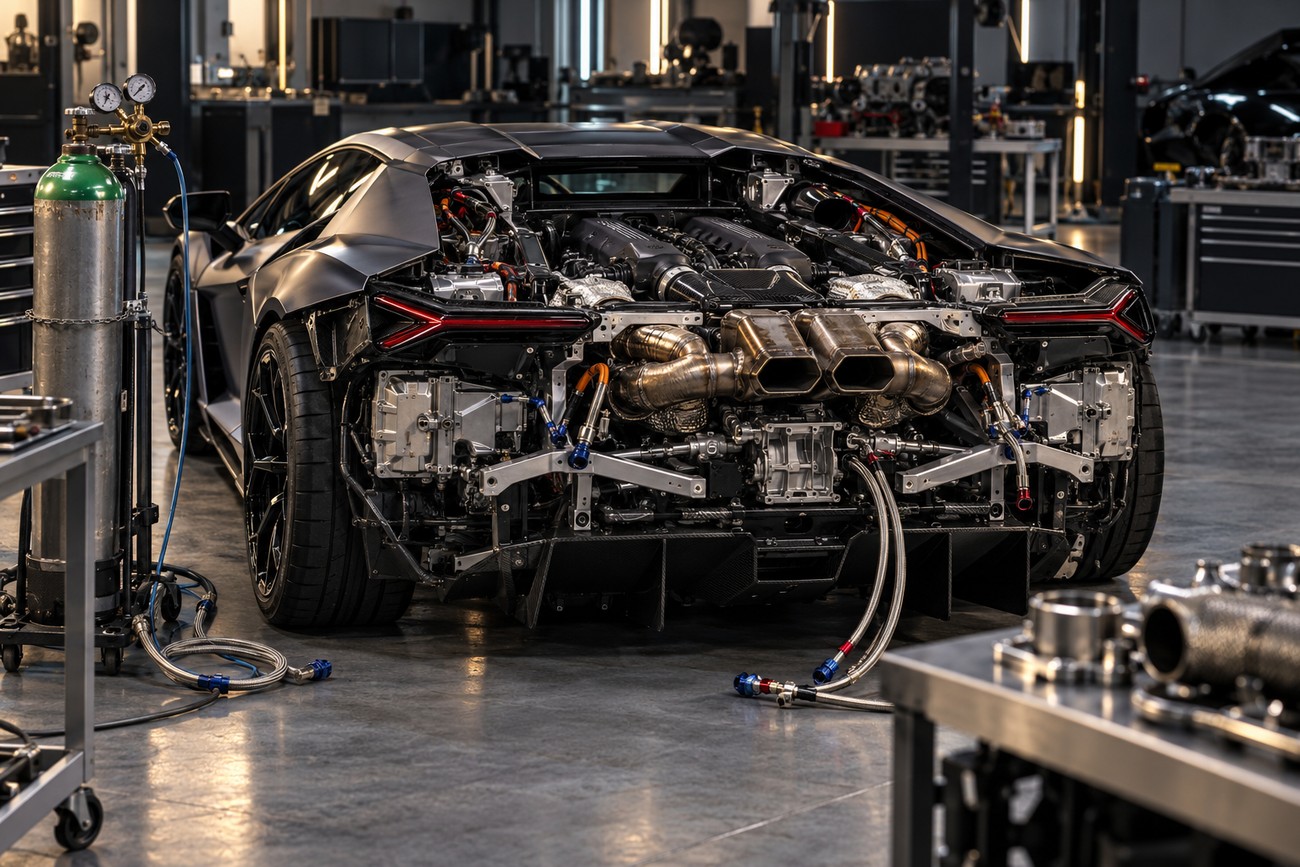
Supplying an oxidizer would solve only the chemical absence at the center of the V12 problem. The oxidizer would need storage, regulation, metering, and a controlled route into the combustion system. Intake components, combustion control, exhaust handling, and safety systems would all require redesign.
The exhaust path would also behave differently in vacuum. Combustion products could be managed through a redesigned system, but the production exhaust architecture assumes an atmospheric environment and would require reassessment of exhaust flow and thermal management. The modified engine would no longer represent a stock Revuelto.
Vacuum introduces material concerns that are easy to overlook. Some lubricants and plastics may evaporate or outgas, releasing compounds that can contaminate optics and electronics or alter the operation of mechanical parts. Seals must retain their function across pressure and temperature changes without relying on materials that lose volatile components.
Lunar regolith adds a mechanical threat. Its abrasive particles could work into seals, joints, brake mechanisms, and exposed cooling surfaces. A vehicle adapted for the Moon would need dust-tolerant interfaces and protection for moving parts, while ordinary road-car components would face a surface unlike asphalt, gravel, or sand.
The theoretical conversion is therefore a new vehicle-design problem. It would combine stored oxidizer, redesigned fluid and gas paths, vacuum-compatible materials, radiation-based cooling, dust protection, and revised traction control. Calling that package a Revuelto could describe its origin, but it would not describe an unmodified production car.
Frequently asked questions
These questions address other Lamborghini-related comparisons and claims. The Fiero nickname concerns appearance rather than factory engineering. Road legality for the Murciélago SV depends on local requirements. V12 speed claims depend on how performance is defined and measured.
Which car is called a “poor man’s Lamborghini”?
The Pontiac Fiero is commonly associated with the phrase “poor man’s Lamborghini.” Its mid-engine layout made it a popular base for replica and kit-car conversions styled to resemble exotic models, including Lamborghinis.
The nickname describes the aftermarket image rather than factory equivalence. A Fiero conversion may imitate the appearance of a Lamborghini, while its engine, chassis engineering, materials, and safety systems remain fundamentally different.
Why is the Murciélago SV illegal?
The Lamborghini Murciélago LP670-4 SV is not universally illegal. Road legality depends on the country, the vehicle’s certification, emissions and safety compliance, import history, and any modifications.
A particular example may be restricted because it lacks local certification or cannot satisfy the rules for registration. That is a jurisdictional compliance issue, rather than a universal defect affecting every Murciélago SV.
What is the fastest V12 car in the world?
There is no single verified answer without defining the category. A claim may refer to a production road car, a track-focused model, a limited-run vehicle, a standing-start acceleration test, or a measured top-speed run.
Those categories produce different leaders, and manufacturer claims are not interchangeable with independently measured results. The same distinction matters for lunar performance: a power figure recorded on Earth does not establish how a car would operate in vacuum, reduced gravity, or extreme temperatures.







