
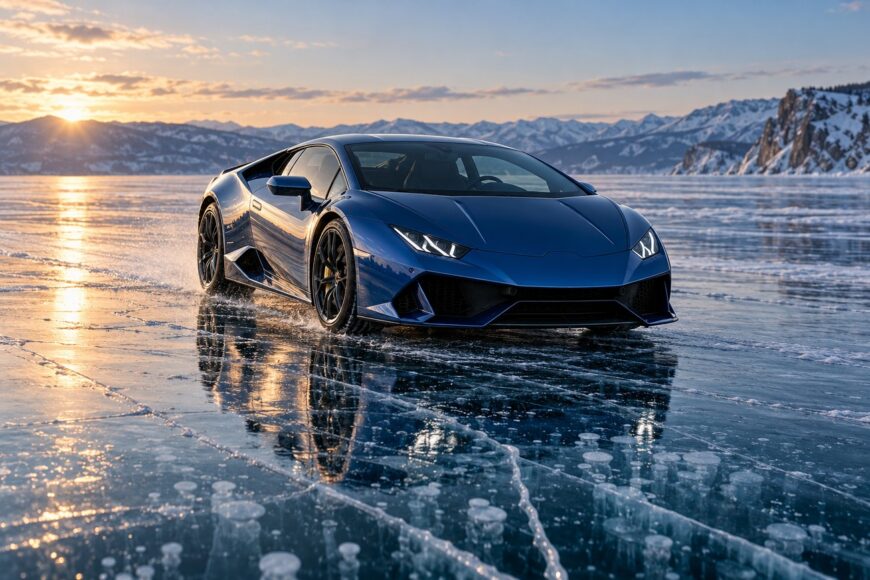
A Lamborghini Huracán against Lake Baikal’s transparent winter ice is a striking image: a low, mid-engine sports car appears to float above dark water. The camera can capture the car and the lake in one clean frame. It cannot show whether the surface beyond that frame will support a safe driving line.
That distinction matters more than the car’s headline performance. Baikal’s ice varies in structure and condition, while Huracán versions differ in specification. A credible run depends on a surveyed route, suitable tires, technical support, and a willingness to stop when conditions change. A controlled demonstration says little about the safety of driving onto the lake casually.
- Why a Huracán on Baikal Ice Is More Than a Viral Image
- What Baikal’s Clear Ice Really Tells You
- Which Lamborghini Huracán Is Actually Being Discussed?
- How an Ice Route Has to Be Prepared Before the Car Arrives
- Why All-Wheel Drive Cannot Make a Huracán Invincible
- The Reality Behind the Perfect Ice Shot
- Frequently asked questions
- What is the poor man’s Lamborghini?
- How much does an oil change on a Lamborghini Huracán cost?
- When is Baikal ice most likely to look clear enough for this kind of filming?
Why a Huracán on Baikal Ice Is More Than a Viral Image
The scene works because the contrasts are real. The Huracán is built around sharp responses and substantial power; Baikal offers a vast surface that can look as smooth as polished glass. In a photograph, there is no visible road edge or barrier to interrupt the view. That apparent freedom is precisely what makes the image easy to misread.
Clean, glass-like ice is a seasonal opportunity, not a winter-long surface condition. Snow and slush can obscure it, while hummocks and pressure ridges interrupt a line that looked open from a distance. Wind, fresh cracking, and temperature shifts can alter conditions within hours. A route selected in the morning may need reassessment before another run.
The car adds its own constraints. Low ground clearance leaves little room for rough ice, and stiff suspension transfers bumps that a taller vehicle might absorb more easily. A prepared trajectory therefore matters even when the intention is filming rather than outright speed. Striking footage may reflect careful selection of a short usable section, rather than the character of the surrounding lake.
There is also a large cost to getting the judgment wrong. Damage, recovery, and exposure to open water are more consequential than a spoiled shot. A professionally planned demonstration should be understood as a managed activity with limits, never as an invitation to repeat the drive wherever the ice looks clear.
What Baikal’s Clear Ice Really Tells You
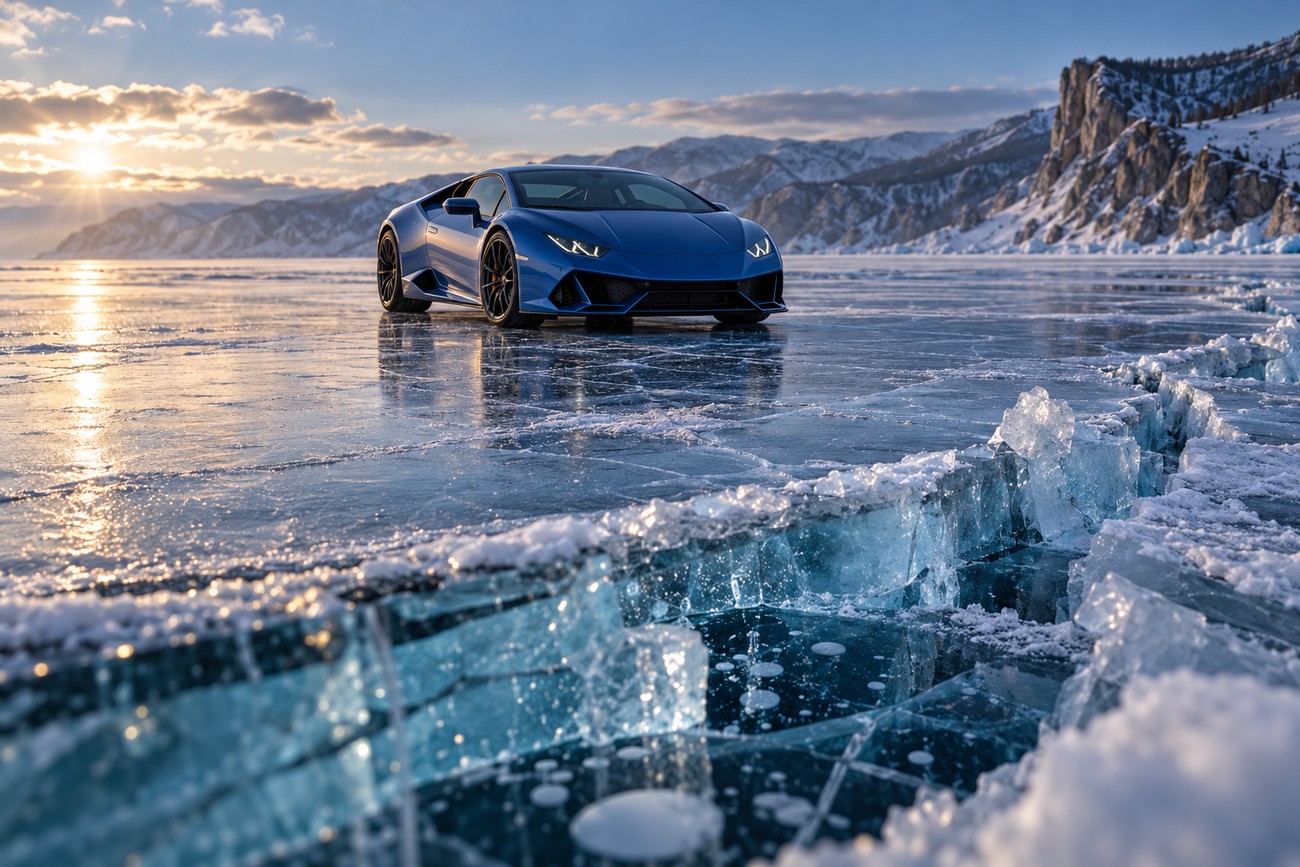
Baikal usually freezes over, with average ice cover lasting from January 9 to May 4. That broad seasonal description has an important exception: an unfrozen stretch about 15–20 km long remains near the Angara headwaters. Elsewhere, a continuous-looking white or transparent surface can still contain cracks, pressure ridges, and locally weak areas. The lake’s frozen appearance does not describe every point along a proposed route.
By late winter, ice is about 1 m thick in general and about 1.5–2 m thick in bays. Those figures provide context, not clearance for a car. A measurement at one location cannot establish the structure of the next section, the condition of a crack, or the continuity of the actual driving line. Transparent, monolithic ice and white ice formed with snow can also have different structures.
Baikal’s clarity is a genuine physical feature. Sunlight passes through clear ice and supports planktonic algae beneath it; the ice’s transparency helps explain the depth visible in some winter images. Transparency, however, is an optical property; thickness and structural integrity must be assessed separately. The most photogenic patch may have no useful bearing on the safest passage nearby.
The water beneath reinforces why mistakes deserve caution. Baikal’s surface water is usually no warmer than +8 to +9 °C in summer, though some bays and shallow areas can reach +15 °C; deep water is around +4 °C. Those temperatures do not provide a shortcut for judging winter ice. They do underline the serious consequences of treating an unverified surface as a road.
Which Lamborghini Huracán Is Actually Being Discussed?
The Lamborghini Huracán is a mid-engine, two-seat sports car, but its name covers multiple versions. For a clear reference point, the LP 610-4 is specified at 610 hp, 0–100 km/h in 3.2 seconds, and a 330 km/h top speed. These are vehicle specifications, not predictions of what the car can achieve on ice.
Many baseline Huracán versions use all-wheel drive. Across the range, however, drivetrain, power, mass, and aerodynamic settings differ. Those details affect how a car responds to steering, throttle, and braking inputs. An account of an ice run is less informative if it identifies only the model family while leaving the version and preparation unclear.
A common specification mix-up assigns 640 hp and a 2.9-second 0–100 km/h time to every Huracán. Those figures refer to later or different versions; they are not universal Huracán numbers. Applying them to an unspecified car makes a dramatic account sound more precise while actually making it less reliable.
Even the correctly identified LP 610-4’s 330 km/h top speed belongs to its published specification, not to Baikal. On ice, available grip and the usable length and condition of the route govern what can be attempted. The useful question for interpreting footage is which car ran, on which tires, and over what prepared surface.
How an Ice Route Has to Be Prepared Before the Car Arrives
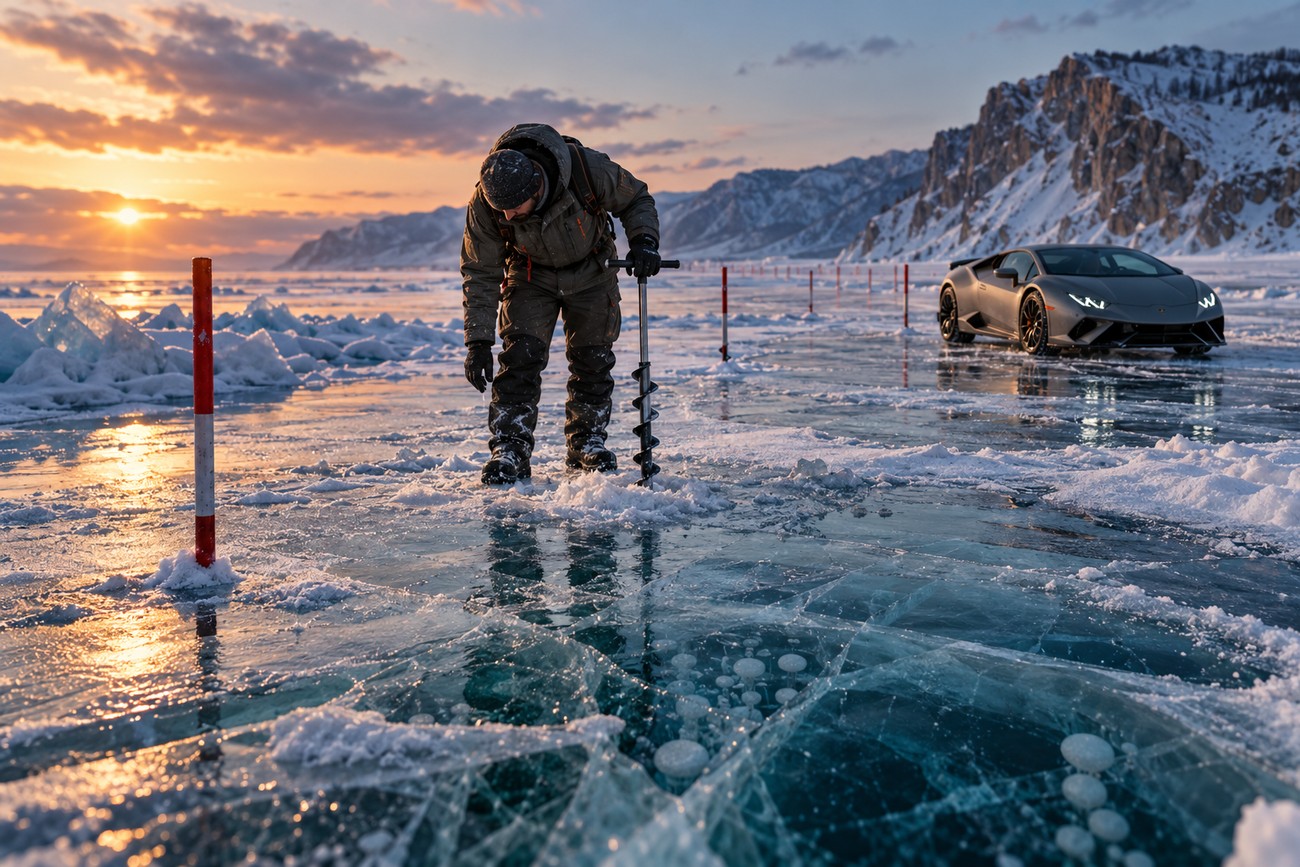
Preparation begins with reconnaissance of the intended line, including its approaches and exit, rather than a glance at a regional ice-thickness figure. Structure, cracks, pressure ridges, temperature, and local conditions all matter. Local specialists who know specific bays can help identify where conditions differ across the lake, while the route team must assess the surface they intend to use that day.
Markers make a selected line legible to the driver and support crew. They cannot make weak ice sound, so a plan also needs a way to change or cancel the run if wind, cracking, or snow alters the surface. Clear ice may give way to white, snow-covered ice along the same course, changing both visibility and the way the tires meet the surface.
The logistics extend beyond the ice survey. Transporting the car, arranging insurance and escort, carrying spare tires, and providing technical assistance can all be part of a supercar ice project. Recovery planning matters because a disabled low car is difficult to move from an uneven frozen surface. These requirements are largely invisible in a finished photograph, yet they shape whether the activity is manageable.
A workable route is also a temporary finding. A team may have to inspect it again as conditions change, and a favorable report for one bay says little about another. The decision to leave the car parked can be the most important result of that inspection.
Why All-Wheel Drive Cannot Make a Huracán Invincible
All-wheel drive can distribute driving torque, but it cannot create grip that the tires do not have. Tire choice, tire pressure, surface temperature, surface quality, and driver inputs determine how much control is available. On smooth ice, that margin can be small even when the car pulls away cleanly.
Acceleration is only one part of an ice run. Braking distances increase as grip falls, and a steering input can produce lateral sliding before the driver reaches the intended turn. Power does not shorten a stop, while a sudden lift, brake, or steering correction can upset a car already close to its traction limit. Open space in a camera shot should not be mistaken for a generous safety margin.
The Huracán’s low clearance adds a separate problem. An uneven patch or ridge can affect the car before the driver has much time to react, regardless of whether the driven wheels retain traction. Its power and mass also make abrupt inputs consequential. A controlled surface and deliberate driving matter more than confidence in the drivetrain badge.
Version differences complicate blanket claims about “a Huracán on ice.” Power, mass, drivetrain, and aerodynamics vary across the range, so two cars bearing the same model name need not respond identically. Neither will behave consistently across transparent ice, snow-covered sections, and slush. Footage of one run cannot establish a general ice-driving capability for the whole line.
The Reality Behind the Perfect Ice Shot
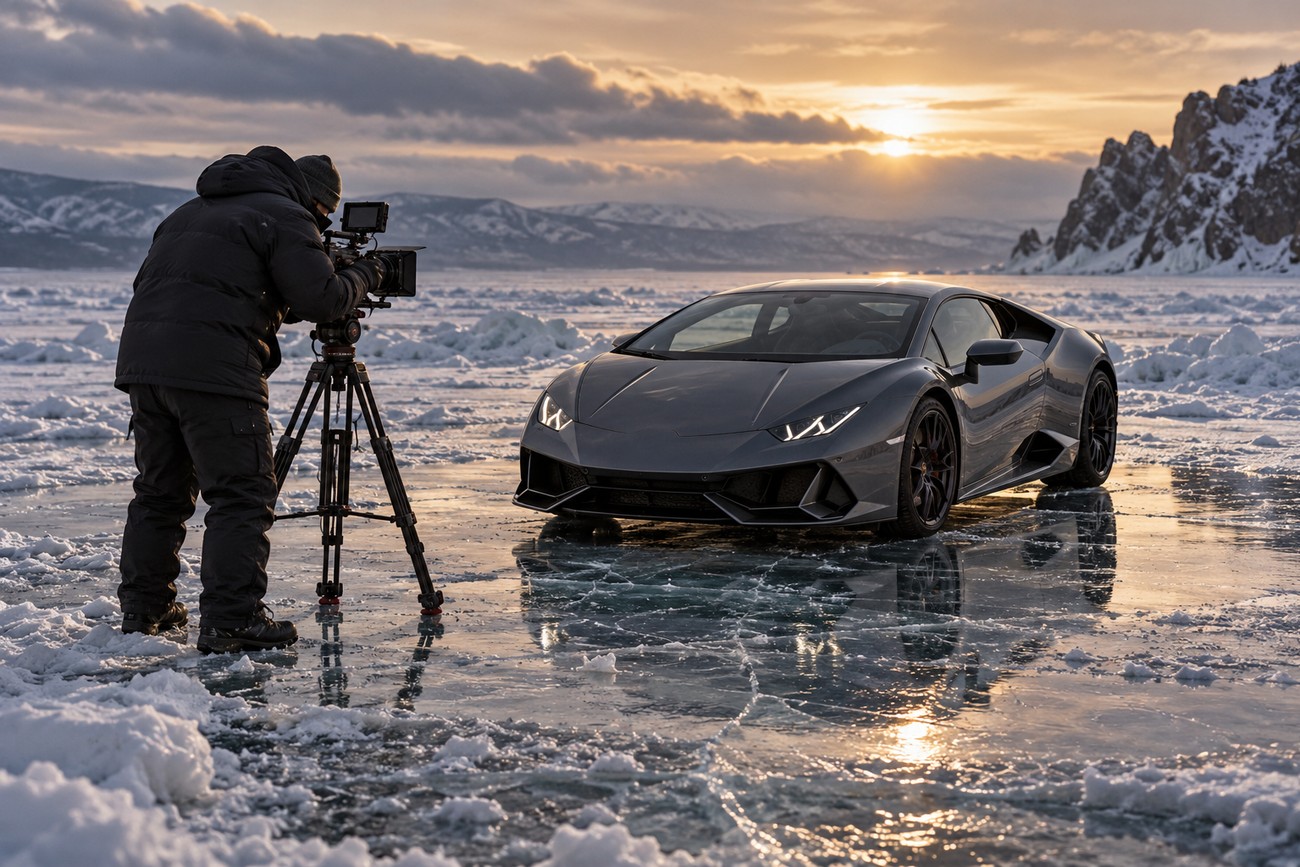
Baikal’s clearest-looking ice is often associated with late January to mid-February. It is a seasonal window, not a booking guarantee: snow, wind, and local surface changes can interfere with filming. A polished image can exclude dull ice, broken sections, and the route work required to reach a usable patch.
Clear conditions can coexist with active movement. Severe frost can cause ice fields to crack, separate, and shift even as the ice thickens. That counterintuitive combination is why appearance and a single thickness number make poor substitutes for current, local assessment. Pressure fissures and uneven thickness rarely feature in a promotional frame.
A claimed record or exceptional speed needs similar scrutiny. The prepared surface, available acceleration distance, and weather and ice conditions determine what the claim demonstrates. Without that context, a number cannot tell readers how the car would behave on a shorter route or on ordinary winter ice. Published top speed and achieved ice speed describe different things.
A Huracán run on Baikal can be technically compelling when the car, tires, route, and changing surface are treated as one system. The spectacle has value precisely because those constraints are demanding. Presenting the finished shot as proof that a powerful supercar can simply drive across a frozen lake would leave out the work—and the risk—that made the image possible.
Frequently asked questions
These related questions need a little context: informal car labels and ownership costs are less precise than a model specification, while a promising filming date says nothing by itself about the route under the car.
What is the poor man’s Lamborghini?
“Poor man’s Lamborghini” is an informal label, not a technical category or the name of a specific car. It is usually applied to a less costly sports car perceived to offer some of the drama associated with a Lamborghini. The label says little about layout, drivetrain, or how the car drives.
An alternative sports car cannot automatically reproduce a Huracán’s mid-engine balance or its particular drivetrain characteristics. On ice, the comparison is less useful still: tires, surface condition, and preparation dominate the result, and a different car brings its own risks.
How much does an oil change on a Lamborghini Huracán cost?
There is no single reliable oil-change price for every Huracán. The version, workshop, specified fluids and filters, and local labor costs all affect the bill. A quoted figure without those details may exclude work that another workshop includes.
For a useful estimate, identify the exact version and ask a qualified workshop for an itemized quote showing parts, fluids, labor, and any additional inspection. An ice project can create separate tire, transport, and technical-support costs; those should not be confused with routine oil-change pricing.
When is Baikal ice most likely to look clear enough for this kind of filming?
Late January to mid-February is often cited as the best-known window for visually clear Baikal ice. It remains a seasonal tendency rather than a fixed filming schedule: snow cover, wind, and changing local conditions can hide the transparent surface on a planned day.
Filming plans therefore need flexibility about location and timing. Clear ice may improve the shot, but visual clarity does not certify a driving route. Any vehicle run still requires current local assessment of the intended line.







