
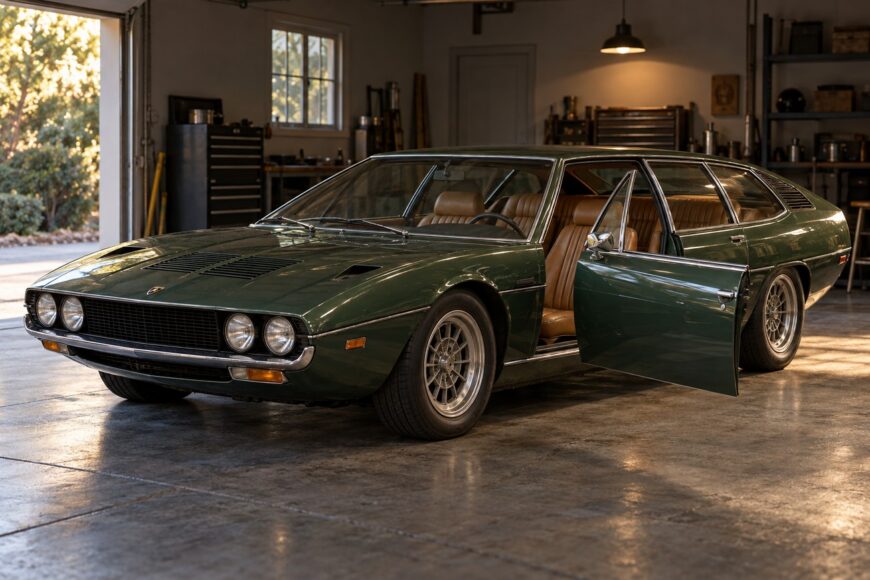
A four-seat V12 Lamborghini promises room to share the journey without giving up the engine that made the marque famous. The Espada delivers on that idea as a late-1960s grand tourer: it is long, low, and designed around travel rather than the easy access and generous headroom of a modern family car.
That unusual purpose still makes the Espada compelling. Its rear seats were part of the design from the outset, giving it a different appeal from Lamborghini’s better-known two-seat cars. For a prospective owner, the same distinction calls for clear expectations: four usable places broaden what the car can do, while its age and complex V12 make the condition of an individual example crucial.
- Why Lamborghini built a four-seat V12 GT
- The cabin: four seats, with a grand tourer’s compromises
- What the V12 Espada is like beneath the shape
- Espada Series I, II, and III: the figures to keep separate
- Why Espada dates and performance figures disagree
- The ownership costs that a specification sheet misses
- Buying an Espada: inspect the work, not just the paint
- Frequently asked questions
- How much does a Lamborghini Espada cost?
- What evidence supports a claim that an Espada left the factory with an automatic transmission?
- How can an Espada owner document its original color and interior trim?
Why Lamborghini built a four-seat V12 GT
The Lamborghini Espada is a two-door, four-seat V12 grand tourer with a front-engine, rear-wheel-drive layout. It was conceived as a car for passengers and luggage as well as performance, rather than a two-seat supercar with extra seats squeezed into the back. That choice explains much of its character before the engine is even started.
A 2650 mm wheelbase gave the cabin room for a genuine rear seating area. It also helped establish the Espada’s long profile, a visible consequence of accommodating passengers behind the front seats. The space was meaningful by the standards of its era, though the car was never intended to serve as a modern family vehicle.
The principal production period is 1968–1978, placing the Espada firmly in the grand-touring tradition of that decade. Some catalogs instead list 1968–1981; that later end date should be treated cautiously rather than assumed to describe continued production. For buyers, establishing the identity and history of a particular car matters more than relying on a broad catalog date.
The cabin: four seats, with a grand tourer’s compromises
The Espada measures 4738 mm long, 1860 mm wide, and 1185 mm high. Those proportions help explain both the appeal of its low roofline and the limits of the accommodation beneath it. Its 2650 mm wheelbase creates space for rear passengers, while the car’s height remains a constraint when getting in and settling down.
The rear seats are central to the Espada’s purpose; they are more than a visual suggestion of practicality. Comfort is a separate question. Some owners describe long journeys in the back as a compromise for adults, so anyone hoping to use all four seats regularly should assess them with the intended passengers aboard.
Length and width also matter beyond the garage. In tight streets or parking spaces, the Espada asks for more room than its Lamborghini badge might lead someone to expect. That follows from its dimensions and GT layout, though it is not a verdict on every car’s maneuverability.
What the V12 Espada is like beneath the shape
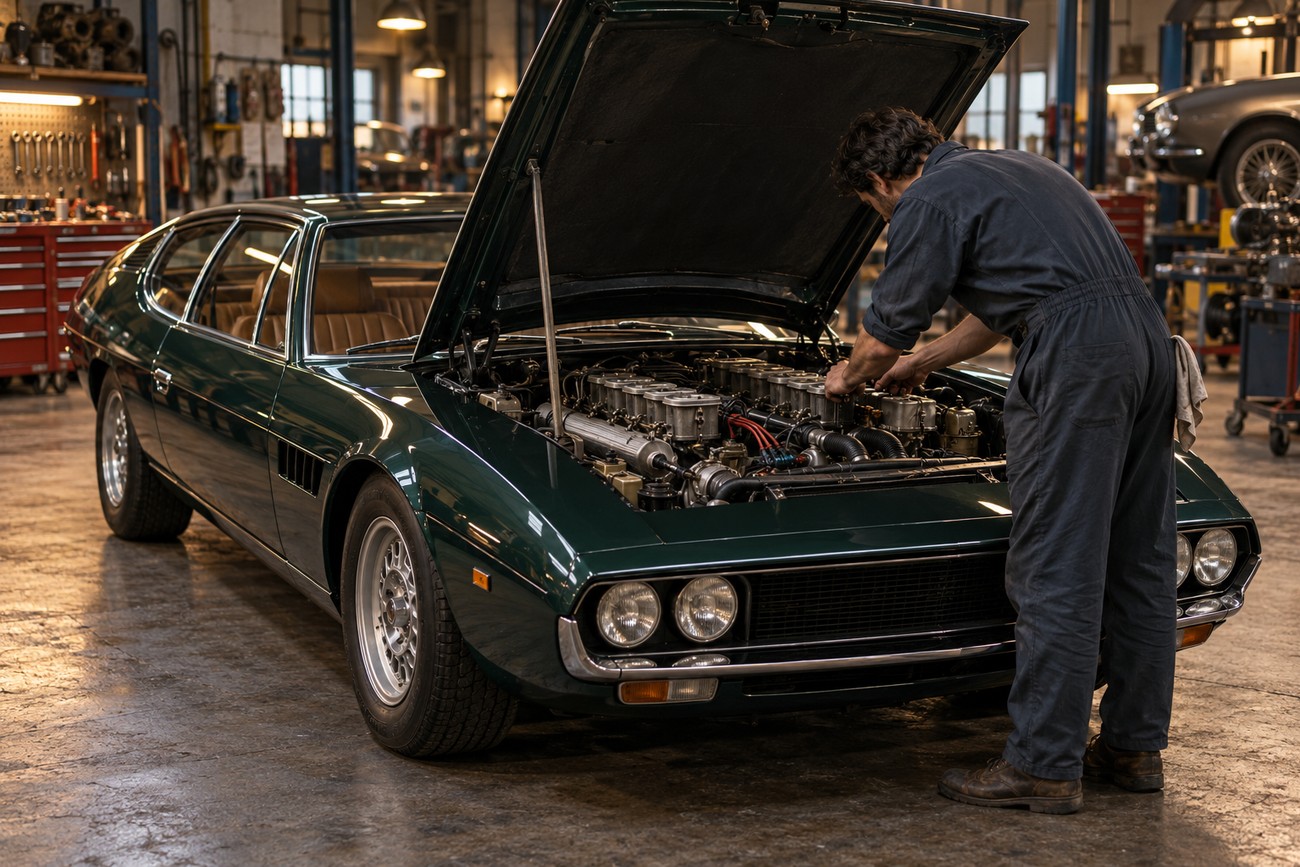
The Espada’s 3939 cm³ V12 sits ahead of the cabin and drives the rear wheels. Reported output is 325 hp in early versions and 350 hp in later versions. Those figures describe an evolution across the model’s life, so a single power claim should not be applied to every example.
Most cars have a five-speed manual transmission, although automatic examples also exist. The choice matters to the driving experience and to any assessment of a car’s specification. A buyer should verify what an individual Espada has, rather than assume that every surviving car follows the most common configuration.
Independent front and rear suspension and disc brakes on all four wheels complete a specification intended for capable grand touring. The Espada’s size and passenger accommodation remain part of how it feels, however. Published performance figures alone cannot convey whether a particular car is properly tuned and operating as intended.
Espada Series I, II, and III: the figures to keep separate
Production totals offer a useful way to distinguish the three series without attaching uncertain performance claims to them.
| Series | Reported production |
|---|---|
| Series I | 186 cars |
| Series II | 575 cars |
| Series III | 456 cars |
| Total | 1217 cars |
Reported output rises from 325 hp in early versions to 350 hp in later versions, but these figures should not be assigned to individual series without evidence specific to the car or specification being discussed. The same caution applies to published maximum speeds: the production counts do not establish which speed claim belongs to which series.
Series identification is useful when comparing cars, parts, and documentation. It is only a starting point for judging rarity or originality; the condition and recorded history of an individual Espada still need separate examination.
Why Espada dates and performance figures disagree
Most descriptions give 1968–1978 as the Espada’s principal production period, while some catalogs list 1968–1981. The available figures do not establish a definitive reason for that discrepancy. A catalog entry extending to 1981 should therefore be identified as such, rather than presented as an uncontested production end date.
Power figures need similar care. The 3939 cm³ V12 is reported at 325 hp in early versions and 350 hp in later versions, making an unqualified “350 hp Espada” description potentially misleading. Establishing the year, series, and supporting records of a particular car is more useful than choosing the most appealing figure.
Published maximum-speed claims include 245, 249, 256, and 261 km/h. Their assignment to particular series is not established here, and the figures should not be treated as proven measurements for any car under consideration. The reported total of 1217 cars is a firmer reference point than an isolated speed quoted without its source or specification.
The ownership costs that a specification sheet misses
The Espada’s 3939 cm³ V12 rewards careful maintenance, but its specification says little about the work required to keep it running well. Owners and restorers report that servicing the six-carburetor setup, particularly adjustment and synchronization, calls for specialist knowledge and can be costly. These are ownership experiences, not quantified failure rates.
Ignition, fuel delivery, and cooling deserve attention alongside the carburetors. A car that runs poorly may have faults elsewhere in those systems, so an adjustment made in isolation can leave the underlying problem unresolved.
Owners and restorers also report difficulty sourcing original body and interior parts. Even where a repair budget is available, finding a suitable component and a workshop familiar with the car may take time. That practical constraint sits alongside the Espada’s genuine usefulness as a four-seat GT: enjoying it regularly depends on planning for maintenance, not simply admiring its specification.
Buying an Espada: inspect the work, not just the paint
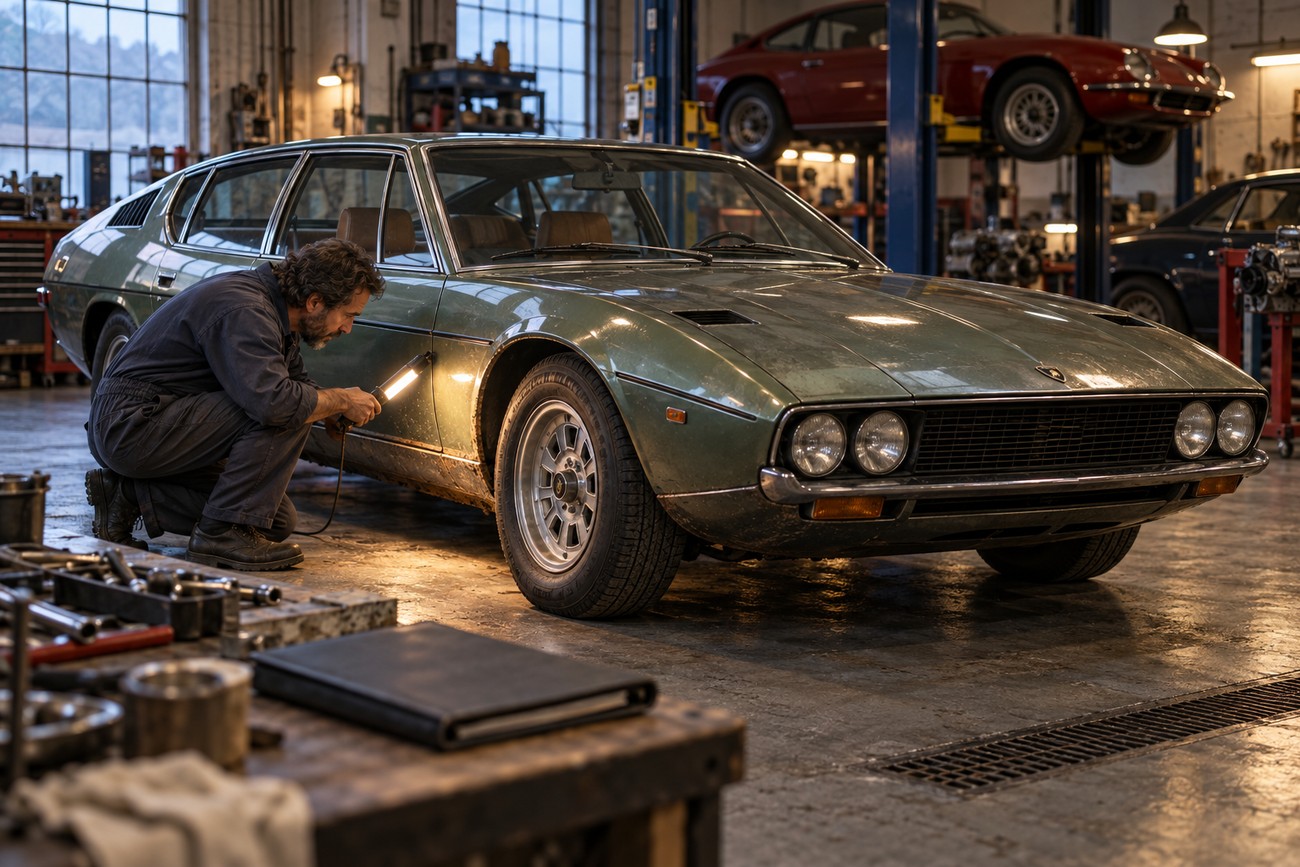
Begin by establishing the car’s series and recorded history. Reported production totals are 186 Series I cars, 575 Series II cars, and 456 Series III cars, but a series label alone cannot establish an individual car’s condition or originality. Confirm its transmission as well: most Espadas have a five-speed manual, while automatic examples also exist.
Next, review evidence of restoration rather than relying on photographs of the finish. Records of body repairs, electrical work, and fuel-system work can help show what was done, when, and to what standard. Missing documentation does not automatically condemn a car, but it increases the importance of a thorough physical inspection.
Commission an inspection by someone familiar with carbureted V12 Lamborghinis, covering bodywork, electrics, fuel delivery, cooling, and engine tune. Owners and restorers report that original body and interior parts can be hard to find, so identify non-original components and assess the quality of past modifications before deciding what you would retain or reverse. A modified car is not necessarily a poor purchase; unclear or poorly executed work makes future decisions harder.
Frequently asked questions
An Espada’s value and provenance depend on evidence tied to the individual car. These checks help put an asking price and claims of originality in context.
How much does a Lamborghini Espada cost?
There is no responsible single price without reference to the car and the market in which it is offered. Compare recent sales of Espadas with similarly detailed records, then adjust your assessment for condition, originality, and the scope of work still needed. An asking price is less informative than a documented sale of a comparable car.
What evidence supports a claim that an Espada left the factory with an automatic transmission?
Look for available factory or period records that identify the individual car and its original transmission. Its current gearbox proves what is fitted now, not what it had when new. If the surviving documents leave a gap, describe the automatic transmission as present rather than factory-original.
How can an Espada owner document its original color and interior trim?
Compare any available factory or period records with historical photographs and restoration documentation tied to the car. Earlier images may help establish when a color or trim change occurred, while restoration records can show what was found beneath later finishes. Evidence may be incomplete, so keep confirmed original details distinct from plausible reconstructions.







