
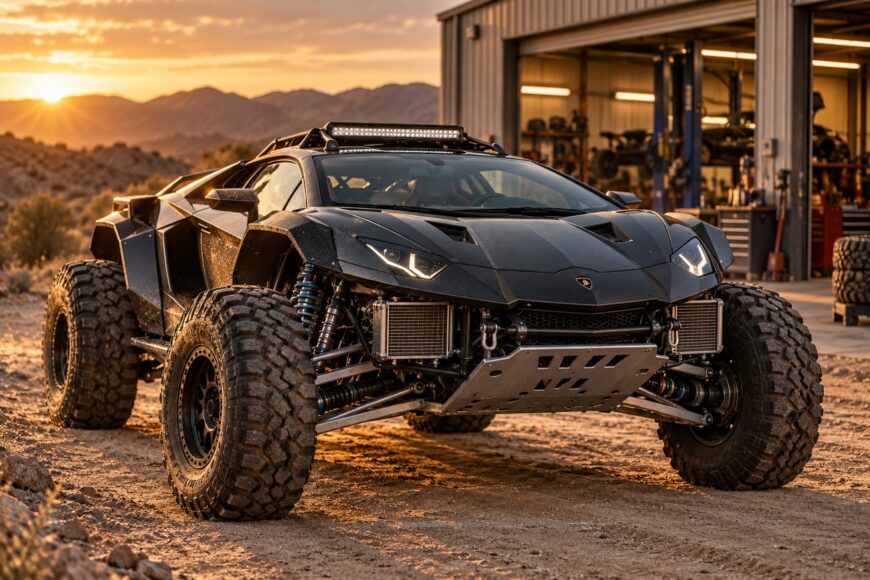
An Aventador on monster-truck tires has obvious visual appeal: a low, sharp-edged supercar body suspended above oversize rubber, with the V12 still visible as the mechanical centerpiece. The image suggests that Lamborghini performance could be combined with the stance and ground clearance of an off-road show truck.
The engineering decision is harder. A static show car can prioritize appearance and occasional movement, while a limited-use off-road conversion needs reliable steering, braking, cooling, and driveline operation. A machine intended to work like a monster truck would require a much deeper redesign. This is a build-requirements analysis for a proposed conversion, not evidence that a specific finished Aventador Bigfoot has been tested.
- Decide what the Aventador Bigfoot must actually do
- Why the stock Aventador is a difficult starting point
- Tires and suspension: clearance is only the beginning
- Drivetrain and electronics must match the new wheels
- Brakes, steering, and cooling face different loads
- Aventador Bigfoot problems: symptoms, causes, and checks
- Safety and road legality may decide where it can drive
- What a credible build plan would include
- Frequently asked questions
- How much would an Aventador Bigfoot build cost?
- How would an Aventador monster truck get to an event?
- How much is a Bigfoot monster truck worth?
- What is the cheat code for Lamborghini monster truck?
- Which car can beat the Lamborghini Aventador?
Decide what the Aventador Bigfoot must actually do
The first decision is the vehicle’s job. A static show build may need tire clearance, a convincing stance, safe low-speed movement, and enough structural integrity for transport. It does not automatically need the suspension travel, underbody protection, or thermal durability expected from a working off-road vehicle.
A limited-use conversion sits between those extremes. It might travel on private property, cross firm dirt, and make short demonstration runs. That still demands engineered suspension geometry, steering travel, reliable brakes, and protection for exposed components. Tire clearance alone creates space around the body; it does not create a durable off-road chassis.
A purpose-built monster-truck-style machine would require coordinated changes to the chassis, suspension, driveline, braking system, steering, cooling, and controls. The stock Aventador has all-wheel drive, which helps distribute traction, but it also has low ground clearance and a road-focused layout. Those characteristics remain important after a lift.
An Aventador’s curb weight is roughly 1.5–1.6 metric tons, depending on the version. Raising that mass substantially changes the vehicle’s center of mass and handling response. The higher body may look appropriate for a Bigfoot concept, while the resulting emergency behavior, rollover risk, and high-speed stability become engineering problems that cannot be solved by appearance.
Why the stock Aventador is a difficult starting point
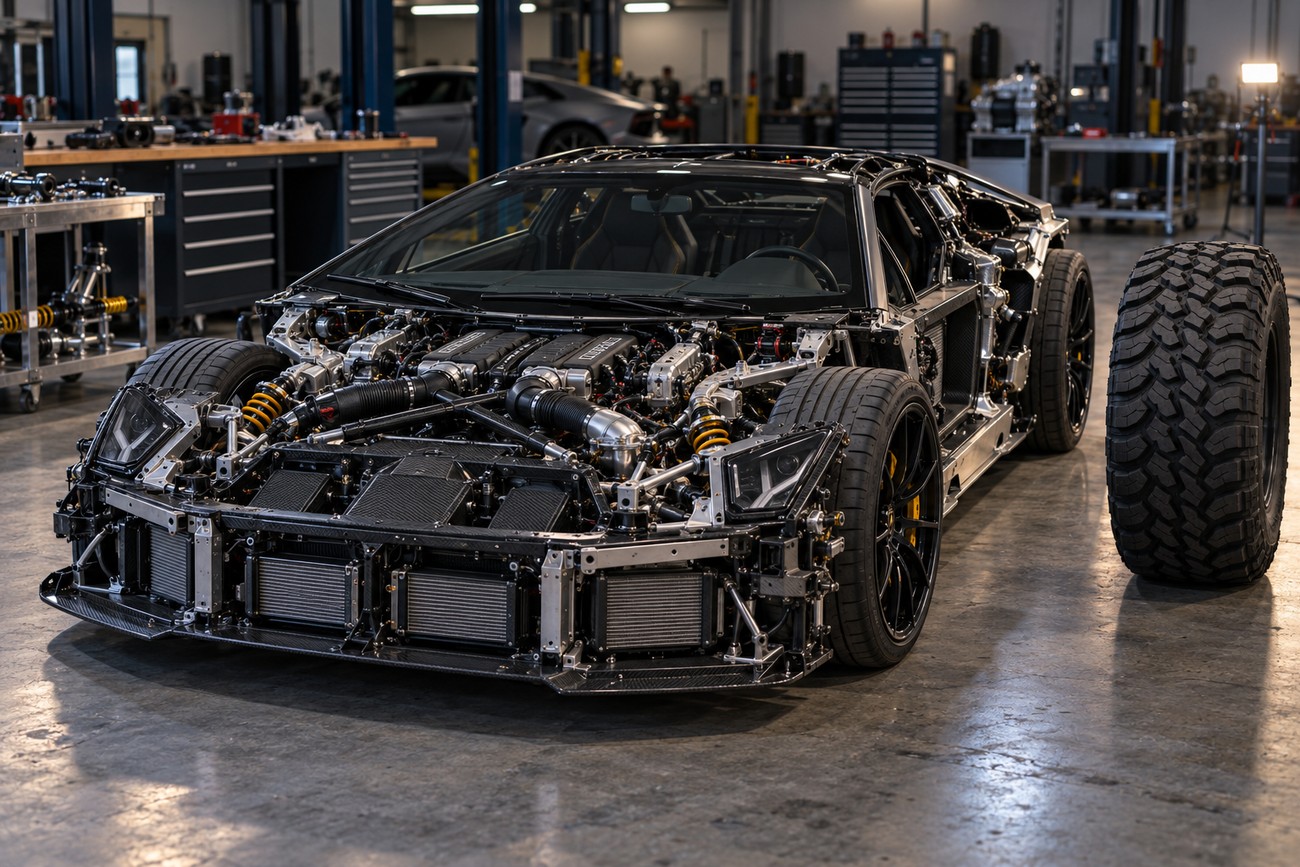
The Aventador packages a powerful engine, all-wheel-drive hardware, cooling equipment, suspension components, and body structure into a low supercar. That compact arrangement leaves little unused space for larger tires, longer suspension travel, revised driveshaft paths, or additional underbody protection. A change in one area quickly affects several others.
The Aventador SVJ provides a useful reference for the power available from this family of cars: its 6.5-liter V12 is rated at 770 hp and 720 Nm. Those figures belong to the SVJ specifically and should not be assigned to every Aventador. Even that level of output cannot substitute for suitable wheel travel, gearing, component protection, and tires designed for the intended surface.
Stock all-wheel drive helps manage traction, yet it does not provide off-road geometry or durability by itself. Low ground clearance, limited suspension travel, exposed driveline parts, and road-oriented calibration can still stop the vehicle or damage it. A large engine may spin the wheels in dirt, but power is useful only if the tires remain in contact with the ground and the driveline can tolerate the loads.
Cooling is another difficult part of the packaging problem. Dirt and sand can restrict airflow, while low-speed operation reduces airflow through the radiators and around the brakes. The conversion would need a plan for filtration, cleaning access, heat rejection, and brake cooling before the vehicle is asked to work slowly in deep or loose terrain.
Tires and suspension: clearance is only the beginning
Large tires affect more than the visible stance. Their diameter changes effective gearing, their width affects body and suspension clearance, and their mass adds load to hubs, bearings, steering parts, and suspension links. Wheel offset and track width also determine whether the tire contacts the fender, inner structure, brake hardware, or suspension components.
Lift height must therefore be considered alongside compression and rebound travel. A tire that clears the body at static ride height may contact the arch during compression or move into a steering component at full lock. At full rebound, a joint or damper may reach an unsuitable angle. Alignment changes can then produce poor steering feel and rapid wear at the tire edges.
Clearance should be checked at full steering lock and throughout compression and rebound. A static ride-height mock-up can miss interference that appears only when the wheel moves through its working range.
Revised mounting points, bump stops, dampers, and control-arm geometry may be required to control those movements. Caster influences straight-line stability and steering return, while camber and toe determine how the tire meets the ground as the suspension moves. The correct setup depends on the chosen tire, wheel, travel, and intended surface rather than on lift height alone.
A radical lift also raises the center of mass and changes handling. The result can be slower weight-transfer response, more body movement, and greater rollover risk during abrupt steering. Large tires may improve clearance or traction in some conditions, while their added unstrung mass can make it harder for the suspension to keep the tire planted over uneven ground.
Drivetrain and electronics must match the new wheels
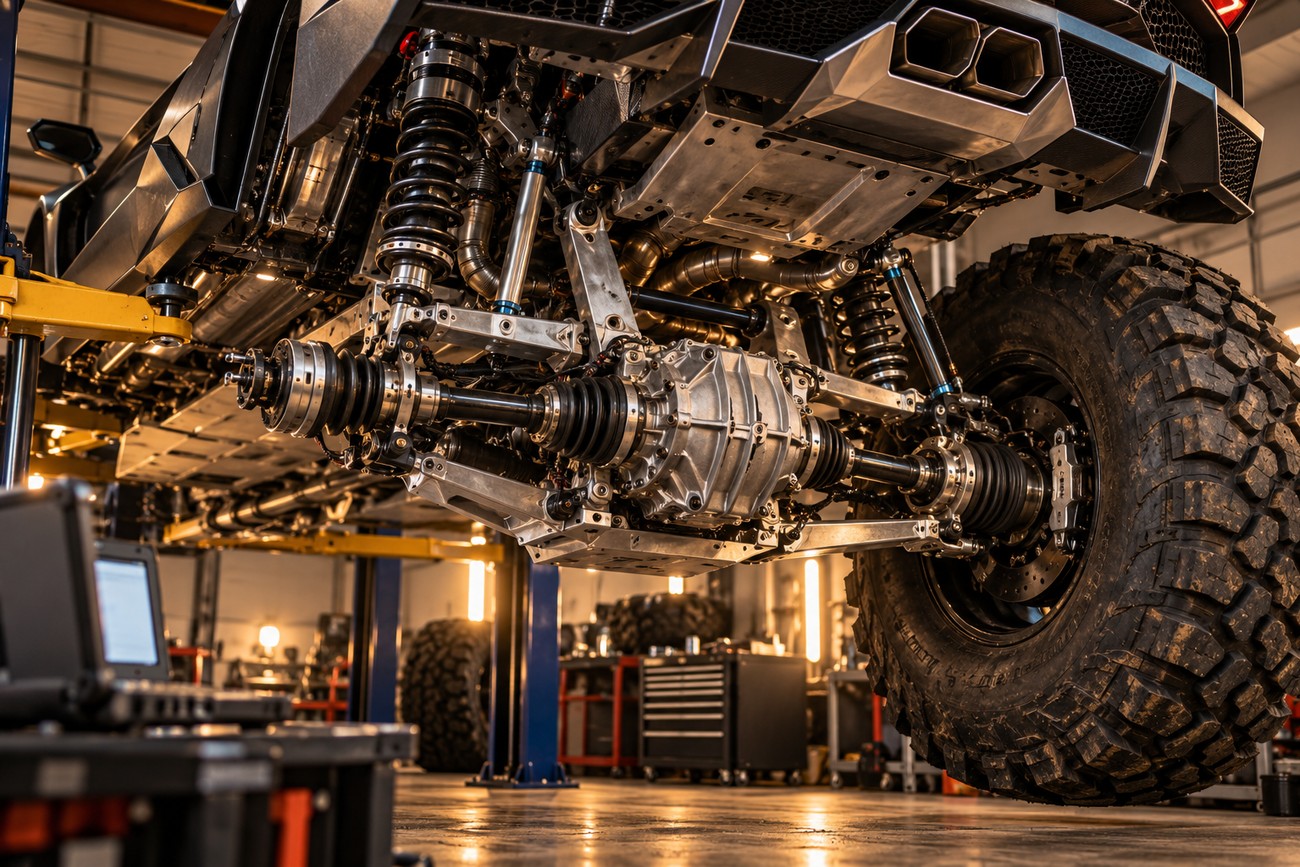
A larger tire acts like taller gearing unless the drivetrain is redesigned around it. That can reduce acceleration at the wheel, especially from rest, while the heavier tire also requires more torque to accelerate its rotational mass. The final effect depends on the complete build, including tire construction, wheel mass, transmission behavior, and available reduction.
Suspension lift changes driveshaft and half-shaft angles. Excessive CV-joint angles can produce vibration and heat, then accelerate wear or cause premature CV-joint and axle failure. Increasing suspension travel without relocating mounting points or checking joint articulation creates a predictable inspection priority, even if the vehicle appears to drive normally on smooth ground.
Retaining all-wheel drive may be sensible for traction, but it does not automatically make the conversion reliable. A specialized build could investigate additional reduction or portal-style solutions, yet those systems are custom engineering choices with their own structural, packaging, lubrication, and unstrung-mass consequences. They are possibilities for a high-budget design, not standard bolt-on requirements.
Wheel-speed sensors and control software also need attention. Major tire-diameter changes can disrupt ABS and stability-control behavior because the systems interpret wheel-speed differences and vehicle motion through their existing calibration. The finished configuration needs validation, including controlled braking and handling tests, before road or off-road use is treated as predictable.
Brakes, steering, and cooling face different loads
Heavier wheels and tires increase the work required to slow the vehicle and add inertia to every steering input. The steering may feel slower or less informative, especially if the new offset increases scrub or places more leverage on the steering system. A visually wide stance can therefore create heavier steering and higher loads at the same time.
Brake performance should be evaluated as a complete system. Larger rotating mass changes the energy the brakes must manage, while off-road debris and low vehicle speed can reduce cooling airflow. A conversion should therefore address rotor and caliper capacity, brake-bias behavior, ducting, heat measurement, and the interaction with ABS rather than assuming that the original road system remains suitable.
Engine cooling faces a similar problem in dirt or sand. Slow movement through loose terrain can combine high engine load with limited airflow, and contamination can reduce the effectiveness of cooling surfaces. Cleaning access, shielding, airflow management, and monitoring are practical requirements for a working build.
The underside also needs protection. Steering links, half-shafts, housings, brake lines, and other vulnerable components can meet rocks or packed dirt once the car leaves the road. Skid protection must be strong enough to protect those parts without creating new heat traps, excessive weight, or interference with suspension movement.
Aventador Bigfoot problems: symptoms, causes, and checks
Post-conversion symptoms should be treated as clues rather than automatic diagnoses. Each one needs inspection and measurement because several changes can create similar behavior.
| Reported symptom | Plausible engineering cause | Diagnostic check | Design response |
|---|---|---|---|
| Poor acceleration | Larger tires changed effective gearing, while added rotational mass increased the torque demand. | Compare wheel and tire mass, effective rolling circumference, drivetrain data, and launch behavior. | Reassess tire and wheel selection, gearing, and available reduction. |
| ABS or stability-control faults | Major tire-diameter changes altered wheel-speed relationships and control-system assumptions. | Read fault data, compare sensor speeds, and validate braking and stability behavior in a controlled area. | Calibrate or re-engineer the control strategy and confirm the result with testing. |
| Vibration, heat, or damaged CV joints | Excessive joint angles or insufficient articulation created harmful operating conditions. | Measure joint angles through compression, rebound, and steering movement; inspect boots, grease, and heat marks. | Revise mounting points, limit travel where necessary, or redesign the axles and joints. |
| Edge-worn tires | Lift-related alignment changes or inadequate control of suspension travel altered the contact patch. | Measure caster, camber, toe, and tire temperatures; inspect wear after controlled use. | Correct geometry and alignment for the actual tire and operating range. |
| Suspension impacts on bumps | Insufficient compression travel, unsuitable bump stops, or poor damper and spring selection. | Check witness marks and travel limits, then inspect movement under load. | Rework travel, dampers, springs, bump stops, and mounting geometry. |
| Low-speed overheating | Dirt or sand restricted airflow while low vehicle speed reduced cooling capacity. | Monitor engine and brake temperatures during sustained low-speed operation and inspect contamination. | Improve airflow, shielding, filtration, cleaning access, and thermal monitoring. |
The table describes investigation paths, not confirmed faults on a particular car. A build that shows one symptom may have several interacting causes, especially when tire mass, alignment, electronics, and cooling were changed at the same time.
Testing should reproduce the conditions that expose the problem. A short road drive may miss CV-joint heat, brake temperature, or cooling restrictions that appear during repeated low-speed work on dirt or sand.
Safety and road legality may decide where it can drive
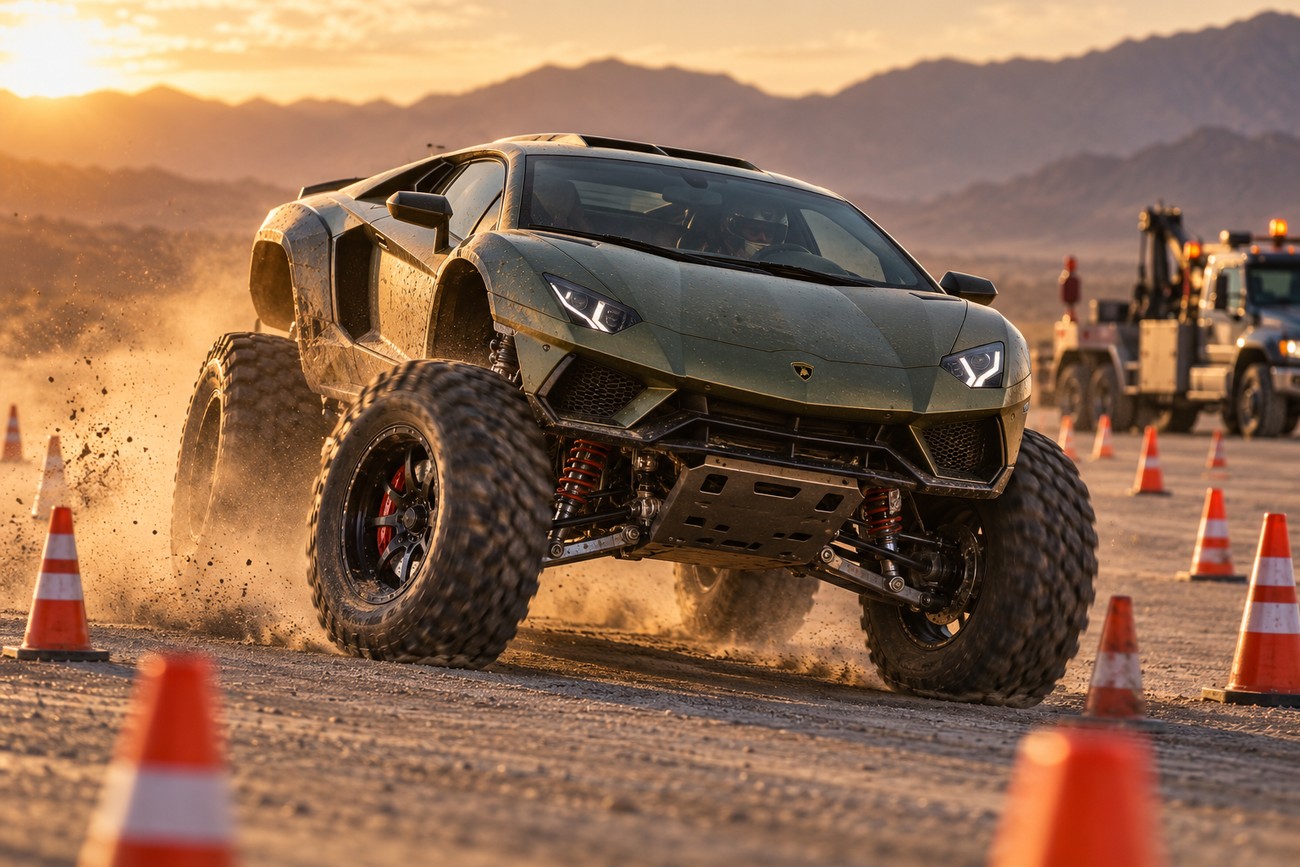
A radical lift raises the center of mass and changes the vehicle’s handling. During an emergency maneuver, the taller vehicle can lean more and transfer load differently between the tires. The risk of rollover can increase, particularly if the build combines a high body, heavy wheels, wide track changes, and abrupt steering inputs.
High-speed behavior also changes. The altered ride height and body exposure can reduce aerodynamic effectiveness and stability, while larger tires may make steering less precise. A conversion designed for a slow demonstration environment should not be assumed to retain the stock Aventador’s road behavior.
Road approval depends on the jurisdiction and the completed vehicle. Suspension height, track width, lighting position and visibility, bumper height, braking performance, registration, and insurance can all become separate requirements. A technically functional build may still need inspection, documentation, or restricted use if it no longer matches the original vehicle configuration.
Insurance deserves early attention because the conversion changes the risk profile and may affect coverage. The owner should confirm the requirements before fabrication is complete, then retain records of component specifications, testing, and any approval work. That approach is more reliable than treating legality as a final paperwork step.
What a credible build plan would include
A credible project begins by defining the operating envelope: static display, private-property driving, limited dirt use, or repeated off-road work. That choice determines acceptable speed, suspension travel, protection, cooling demand, and testing depth. It also prevents a show-car specification from being mistaken for a working off-road specification.
The next stage establishes tire and chassis packaging before parts are ordered. Designers need to map steering lock, compression, rebound, bump stops, body clearance, wheel offset, track width, and brake compatibility. From there, suspension and driveline geometry can be engineered around the actual wheel and tire rather than around a visual mock-up.
Braking, steering, cooling, electronics, and underbody protection should be developed as one system. The power available from an Aventador does not remove the need for suitable gearing or component strength, while all-wheel drive does not remove the need to manage joint angles and wheel-speed calibration. A radical lift must also be checked for its effect on emergency handling and stability.
Validation should cover alignment, full-travel interference, brake temperatures, engine temperatures, wheel-speed data, vibration, and repeated off-road loads. Custom fabrication, calibration, testing, registration, and insurance can dominate the budget beyond the cost of tires and suspension. A visually convincing show car may be complete when it looks right; a credible working build is complete only after its systems have been tested for the conditions it is meant to face.
Frequently asked questions
The questions below address the project’s cost, transport, value, performance, and practical limitations. The answers depend on the vehicle’s specification and intended use. A proposed conversion should be assessed as an engineered system rather than as a visual modification alone.
How much would an Aventador Bigfoot build cost?
There is no defensible total without a defined specification and a verified donor vehicle. A quote request should identify the donor’s condition, intended terrain, tire and wheel package, target ride height, suspension travel, driveline strategy, brake requirements, cooling changes, electronics calibration, protection, testing, and approval work.
Fabrication and validation can change the scope substantially once interference, joint angles, heat management, or control-system faults appear. Any credible estimate should separate design, parts, fabrication, calibration, testing, transport, registration, and insurance-related work rather than treating the project as a tire-and-suspension purchase.
How would an Aventador monster truck get to an event?
The finished vehicle should be measured for overall width, height, length, wheel clearance, and loading angle before a trailer is selected. The plan also needs suitable ramps, tie-down points, loading access, and enough clearance for the altered underside and bodywork.
Route restrictions may apply to the trailer and the loaded vehicle, including height limits, width limits, bridge access, and event-site entry rules. A build that fits the trailer may still be difficult to unload if the venue lacks a level approach or suitable equipment.
How much is a Bigfoot monster truck worth?
Value depends on the specific vehicle, its build quality, documentation, competition or display history, condition, and legal status. There is no single reliable value for a generic Bigfoot-style truck, and a proposed Aventador conversion should not be assigned a market price without a verified finished vehicle and comparable sales.
What is the cheat code for Lamborghini monster truck?
There is no shortcut that turns an Aventador into a reliable monster truck. The closest practical formula is to define the use, package the tires, engineer suspension and driveline geometry, upgrade protection and cooling, calibrate the electronics, and test the finished vehicle before relying on it.
Which car can beat the Lamborghini Aventador?
That depends on the test: acceleration, braking, cornering, off-road traction, or a specific surface. A vehicle designed for one of those tasks can outperform an Aventador in that environment, while a modified Aventador Bigfoot would introduce different compromises in gearing, mass, stability, and handling.







