
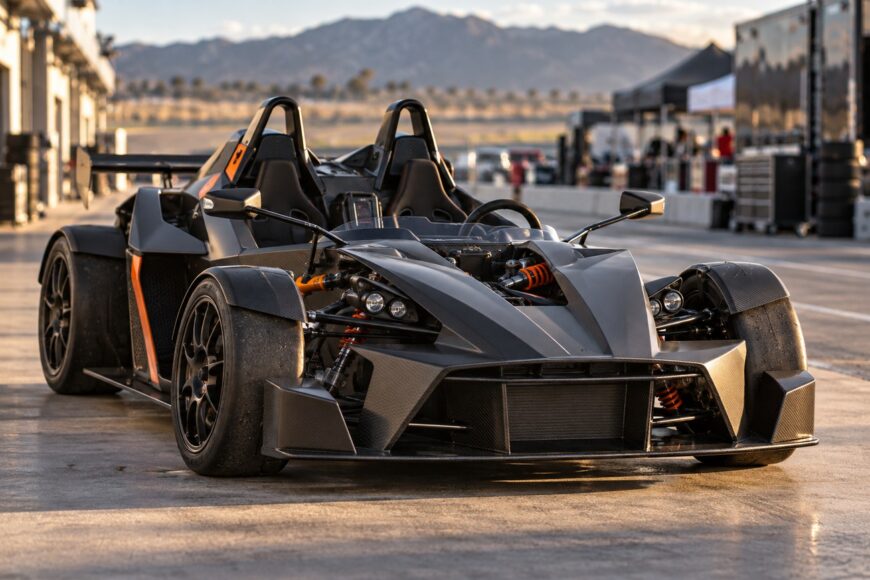
KTM is best known for motorcycles, yet the X-Bow is a purpose-built sports car with a carbon-fiber monocoque, rear-wheel drive, and Audi-sourced automotive power. Its motorcycle-brand identity explains the aggressive design language, but the engineering is fundamentally four-wheeled and car-based.
The central appeal is direct track feedback with very little mass between you and the road. That same focus limits comfort, weather protection, storage, and daily usability. An open early X-Bow and a roofed GT-XR may share a name, but they do not deliver the same weight, power, aerodynamic behavior, or ownership experience.
Published specifications therefore need careful handling. Across the range, cited mass figures span approximately 790–1250 kg, while power outputs run from an early 237-hp four-cylinder to figures above 500 hp in later five-cylinder versions. Treat the model badge as a starting point, then verify the exact car.
- What the KTM X-Bow Actually Is
- KTM X-Bow Versions: What Changes Between Them
- Engines, Performance, and Why Weight Matters More Than the Badge
- The Ownership Reality: Track Weapon, Difficult Road Car
- Buying Mistakes and Hidden Costs to Check Beforehand
- KTM X-Bow Myths That Distort the Buying Decision
- Frequently asked questions
- How much does a KTM X-Bow car cost?
- What is the average price of a KTM X-Bow?
- What should insurance cover on a carbon-monocoque X-Bow?
What the KTM X-Bow Actually Is
The KTM X-Bow is a lightweight sports car, not a motorcycle on four wheels. Its low seating position, exposed suspension, and open bodywork can create that impression, but the vehicle uses an automotive chassis, automotive controls, and automotive powertrains. The concept is closer to a road-legal track car than to a conventional performance coupe.
Early X-Bow versions used a carbon-fiber monocoque. This structure provides a stiff safety cell while helping keep mass low, which is central to the car’s sharp response. It also changes the financial risk of ownership: damage to the structural tub is a specialist repair problem rather than a routine body-shop job.
The engines are sourced from Audi rather than derived from KTM motorcycle units. Depending on the version, the X-Bow uses a 2.0-liter Audi turbocharged four-cylinder or a 2.5-liter Audi turbocharged five-cylinder. Rear-wheel drive is explicitly specified for the RR, and rear-drive behavior is a defining part of the car’s track-focused character.
Body configuration separates the versions more clearly than the KTM badge suggests. Early cars are open and provide little protection from weather, while GT and GT-XR versions can include a windshield, side windows, and a roof. That extra equipment improves road usability, but it also adds mass and moves the car away from the uncompromising feel of the original open design.
KTM X-Bow Versions: What Changes Between Them
The following comparison is a guide to the published version differences, not a universal specification sheet. Equipment, engine calibration, and customer-selected packages can alter the final car.
| Version | Body configuration | Approximate mass | Engine family | Published output | Intended use |
|---|---|---|---|---|---|
| Early X-Bow | Open cockpit with minimal weather protection | Approximately 790 kg in cited lightweight configurations | 2.0-liter Audi turbocharged four-cylinder | 237 hp and 310 Nm cited for early versions | Track-focused road car |
| GT | Windshield, side windows, and more road-oriented equipment | Higher than the lightest open cars; exact figure varies by specification | 2.0-liter Audi turbocharged four-cylinder | Published figures vary; later 2.0-liter versions are cited at 300 hp and 400 Nm | More usable on the road while retaining track intent |
| RR | Race-oriented configuration with specification-dependent equipment | Varies with ordered package and equipment | 2.0-liter Audi turbocharged four-cylinder | Depends on engine and equipment specification | Competition and serious track use |
| GT-XR | Roofed road-oriented body with windshield and side windows; almost entirely carbon-fiber exterior panels | Up to approximately 1250 kg in published lineup figures | 2.5-liter Audi turbocharged five-cylinder | 500 hp and 581 Nm cited; some publications cite 530 hp and 649 Nm | Extreme road-legal architecture with strong track bias |
The mass range across X-Bow versions is approximately 790–1250 kg. That is too broad for a single “X-Bow weight” figure to be useful. A lightweight open car and a heavily equipped GT-XR will respond differently to braking, turn-in, tire changes, and aerodynamic load.
The GT adds genuine road equipment rather than merely a cosmetic screen. Windows, a windshield, and a roof make longer journeys more realistic, yet they also bring additional mass and alter the atmosphere of the car. The GT-XR goes further with a carbon monocoque and almost entirely carbon-fiber exterior panels, while retaining an architecture that remains fundamentally extreme.
RR and special-version data require particular caution. The ordered engine and equipment package can affect the final characteristics, so a buyer should inspect the build sheet, registration documents, and technical records instead of assuming that every car carrying the same badge shares identical output or mass.
Engines, Performance, and Why Weight Matters More Than the Badge
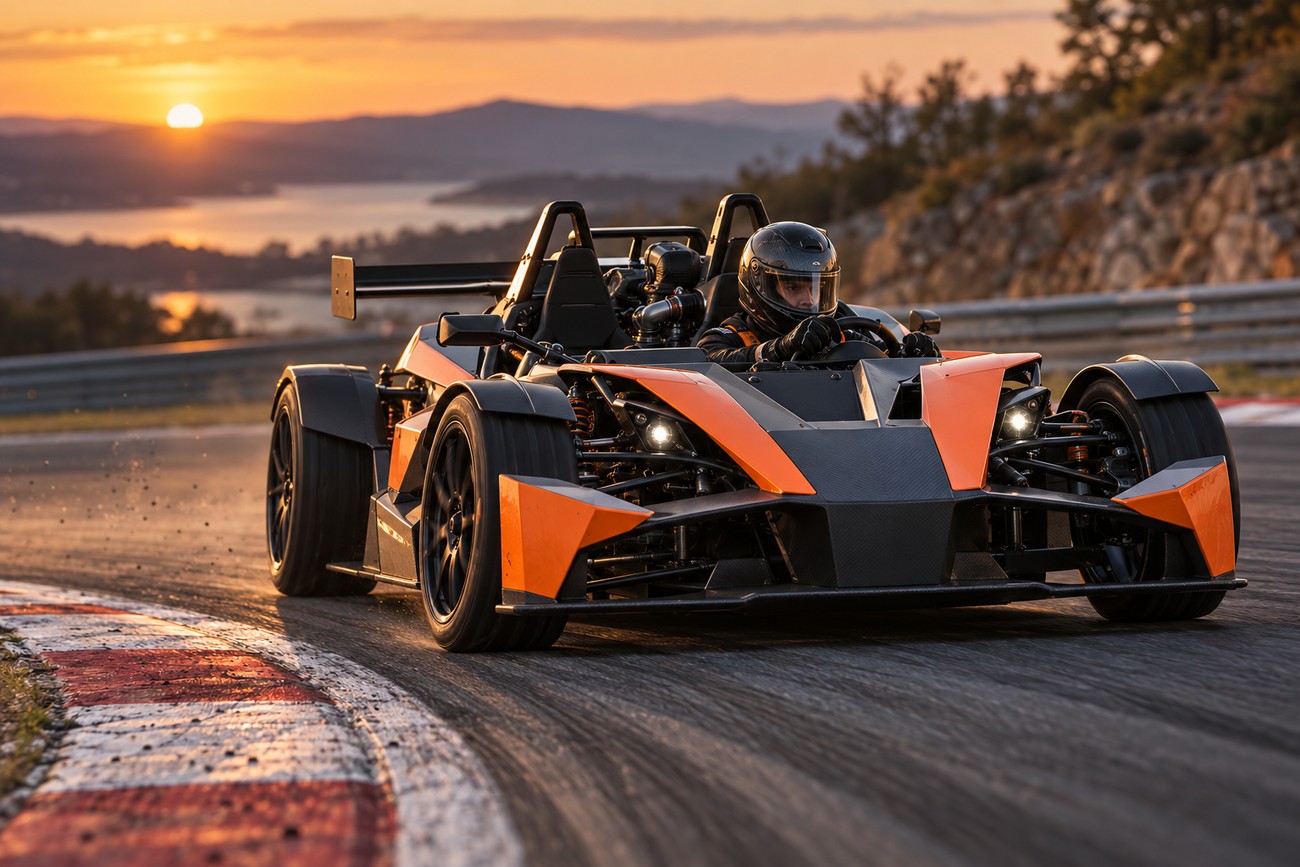
Early X-Bow performance figures are often quoted with a 2.0-liter Audi turbocharged engine producing 237 hp and 310 Nm. That combination is significant because the early car’s low mass allows modest power to produce a serious track response. A published 0–100 km/h time for an early X-Bow is 3.9 seconds, although acceleration figures depend on the exact version and test conditions.
Later 2.0-liter versions are cited at 300 hp and 400 Nm. The higher output changes the balance of traction, tire demand, and driver workload, especially in a car with little isolation from the mechanical events at each corner. A GT example is commonly listed at 0–100 km/h in 4.1 seconds, demonstrating why a heavier, more road-equipped version should not be compared directly with the lightest open car.
The GT-XR moves to a 2.5-liter Audi turbocharged five-cylinder. One published specification gives 500 hp and 581 Nm, while other publications covering GTX or GT-XR cars cite 530 hp and 649 Nm. These figures should remain labeled as alternative published specifications; they may reflect different calibrations, packages, or reporting conventions rather than one definitive output for every car.
Published acceleration examples include 3.9 seconds for an early X-Bow, 4.1 seconds for the GT, and 3.4 seconds for the GT-XR. The differences cannot be explained by horsepower alone. Mass, traction, gearing, tires, aerodynamic configuration, and launch conditions all influence the result, and the GT-XR’s approximately 280 km/h top speed belongs to that specific high-performance configuration.
For track use, the more useful question is how the car maintains speed through a sequence of corners. A lighter X-Bow generally asks less of its brakes and tires, changes direction with less inertia, and communicates load more directly. A more powerful or more heavily equipped version can be faster on a suitable circuit, but it also demands more from consumables and from the driver’s ability to manage traction.
The Ownership Reality: Track Weapon, Difficult Road Car
The X-Bow’s road manners are shaped by its track purpose. The ride is firm, the seating position is low, and the cabin provides little of the isolation expected from an ordinary sports car. On smooth pavement that focus can feel precise and rewarding; on poor roads it can become tiring quickly.
Weather protection varies sharply by version. Early open cars leave occupants exposed to rain, wind, and road spray, while GT and GT-XR versions provide a windshield, side windows, and a roof. The enclosed versions are more practical for road use, but they do not turn the X-Bow into a conventional grand tourer.
Entry and exit are part of the ownership decision, not a minor inconvenience. The low seat and race-oriented packaging require a deliberate movement over the body structure, which can be awkward in tight parking spaces or when the roof and doors limit access. Storage is also limited, so even a short trip requires more planning than it would in a normal performance car.
Purchase and running costs can resemble those of an exotic sports car. Specialized parts, track-oriented tires, brakes, inspection requirements, and carbon-fiber components all affect the budget. The car makes the most sense when its owner has access to suitable track conditions and accepts that routine urban driving uses only a small part of its capability.
Road equipment creates a genuine trade-off. Added glass, weather sealing, and interior equipment make the car easier to use, but they increase mass and can dilute some of the original open-car purity. That does not make the GT or GT-XR inferior; it makes them different tools for owners who value access to public roads as well as track performance.
Buying Mistakes and Hidden Costs to Check Beforehand
The first mistake is treating the X-Bow as a normal daily sports car. A test drive around town may reveal the difficult ride, awkward access, limited storage, and weather exposure, but it cannot show whether the car suits the buyer’s intended track use. Before purchase, define the actual role: occasional circuit work, competition, weekend road use, or collection.
The second mistake is combining specifications from different versions. A quoted mass from an early open car, power from a later 2.0-liter model, and acceleration from a GT-XR do not describe one vehicle. Confirm the model year or version, engine calibration, transmission, aerodynamic package, body equipment, and recorded mass for the individual example.
Cosmetic carbon-panel damage and structural carbon-tub damage must be assessed separately. A low purchase price can become poor value if the monocoque requires specialist repair or replacement.
The carbon-fiber monocoque deserves particular attention after any accident or heavy impact. Exterior panels may be replaceable without structural consequences, while damage to the tub can require specialist inspection and substantially change the repair economics. A pre-purchase assessment should therefore include the chassis structure, suspension mounting areas, and evidence of previous repairs.
Do not assume that every RR or special version has the same engine output. Some characteristics depend on the customer’s ordered engine and equipment package. The build sheet, factory documentation, service history, and inspection of the installed hardware are more reliable than a generic online listing.
Finally, check whether the car’s tires, brakes, alignment, and aerodynamic parts match the intended use. The X-Bow needs appropriate track conditions and an experienced driver to exploit its abilities safely. Buying the most powerful specification without the necessary circuit time, consumables budget, or driving discipline can produce a slower and more expensive ownership experience than choosing a lighter, simpler car.
KTM X-Bow Myths That Distort the Buying Decision
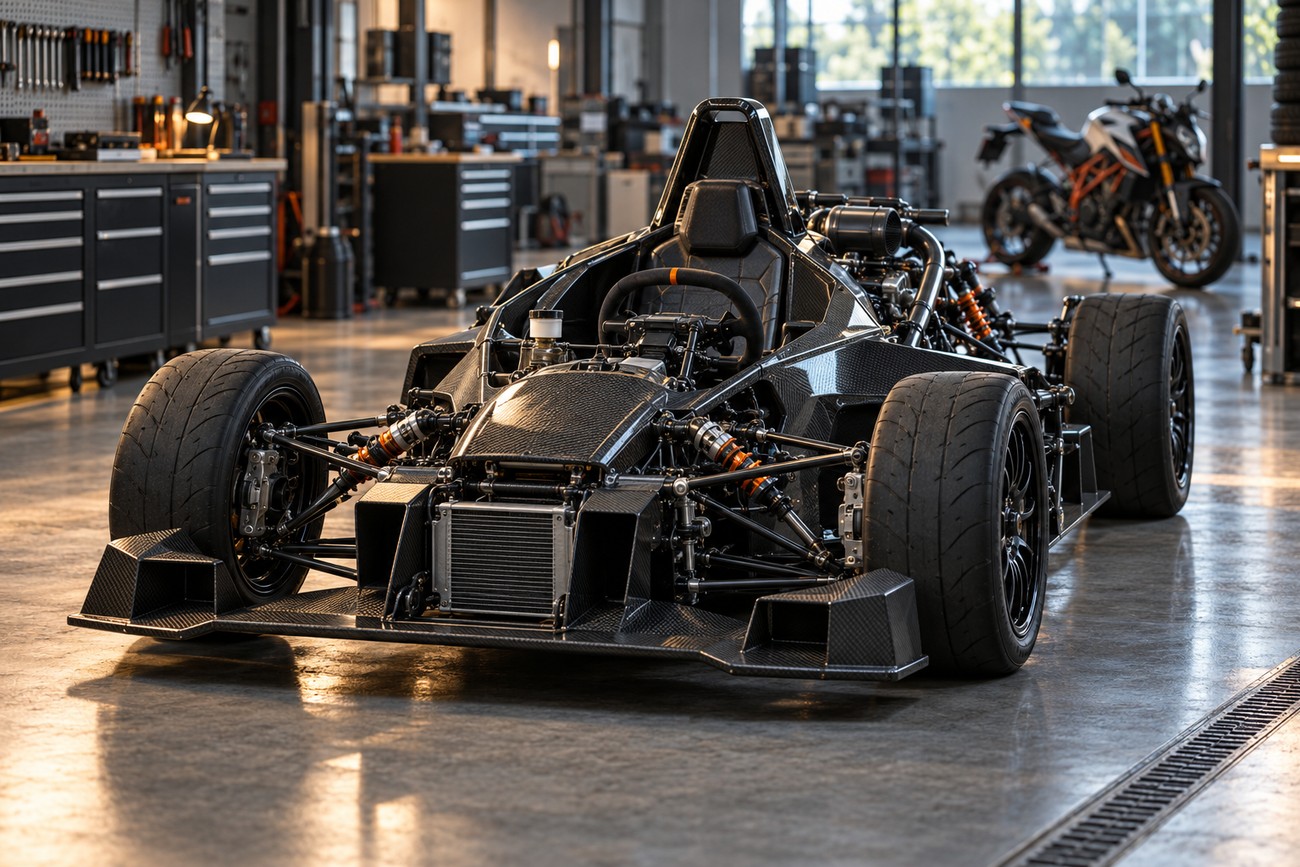
The claim that the X-Bow is a “motorcycle on four wheels” is useful as a description of its attitude, but inaccurate as a technical classification. It is a lightweight sports car with an automotive carbon monocoque, automotive seating layout, and Audi powertrain. KTM’s motorcycle background is part of the identity, not the basis of the vehicle’s mechanical design.
The idea that every X-Bow weighs around 700 kg is also misleading. Published figures across the range span approximately 790–1250 kg, depending on the version and equipment level. The difference changes braking behavior, cornering response, tire demand, and the amount of effort required to make the car feel agile.
Open-cockpit assumptions are equally outdated. Early cars offer little weather protection, but GT and GT-XR versions can have a windshield, side windows, and a roof. Those features improve road usability while adding mass, so buyers should inspect the actual body configuration rather than infer it from photographs of another X-Bow.
There is no single X-Bow engine or power figure. The range includes a 2.0-liter Audi turbocharged four-cylinder and a 2.5-liter Audi turbocharged five-cylinder. Published outputs range from approximately 237 hp to 530 hp depending on version and source, with the higher figures requiring careful qualification rather than being applied to every car.
Frequently asked questions
How much does a KTM X-Bow car cost?
There is no universal KTM X-Bow price. The appropriate comparison depends on the specific version, market, condition, mileage, service history, and equipment, with an early open car occupying a different value bracket from a road-equipped GT or a GT-XR.
To compare asking prices, first group cars by version and engine, then check included equipment, carbon-body condition, documented maintenance, and road-registration status. Adjust the comparison for track use, accident history, and specialist inspection costs rather than treating the lowest advertised figure as the best value.
What is the average price of a KTM X-Bow?
A meaningful average is difficult because early open cars, road-going GT versions, race-oriented cars, and GT-XR examples are substantially different products. Combining them into one number would hide the specification differences that have the greatest effect on value.
Use a range of comparable cars instead. Separate open and roofed versions, identify the engine and equipment package, and compare mileage and condition within that group. This approach gives a more useful market reference than an average built from the entire X-Bow nameplate.
What should insurance cover on a carbon-monocoque X-Bow?
Insurance should address both ordinary body-panel damage and structural carbon-monocoque damage, because the repair process and financial consequences can differ substantially. Confirm whether the policy recognizes specialist carbon-tub inspection and repair, rather than limiting coverage to conventional panel replacement.
Ask the insurer what documentation is required after an impact, which repair facilities are approved, and whether a structural inspection is mandatory before the car returns to use. Also clarify track-day coverage separately: road insurance may exclude circuit driving, and a carbon-tub claim can affect valuation, repair authorization, and future insurability.







