

A 1,600-hp hypercar meeting a soft sand dune is a mismatch between engine output and ground physics. The Jesko can produce extraordinary acceleration on a prepared surface, yet sand demands flotation, clearance, suspension movement, and controlled tire deformation. Power alone can make the tires dig faster.
Asphalt aerodynamics do not solve those problems. There is no confirmed factory dune-specific configuration or universal safe tire-pressure figure for a Jesko running Michelin Pilot Sport Cup 2 or Cup 2 R tires. The assessment here is therefore based on verified Jesko hardware and established sand-driving physics, not a claim of tested dune capability.
What the Jesko Brings—and What It Does Not
The Jesko Attack uses a 5.0-liter twin-turbo V8 connected to a 9-speed Light Speed Transmission (LST). Koenigsegg lists 1,280 hp on gasoline and 1,600 hp on E85, with the higher figure requiring compatible fuel and suitable regional availability. That output gives the car a large reserve of wheel torque, but it does not create traction on loose sand.
Its factory tire model is Michelin Pilot Sport Cup 2, with Cup 2 R available as an option. Sizes are 265/35 R20 at the front and 325/30 R21 at the rear. These are road-track tires with low-profile construction, rather than tires designed to spread the vehicle’s weight across soft sand.
A ground-clearance figure of approximately 100 mm appears in a secondary reference, not in Koenigsegg’s official specification. It should therefore be treated cautiously. Even that approximate figure indicates little tolerance for dune crests, buried rocks, or a soft surface that allows the chassis to settle.
The Jesko’s hardware is optimized for road performance, braking, and high-speed control. No confirmed factory dune configuration or recommendation is established in the available evidence. That distinction matters: a road-legal hypercar may reach sand, but it is not thereby approved or engineered for repeated dune use.
Why Sand Reverses the Hypercar Advantage
Sand rewards a large, lightly loaded contact patch. A useful approximation is p ≈ W/A, where p is ground pressure, W is vehicle weight, and A is the contact area. Increasing A reduces pressure and can limit sinking, while a narrow or heavily loaded tire cuts into the surface and increases rolling resistance.
Lowering tire pressure generally lengthens the contact patch more than it widens it, depending on the tire carcass and sidewall. Cup 2 and Cup 2 R tires have stiff, low-profile sidewalls, so they offer less controlled deformation than dedicated sand tires. Their construction also gives limited protection against hidden stones, compacted crust, and sharp dune edges.
The Jesko’s reported low clearance and road-focused suspension leave little room for the surface to move beneath the car. Once the underbody drags, wheel traction becomes almost irrelevant: the chassis acts as an anchor, and the car may stop before the tires have fully lost grip.
Downforce does not provide low-speed flotation. Aerodynamic load depends on speed, and at typical dune speeds it may be limited; any additional vertical load that is generated also increases W in the pressure equation. An aerodynamic advantage on asphalt can therefore become extra load on sand without producing useful support.
Tire Pressure, Throttle Control and the Cost of a Mistake
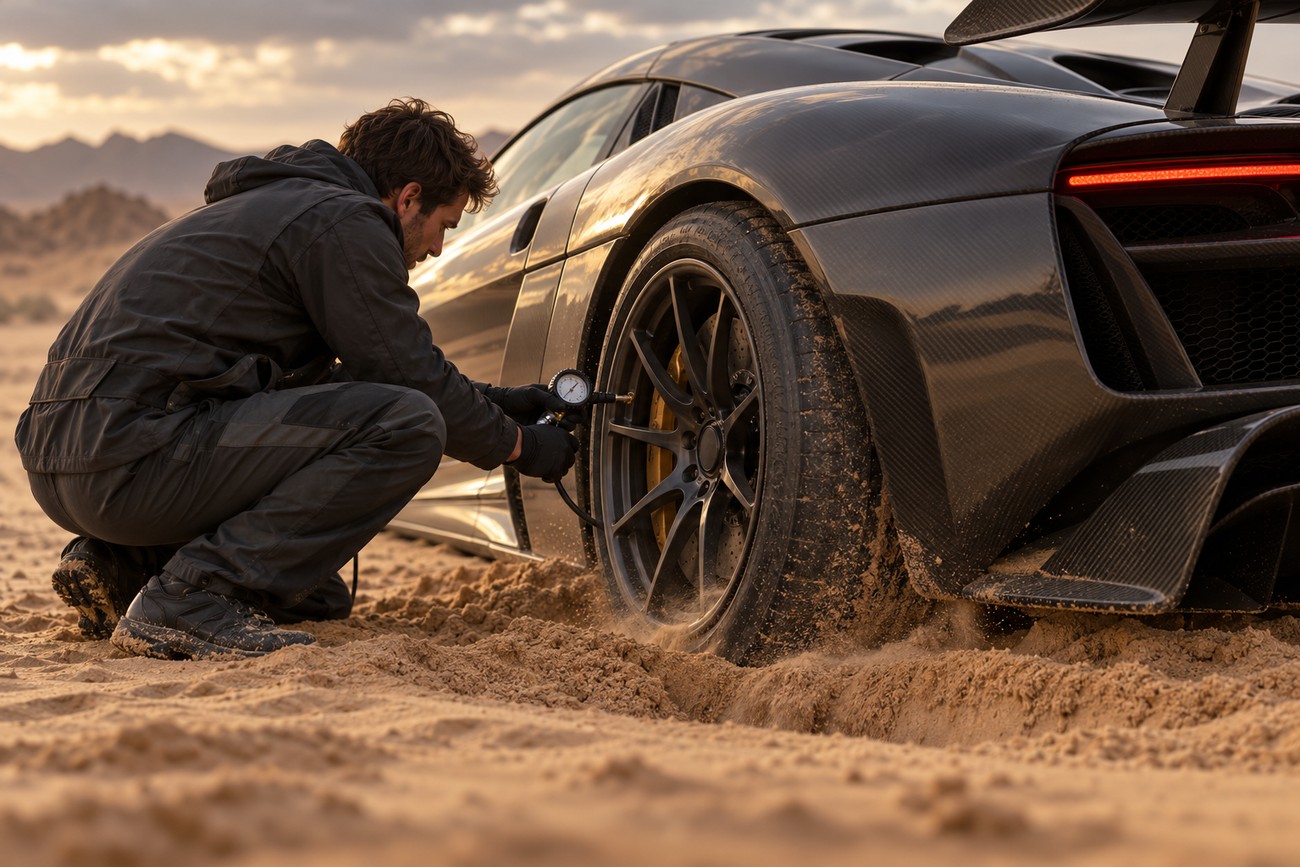
General off-road guidance often starts around 15–20 psi, while some soft-sand guides suggest 12–15 psi. Those figures apply to typical off-road vehicles and cannot be treated as a safe allowance for Cup 2 or Cup 2 R tires on a Jesko. There is no universal or factory-confirmed safe PSI for this combination.
Going below roughly 10–12 psi can increase bead-unseating risk on standard wheel-and-tire setups, although this is general guidance rather than a Jesko-specific factory limit. Excessive deflation can also let the rim strike an obstacle, overload the sidewall, or damage the tire during steering. The car’s mass cannot be compensated for by simply removing more air.
Pressure selection depends on tire construction, wheel security, vehicle load, sand condition, temperature, and the risk of recovering the car. Copying one PSI number from an off-road guide ignores the component that may fail first.
Throttle technique is equally important. Abrupt acceleration can overwhelm the available surface shear strength, spin the tires, and excavate holes beneath the driven wheels. Smooth torque delivery and continuous momentum are preferable; stopping, reversing direction, or turning sharply on a steep soft slope increases the chance of burying the car.
The practical exit plan must include a pressure gauge, recovery equipment, and a safe route back to firm ground. Tire pressure must be restored before returning to asphalt. Driving there with deflated tires can impair steering response, heat control, and stability, while raising pressure without checking for damage can conceal a developing failure.
Failure Points: Tires, Wheels, Cooling and Warranty
The Jesko’s factory sizes—265/35 R20 front and 325/30 R21 rear—leave relatively little sidewall between the rim and the terrain. A hidden rock or hardened sand crust can cut a sidewall or damage the wheel before the driver sees the obstacle. A sharp dune lip can also produce a suspension or underbody strike even when the tires remain inflated.
Wheel choices include forged aluminum or optional carbon Aircore wheels. The design uses a central locking nut and TPMS, which are valuable features for road operation and monitoring. TPMS can report pressure loss, but it cannot prevent a sidewall cut, bead unseating, rim damage, or overheating.
Sand and dust can reach radiators, brake components, seals, and moving parts. Abrasive contamination may become a maintenance issue after the drive, even if the car completes the route. Cooling airflow and brake performance that work reliably on clean pavement should not be assumed to remain unaffected in a dusty convoy or during repeated low-speed load.
Central-lock hardware and carbon wheels also make field repairs more specialized and potentially more costly. No confirmed factory dune-use recommendation is available in the supplied evidence, so warranty and service consequences must be checked against the official terms for the individual car and market.
Frequently asked questions
The Jesko’s performance figures do not establish its suitability for soft sand. Its tires, clearance, suspension, and recovery requirements matter as much as its engine output. The following answer separates vehicle classification from raw power.
What is the fastest dune buggy in the world?
There is no single universal title without defining the course, surface, timing method, and vehicle class. A purpose-built sand racer, a trophy truck, and a modified buggy may be fastest in different conditions, so a headline claim requires a specific record and test definition.
The Jesko should not be classified as a dune buggy because it has extreme power. It is a road-legal hypercar built around road and track performance. Its 1,600-hp E85 output, low-profile tires, limited clearance, and road-focused systems do not establish dune capability.







