
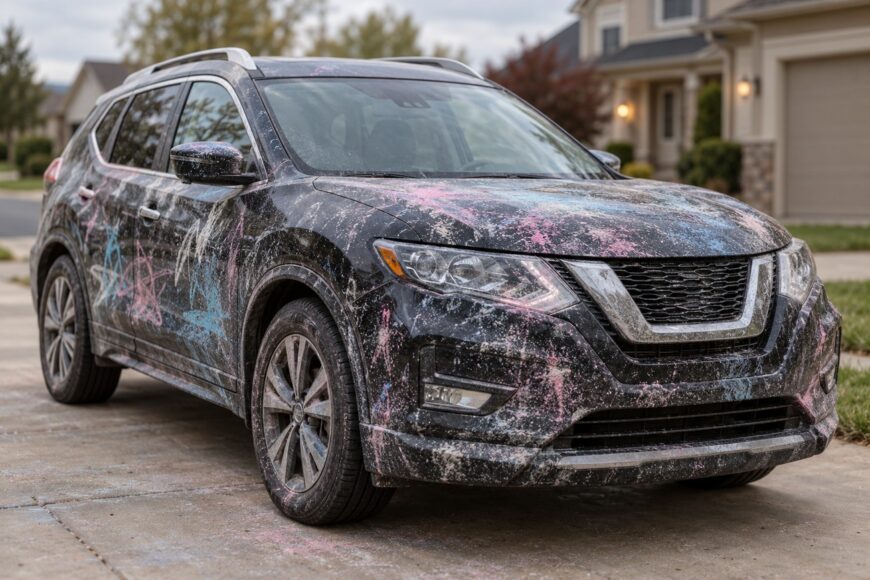
Sidewalk chalk across a Nissan Rogue can look like a permanent stain, especially after the colored powder dries into a dull white, blue, or pink film. That appearance does not automatically mean the clear coat has been damaged. The greater immediate risk often comes from trying to remove the mark by rubbing dry particles across the paint.
The safest choice is to soften and rinse first, then wash gently with mild automotive soap. Sidewalk chalk formulas vary by brand, and the Rogue’s finish may already have scratches, oxidation, repairs, or a nonstandard surface. The result can also be affected by sand, marker, wax, road grime, or another substance mixed with the chalk.
- What Sidewalk Chalk Can Do to a Nissan Rogue’s Finish
- The Safest First Response: Rinse Before You Touch It
- Step-by-Step Chalk Removal From Rogue Paint and Trim
- What Not to Use—and Why Common Shortcuts Backfire
- If the Chalk Leaves a Colored Haze or Streak
- How to Handle the Situation Without Making It Worse
- Frequently asked questions
- How can I tell whether the mark is on the clear coat or only sitting on top?
- What should I do before touching sidewalk chalk on the Rogue?
- When should I ask a professional to inspect the mark?
What Sidewalk Chalk Can Do to a Nissan Rogue’s Finish
Once sidewalk chalk dries, its powder can settle into the texture of a clear coat, trim, panel gaps, and surface scratches. Moisture disappears, leaving pigment and mineral particles that can look bonded to the vehicle. A dry film may therefore appear more serious than it is, even when it is sitting on top of the finish.
A visible white or colored haze is not proof of permanent clear-coat damage. It may be chalk residue, water spotting, transferred material, or dirt that became noticeable when the panel dried. Nissan does not promise that every foreign substance will disappear without a trace, so a remaining mark deserves assessment rather than an immediate conclusion that the paint is ruined.
Sidewalk chalk is not one uniform chemical product. Its formula varies by brand and color. Crayola Sidewalk Chalk safety data describes that product as nontoxic and compliant with ASTM D-4236, but that standard concerns the evaluation and labeling of art materials; it does not test compatibility with automotive clear coat.
The condition of the Rogue also matters. Intact factory paint may respond differently from an older, scratched, oxidized, matte, or poorly repaired finish. If the material includes marker, wax, sand, road grime, or someone else’s paint, a method chosen for ordinary chalk may not remove every component safely.
The Safest First Response: Rinse Before You Touch It
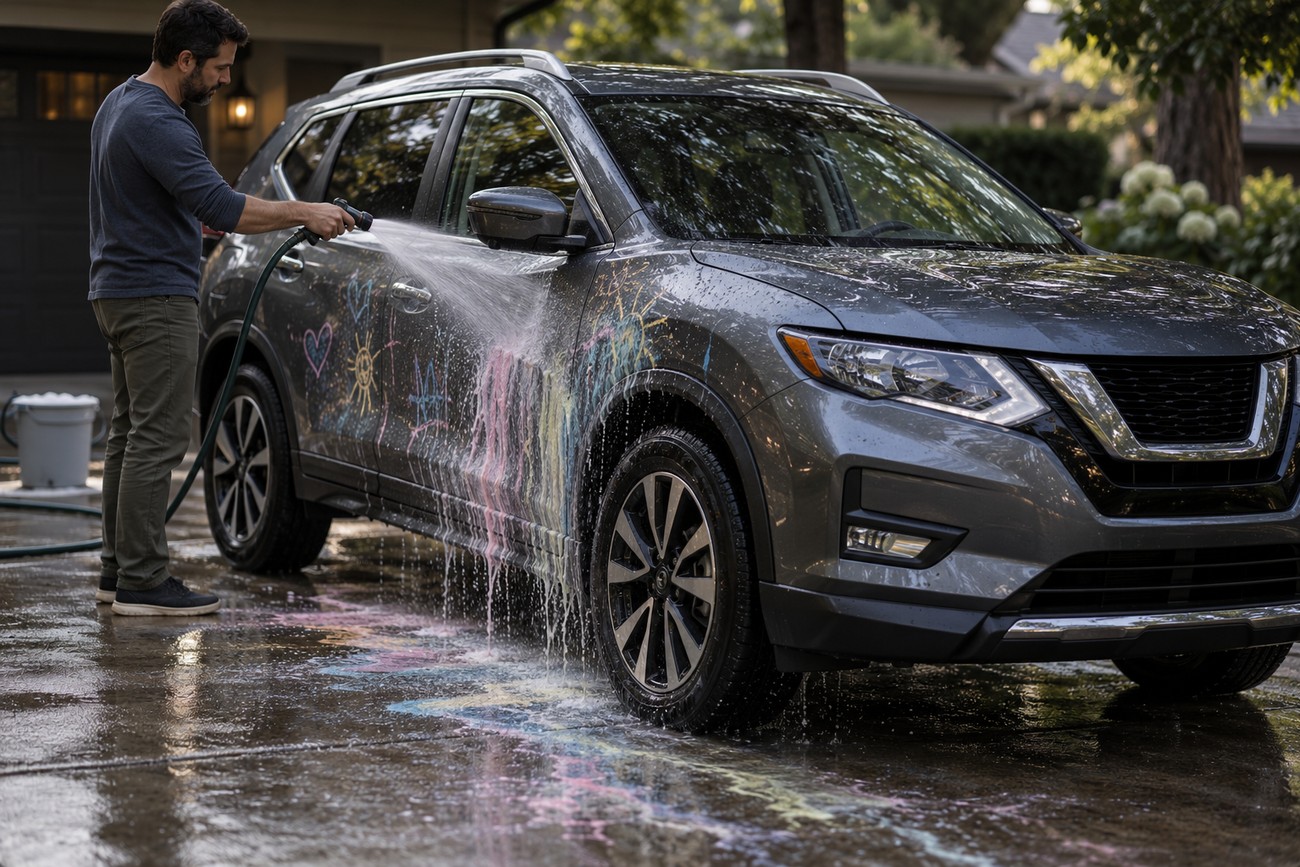
Move the Rogue into shade or a cooler location if practical, and remove the contamination as soon as possible. Nissan recommends plenty of water and mild automotive soap for exterior cleaning. Do not wash a hot vehicle or a hot body panel in direct sunlight, because water can dry quickly and leave spots.
Begin with a generous, low-contact water rinse. The purpose is to carry away as many loose chalk particles as possible before a cloth or sponge touches the panel. Direct the water across the surface rather than pressing a nozzle close to the paint, and allow the runoff to take loose powder away from clean areas.
After that first rinse, use mild automotive soap with a clean, soft microfiber. Work lightly and let the water and soap do the softening. Dry chalk should not be rubbed with a dry cloth or sponge: loose particles can act as an abrasive and create fine scratches across the clear coat.
Do not polish the panel while chalk particles remain. A polish, abrasive wax, plastic card, hard brush, or rough sponge can spread grit and turn a removable contaminant into visible surface damage. Removing the particles first is the important safety step, even if an owner’s forum suggests that water alone is enough; Nissan’s fuller guidance calls for plenty of water, mild automotive soap, and thorough rinsing.
Step-by-Step Chalk Removal From Rogue Paint and Trim
Once the loose powder has been rinsed away, prepare a bucket of mild automotive soap, plenty of clean water, and several soft microfiber towels. Start with a painted side panel and work in a small section rather than washing the entire vehicle at once. Small sections make it easier to see whether the chalk is lifting and prevent dirty water from drying on the finish.
- Rinse the selected section again with abundant water, especially around badges, seams, and panel edges.
- Use a clean, damp microfiber with mild automotive soap and glide it gently over the softened residue.
- Rinse the cloth frequently, and turn it to a clean side as soon as pigment or grit appears.
- Rinse the panel thoroughly before moving to the next section.
- Blot the surface or wipe it with a damp microfiber or chamois; do not let the rinse water air-dry on the Rogue.
Replacing or flipping the microfiber after each small section keeps loosened pigment and grit from being carried across the next panel, where they can act like fine abrasives.
Textured plastic moldings need patience because chalk can remain in their grain and around fasteners. Use water and the soft microfiber without forcing the cloth into the texture. For gaps and edges, repeated rinsing is safer than pressing a card, fingernail, or stiff brush into the opening.
Nissan does not provide a separate procedure specifically for sidewalk chalk, so this sequence is a cautious application of its general exterior-care guidance. If a colored halo remains after all visible residue has been removed, stop before using stronger chemistry. The remaining appearance may be spotting, transferred material, embedded grit, scratches, or oxidation rather than chalk that simply needs more force.
What Not to Use—and Why Common Shortcuts Backfire
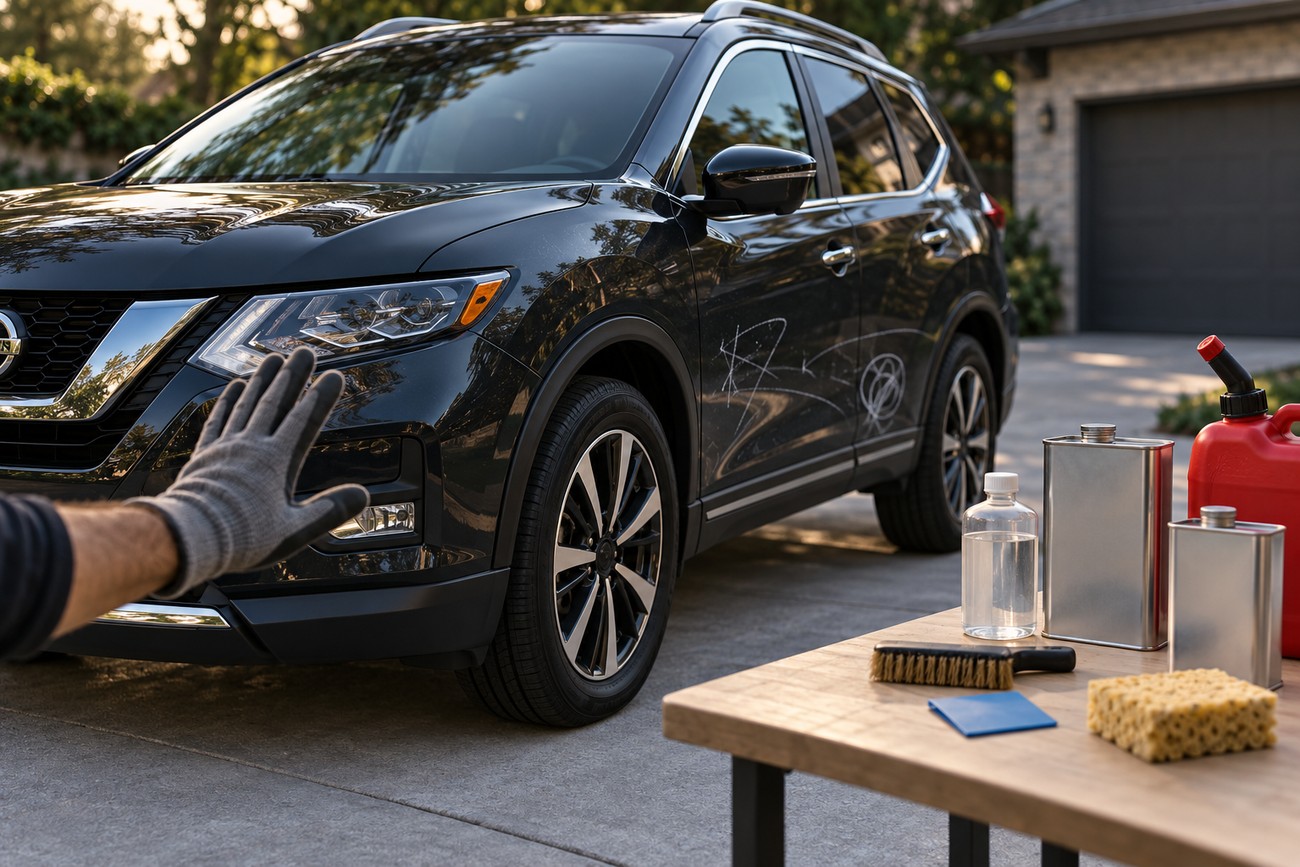
Do not reach for acetone, paint thinner, solvent, gasoline, strong household cleaner, or an aggressive degreaser. Nissan advises against strong household cleaners, solvents, gasoline, and aggressive chemicals on the paint finish. Such products may affect more than the chalk, particularly where the clear coat is already thin, scratched, repaired, or weathered.
Mechanical shortcuts create a separate risk. Scraping with a plastic card, pressing with a hard edge, using a stiff brush, or choosing the rough side of a sponge can scratch the finish while trying to remove dried material. Boiling water is also inappropriate, and hot water on a hot panel can accelerate spotting rather than improve cleaning.
“Nontoxic” describes a product’s intended human-safety classification; it does not certify automotive paint compatibility. Likewise, ASTM D-4236 labeling is not a clear-coat test. Treat the chalk as a contaminant and use the least aggressive effective cleaning method.
Dry polishing and abrasive wax are poor first responses. They can grind remaining particles into the surface and make diagnosis harder. Wait until the panel is clean, rinsed, and dry enough to inspect before considering any correction, and avoid abrasive products if the cause of the mark is uncertain.
If the Chalk Leaves a Colored Haze or Streak
Inspect the panel only after gentle washing has removed the loose chalk. A remaining haze may be residue, water spotting, embedded grit, transferred paint, or a pre-existing defect revealed by cleaning. It may also be a scratch or oxidation, but a colored halo alone does not establish permanent clear-coat damage.
Look at the surface in even shade and then under a different angle of light. Water spots are more likely when the Rogue was washed on a hot panel or when rinse water was allowed to dry. If the mark changes as the lighting changes, that observation can help describe the problem, although it cannot replace a proper finish inspection.
Do not keep rubbing a stubborn area to prove that it will come off. More friction can enlarge fine scratches and redistribute pigment. Nissan warns that rough removal of dried foreign material may damage the finish, and it does not guarantee that every foreign substance will disappear without a trace.
A professional detailer should inspect the panel if the haze remains after gentle washing, particularly when the Rogue has matte paint, oxidation, prior scratches, bodywork, or an unusual repair. Avoid intensifying the chemical treatment or applying abrasive polish until the mark has been identified.
How to Handle the Situation Without Making It Worse
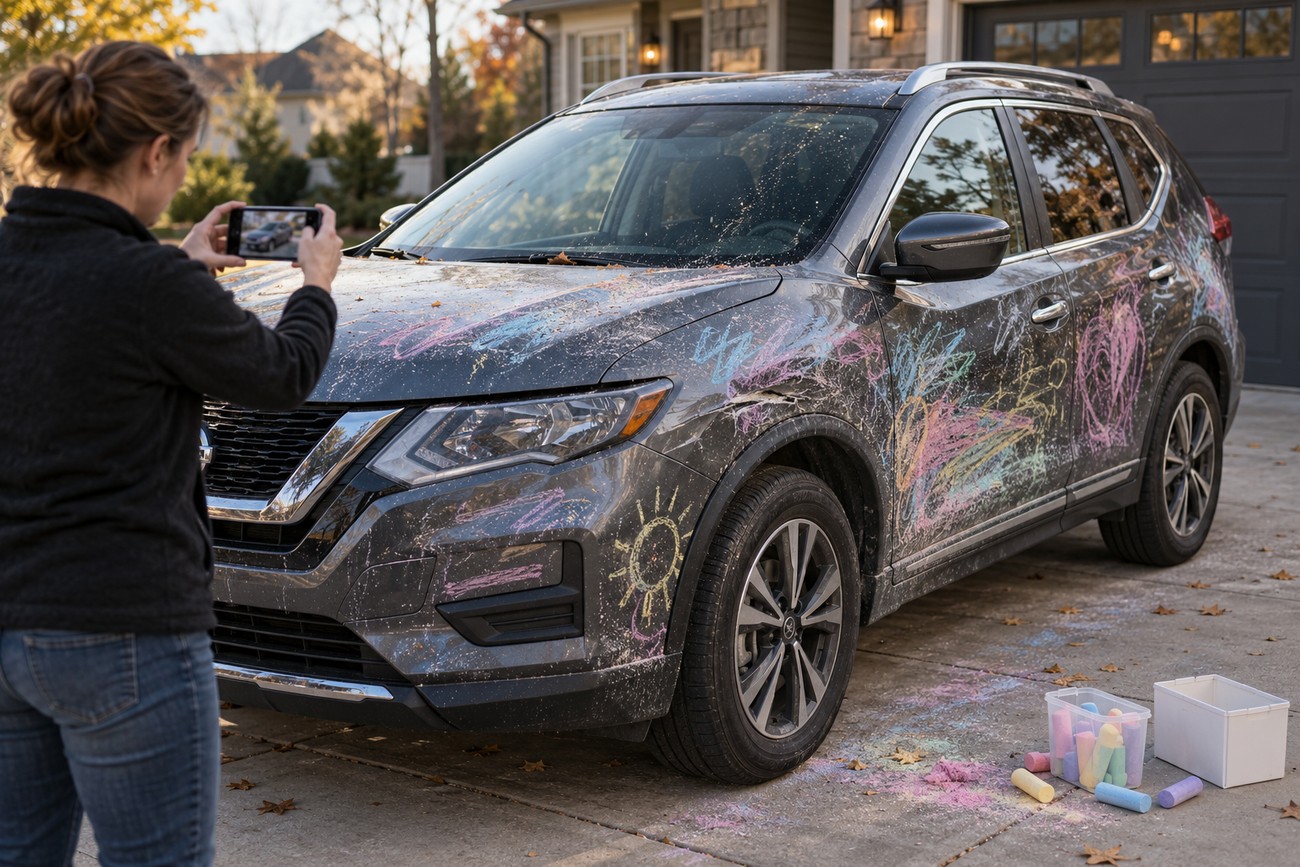
Photograph the Rogue before cleaning if the incident may need to be discussed with another party or included in an insurance conversation. Capture the overall pattern and close views of the affected panels, edges, trim, and any pre-existing damage. Photographs are more useful when the vehicle is evenly lit and the chalk has not yet been disturbed.
Record the chalk brand and color if they are known, along with whether the residue was dry, wet, gritty, or mixed with another material. This information can help a detailer distinguish ordinary chalk from marker, wax, sand, road dirt, or transferred paint. A product’s safety sheet may describe its intended use, but it cannot confirm compatibility with the Rogue’s clear coat.
A calm response around children also protects the vehicle. Explain that the drawing must be removed gently because hard rubbing can scratch the paint, then keep additional chalk away from the vehicle until cleaning is complete. Prevention can be as simple as reserving a driveway or play area with a clear boundary from parked vehicles.
Home washing is reasonable when the finish is intact and the chalk comes away with water, mild automotive soap, and gentle microfiber work. Choose professional inspection when the finish is matte, previously damaged, oxidized, repaired, or still visibly marked after residue removal. That decision avoids turning an uncertain stain into a confirmed polishing or repainting problem.
Frequently asked questions
The questions below cover the safest first steps, how to assess a remaining mark, and when further inspection is appropriate.
Gentle washing should come before rubbing, scraping, solvents, or polishing. Persistent marks require assessment rather than more aggressive cleaning.
The condition of the Rogue’s finish also affects how safely the mark can be evaluated.
How can I tell whether the mark is on the clear coat or only sitting on top?
First remove the loose material with water and mild automotive soap, then inspect the clean panel in shade and under angled light. Do not diagnose from the dry chalk pattern alone. A mark that disappears after washing was surface contamination; a mark that remains needs closer assessment.
Only touch the surface after washing, and use a clean fingertip lightly to notice whether it feels raised or gritty. This simple check cannot reliably identify every type of clear-coat damage, and a smooth-looking haze may still be spotting, transferred material, oxidation, or a defect beneath the surface. If the mark persists, professional inspection is safer than home scraping, solvent use, or abrasive polishing.
What should I do before touching sidewalk chalk on the Rogue?
Move the vehicle into shade and rinse the affected area generously with water before using any cloth. This helps remove loose particles that could scratch the clear coat during washing.
After rinsing, use mild automotive soap and a clean, soft microfiber. Avoid rubbing the dry chalk, scraping it, or applying polish while grit remains on the surface.
When should I ask a professional to inspect the mark?
Arrange a professional inspection if the haze remains after gentle washing or if the Rogue has matte paint, oxidation, previous scratches, bodywork, or an unusual repair. A persistent mark may be spotting, transferred material, embedded grit, or clear-coat damage rather than ordinary chalk residue.
Do not escalate to solvents or abrasive polishing before the cause is identified. Professional assessment is safer when home testing cannot reliably distinguish surface contamination from damage.







