
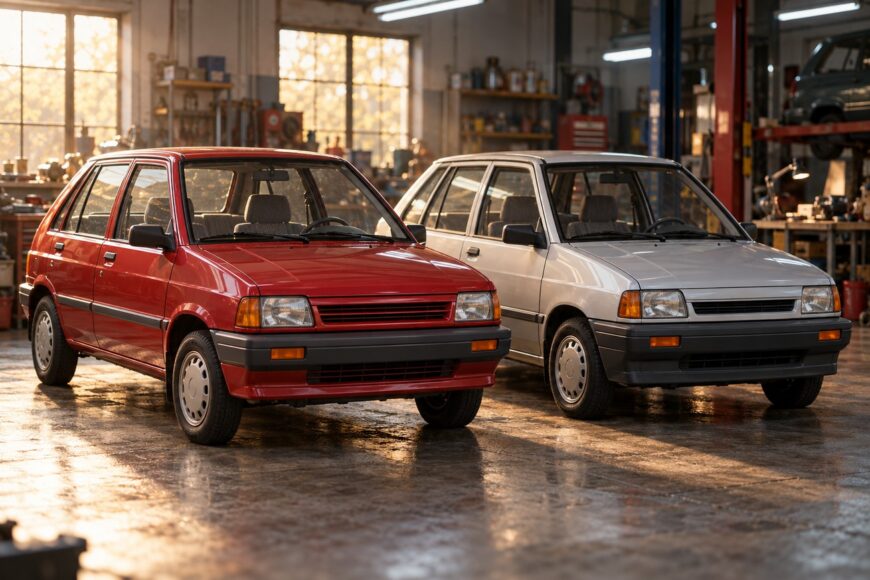
The Kia Pride appeals as an inexpensive, mechanically simple small car with a connection to the Ford Festiva. Its compact size and straightforward layout can make it easier to understand than many newer vehicles. For a buyer, though, the shared names tell you less than they first appear to: a Festiva listing may describe the wrong specification, and a Mazda 121 part may still fail to fit.
A surviving Pride is also an old car, whatever its indicated mileage. Body condition, aging components, local parts supply, and period crash protection matter more than a badge relationship or an engine that starts readily. Understanding where the Pride came from is useful; assessing the particular car in front of you is what makes that history relevant to a purchase.
- What the Kia Pride has to do with the Ford Festiva
- Kia Pride, Ford Festiva, and Mazda 121: what the names tell you
- Bodies, engines, and specifications worth checking
- What a Pride feels like to drive today
- Inspect the body and age-related wear before the odometer
- Wet-weather starting and gearbox trouble: how to test for them
- Parts availability is the real test of a cheap Pride
- Safety and value: when the Pride makes sense
- Frequently asked questions
- How can I identify a Kia Pride if its badges or trim have been changed?
- What should I check before importing or registering a Kia Pride?
- What should I ask a seller to send before traveling to view one?
- Which workshop manual should I use for a Kia Pride?
- How should an infrequently driven Kia Pride be kept ready for use?
What the Kia Pride has to do with the Ford Festiva
The Pride is a licensed relative of the Ford Festiva and Mazda 121. The connection places it within the same small-car family and provides useful leads when looking for specifications, service information, or parts. It does not make every vehicle sold under those three names an identical car.
Kia produced the Pride in South Korea from 1987 to 2000. Across that period, buyers encountered different bodies and market specifications, while the Festiva and Mazda 121 names also require careful identification. A production date and a model name are therefore starting points for research, rather than a complete description of the vehicle.
As a passenger car, the Pride was designed around compact dimensions and modest engines. That helps explain its appeal to someone who wants uncomplicated transport or an accessible older car to maintain. It also explains why the condition of the body and basic systems has an immediate effect on how well a surviving example works.
The licensed relationship is most useful when treated as a search tool. A Festiva reference might help locate a relevant mechanical diagram, while a Mazda 121 listing might identify a possible service component. Before either becomes a purchase decision, the buyer must establish the Pride’s market, year, body style, engine, and the identity of the component itself.
Kia Pride, Ford Festiva, and Mazda 121: what the names tell you
These names help narrow a search, but none is a substitute for identifying the actual car and part.
| Related name | What it tells you | How it can help | What it cannot prove |
|---|---|---|---|
| Kia Pride | The name identifies Kia’s South Korean-built member of this licensed small-car family. | Start with Pride-specific records, manuals, and catalogs for the car’s market and year. | A Pride listing alone does not establish its engine, equipment, or the fit of a part from another body style. |
| Ford Festiva | It identifies a closely related model and a useful source of comparative information. | Search Festiva documentation when Pride information is limited, then compare the relevant assembly. | The Festiva name does not confirm identical market specifications or interchangeable components. |
| Mazda 121 | It reflects the Mazda connection within the related model family. | Use the name to investigate possible mechanical parts and reference diagrams. | A 121 listing does not prove that electrical items, mountings, or body panels fit a Pride. |
| Before ordering | Shared origins provide leads, not a fitment guarantee. | Check the market, year, body style, engine, and individual component or part number against the car. | A visual resemblance or a matching model-family name cannot replace those checks. |
Bodies, engines, and specifications worth checking
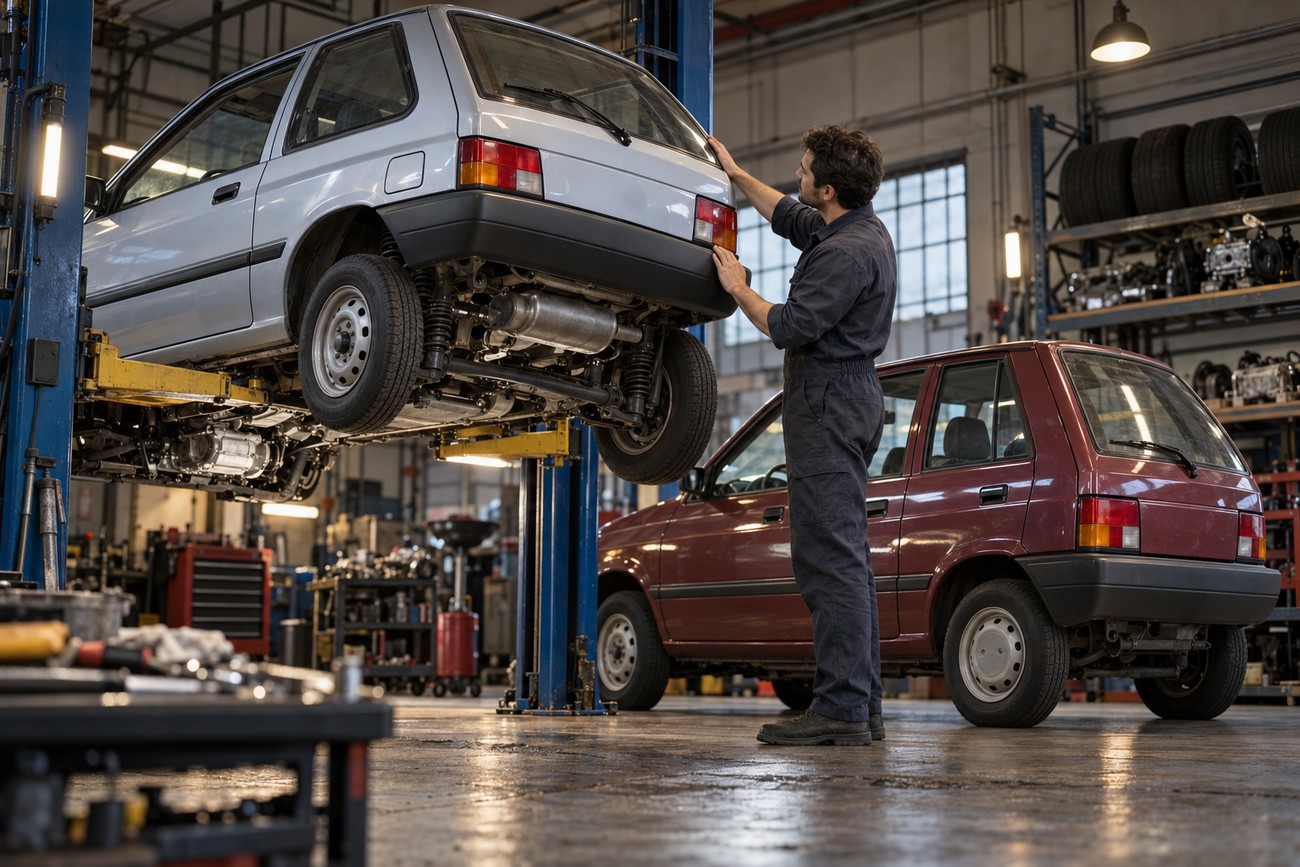
The Pride range included three- and five-door hatchbacks, a sedan, and a five-door wagon. Those choices affect more than luggage space. Doors, glass, trim, and rear body pieces need to be researched for the body style you intend to buy, especially if an example is incomplete.
The basic mechanical layout used front-wheel drive, a transverse inline-four engine, independent front suspension, and a semi-independent rear beam. This is a relatively straightforward arrangement to inspect and understand. It does not, by itself, tell you which replacement parts will fit a specific car.
Early Pride and Festiva specifications primarily cite gasoline engines of approximately 1.1–1.3 liters, with power varying by market and year. Gearbox options included four- or five-speed manuals and, in some markets, a three-speed automatic. A quoted output or transmission specification is useful only when it belongs to the same version as the car being assessed.
Conflicting online listings deserve particular caution. Some modern Festiva entries cite a 1.6-liter engine and 120 hp; those figures should not be assigned to an early Pride without verifying the exact vehicle. Listings can combine different versions or generations under a familiar name, giving a buyer a confident-looking number that describes the wrong car.
Check the vehicle identification number, registration details, engine information, and available service records against the actual equipment under the hood. The same discipline applies to fuel economy: there is no reliable single figure for every surviving Pride, because specification and mechanical condition both affect the result. Identification first makes every subsequent comparison more useful.
What a Pride feels like to drive today
A sound Pride should feel like a small car built around modest performance, rather than a vehicle with ample acceleration in reserve. Owners have reported weak acceleration in small-engine examples, particularly with a four-speed gearbox and a full load. On a test drive, judge how the particular car pulls on the roads and with the sort of load you expect to use, without treating its basic engine size as an explanation for every hesitation.
The compact body and simple controls can be appealing in ordinary use. Driving one also gives you a direct sense of its limitations: you may need to plan overtaking and hills more carefully than in a newer small car. Poor running, reluctant starts, or unusually uneven power still call for investigation rather than being dismissed as period character.
Low fuel use cannot be assumed from size alone. The condition of the fuel system, ignition, tires, and gearbox, along with the load carried, influences consumption. Comparing an advertised economy claim with the car’s maintenance history and road-test behavior is more useful than relying on a single figure found in a general listing.
Running costs are similarly local and car-specific. Routine servicing may be manageable where the right parts remain available, but a simple design offers little financial protection if a missing electrical component or damaged body piece is difficult to source. The realistic question is whether you can maintain this particular Pride in your region, rather than whether old small cars are generally cheap to run.
Inspect the body and age-related wear before the odometer
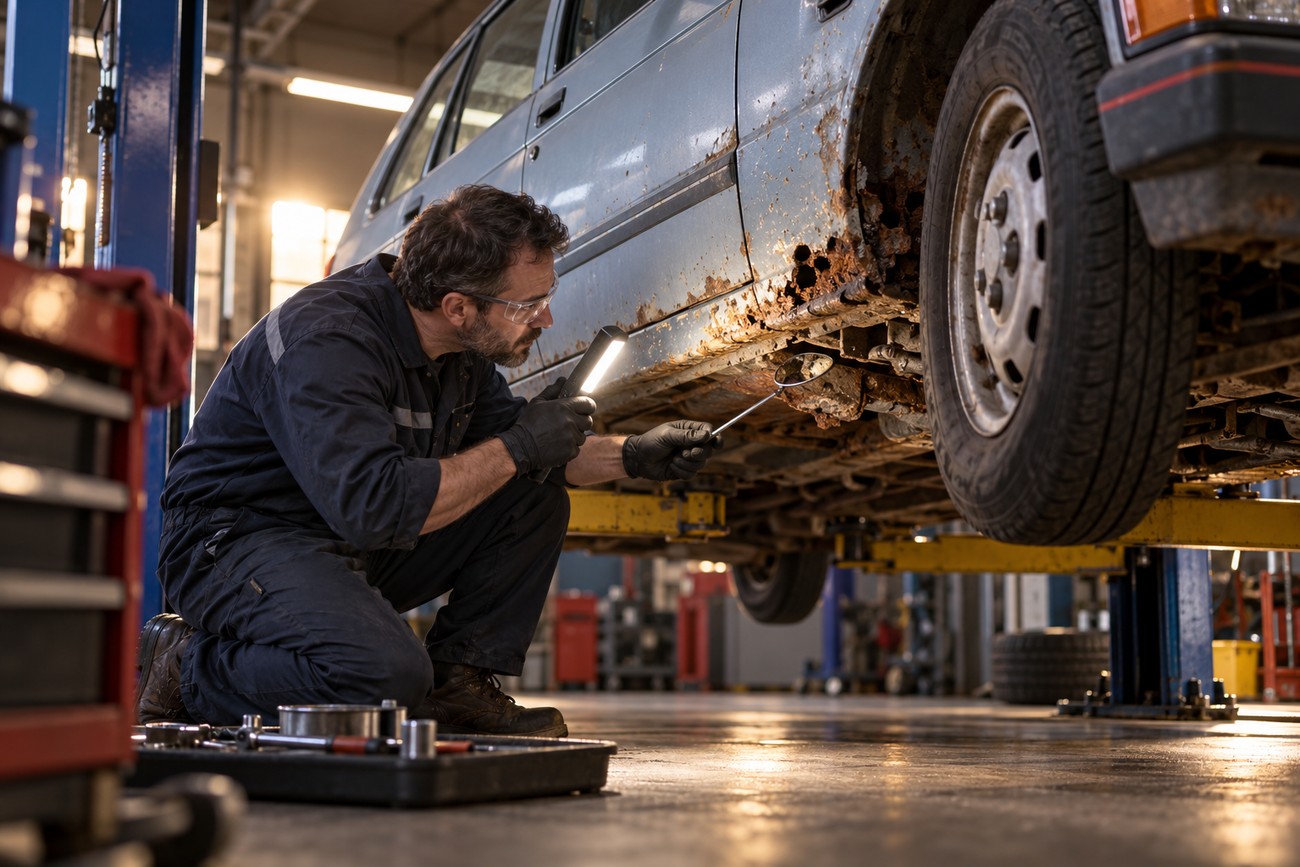
Begin a viewing with the body structure, ideally with safe access to the underside. Look closely at the sills, floor, underside, and areas where the suspension mounts to the body. Corrosion near a mounting area needs a more serious assessment than a cosmetic blemish; seek a qualified inspection if access is poor or the extent is unclear.
Follow visible rust beyond its first appearance. Check adjacent seams and metal, and look for repairs whose extent cannot be established from the outside. A running engine is encouraging, but it cannot compensate for serious deterioration in the structure that supports the suspension and occupants.
Next, examine parts that age even when a car is rarely driven. Rubber components, hoses, seals, wiring, and brake parts can deteriorate on a low-mileage Pride. Inspect for leaks, brittle or damaged wiring, and evidence that the braking system has been maintained; a low odometer reading cannot establish the condition of any of these items.
Keep findings specific to the car. The available evidence does not support presenting a particular suspension or engine failure as an established Pride-wide defect. A thorough inspection is still essential, because age, prior repairs, storage, and use can leave two examples with similar mileage in markedly different condition.
Wet-weather starting and gearbox trouble: how to test for them
Some owners have reported trouble starting in wet weather around the distributor and high-voltage ignition components. Moisture in that area is therefore a useful inspection clue, especially on a car with aging ignition parts. It is an owner-reported problem, rather than a fault that can be assumed on every Pride.
Ask to see the engine start from cold before the seller has warmed it up. Note how readily it fires, whether it settles into a steady idle, and whether there is visible damage or poorly secured wiring around the ignition system. A dry-day demonstration cannot establish wet-weather reliability, so ask about previous symptoms and any relevant repair records.
The gearbox needs a road test rather than a few shifts while parked. Drive through every gear, observe changes under load, and pay attention when lifting off and coasting. On an automatic, assess whether drive engages and changes occur consistently; on a manual, note any reluctance to select gears or signs of clutch slip, such as engine speed rising without corresponding acceleration.
After the drive, check beneath the car for fresh transmission fluid leaks and compare them with any residue seen before setting off. Owners have reported slipping and leaks, but those reports do not establish a failure rate for the model. Their practical value is to make sure a smooth stationary demonstration does not replace a proper drive and post-drive inspection.
Parts availability is the real test of a cheap Pride
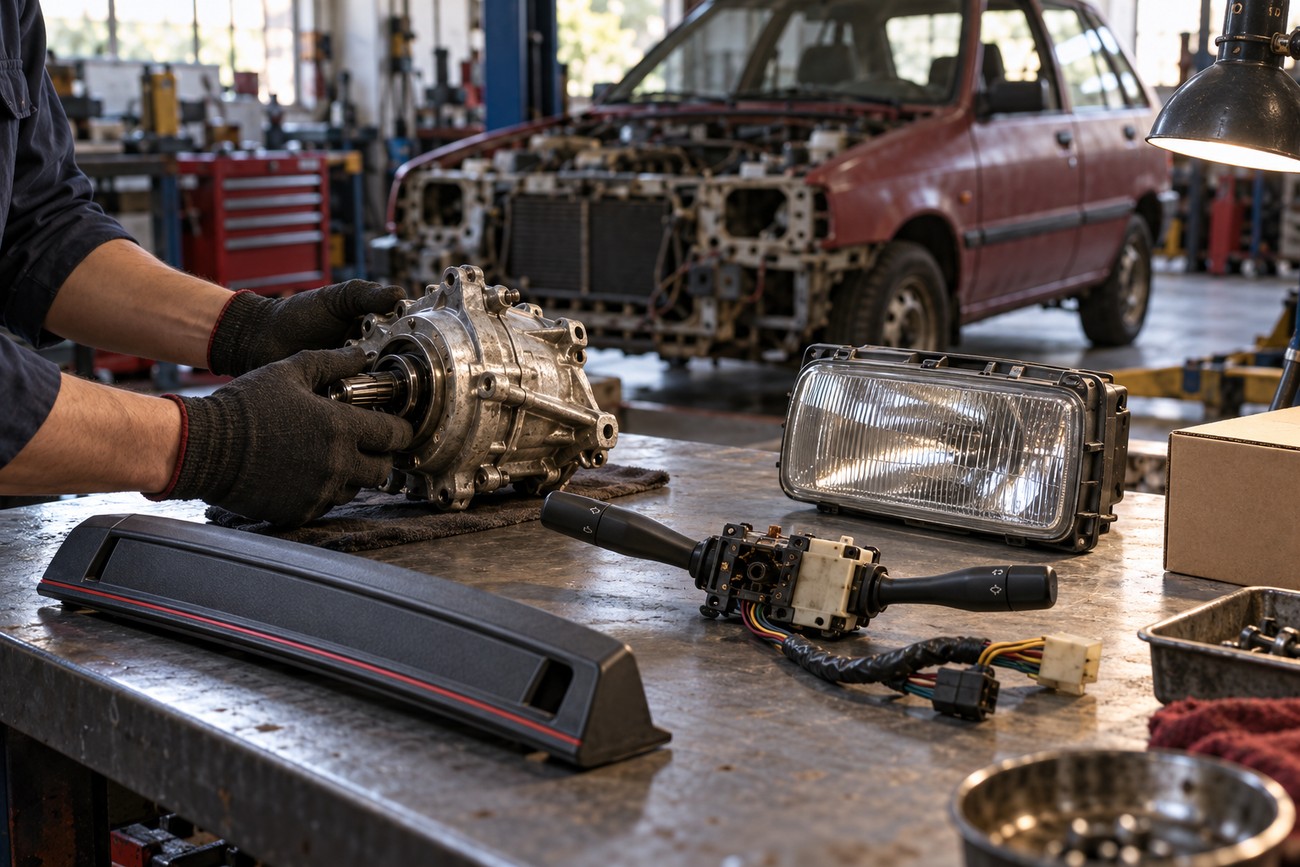
Routine service items may be easier to obtain than body, electrical, and some transmission components, depending on the region. That distinction matters when comparing two cars at a similar asking price. One that needs ordinary maintenance may be a more predictable project than an incomplete example awaiting a hard-to-find panel or electrical assembly.
Start a parts check with the faults you can already see. If a light, switch, trim piece, or transmission component needs replacement, establish its exact identity and whether a suitable part is obtainable where the car will be maintained. The existence of a general Festiva or Mazda 121 parts catalog is useful, but it is not evidence that the required item is available for your Pride.
A visually similar Festiva or Mazda 121 component can still be the wrong purchase if its connector or mounting differs. Match the number on the original part and compare its physical connections before ordering.
Body style makes this especially important for sedans and wagons. A hatchback listing should not be treated as proof that rear body or interior pieces will fit either version. Missing pieces can also be harder to identify from a distant advertisement, so photograph the car and the relevant mounting points before searching for replacements.
For any candidate part, work from the vehicle’s market, year, body style, and engine to the individual component or part number. Then check the supplier’s application information against what is fitted to the car. This takes longer than ordering by model name, but it gives a far better basis for judging whether an inexpensive Pride will remain affordable to keep on the road.
Safety and value: when the Pride makes sense
The Pride belongs to an earlier era of small-car safety. UCSR rated the first-generation Festiva 2 out of 5, below average for light vehicles. Because the Pride is a related model rather than an identically specified vehicle in every market, that result is best understood as relevant period evidence, not a crash rating assigned to the individual Pride you are viewing.
Test descriptions can be misleading when detached from results. NHTSA describes a 35-mph frontal test and a 38.5-mph side-barrier test, but the existence of those procedures does not establish a modern crash rating for a particular Pride. Routine repairs can keep brakes and other systems in sound operating condition; they cannot bring the car’s underlying passive-safety design up to a modern standard.
Intended use should shape the decision. A buyer seeking an older compact car for limited use may reasonably weigh the Pride differently from someone who needs a primary vehicle for frequent journeys. In either case, structural condition deserves priority because repairs to a badly deteriorated body can overwhelm the apparent saving in the asking price.
Completeness comes next. Confirm that body, interior, electrical, and transmission parts needed immediately are present or realistically obtainable in your region. A low purchase price is less persuasive if it depends on restoring neglected brakes, replacing aged components, and locating scarce pieces before the car can be used reliably.
The strongest candidate is a structurally sound, substantially complete Pride with identifiable specifications and credible maintenance evidence. Its appeal lies in knowing exactly what this small car can offer and what it cannot. Buy for the condition and suitability of the individual vehicle, with its parts supply and safety limitations included in the calculation.
Frequently asked questions
For an older Pride, identification and paperwork are part of the buying assessment. These checks help resolve uncertainties that a road test or an exterior badge cannot answer.
How can I identify a Kia Pride if its badges or trim have been changed?
Start with the registration records and vehicle identification number, then compare them with the identifiers on the car and the engine information available in its paperwork. Check that the recorded year, market, and body style agree with the vehicle you are viewing. If an identifier is missing or does not agree, resolve the discrepancy before relying on a parts catalog or committing to a purchase.
Exterior badges and trim can be changed, so they are weak evidence of specification. Keep clear photographs of the identifiers and engine details for inquiries with a parts supplier or workshop; a precise description is more useful than asking for a component for a “Pride/Festiva.”
What should I check before importing or registering a Kia Pride?
Confirm the rules in the jurisdiction where the car will be registered before paying for it or arranging shipping. Ask the relevant authority which documents establish ownership and vehicle identity, whether the car is eligible for registration, and what inspection or compliance requirements apply. Requirements vary by location, so a seller’s experience elsewhere may not transfer.
Match the identification number across the car and its documents, and obtain copies of the available ownership and registration records in advance. If the paperwork is incomplete or an identifier is unclear, establish how the receiving authority handles that issue before adding transport costs to the purchase.
What should I ask a seller to send before traveling to view one?
Request clear photographs of the vehicle identification details and registration documents, with personal information handled appropriately, plus close views of the underside, sills, and suspension mounting areas. Ask for a cold-start video that begins before the engine is running and continues long enough to show how it settles at idle. These materials cannot replace an inspection, but they can reveal reasons to seek clarification before traveling.
Also ask for photographs of every missing or damaged body and interior piece, including the surrounding mounting area. A broad exterior shot may hide an absent part whose replacement is difficult to identify or find. Use the images to check availability locally before treating the seller’s asking price as the likely total cost.
Which workshop manual should I use for a Kia Pride?
Choose documentation that matches the car’s year, market, engine, and equipment as closely as possible. Pride-specific material is the first place to look; a Festiva or Mazda 121 manual may help explain a related assembly when the exact Pride reference is unavailable. Keep the car’s identification and engine information to hand while searching.
Before following a wiring diagram, service procedure, or parts illustration, compare its connectors, mountings, and component layout with the vehicle. If they differ, do not assume the remaining instructions apply. Related-model manuals are valuable references, but they cannot establish that every system on a particular Pride is identical.
How should an infrequently driven Kia Pride be kept ready for use?
Store it in a dry, suitable place where possible, and follow an appropriate plan for battery care and periodic checks. Before returning it to the road, inspect tire condition and pressure, fluid levels and leaks, hoses, seals, and the operation of the brakes. If storage has been prolonged, have safety-critical items assessed before a normal drive.
Low annual mileage slows some forms of wear while leaving age-related deterioration possible in rubber, wiring, seals, and brake components. Record what was checked or replaced during storage, then make the first drive a careful test rather than assuming the car is ready because it started.







