

A Porsche 911 can make a striking living-room display, but a room that looks large enough may still be unsuitable. Getting the car inside can damage door frames and floors; keeping it there introduces concentrated loads, fluids, odors, and fire risks. The central question is whether the building, delivery route, and room can safely accommodate the vehicle.
That answer needs more than a tape measure. A structural assessment, a controlled movement plan, appropriate floor protection, and written clarity on permissions and insurance should come before any installation. Treating a road car as furniture is an expensive shortcut if the floor, finish, or policy proves unsuitable afterward.
- Is a Porsche 911 Actually Suitable for a Living Room?
- Measure the 911, the Route, and the Building
- Check the Floor: Weight Is Not the Same as Load
- Prepare the Car and Room Before Moving It Indoors
- Move and Position the Car Without Damaging the Property
- Living With the Car: Odor, Dust, Insurance, and Reversibility
- Frequently asked questions
- What Porsche 911 should you stay away from for a living-room display?
- How can you keep a 911 from looking dusty and out of place in a living room?
- What is the average age of people who buy a Porsche 911?
- What is called the poor man’s Porsche?
Is a Porsche 911 Actually Suitable for a Living Room?
A functioning 911 remains a functioning vehicle when its engine is off. Fuel vapors, a connected battery, and oil, coolant, or brake fluid can still present hazards. A minor seep that would be noticed and cleaned in a garage may reach a living-room floor finish before anyone sees it.
The materials themselves change how the room feels. Tires, leather, plastics, adhesives, and detailing products can produce persistent smells, especially where air movement is limited. Dust also settles quickly on a polished body, leaving you to choose between frequent cleaning and a cover that hides the display.
Define the intended use before selecting the car. A road-going 911 that must remain ready to drive requires a different storage plan from an exhibit that will rarely move. The lowest-risk display configuration is a specially prepared vehicle with no fuel, an isolated electrical system, and a documented method of moving it.
Preparation should be proportionate to the car’s value and future use. Altering an original road car solely to make it easier to exhibit may reduce its appeal or value later. If driving it regularly matters, a properly separated garage with a view into the home may serve that aim better than direct placement in a living room.
Measure the 911, the Route, and the Building
The Porsche 911 Carrera specification cited here is 4,542 mm long, 1,852 mm wide without mirrors, 2,033 mm wide with mirrors, and 1,302 mm high. Those figures describe the vehicle, not the space needed to transport it. Confirm the dimensions of the actual car, then allow for protective equipment and controlled movement.
Survey the entire route from unloading point to final position. Door frames, thresholds, tight turns, elevators, and stair landings can defeat a plan even when the room itself has ample floor space. Measure clear openings as they will exist during delivery, including any door leaf or trim that remains in place.
For a tight turn, installers need the complete moving envelope: the car, protected or folded mirrors, and the space needed to change direction. A straight doorway measurement alone cannot establish that the route works.
Check vertical clearance at ramps and changes in floor level as well as at doors. The underside, front overhang, and temporary transport equipment can meet a threshold before the roof approaches anything overhead. A proposed route should also account for where handlers can stand without being trapped against a wall.
Have a structural engineer or the responsible building authority verify the specific floor and delivery route before arranging transport. This is particularly important where an elevator, suspended floor, or shared part of a building is involved. A sketch showing the route and intended parking position gives them something concrete to assess.
Check the Floor: Weight Is Not the Same as Load
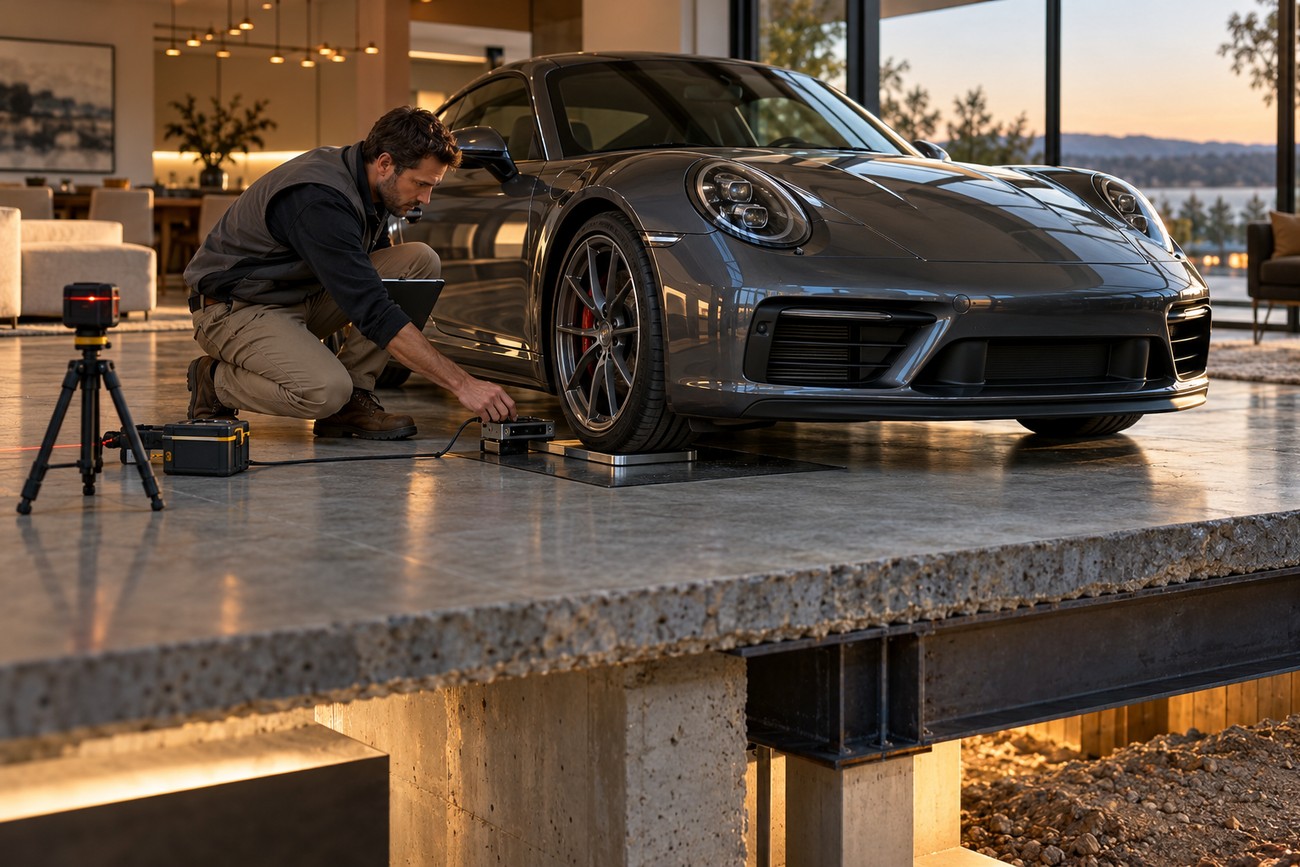
A current Carrera weighs approximately 1,505–1,520 kg, depending on version, market, equipment, and weighing method; the specification cited in the brief is about 1,520 kg. That mass does not act evenly across the car’s footprint. It reaches the floor through four small tire contact patches, so dividing total weight by the area of the room is not a sufficient safety assessment.
A concrete surface offers no automatic guarantee. Its capacity depends on the particular slab, supports, condition, and location of the car; an apartment floor or older structure needs particular care. An engineer should assess the proposed wheel positions and any load-distributing system rather than relying on a generic floor rating.
The cited tire sizes are 235/40 ZR19 at the front and 295/35 ZR20 at the rear. Tires can mark finishes, while small supports can transfer damaging loads into boards, stone, or the structure below. Ordinary planks, decorative mats, and carpet should not be assumed to protect either the floor finish or the supporting floor.
Specify a protective system that combines point-load distribution, chemical and moisture resistance, and slip control. Its layers need to work together: a sealed surface that catches a drip is of little use if the support beneath it shifts as the car moves. The system must also be acceptable to the engineer assessing the floor.
Prepare the Car and Room Before Moving It Indoors
Agree on the car’s display condition before delivery. Have qualified professionals assess whether fuel should be removed, inspect for fluid leaks, and isolate the electrical system where appropriate. Cleaning the vehicle helps, but a clean underside is not evidence that every hose, seal, and reservoir will remain dry.
Protect the tire contact points and establish the sealed, load-distributing floor system before the car crosses the room. A temporary pad may catch dirt while offering little resistance to chemicals, moisture, slipping, or concentrated loads. Keep the protection continuous across vulnerable parts of the delivery route, not solely under the final parking position.
Plan ventilation for persistent material odors, and keep exits unobstructed. The room needs suitable smoke and carbon monoxide detectors and a fire plan that occupants can follow with the car in place. Confirm the applicable building and fire requirements rather than assuming that a residential room may be used for vehicle storage.
Do not start the engine in a living space. Carbon monoxide and other exhaust contaminants can accumulate, and open windows are not a substitute for professionally designed exhaust extraction that discharges outdoors. If the car must be moved again, arrange a non-running movement method instead of planning to drive it through the room.
Move and Position the Car Without Damaging the Property
Use a transport team with a written sequence for unloading, entering, turning, and stopping the car. Depending on the property, the job may require temporary door removal, a ramp, a winch, or lifting equipment. Each addition changes the clearances and the forces applied to the building, so it belongs in the plan from the start.
Protect frames, thresholds, walls, and the full floor route before movement begins. Use controlled wheel movement; turning the tires while the car is stationary can impose significant shear forces on flooring. A seemingly small steering correction on soft or finished material may leave damage that a simple protective sheet will not prevent.
Mirrors should be folded or removed only according to the manufacturer’s procedure. Calculate the route using the maximum width of the car and its transport protection in the configuration actually being moved. Leave room for handlers to work without using the bodywork or a wall as a stopping point.
Once positioned, follow storage guidance for the specific 911 version. Tire pressure, long-term parking, and storage conditions can contribute to flat spots, so generic advice should not override the applicable vehicle guidance. Record the car’s condition and the property’s condition before and after installation; damage to walls, mirrors, thresholds, or flooring may otherwise become a difficult liability dispute.
Living With the Car: Odor, Dust, Insurance, and Reversibility
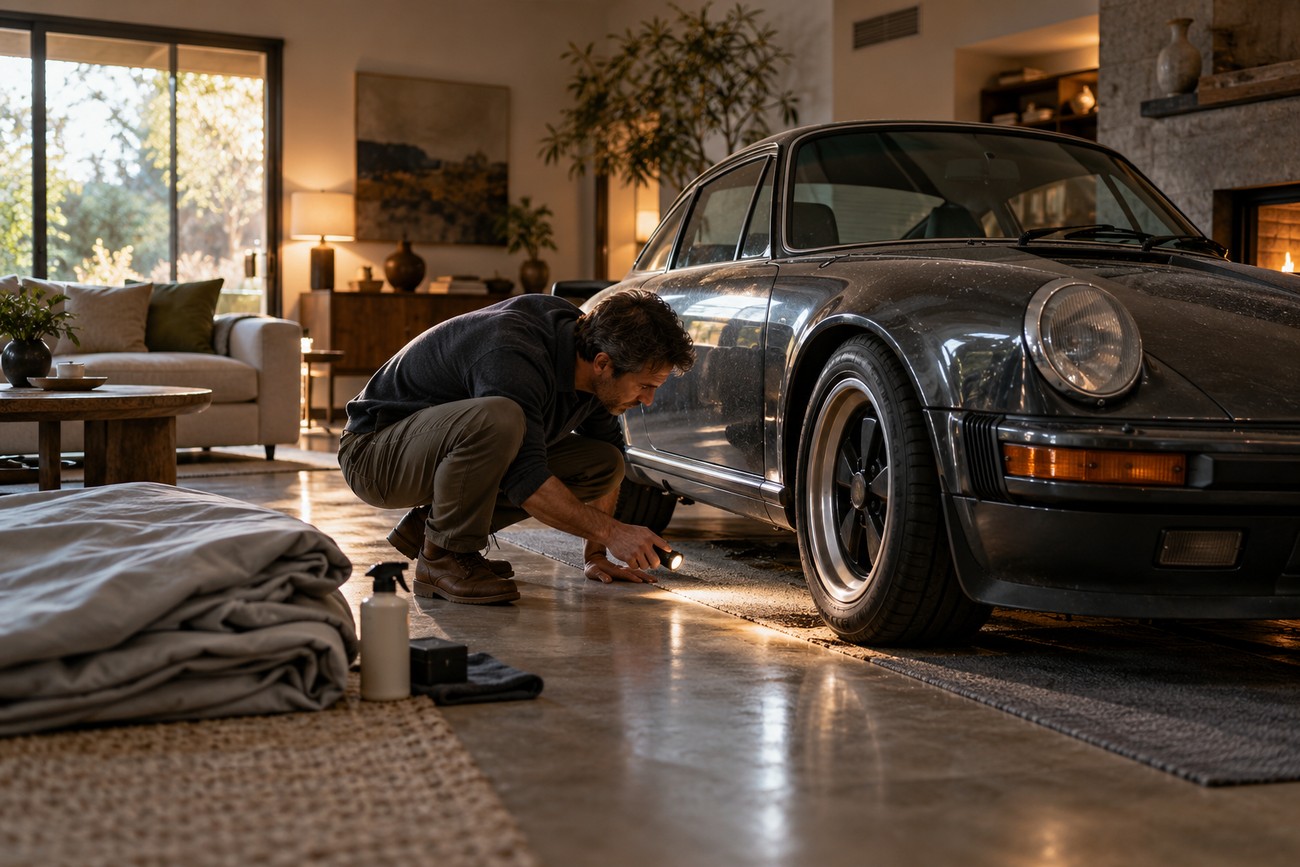
The display will need upkeep even if no one drives the car. Dust collects on horizontal surfaces, and odors from gasoline, rubber, plastics, and detailing products may persist after cleaning. A cover reduces dust but also conceals the feature the room was designed around.
Maintenance access matters as much as viewing distance. Leave enough space to inspect for leaks and clean around the wheels without dragging equipment against furniture. Opening doors, repositioning the car, or using lifting equipment can also create noise and vibration that would be unremarkable in a garage but intrusive in a living area.
Check lease terms, building permissions, and fire requirements before committing to construction or delivery. Ask insurers in writing how home, vehicle, and liability policies treat indoor vehicle storage and resulting building damage. Coverage for a car in a garage should not be assumed to extend to a living room.
Choose a reversible installation if the 911 is a road car you intend to preserve. Document removable floor protection and a practicable exit route, and avoid alterations that diminish the car’s originality. Where the room is primarily an exhibition space, a specially prepared display vehicle is the more coherent choice.
Frequently asked questions
These decisions depend on the particular car and property. The distinctions below help with vehicle selection and presentation; they do not replace approval of the installation itself.
What Porsche 911 should you stay away from for a living-room display?
Avoid making an especially valuable or originality-sensitive road car the test case for an unproven installation. Repeated handling, protective modifications, and a difficult exit can have consequences even if the car looks untouched once parked. A poorly documented car is also a weak choice because its condition is harder to establish before and after the move.
How can you keep a 911 from looking dusty and out of place in a living room?
Leave practical cleaning access around the car, and position lighting so it reveals the shape without making every layer of dust prominent. A breathable cover suited to the car’s finish can help between viewings, provided the car is clean before it is covered. Relate the display area to the surrounding furnishings through restrained materials and clear sightlines, rather than crowding the car with automotive memorabilia.
What is the average age of people who buy a Porsche 911?
There is no reliable average buyer age in the information available here, and an age quoted without a defined market, model year, and data source would be misleading. Buyer demographics also offer little help in deciding whether a particular 911 belongs indoors; the vehicle’s condition and the property’s suitability are the relevant facts.
What is called the poor man’s Porsche?
The phrase has been used informally for lower-priced Porsche models, particularly the 914, and sometimes for other entry-level models. It is not an official designation and does not describe a specific 911. For a living-room display, condition, proportions, and the ability to install the car safely matter more than the nickname.







