
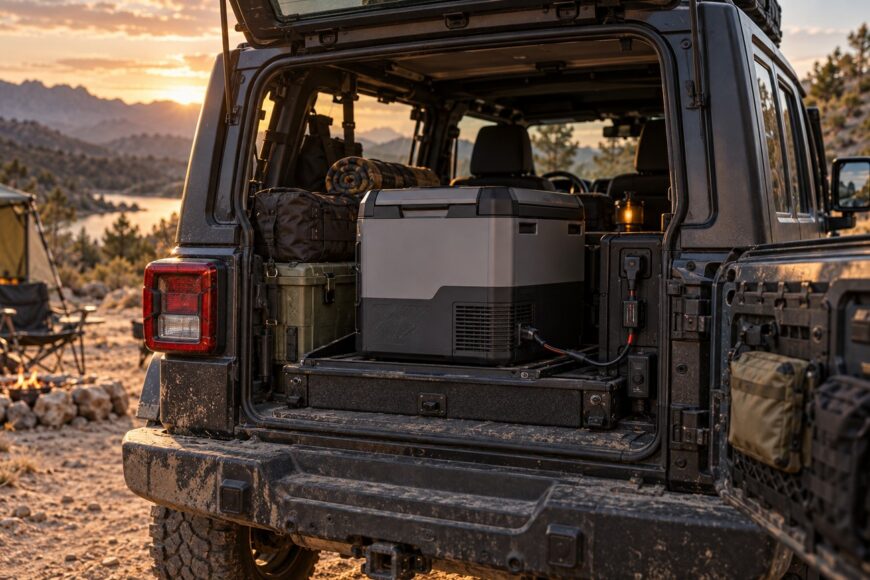
A Wrangler can keep a compressor fridge cold overnight and still refuse to start in the morning. The opposite failure is also common: the fridge’s low-voltage cutoff disconnects it before dawn, and food warms while the battery appears to have been “protected.” Both outcomes come from treating a socket, a battery label, or a protection setting as a complete power system.
Your practical choices are factory power for driving, a dedicated fused circuit for more reliable wiring, or separate storage power for overnight stops. The right arrangement depends on the Wrangler’s model year and outlet behavior, the fridge’s actual 24-hour consumption, battery chemistry, cable length, ambient temperature, and whether solar energy is available. There is no universal runtime figure that applies to every Jeep, fridge, and campsite.
- How the Wrangler’s 12-Volt Power Really Behaves
- Estimate Fridge Runtime Before You Camp
- Build a Dedicated, Low-Loss Power Circuit
- Choose a Safe Overnight Power Strategy
- Avoid the Failures That Leave You With Warm Food
- Make the Fridge Work Less in a Hot Wrangler
- Frequently asked questions
- How can I verify whether my Wrangler’s rear outlet stays live with the Jeep off?
- What should I do after the fridge shuts down on low voltage overnight?
- How can I keep the fridge cooler inside a hot Wrangler without adding another battery?
How the Wrangler’s 12-Volt Power Really Behaves
The Wrangler’s factory 12-volt outlets are rated up to 160 W/13 A. A compressor fridge will commonly draw less than that during normal operation, but the limit still applies to the complete outlet circuit. Adding another high-draw accessory to the same circuit can bring a fuse, connector, or wiring run close to its limit.
Outlet location matters because the socket may not remain powered when the Jeep is parked. The front 12-volt outlet operates only with the ignition in ACC/ON, so a fridge connected there will stop when the ignition is switched off. The rear outlet may be ignition-switched or continuously live depending on the model year and equipment.
A continuously live rear outlet can run a fridge while the Wrangler is unattended, yet it can also discharge the starter battery if the fridge is forgotten. The owner’s manual warns that extended use of accessories with the engine off can discharge the starter battery; driving may be required to recharge it. A short drive after a low-battery event may not restore the charge fully.
Check the exact model year, trim, fuse layout, and outlet behavior before planning an installation. General advice for one Wrangler generation can be wrong for another. With the ignition off, test the socket using a simple 12-volt accessory or a voltmeter, and confirm whether power remains after the Jeep has gone through its normal shutdown period.
Estimate Fridge Runtime Before You Camp
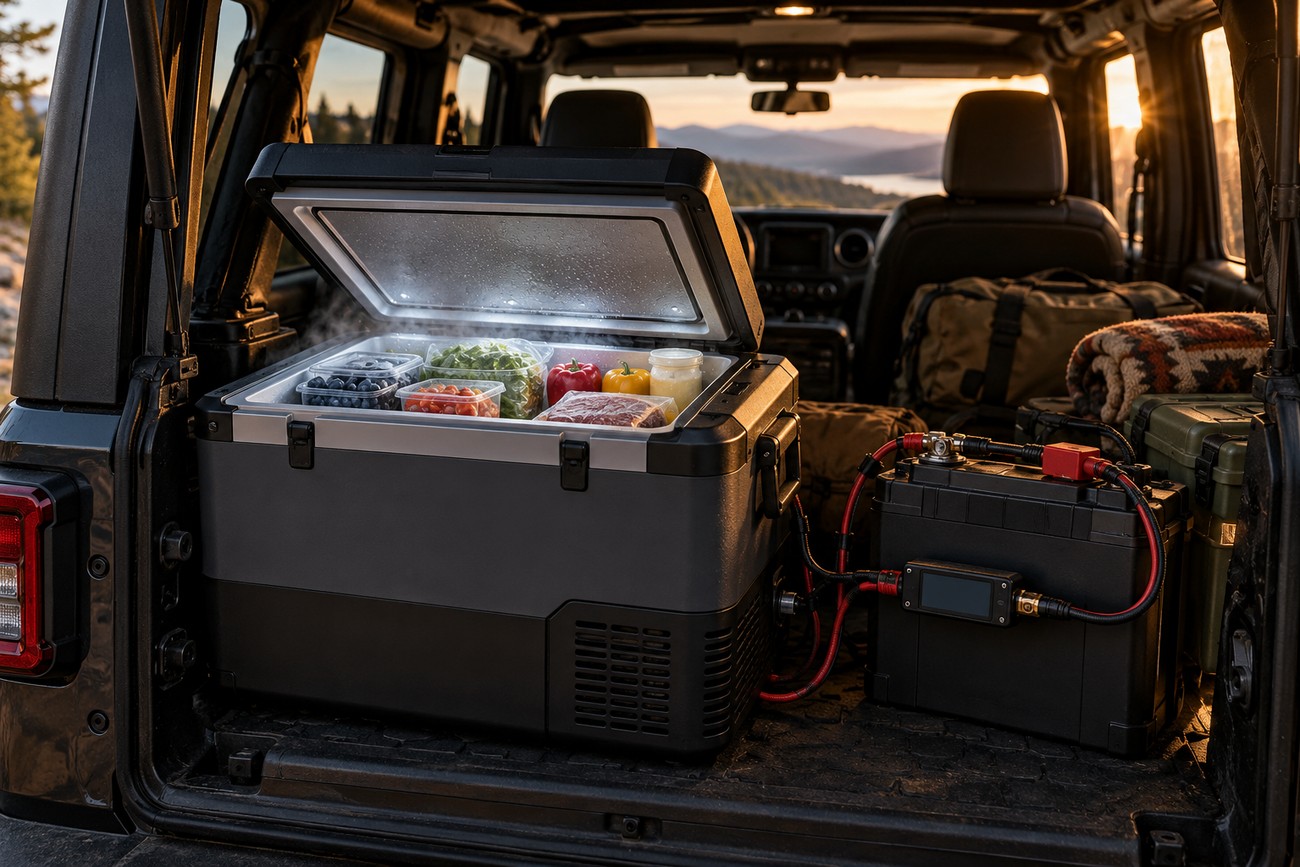
A compressor fridge draws power cyclically. Its compressor may have a stated running current, yet it does not necessarily run continuously, so that number cannot predict daily consumption by itself. Duty cycle changes with the fridge model, ambient temperature, thermostat setting, loading, ventilation, and how often the lid is opened.
Battery capacity needs the same caution. A 100 Ah rating does not mean 100 Ah of equally usable energy across a starter AGM, an auxiliary AGM, and a LiFePO₄ battery. The battery’s permitted depth of discharge, age, temperature, charging method, and the voltage at the fridge terminals all affect the usable result.
Some owner reports estimate about 50–75 Ah/day for certain ARB fridges in hot, continuous use. That is an owner estimate, not a universal specification. Owner reports for a 100 Ah battery range from approximately 12–15 hours to 3–4 days. In one private example, a 100 Ah LiFePO₄ battery paired with 100 W solar supported about 3–4 days; the difference reflects fridge draw, battery chemistry, allowable discharge, temperature, and solar input.
Plan from measured energy use rather than the most favorable claim. Run the fridge in conditions resembling your trip and record its average current or energy use over 24 hours. A clamp meter, battery monitor, or suitable inline meter can reveal the real duty cycle and show whether the system has enough reserve for a cloudy or unusually hot day.
Build a Dedicated, Low-Loss Power Circuit
For a permanent installation, run a separately fused line from the battery to the fridge. Use connectors that fit the fridge securely, protect the cable from abrasion and heat, and keep the route as short as practical. This arrangement reduces voltage drop and removes much of the continuous load from the factory outlet circuit.
Thin or long cable can lose enough voltage to trigger the fridge’s low-voltage cutoff even when the battery still has useful charge. Practical recommendations commonly suggest approximately 10–8 AWG cable for a dedicated fridge circuit, selected for the actual run, fuse rating, connector type, and installation conditions. That range is guidance, not a universal specification for every Jeep.
A fridge that works on a short test lead can still shut down overnight after installation. Long cable runs, undersized conductors, or a marginal socket may allow the compressor’s startup demand to pull the fridge voltage below its cutoff threshold.
Place the fuse close to the battery and size the circuit for the cable and equipment. Avoid sharing the run with lights, inverters, air compressors, or other powerful accessories. The factory outlet limit remains 160 W/13 A even when the fridge itself normally draws less, and a larger fuse cannot safely increase that limit.
Choose a Safe Overnight Power Strategy
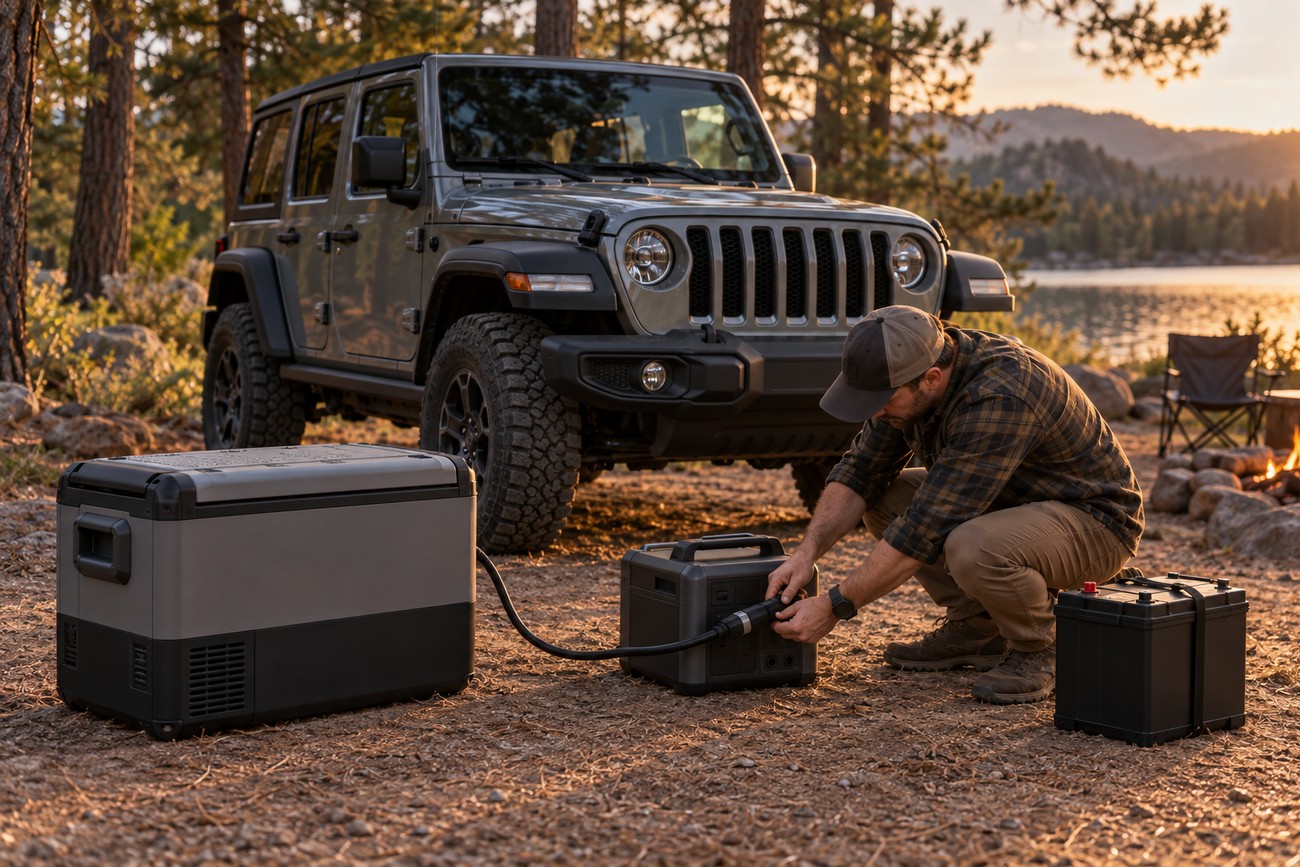
The simplest arrangement is to power the fridge from the Wrangler while driving, then move it to separate storage power at camp. A dedicated auxiliary battery, portable power station, or suitably sized secondary system can carry the overnight load while preserving the starter battery for starting the engine.
A starter battery is designed for short, high-current engine starts, so its rated capacity should not be treated like the full usable capacity of a deep-cycle system. AGM auxiliary batteries can work well when installed and charged correctly, while an under-hood auxiliary battery operates in substantial heat. That heat can shorten service life and complicate the choice and installation of lithium chemistry.
A portable power station reduces installation work and can be convenient to move between vehicles, but its displayed capacity still needs to be compared with the fridge’s measured daily use. A fixed auxiliary system can provide cleaner wiring and easier integration with vehicle charging. Either arrangement needs a charging plan for the energy used during each stop.
Solar can extend an auxiliary system’s endurance, though it is not automatically an unlimited source. A 100 W panel can produce inconsistent energy in shade, under trees, when dirty, or when poorly oriented. The fridge may consume more energy during the same conditions that reduce solar output, so size the battery for periods without meaningful solar input.
Avoid the Failures That Leave You With Warm Food
Leaving the fridge in the front outlet is a basic installation mistake because that outlet shuts off with the ignition. A live rear outlet solves the switching problem only if its behavior has been verified. If it stays powered with the Jeep off, a forgotten fridge can discharge the starter battery during a single extended stop.
Low-voltage protection is a battery safeguard, not a food-safety system. It disconnects the fridge at a selected voltage, yet voltage can fall because of low state of charge, cable drop, a poor connection, or heat-related performance changes. After shutdown, the food may warm beyond its intended safe range before you notice the fault.
Check plug fit, terminals, fuses, ground points, and cable condition before blaming the fridge. An undersized extension lead can create early cutoff, especially during compressor startup. Running other powerful loads on the same circuit adds voltage drop and may exceed the Wrangler’s 160 W/13 A factory outlet limit.
Measure actual average current over 24 hours and record the fridge temperature during the test. A fridge thermometer or temperature monitor gives more useful information than an advertised runtime claim because it shows whether cooling remained adequate before and after a cutoff. Test the complete installed circuit, including its final cable length and connectors, rather than testing only the fridge on a bench.
Make the Fridge Work Less in a Hot Wrangler
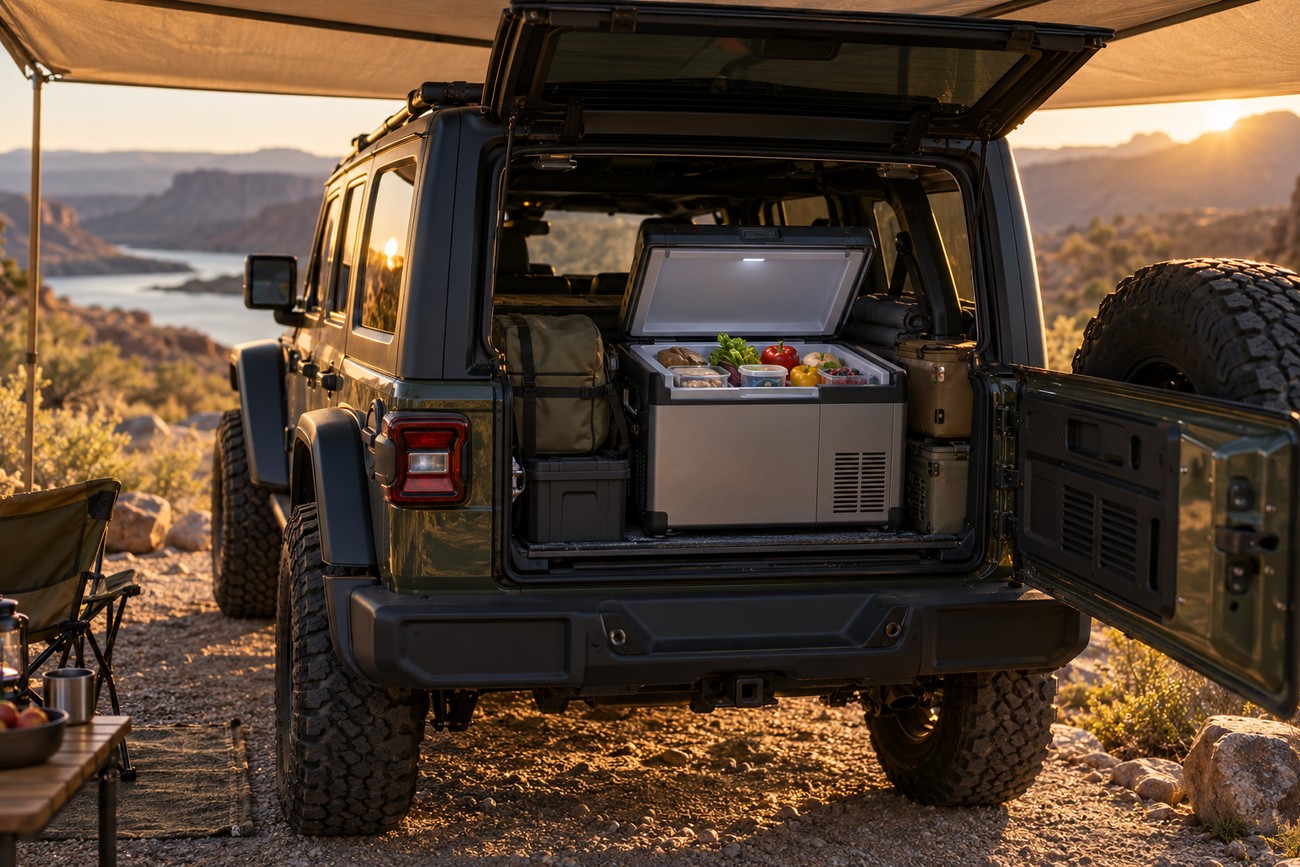
Heat changes the compressor duty cycle, and a stationary Wrangler can become much hotter than the outside air. Place the fridge in shade where possible, leave clear airflow around the compressor and condenser, and keep ventilation openings free of luggage. Dirt on cooling surfaces also reduces the system’s ability to reject heat.
Pre-chill the fridge and food before loading it into the vehicle. A well-loaded fridge usually has less empty warm air to exchange when the lid opens, though the benefit depends on the food temperature, packing arrangement, and outside conditions. Avoid loading large quantities of warm items immediately before a long unattended stop.
Reduce lid openings by organizing frequently used items near the top and keeping the lid closed while deciding what to take out. Secure the fridge so it stays level and cannot block its own ventilation or shift on rough trails. These small installation details matter because vibration, heat, and repeated openings can turn a cool-night energy estimate into a hot-day failure.
Compare performance in the conditions you actually expect to face. A cool night with shade may produce a substantially lower daily load than a hot, parked Wrangler in direct sun. If the system only works in the most favorable conditions, add cooling margin, battery reserve, or charging capacity before relying on it for food storage.
Frequently asked questions
These checks help separate a Wrangler-specific wiring behavior from a fridge or battery problem. They also keep a power-system fault from being mistaken for a food-safety decision.
How can I verify whether my Wrangler’s rear outlet stays live with the Jeep off?
Switch off the ignition, remove the key or turn the vehicle fully off, and plug in a low-power 12-volt test device or use a voltmeter. Check immediately and again after the Jeep has completed its normal shutdown period. If the device loses power, the outlet is ignition-switched; if it remains powered, treat it as continuously live until the owner’s manual and fuse information confirm otherwise.
Repeat the check for the exact socket you intend to use, since behavior can vary by model year and equipment. Do not infer outlet behavior from another Wrangler or from the physical presence of a rear socket.
What should I do after the fridge shuts down on low voltage overnight?
Protect the food first: check its temperature and follow applicable food-safety guidance before deciding what can be kept. Then disconnect the fridge, inspect the battery voltage, fuse, plug, ground, and cable connections, and recharge the system fully with an appropriate charger or vehicle charging system.
If the battery is charged but the fridge still shuts down, test for voltage drop at the fridge while the compressor starts. A low state of charge, a long or undersized cable, a poor connection, or excessive heat can produce similar symptoms. Record the battery and fridge-terminal voltage under load before changing the cutoff setting.
How can I keep the fridge cooler inside a hot Wrangler without adding another battery?
Park in shade, improve airflow around the condenser, keep vents clear, and clean dust from accessible cooling surfaces. Pre-chill both the fridge and its contents, limit lid openings, and avoid adding warm food immediately before leaving the Jeep unattended.
Use a thermometer to verify the result, because a cooler cabin does not always mean a cool compressor compartment. If the fridge remains hot despite shade and clear airflow, inspect its installation space and cable voltage before assuming that more battery capacity is needed.







