
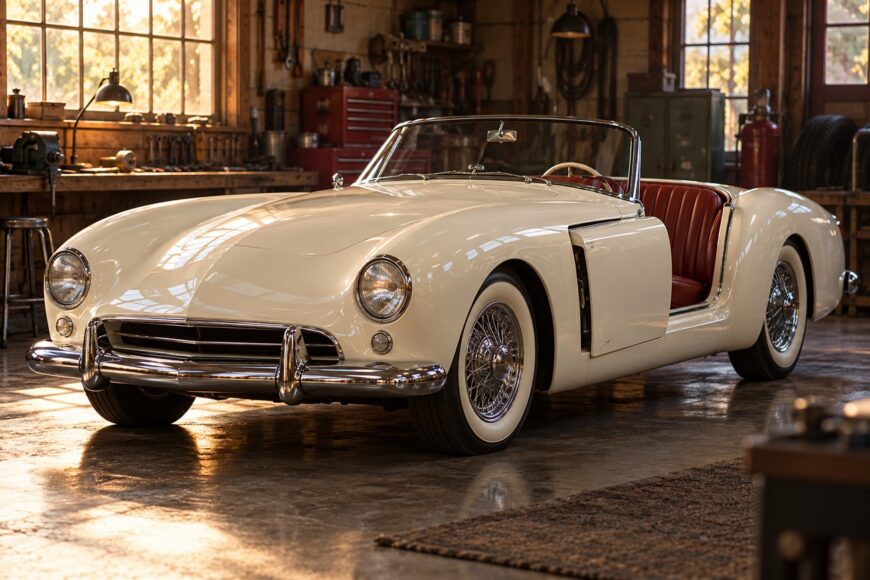
The Kaiser Darrin is a striking contradiction: a 1950s roadster with dramatic proportions, unusual sliding doors, and far less performance or practicality than its appearance suggests. Its doors retract into the front fenders, a solution rare even among experimental cars of the period.
Built in 1954–1955, the Kaiser Darrin reached only 435 examples. Power came from a 90-hp Willys/Hurricane inline-six, so the car’s visual promise exceeded its acceleration. That leaves the Darrin in an unusual category: part sports car, part design experiment, and increasingly, a collector object whose originality matters as much as its condition.
- A Design Experiment Built from Kaiser Henry J Parts
- How the Kaiser Darrin’s Sliding Doors Really Worked
- Kaiser Darrin at a Glance: Verified Specifications
- The Performance Problem Behind the Sports-Car Image
- Three-Position Roof, Limited Practicality, and Ownership Trade-Offs
- Myths That Distort the Kaiser Darrin’s Story
- What Collectors Should Check Before Calling One Original
- Frequently asked questions
- What is the estimated value of a 1954 Kaiser Darrin?
- How many Kaiser Darrins are left today?
- What American car had sliding doors before the Kaiser Darrin?
- What is considered the best car from 1954?
A Design Experiment Built from Kaiser Henry J Parts
Howard Darrin’s personal initiative produced the Kaiser Darrin as an unusual project within Kaiser Motors. The car looked like a bespoke fiberglass sports roadster, with a low nose, sculpted bodywork, and concealed door movement. Underneath, however, it relied on the Kaiser Henry J chassis and components rather than a dedicated high-performance platform.
That mixture shaped the car’s character. The fiberglass body allowed Darrin to pursue forms that would have been more difficult in conventional steel, while the Henry J foundation offered Kaiser a pragmatic way to support a limited-production model. The result was visually exotic without being mechanically independent in the way a fully bespoke sports car would have been.
Production ran from 1954 to 1955, and only 435 examples were built. Such a small run made the Darrin unusual from the beginning, rather than turning it into a common model that later became rare. It also means that surviving cars can differ in restoration quality, replacement parts, and the degree to which their unusual mechanisms remain original.
How the Kaiser Darrin’s Sliding Doors Really Worked
The Kaiser Darrin’s doors slide forward into the front fenders. They do not simply vanish into the lower body or operate like the doors of a later minivan. The front fenders themselves accommodate the retracted doors, making the entire side structure part of the mechanism.
This arrangement created an exceptionally clean profile when the doors were open. It also demanded accurate alignment between the door, its track, the fender, and the surrounding bodywork. A door that moves stiffly or fails to sit correctly can indicate adjustment problems, wear, or earlier repair work.
Servicing is therefore more involved than the dramatic photographs suggest. Body repairs around the front fenders can affect door travel, while work on the mechanism may require attention to several related components. The design is an engineering and styling feature first; it offers no inherent evidence that the car is easy to use every day.
For an owner, the practical test is complete movement from closed to fully retracted and back again. Visual inspection alone can miss binding, poor clearances, or repairs that preserve the exterior shape while compromising the mechanism.
Kaiser Darrin at a Glance: Verified Specifications
The following figures summarize the commonly reported specification while preserving the documented disagreement over the manual transmission.
| Specification | Kaiser Darrin |
|---|---|
| Production period | 1954–1955 |
| Production total | 435 examples |
| Body type | Two-seat sports roadster/convertible |
| Chassis basis | Kaiser Henry J chassis and components |
| Engine | Willys/Hurricane inline-six, 161 cu in (2.6 L) |
| Output | 90 hp |
| Top speed | Approximately 154–160 km/h |
| Acceleration | Approximately 15–16 seconds from 0 to 96 km/h |
| Drivetrain | Rear-wheel drive |
| Transmission | Disputed: sources identify either a 3-speed or 4-speed manual transmission |
| Roof | Three-position top: lowered, three-quarter raised, or fully raised |
| Reported period price | Approximately $3,668 |
The Performance Problem Behind the Sports-Car Image
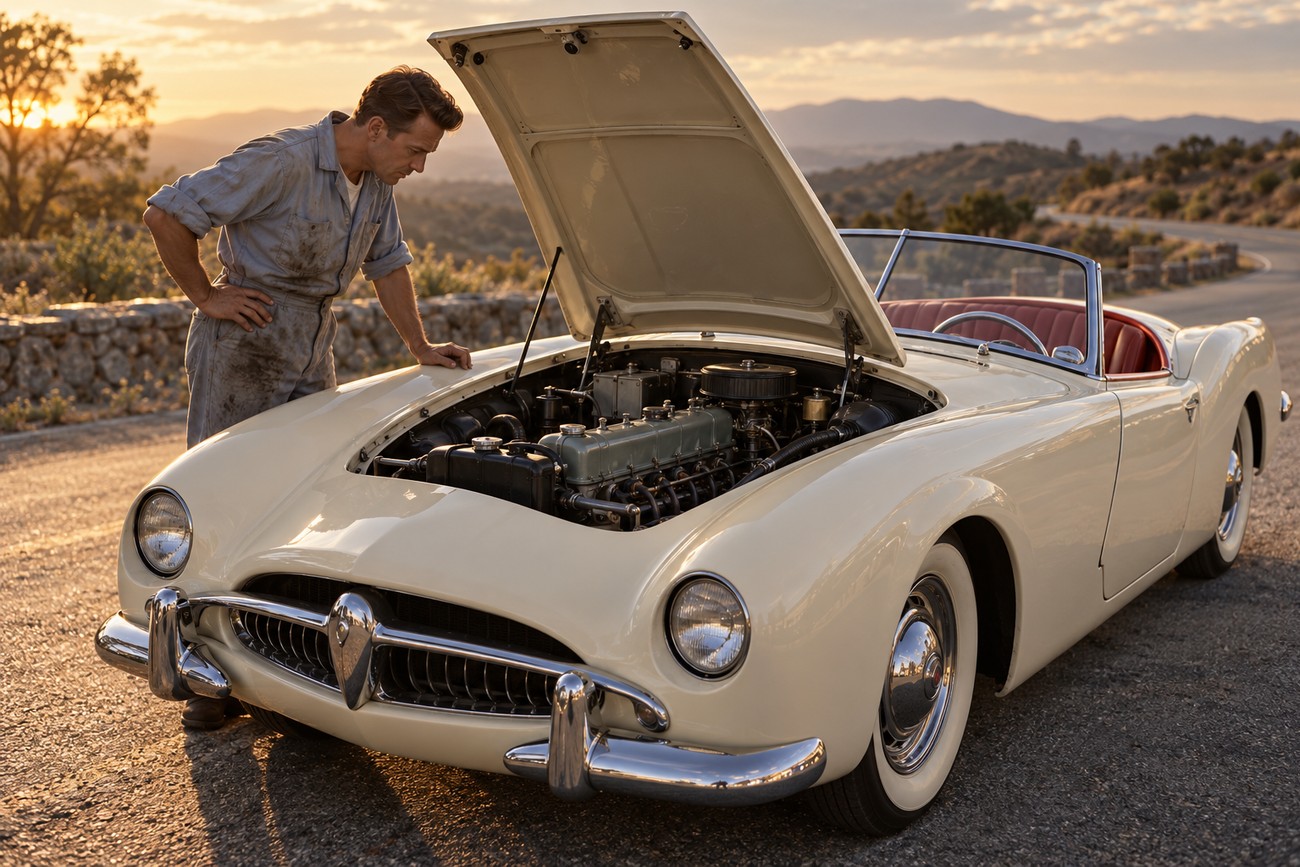
The Kaiser Darrin’s appearance suggests a sharper sports-car experience than its standard mechanical specification could deliver. Its 90-hp, 161 cu in (2.6 L) inline-six provided usable power for a lightweight roadster, yet it did not offer the strong acceleration associated with the car’s low, dramatic body.
Reported performance figures place the top speed at approximately 154–160 km/h, with 0–96 km/h taking approximately 15–16 seconds. These are approximate period figures rather than a single universally settled test result. They describe moderate performance, not outright sports-car urgency.
The distinction matters when evaluating a restored example. A Darrin can feel special because of its seating position, body shape, and door operation even when its acceleration feels ordinary. Expecting modern sports-car response, or assuming that the styling reflects a powerful engine, leads to an inaccurate ownership judgment.
The car’s strongest appeal lies in design and scarcity. Its rear-wheel-drive layout and roadster format provide the basic ingredients of a sporting car, but the Darrin is better understood as a design-led niche collectible than as a high-performance machine.
Three-Position Roof, Limited Practicality, and Ownership Trade-Offs
The Kaiser Darrin used a three-position top that could be lowered, raised three-quarters, or raised fully. That gave the driver more configuration choices than a simple open-or-closed soft top. It also introduced more moving parts and more opportunities for adjustment problems.
A roof that works in one position may still perform poorly in another. The partially raised setting is especially important because it tests the mechanism between its two extremes. Owners should assess smooth movement, fit, tension, and the condition of the related trim rather than treating the roof as a cosmetic accessory.
The production total of 435 cars limits the supply of original door mechanisms, roof components, and trim. Reproduction or adapted parts may keep a car usable, yet they can affect historical accuracy and future restoration work. A visually convincing replacement is not automatically equivalent to an original component.
These limitations make the Darrin better suited to a niche collector role than to unquestioned daily use. Its ownership appeal comes from the complete experience of an unusual design, while its practical compromises become more apparent with frequent use, repeated adjustments, or difficult body repairs.
Myths That Distort the Kaiser Darrin’s Story
The first common error concerns the engine. The standard Kaiser Darrin used a 90-hp Willys/Hurricane inline-six, not a powerful sports-car motor. The car’s styling creates an expectation of performance that the engine and reported acceleration figures do not support.
The door layout is also often described too loosely. The doors do not merely slide into the body in the manner of later sliding-door vehicles; they retract into the front fenders. That specific arrangement is central to the Darrin’s identity and explains why body alignment is so important.
Transmission descriptions require caution. Sources identify either a 3-speed or 4-speed manual transmission, so a single specification should not be presented as universally settled without documentation for the individual car. The discrepancy is a research issue rather than a reason to assume that every surviving example has the same equipment.
Finally, the Darrin was never a mass-market convertible. Only 435 examples were built, and the model was commercially unsuccessful. Its rarity came from limited production and weak market acceptance, which also helps explain today’s restricted parts and information supply.
What Collectors Should Check Before Calling One Original
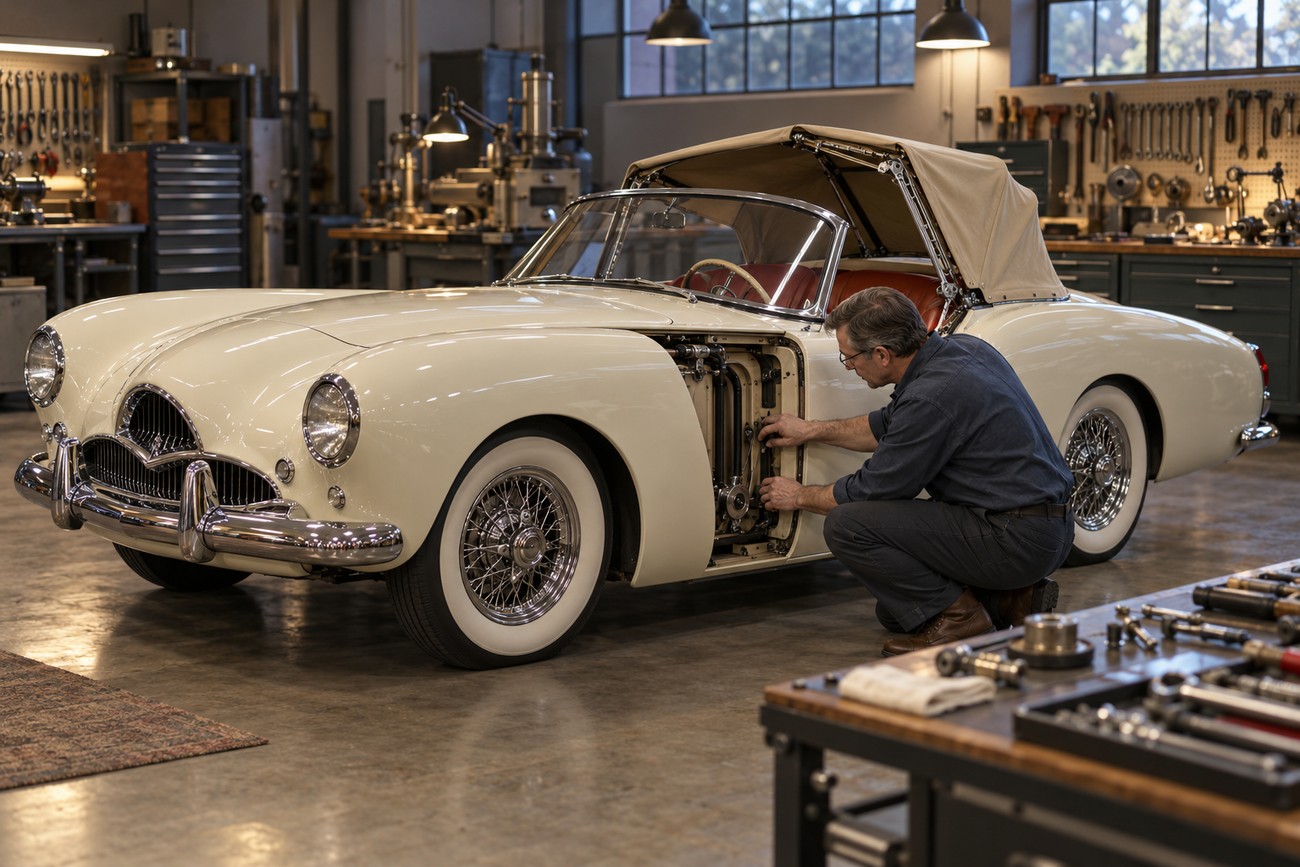
Inspection should begin with the features that define the car rather than with paint quality alone. Both doors should travel fully into the front fenders and return without binding, scraping, or excessive force. Their fit when closed should be assessed alongside the condition of the tracks, guides, and surrounding bodywork.
The three-position roof deserves the same level of attention. Test it lowered, three-quarters raised, and fully raised, checking whether each position can be reached without abnormal resistance. A roof that has been adjusted to look correct in one position may reveal restoration compromises when moved through its full range.
Complete door travel and roof operation can reveal restoration compromises that photographs conceal. Cosmetic originality is easier to judge after the mechanisms have proved that the car’s defining features still function correctly.
Next, examine the originality of the doors, roof components, trim, and fittings. Limited production increases the likelihood of replacement or reproduction parts, and small deviations can matter to collectors even when the car appears correct at a glance. Documentation can help distinguish factory features from later solutions.
Condition, originality, and provenance should be considered together. A fresh exterior cannot compensate for damaged door mechanisms, incomplete roof hardware, or undocumented substitutions. Conversely, an honest car with clearly recorded restoration work may be easier to evaluate than one with attractive but uncertain cosmetic repairs.
Frequently asked questions
The Kaiser Darrin’s rarity, unusual doors, and limited production make it difficult to evaluate by appearance alone. Its value and historical importance depend on condition, originality, documentation, and mechanical operation. The following answers address common questions about the model.
What is the estimated value of a 1954 Kaiser Darrin?
There is no reliable universal value for a 1954 Kaiser Darrin. A sound assessment should combine condition, originality, provenance, documentation, mechanical operation, and comparable auction results for cars with similar specifications and restoration quality.
Particular attention should go to the sliding doors, three-position roof, trim, and evidence of non-original parts. A car with attractive paint but compromised mechanisms may deserve a different valuation from a less polished example with strong originality and complete documentation.
How many Kaiser Darrins are left today?
The confirmed production total is 435 examples, but that figure does not establish how many cars survive today. Some may have been scrapped, heavily modified, lost from records, or preserved without appearing in a public registry.
Registry data can therefore indicate known cars rather than provide a definitive survivor count. The absence of a car from a database does not prove that it no longer exists, while multiple records can sometimes describe the same vehicle over different periods.
What American car had sliding doors before the Kaiser Darrin?
The Kaiser Darrin is itself a documented American example of an early production car with sliding doors, and its front-fender layout distinguishes it from later minivans and modern concept cars. Broad claims about a single predecessor require careful definition because experimental and specialty vehicles used different forms of sliding or retracting access.
The important historical point is the mechanism’s location. Darrin’s doors moved into the front fenders, creating a solution unlike the side-mounted tracks associated with later passenger vehicles. That makes the car significant as a specific American design experiment rather than as a direct template for modern minivan doors.
What is considered the best car from 1954?
There is no objective single winner for 1954. Awards, engineering significance, performance, design influence, usability, and collector desirability produce different answers, and the Kaiser Darrin scores most strongly in design distinctiveness and rarity.
Its 90-hp engine and limited practicality weaken its case as the best-performing or most useful car of the year. Its unusual doors, fiberglass body, and Howard Darrin connection make it a compelling specialist collectible, which is a different judgment from declaring it the best all-round automobile of 1954.







