
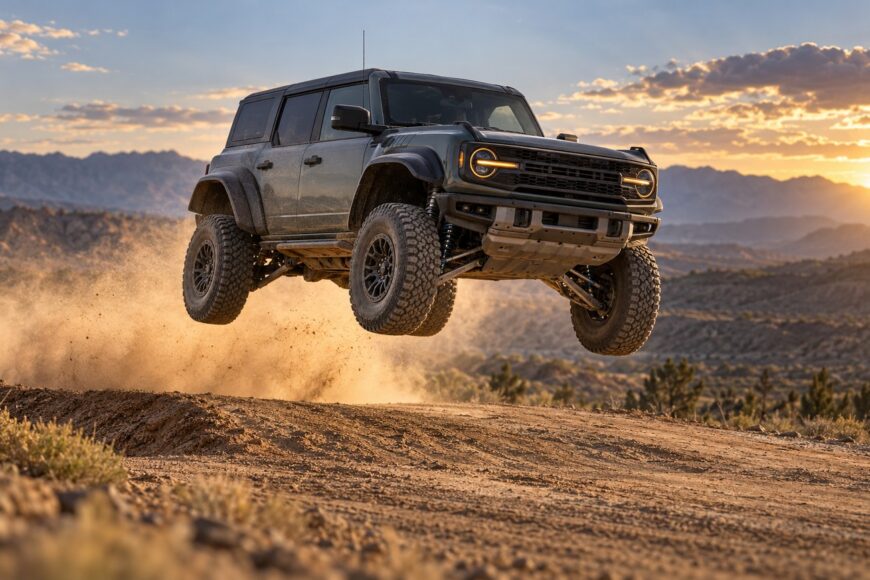
Launching a Ford Bronco from a dirt ramp has obvious visual appeal: a large, upright SUV leaves the ground, its suspension extends, and the vehicle appears to float before returning to the trail. The Bronco’s body-on-frame construction, long-travel suspension, and available off-road hardware make that image plausible.
Those qualities do not make a production SUV immune to landing loads. A jump concentrates energy into dampers, control arms, ball joints, mounts, wheels, tires, and the surrounding structure. This article assesses the Bronco’s capability, the differences between versions, the risks of a dirt ramp, and the professional context behind public stunts rather than encouraging an uncontrolled attempt.
- What Makes a Ford Bronco Capable Off the Ground
- Bronco Versions: What Changes the Jumping Risk
- The Dirt Ramp Matters More Than the Marketing
- What Baja Mode Can—and Cannot—Do
- The Damage That Can Follow a Hard Landing
- What the Famous 13-Meter Jump Actually Proves
- A Safer Way to Think About the Stunt
- Frequently asked questions
- How high is a Ford Bronco off the ground?
- What should I look for in a used Bronco that may have been jumped?
- How do you jump a Ford Bronco?
- Why is no one buying Broncos?
What Makes a Ford Bronco Capable Off the Ground
The sixth-generation Ford Bronco is a body-on-frame SUV, a construction that suits rough terrain and substantial suspension movement. Its design gives the vehicle a useful combination of chassis strength, ground clearance, four-wheel-drive capability, and available tire sidewall. That combination can keep the wheels working over terrain where a road-oriented crossover would quickly lose traction or clearance.
The Bronco Raptor is the clearest example. Its 3.0-liter V6 EcoBoost produces 424 hp and 597 N·m, giving it strong acceleration on loose surfaces. The power helps the vehicle reach and maintain speed across rough ground, but engine output alone says little about how cleanly the chassis will absorb a landing.
Suspension travel is more relevant to wheel control. The Raptor has 330 mm of front travel and 356 mm at the rear, with 333 mm of ground clearance on standard 37-inch tires. Those figures provide more room for the wheels to follow dips and rises before the chassis contacts the terrain.
Its approach angle is 47.2°, departure angle is 40.5°, and breakover angle is 30.8°. These measurements describe how the Bronco negotiates obstacles and crests at low or moderate speed. They do not certify the vehicle for airborne use, and they cannot correct an unsuitable launch attitude, excessive speed, or a poor landing surface.
Bronco Versions: What Changes the Jumping Risk
Bronco versions differ substantially in clearance, suspension travel, tires, and calibration. The specifications below help explain the margin between them, but a higher specification still does not make repeated jumps safe.
| Version | Relevant capability | What it means for a jump |
|---|---|---|
| Regular Bronco | 211–295 mm of ground clearance, depending on version and package | Useful clearance, but the available suspension and tire packages vary considerably. |
| Base Bronco | 200 mm front and 215 mm rear suspension travel | Less wheel movement than specialist versions, leaving less margin over rough ground. |
| Bronco Badlands | 240 mm front and 261 mm rear suspension travel | More control over uneven terrain, though bottoming out and impact damage remain possible. |
| Bronco Raptor | 333 mm of clearance, 330/356 mm of travel, and standard 37-inch tires | The strongest factory off-road package here, yet still a production SUV rather than an indestructible stunt vehicle. |
| Bronco Sport | Lighter crossover with a different platform and vehicle category | It should not be treated as the same vehicle or substituted in jump assumptions. |
Ground clearance and suspension travel solve different problems. Clearance helps keep the body and underbody away from an obstacle, while travel determines how far the wheels can move relative to the body. A vehicle may have generous clearance and still use all of its suspension travel abruptly during a landing.
Tires also change the result. The Raptor’s 37-inch tires provide a large contact patch and useful sidewall, but they and their wheels are expensive components to damage. Tire size does not remove the risk of a hard side load, bead damage, wheel deformation, or a puncture on landing.
The Dirt Ramp Matters More Than the Marketing
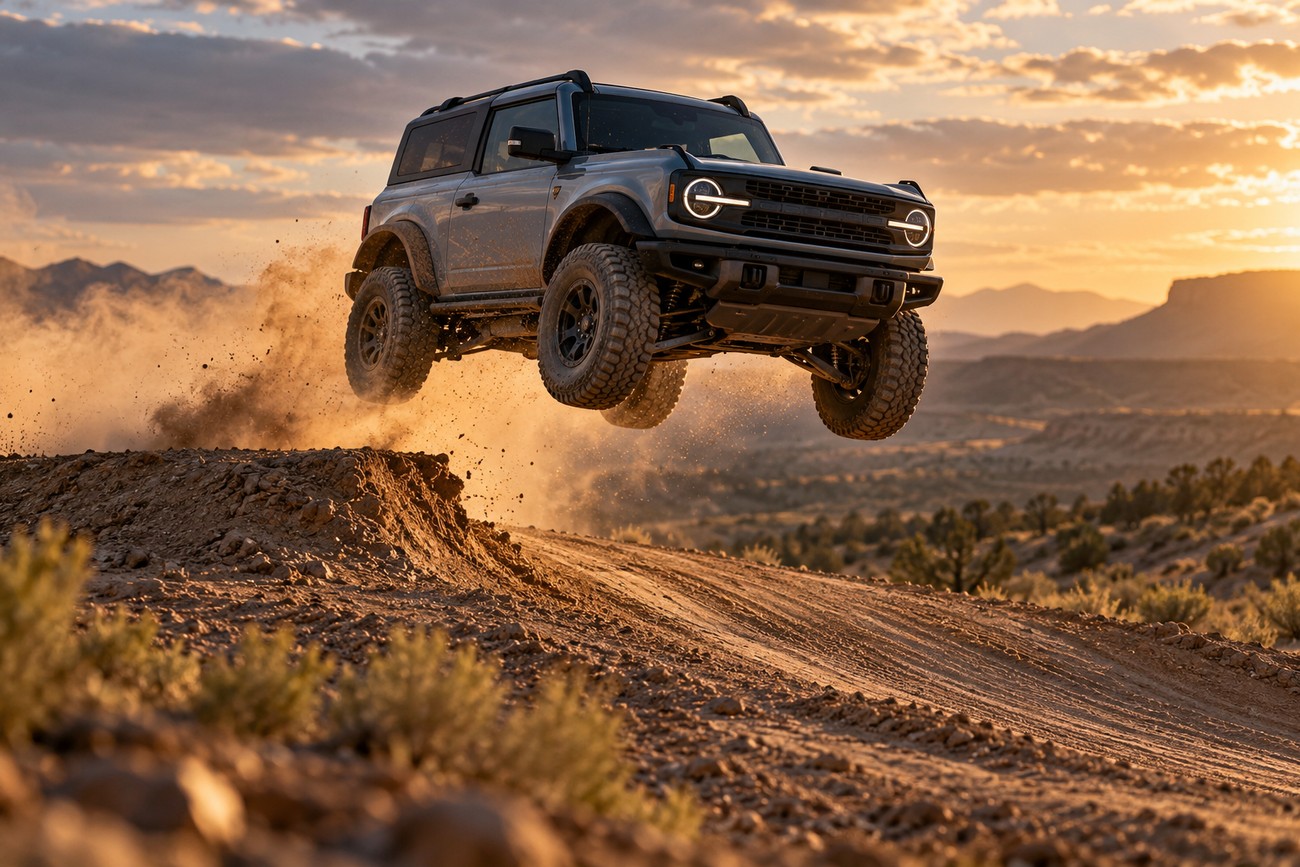
A dirt ramp is part of the vehicle system during a jump. Its transition, lip, takeoff attitude, and landing slope determine how the Bronco leaves the ground and how its suspension receives the vehicle’s mass. A prepared ramp and landing zone are shaped for a predictable trajectory; a random mound can produce a nose-down, nose-up, or sideways arrival.
Speed and launch angle interact with the shape of the landing. Too much speed can carry the vehicle beyond the intended zone, while an unsuitable attitude can load one axle or one corner first. Long suspension travel cannot compensate for a landing that forces the dampers to reach full compression too quickly, causing bottoming out.
The Bronco’s mass also matters. A heavy SUV generally transfers more energy into its suspension and wheels than a lightweight buggy at the same general speed. The consequences of a small steering or trajectory error can therefore include overloaded dampers, control arms, ball joints, mounts, wheels, and tires.
Engine power is only one part of the equation. Suspension behavior on compression and rebound, weight distribution, tire pressure, surface consistency, and the driver’s ability to maintain a stable trajectory all influence the landing. Professional SUV jumps are typically performed on prepared ramps and landing zones, with safety controls that a casual trail environment does not provide.
What Baja Mode Can—and Cannot—Do
The Bronco’s G. O. A. T. drive modes adjust the vehicle for different surfaces and driving conditions. Baja is designed for high-speed travel over loose or rough terrain, where throttle response, transmission behavior, traction management, and other controls need to support a fast, unsettled surface.
That can help the Bronco remain more predictable before and after brief wheel lift. It may support stability when the tires cross ruts or small rises, but it does not change the basic physics of a landing. The dampers, mounts, wheels, and tires still receive the vehicle’s impact energy.
Baja is not an official unrestricted jump mode. Selecting it cannot protect the vehicle from bottoming out, an incorrect trajectory, or a landing that arrives on one corner. The setting should be understood as a calibration for fast loose-surface driving, not permission to treat a dirt ramp as a test facility.
Version-specific suspension and tire calibration can change behavior more than the model badge alone. A Raptor has more clearance and travel than regular Bronco versions, but even its specialized hardware has a finite operating range. The useful question is whether the complete vehicle remains controlled on the surface, not whether one drive mode sounds suitable for desert footage.
The Damage That Can Follow a Hard Landing
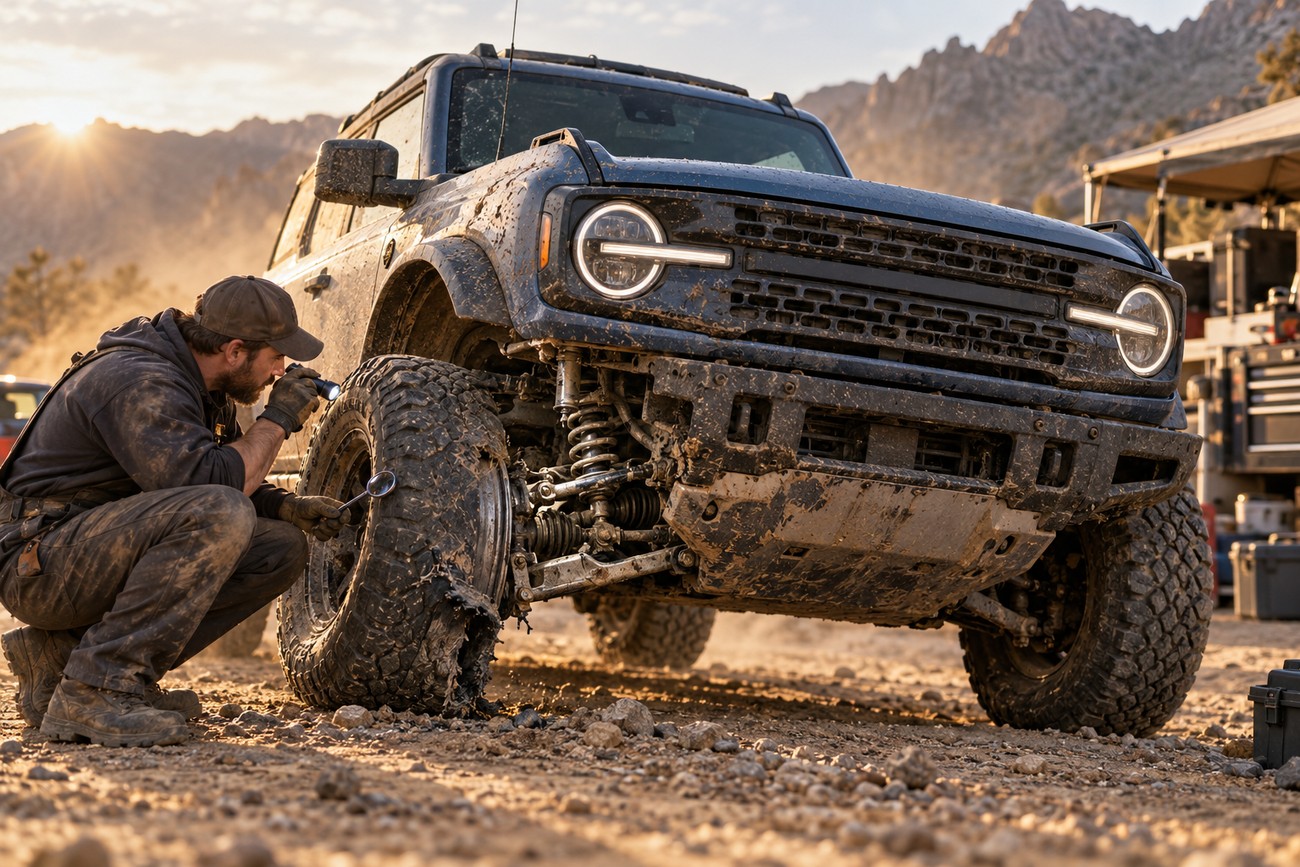
A hard landing can damage parts without leaving an immediate visual clue. Bottoming out sends a sharp load through the dampers and their mounts, while an uneven arrival can overload a control arm, ball joint, steering component, or wheel. The vehicle may continue moving afterward, making a serious inspection easy to postpone.
Common post-impact clues include new knocking noises, a steering wheel that no longer sits centered, or a vehicle that pulls to one side. A bent wheel, damaged tire, or changed alignment can create these symptoms. Sensor warnings may also appear if an impact disturbs a wheel-speed sensor, wiring, or another component near the suspension.
Steering-center changes, fresh suspension knocks, wheel damage, and warning lights deserve attention before a hard landing is treated as harmless. A visual check alone can miss alignment or mounting damage.
The Raptor’s factory 37-inch tires and wheels can be costly to replace, and their size does not make them immune to impact. Inspectors should look for sidewall cuts, bulges, bead damage, rim deformation, and uneven wear. A tire that still holds air may nevertheless have suffered damage that becomes apparent later.
Repeated severe off-road use can also produce body and interior squeaks, including in a prepared version. New noises are not proof of structural failure, but they are useful evidence that the vehicle has experienced more load than ordinary trail driving. A proper inspection should include alignment measurement, underbody checks, suspension joints, wheel condition, and electronic diagnostics.
What the Famous 13-Meter Jump Actually Proves
A publicized Bronco stunt has been described as a successful 13-meter jump. It is an impressive demonstration of controlled vehicle movement, but it should not be read as a durability benchmark for every Bronco or as evidence that a stock vehicle can be jumped repeatedly without consequence.
The stunt was associated with a professional freestyle motorcyclist and a prepared stunt environment. That context matters because the ramp, landing zone, trajectory, vehicle setup, and driver preparation are all part of the result. A production SUV completing one planned jump does not establish its service life under repeated high-load impacts.
Marketing language about desert readiness describes a vehicle’s ability to operate over demanding loose and rough terrain. It does not promise unlimited jump durability. Factory geometry, suspension, and drive-mode specifications describe capability data, not manufacturer approval for airborne use.
The useful lesson is narrower: the Bronco can be engineered to perform a controlled demonstration under suitable conditions. It does not follow that an ordinary owner should copy the stunt on an unprepared dirt ramp, especially with a vehicle whose maintenance history and suspension condition are unknown.
A Safer Way to Think About the Stunt
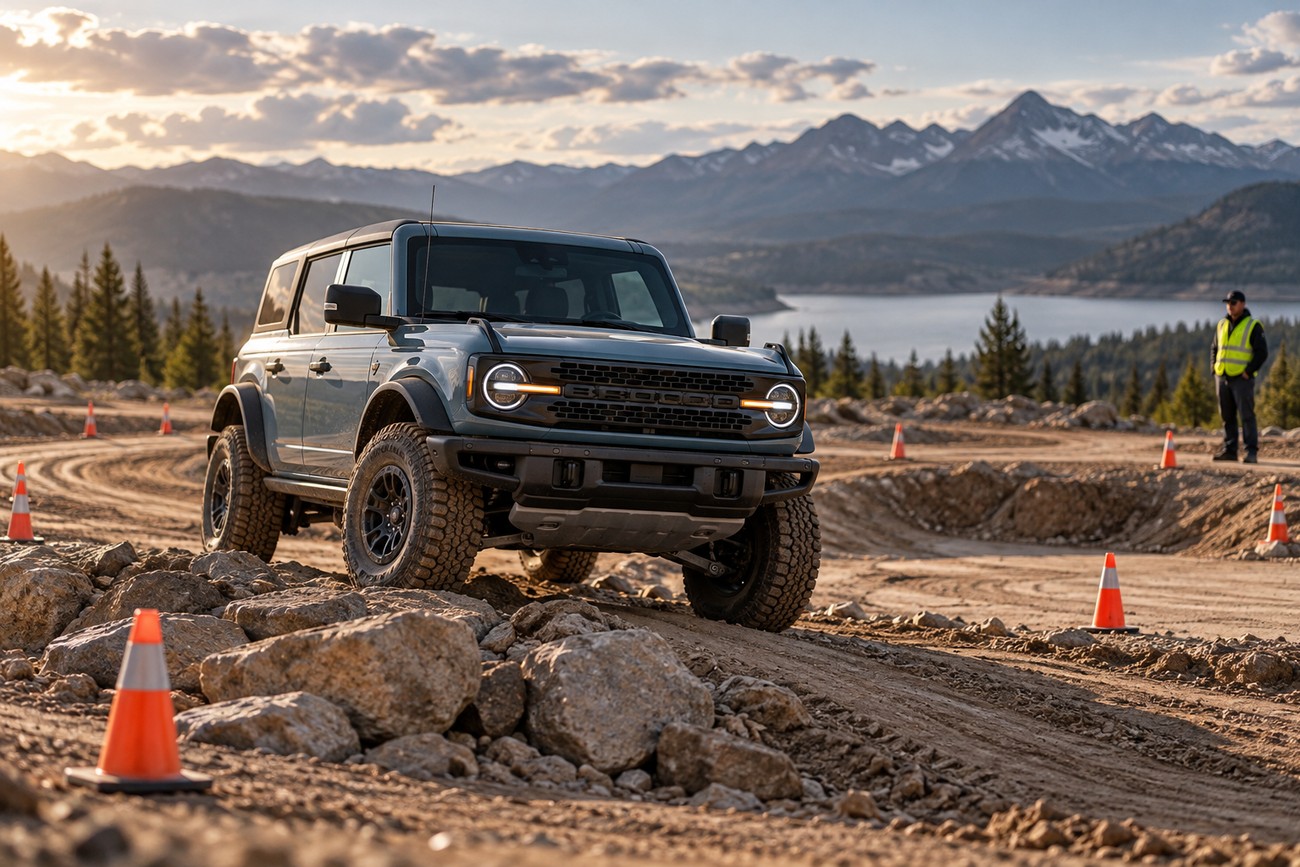
The sensible decision starts with the use case. Ordinary trail driving, fast movement over rough ground, and deliberate jumps impose different loads, even if all three are marketed as off-road activity. Repeated jumps should be treated as an abnormal high-load use case rather than ordinary trail driving.
Any controlled testing belongs on private or properly authorized land, with a prepared surface, suitable safety planning, and people qualified to manage the vehicle and the site. Exact launch speeds, ramp dimensions, and improvised techniques cannot be transferred safely from one vehicle, surface, or driver to another.
Vehicle preparation should include checking tires, wheels, suspension joints, dampers, steering, underbody components, and warning systems. After a heavy impact, alignment and diagnostics matter even when the body panels look straight. A capable off-road package improves the margin; it does not make the Bronco indestructible.
The Bronco Raptor offers more suspension travel and clearance than regular Bronco versions, but that advantage is best understood as additional control over difficult terrain. Bronco Sport is a lighter crossover on a different platform and should not be used as a substitute in comparisons or stunt assumptions. Capability assessment is the responsible conclusion; casual imitation is not.
Frequently asked questions
How high is a Ford Bronco off the ground?
There is no single clearance figure for every Ford Bronco. Regular Bronco ground clearance ranges from 211 to 295 mm, depending on the version and package, while the Bronco Raptor has 333 mm on standard 37-inch tires.
Ground clearance is the space beneath the vehicle at rest. Suspension travel describes how far the wheels can move relative to the body: the base Bronco has 200 mm front and 215 mm rear, while the Badlands has 240 mm front and 261 mm rear. Neither figure predicts a safe landing by itself.
What should I look for in a used Bronco that may have been jumped?
Check whether the steering wheel sits off-center, whether the vehicle pulls during a straight road test, and whether new knocks appear over small bumps. Inspect wheels and tire sidewalls for bends, cuts, bulges, bead damage, or uneven wear.
Warning lights, sensor messages, unexplained body or interior squeaks, and fresh-looking suspension parts also justify closer inspection. An alignment measurement and diagnostic scan can reveal impact consequences that are not visible from outside.
How do you jump a Ford Bronco?
A production Bronco should not be treated as a vehicle for casual or improvised jumps. A controlled stunt requires a prepared ramp and landing zone, an appropriate vehicle, qualified supervision, legal access, and a post-run inspection; copying a video on an untested dirt mound removes those controls.
Baja mode does not make jumping safe, and no factory clearance or suspension figure removes landing loads. For normal owners, assessing the Bronco’s performance over rough ground is a safer and more useful test than attempting to leave the surface.
Why is no one buying Broncos?
The premise is too broad: Bronco demand varies by market, trim, price, financing conditions, inventory, and consumer preferences. A slower sales period does not mean that nobody is buying the model.
Some buyers may also choose smaller crossovers, different off-road vehicles, or less expensive trims. Those factors concern market demand and ownership costs, not whether the Bronco is mechanically capable on rough terrain.







