
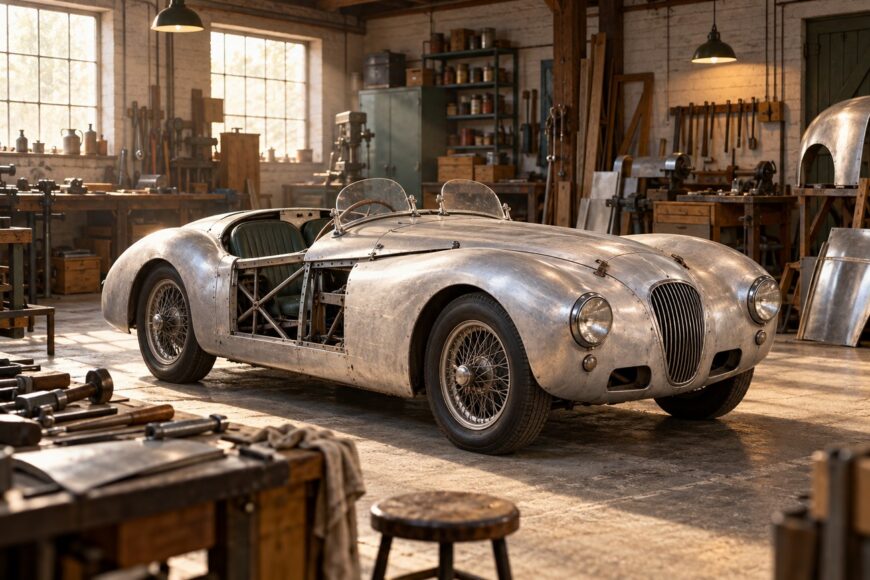
The Jowett Jupiter earned its Le Mans reputation through efficiency rather than overwhelming power. It was a class winner, not the outright winner of the 24 Hours, yet that distinction has often been blurred in popular descriptions. The surviving road cars are also far removed from the specially prepared machines that made the headlines.
Built in small numbers, the Jupiter combines an aluminum body, tubular steel chassis, and an unusual flat-four engine. Published figures vary for good reasons: power is quoted at approximately 60–62.5 bhp, while weight appears as about 711 kg for one lightweight specification and about 860 kg for another. Condition, equipment, gearing, race preparation, and decades of repairs matter more than a single catalogue number.
- A Small British Sports Car Built in a Hurry
- How the Flat-Four Jupiter Worked
- Why the Jupiter Won Its Le Mans Class
- The Road Jupiter Was Not the Le Mans Car
- What the Numbers Hide in a Surviving Car
- Buying a Rare Jupiter: Inspection Before Romance
- Frequently asked questions
- How many Jowett Jupiter cars were made?
- Was Ken Miles robbed of his win?
- Why is the Jowett Jupiter’s weight listed so differently in reference books?
A Small British Sports Car Built in a Hurry
Jowett produced the Jupiter from 1950 to 1954, during a brief period when the Bradford company tried to turn its unconventional engineering into a serious sports-car proposition. The first two completed Jupiters reached the road by March 1950. That timetable says much about the project: it was developed with urgency, and its competition potential was tested almost immediately.
The car grew from Jowett’s post-war engineering approach, which favored compact dimensions and a horizontally opposed engine over more conventional British sports-car layouts. Its aluminum body sat over a steel frame, helping control mass while giving the Jupiter a distinctive, low-slung appearance. Aluminum panels resist ordinary steel-panel rust, although they do not remove the structural concerns associated with an old car.
Approximately 901 Jupiters were built. That limited production makes the model historically significant, but it also explains why ownership requires more research than a better-supported MG, Triumph, or Austin-Healey. A Jupiter’s importance lies partly in how much engineering ambition Jowett packed into a small production run.
How the Flat-Four Jupiter Worked
The Jupiter used a water-cooled, horizontally opposed four-cylinder OHV engine of 1485–1486 cc, fitted with two Zenith carburetors. Published output ranges from approximately 60–62.5 bhp at 4500 rpm, depending on version and measurement method. The figures should therefore be read as period specification data, rather than as a precise description of every surviving engine.
Its tubular steel chassis carried an aluminum body over a steel frame. Independent torsion-bar front suspension worked with a live driven rear axle, while rack-and-pinion steering gave the car a direct mechanical layout. A four-speed gearbox was operated through a column-mounted shift, an arrangement that reflects the period and deserves a careful assessment for wear, adjustment, and originality.
Weight is one of the Jupiter’s most confusing published details. About 711 kg refers to a lightweight specification, whereas about 860 kg belongs to another specification; the figures are not directly comparable without configuration details. Equipment, body style, competition preparation, and the method used to record mass can all change the result.
The engine’s compact form helped keep weight low at the front of the car and left the Jupiter with a character unlike that of the more familiar front-engine British sports cars of the era. Its performance depended on the whole package: mass, gearing, aerodynamics, and engine tune mattered as much as the nominal power figure.
Why the Jupiter Won Its Le Mans Class

At Le Mans in 1950, the Jupiter won the class up to 1.5 litres, covering 1819.725 miles at an average 75.84 mph. That was a substantial result for a small manufacturer entering a new sports car. It was a class victory, however, rather than an outright win against every car in the race.
Factory Jupiters won their class at Le Mans in 1950, 1951, and 1952. The result came from sustained speed and endurance discipline rather than headline horsepower. Low mass, useful aerodynamic efficiency, careful preparation, and a suitable engine capacity allowed the car to remain competitive over a long distance.
In 1951 and 1952, the factory used special lightweight R1 cars with sports-racing-style bodies. These were competition-oriented versions, not ordinary road Jupiters with a racing paint scheme. Their lighter construction and preparation make direct comparisons with a fully equipped road car misleading.
The Jupiter’s achievement is best understood as an example of intelligent engineering under a capacity limit. A modest engine could be effective when the chassis, body, gearing, and preparation reduced the work required from it. That lesson explains the Le Mans record more convincingly than the phrase “small racing miracle.”
The Road Jupiter Was Not the Le Mans Car
Factory racing Jupiters were specially prepared, and their results should not be treated as a promise made by every road car. The R1 was a distinct lightweight competition-oriented version, with a sports-racing-style body and a different purpose. A standard Jupiter carried road equipment, additional mass, and the accumulated effects of normal production variation.
Period specifications and promotional sources quote a top speed of about 85–90 mph. This is a range of published claims, not a universal guarantee for every surviving car. An individual Jupiter may have different gearing, engine condition, carburetor settings, body weight, or rolling resistance after decades of use.
Even a mechanically sound road example should be judged on its present condition. A car that has received replacement parts, altered induction, repaired bodywork, or a rebuilt engine may drive well while differing substantially from its original specification. That is common in old sports cars and does not automatically make the car undesirable.
What the Numbers Hide in a Surviving Car
Power figures of 60, 62, and 62.5 bhp can reflect different versions or measurement methods. The Jupiter engine also used tuning distinct from the Javelin despite the same basic displacement, including differences in compression ratio and carburetion. A catalogue number without the relevant engine specification has limited value.
The same caution applies to weight. About 711 kg and about 860 kg describe different specifications, so choosing one figure as the “correct” Jupiter weight creates a false certainty. A buyer should establish which body, equipment level, and competition or road configuration the source describes.
Age introduces another layer of uncertainty. Engines may have been rebuilt, aluminum panels replaced, chassis sections repaired, and running gear altered. Period performance figures describe a particular specification in suitable condition; they do not certify the condition of a car offered for sale today.
For that reason, an advertisement without a chassis number and exact configuration is incomplete. The number helps connect the car to its history, while detailed inspection reveals whether the surviving vehicle still resembles the claimed specification in any meaningful mechanical sense.
Buying a Rare Jupiter: Inspection Before Romance

Begin with identity and structure. Verify the chassis number and establish whether the car’s specification matches its description. The tubular steel chassis requires its own inspection, separate from the visible aluminum body, because attractive panels can conceal expensive structural work.
Inspect the steel body frame, fixings, mounting points, and areas where dissimilar materials meet. The aluminum skin is less vulnerable to ordinary rust, while the steel beneath it remains exposed to corrosion and fatigue. Look also for distortion, poorly fitted panels, and repairs that have altered door gaps or the relationship between body and chassis.
Undocumented aluminum repairs are both a structural and valuation issue: the quality of the panel work can matter as much as the absence of visible rust, particularly where the body frame and mounting points are involved.
Mechanical inspection should cover the engine, cooling system, carburetors, gearbox, steering, suspension, brakes, and axle, without assuming that period specifications predict present behavior. Confirm which parts are original, which are replacements, and which may be difficult to source. With approximately 901 cars built, many body and mechanical components are model-specific rather than readily interchangeable.
Finally, separate historical appeal from condition. A prestigious Le Mans association can inflate an asking price beyond the mechanical value of an individual car. Specialist support, competent aluminum repair, and access to model-specific parts may matter more to ownership than a polished presentation or an impressive racing story.
Frequently asked questions
The Jupiter’s history is often compressed into a few attractive claims, which can obscure useful distinctions about production, racing success, and specification. These answers keep the main facts tied to their proper context.
How many Jowett Jupiter cars were made?
The commonly cited production total is about 901 cars, built between 1950 and 1954. It is an approximate historical count, not a guarantee that the same number of original, complete, or roadworthy cars survives today.
Because production was so limited, a surviving car should be assessed individually. Its chassis identity, body repairs, specification, and history are more useful than treating the model as a uniform product.
Was Ken Miles robbed of his win?
The famous Ken Miles controversy concerns the 1966 Le Mans finish and has no connection with the Jowett Jupiter. The Jupiter’s Le Mans record concerns class victories in 1950, 1951, and 1952.
In 1950, the Jupiter won the class up to 1.5 liters. It did not win the overall 24 Hours of Le Mans, so the two stories should remain separate.
Why is the Jowett Jupiter’s weight listed so differently in reference books?
The published figures of about 711 kg and about 860 kg refer to different specifications. Equipment, body configuration, lightweight competition preparation, and measurement practice can all affect the stated mass.
Neither figure should be selected without context. A precise assessment requires the individual car’s configuration, because a road Jupiter and a lightweight competition specification are not directly comparable.







