
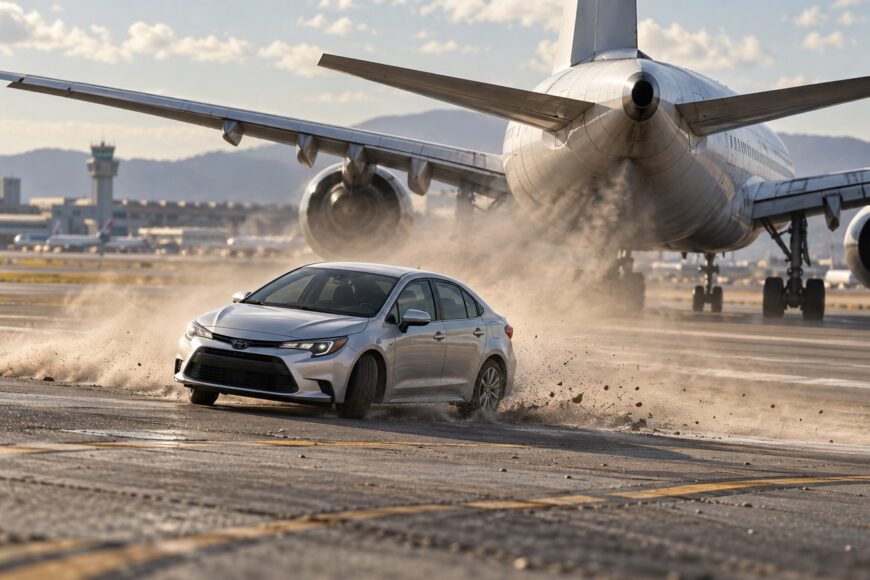
A compact Toyota Corolla can appear safely parked while a turning or accelerating jet shifts it, cracks its glass, or drives abrasive debris across its paint. The danger comes from the high-speed flow behind the engines, where exhaust gases and surrounding air can reach a vehicle with enough force to move it or damage exposed parts.
There is no universal safe distance. Risk depends on engine setting, aircraft orientation, wind, surface condition, aircraft type, and whether the Corolla is positioned behind the engines or well to the side. A taxiing aircraft may create less blast than one at takeoff power, yet even a low-power setting can lift stones, dust, and sand.
- What Happens When Jet Blast Hits a Toyota Corolla
- How Powerful Is Jet Blast?
- Where the Risk Is Highest: Distance, Direction, Wind, and Surface
- The Mistakes That Put a Car in the Blast Path
- What Jet Blast Can Damage—and What May Stay Hidden
- How to Avoid Jet Blast Near a Runway
- Why Warning Signs and Compensation Rules May Not Settle the Problem
- Jet Blast Myths That Put Vehicles at Risk
- Frequently asked questions
- How powerful is a jet blast at the car itself?
- How can you avoid jet blast near a runway if an aircraft starts turning toward you?
- Can jet blast damage a parked car when its engine is turned off?
- What evidence should a driver collect after suspected jet-blast damage?
What Happens When Jet Blast Hits a Toyota Corolla
A jet engine creates thrust by expelling gases and air backward. This follows conservation of momentum and Newton’s third law: accelerating the flow in one direction produces a reaction force that moves the aircraft forward. Behind the engine, that exhaust combines with surrounding air to form jet blast, a high-speed flow that spreads and weakens with distance.
A Corolla has relatively low mass compared with an airliner and presents a broad side area to moving air. If the vehicle is aligned with the blast, the flow can push it, rotate it, or move it toward another vehicle or fixed object. The outcome depends on the aircraft, power setting, angle, wind, tires, parking brake, and surface.
Large passenger aircraft can produce static takeoff thrust measured in tens of kilonewtons per engine. That figure describes engine output, not a direct force applied to a car, but it explains why a lightweight passenger vehicle can be vulnerable close behind a large aircraft.
Reported compact-car incidents have included vehicle movement, rotation, deformed panels, broken or cracked glass, detached trim, and damage from debris. A Corolla will not overturn in every exposure, and a visible lack of movement does not prove that the car escaped without damage.
How Powerful Is Jet Blast?
Jet blast is a fast-moving mixture of exhaust gases and air behind the engine. Exhaust velocity can exceed the speed of sound and may be several times sonic, depending on engine type and operating condition. The flow becomes more dispersed with distance, but it can remain hazardous where people, vehicles, equipment, or loose material are exposed.
Engine thrust and exhaust velocity are different measurements. Thrust describes the force used to propel the aircraft, while the air reaching a Corolla depends on the engine nozzle, aircraft geometry, power setting, distance, angle, wind, and the vehicle’s exposed surfaces. A thrust rating therefore cannot be converted directly into one reliable force figure at a parked car.
One pilot-forum estimate describes dynamic pressure comparable to winds above 70 m/s at up to 50 m. This is a disputed, forum-based estimate, not a universal aviation standard or a substitute for an airport’s aircraft-specific hazard data.
For drivers, the practical conclusion is simple: a jet does not need to be at full takeoff power to create a vehicle hazard. Taxiing and engine-start settings are less powerful, but they can still move loose material and cause damage near the aircraft.
Where the Risk Is Highest: Distance, Direction, Wind, and Surface
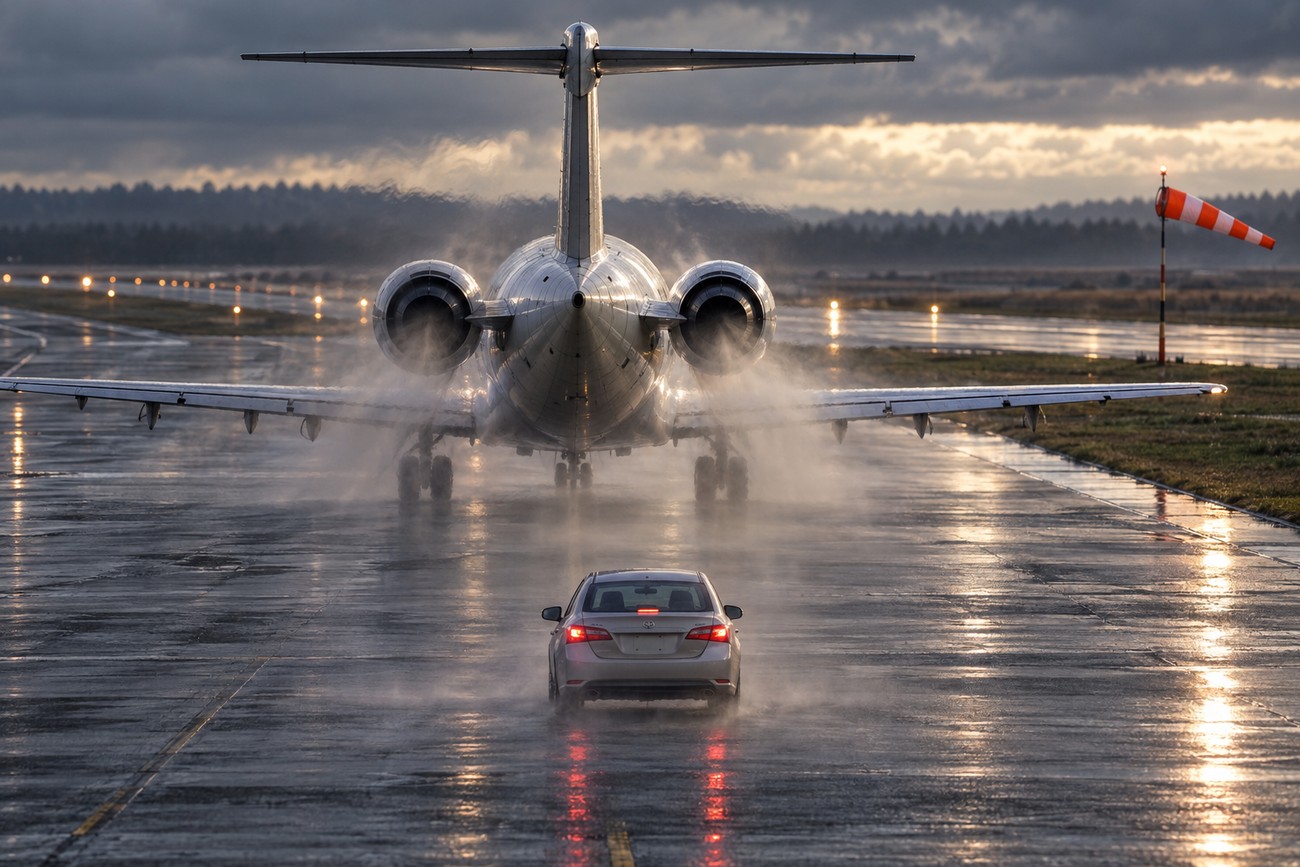
Horizontal distance alone is a poor safety test. The sector directly behind the engines is generally more hazardous than an equivalent distance to the side because the vehicle receives the main flow rather than its diluted edge. A car that appears far from a runway can still be exposed if an aircraft turns and points its tail toward it.
Incident reports and videos describe compact-car damage at approximately 20–60 m behind jet aircraft during taxiing or departure-related power increases. These reports show why a distance range should not be treated as a guaranteed clearance. Aircraft type, engine setting, aircraft angle, barriers, and local procedures can change the exposure substantially.
Wind can lengthen or shift the hazardous area. A crosswind may carry the flow sideways, while other wind conditions can extend the blast farther along the ground or alter where debris lands. The aircraft’s turn is especially important because it can bring the engine exhaust into alignment with a car that was previously outside the apparent path.
Surface condition changes the type of damage as well as its severity. Concrete may provide less loose material than gravel, soil, or an uncleaned shoulder, while gravel and soil can supply stones and abrasive dust. Even where the airflow does not move the Corolla, airborne debris can chip paint, scratch glass, and damage plastic trim.
The Mistakes That Put a Car in the Blast Path
Parking as close as possible to a runway or taxiway creates exposure for the sake of convenience. A driver may judge the location by the runway edge or a nearby fence while overlooking the aircraft’s tail, engine position, and turning path. The greater danger is usually directly behind the engines, rather than at the same distance beside the aircraft.
Another common mistake is assuming that taxiing or engine start means harmless airflow. Lower power can still lift dust, sand, stones, and other loose objects. Open windows, doors, or a trunk then allow debris inside the vehicle and increase the chance of glass, trim, and interior damage.
A turning aircraft can align its engines with a vehicle before the driver hears a clear warning. Ramp drivers watch the tail and the turn, not only the runway edge, because the blast path can change in seconds.
Leaving the Corolla in neutral, relying on an unsecured parking brake, or stopping on a sloped or loose surface adds a movement risk. A vehicle may shift, rotate, or roll into another car, equipment, or a barrier. Ground personnel should also avoid placing vehicles closer to an active taxi route simply to shorten a passenger pickup or servicing task.
What Jet Blast Can Damage—and What May Stay Hidden
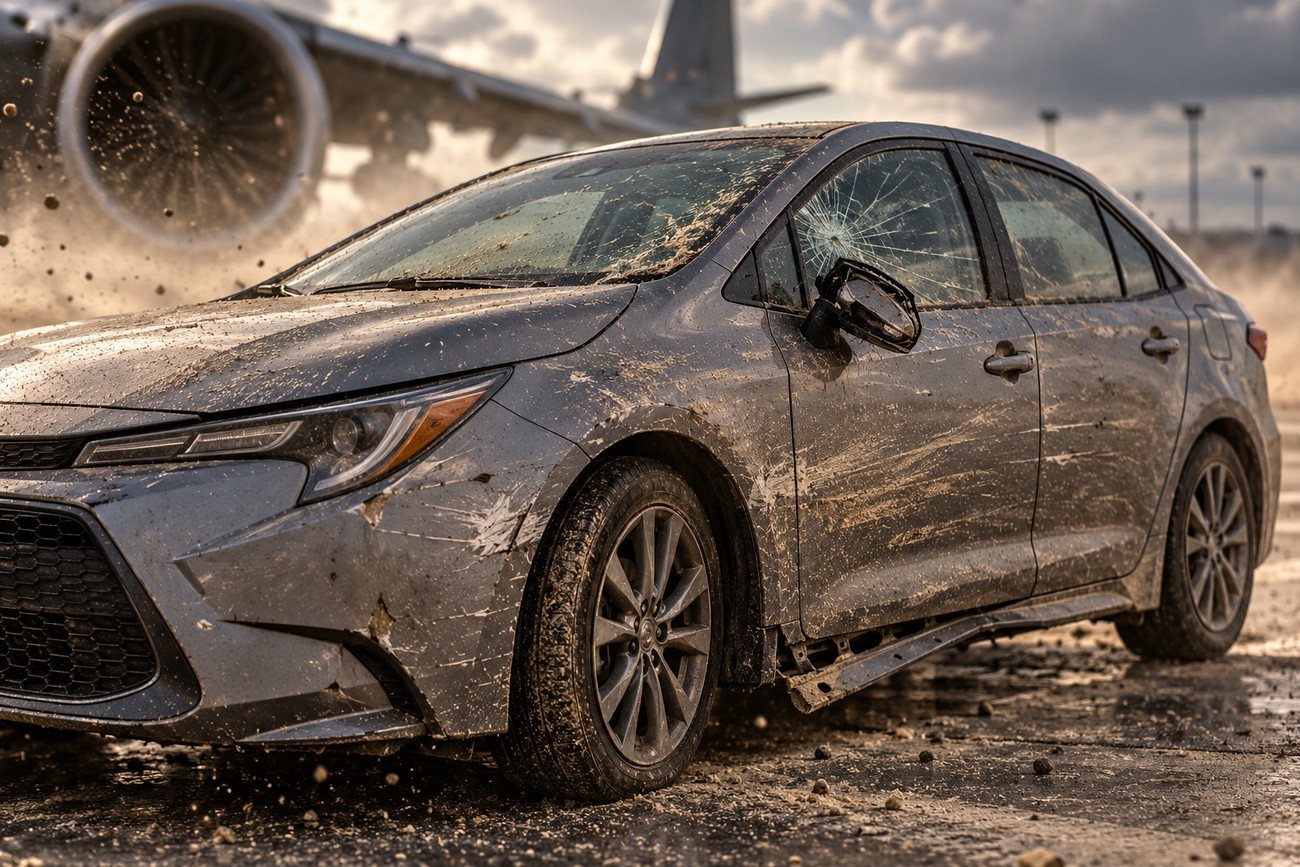
Direct airflow can shift or rotate a vehicle and deform body panels, especially if the car moves into an obstacle. Plastic trim, mirrors, underbody panels, and other lightly attached parts may detach. Glass can crack or break under combined airflow, vibration, and debris impact.
Loose material creates a separate damage mechanism. Stones and sand can produce paint chips, abrasive scratches, and damage around seals or exposed edges. Repeated abrasive exposure can accelerate paint wear and corrosion, even when each individual event appears minor.
A sudden movement can also load suspension or steering components. A Corolla may look largely intact after the blast while having experienced a sharp tire, wheel, suspension, or steering load. Inspection is sensible if the vehicle moved abruptly, struck a curb or object, developed a steering pull, or began making unfamiliar noises.
Post-event checks should include glass edges, door and trunk seals, wheel arches, underbody panels, lights, mirrors, and the underside of the car. Loose debris can remain trapped underneath, and small paint chips may become more significant if moisture reaches exposed metal.
How to Avoid Jet Blast Near a Runway
Follow airside markings, barriers, airport instructions, and ground-control directions first. Vehicles and people should not remain in designated jet-blast hazard areas behind engines at high power. Signs and barriers are important controls, but they do not replace attention to aircraft orientation, engine sound, wind, and changing ramp activity.
Keep the greatest practical lateral separation from the aircraft and avoid the sector behind its engines. Move away before the aircraft begins a turn or engine power rises. There is no single safe distance that applies to every aircraft, engine setting, wind condition, or surface.
Secure the vehicle on a stable surface, apply the parking brake fully, select the appropriate transmission setting, and close windows, doors, and the trunk. Closing openings reduces exposure to dust, sand, and small debris, but it does not make a vehicle safe inside the blast path.
If an aircraft begins turning toward the vehicle, stop nonessential activity and alert anyone nearby. Follow ground-control or ramp-staff instructions, then leave the alignment using a route that does not put the car into another aircraft, vehicle, barrier, or pedestrian hazard. Do not wait for visible exhaust or smoke; a jet engine can be at a hazardous power setting without an obvious visual warning.
Why Warning Signs and Compensation Rules May Not Settle the Problem
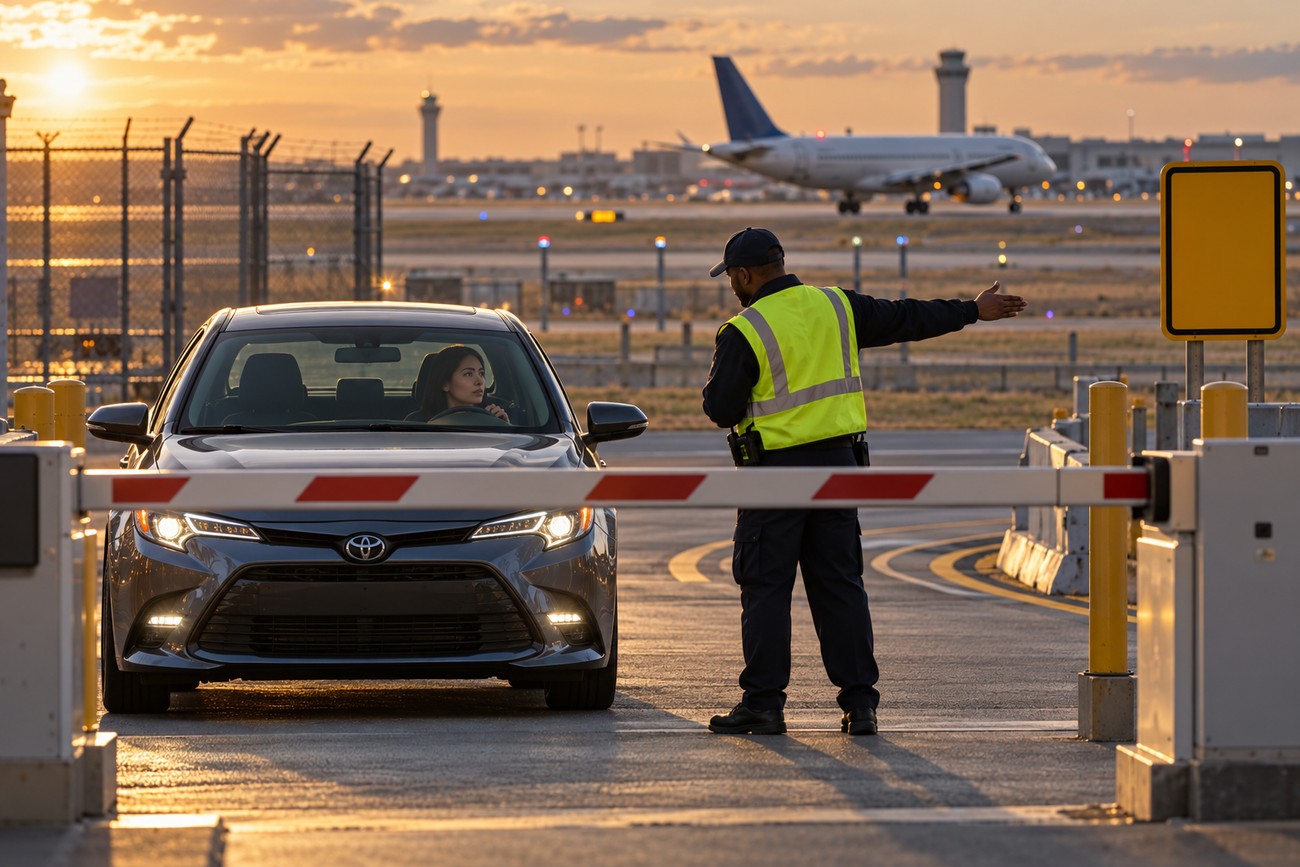
Public airport information does not always provide detailed jet-blast maps for private drivers, taxis, or visitors. A general warning near a taxiway may not show how the hazard changes with aircraft type, engine power, wind, or surface condition. This gap can leave drivers relying on informal instructions such as moving to an apparently safe shoulder.
Responsibility for damage may be disputed. Depending on the location, access rules, operator instructions, and applicable law, the event may be treated as an accepted airside risk by the driver or operator rather than as clear responsibility on the part of an airport or airline. Compensation is therefore not automatic.
Document the scene promptly if jet blast is suspected. Record the time, exact location, aircraft position and orientation, apparent engine activity, wind, surface, staff instructions, and nearby witnesses. Take photographs before moving or cleaning the vehicle where doing so is safe and permitted.
Keep repair estimates, communications, access records, and inspection findings. An independent inspection can identify glass, paint, underbody, suspension, or steering damage that is not apparent in initial photographs. The aircraft’s position, engine setting, wind, surface, and vehicle location are material details when reconstructing the incident.
Jet Blast Myths That Put Vehicles at Risk
Myth: jet blast only affects people. Reality: the flow can move or rotate compact vehicles, damage glass and panels, and carry abrasive debris into paint, seals, and openings. The result depends on exposure conditions, so the absence of a dramatic vehicle movement does not make the situation harmless.
Myth: being away from the runway eliminates the risk. Reality: risk can extend tens of metres behind an aircraft, particularly with high power and favorable wind conditions. A taxiway shoulder, service road, or parking area may still be in the engine sector when the aircraft turns.
Myth: taxi power is harmless. Reality: taxiing and engine-start settings are less powerful than takeoff power, but they can lift dust, sand, stones, and other loose objects. A car may suffer abrasive damage even when the airflow does not visibly push it.
Myth: smaller aircraft cannot create meaningful blast. Reality: business jets and regional aircraft can still lift gravel and damage nearby vehicles at high engine power. Forum claims about exact wind-equivalent pressures should be treated cautiously; the operational principle is broader and more reliable: aircraft-specific power, direction, wind, and surface determine the hazard.
Jet blast assessments depend on the aircraft and the location of the vehicle, so engine ratings alone cannot answer every case.
Frequently asked questions
How powerful is a jet blast at the car itself?
No single force figure can be calculated reliably from engine thrust or exhaust speed alone. A meaningful estimate would require the aircraft and engine type, power setting, distance from the nozzle, angle to the vehicle, wind speed and direction, ground surface, and the Corolla’s orientation and exposed area.
Thrust is an aircraft-performance measurement, while the car experiences local airflow and debris loads. Those loads may be uneven across the vehicle, which is why one side can receive stronger pressure or more debris than the other.
How can you avoid jet blast near a runway if an aircraft starts turning toward you?
Stop nonessential activity, close windows and doors, apply the parking brake, and alert people nearby. Follow ground-control or ramp-staff instructions and leave the developing alignment as soon as a safe route is available.
Do not drive blindly into another aircraft movement area, vehicle lane, barrier, or pedestrian zone. If there is no safe route, remain secured and communicate your position to the responsible ground staff rather than improvising a maneuver into a new hazard.
Can jet blast damage a parked car when its engine is turned off?
Yes. The Corolla’s engine status does not affect the external airflow or debris coming from the aircraft. A switched-off car can still suffer glass, paint, trim, body, or mechanical damage, and it can still move if the parking brake or transmission is not secured.
After the event, check glass seals, door and trunk gaps, wheel arches, underbody panels, suspension, steering response, tire condition, and trapped debris. Stop driving and arrange an inspection if the vehicle pulled to one side, vibrated, made new noises, or moved into an object.
What evidence should a driver collect after suspected jet-blast damage?
Record the timestamp, exact position, aircraft orientation, approximate distance, weather and wind, surface condition, engine activity, staff instructions, and names or contact details of witnesses where appropriate. Photograph the vehicle from several angles, including broken glass, paint chips, displaced trim, tire marks, debris, and the surrounding layout.
Preserve relevant messages, access logs, incident reports, repair estimates, and security or dash-camera footage. Arrange an independent inspection promptly, because a credible claim depends on timely documentation and technical findings rather than appearance alone.







