
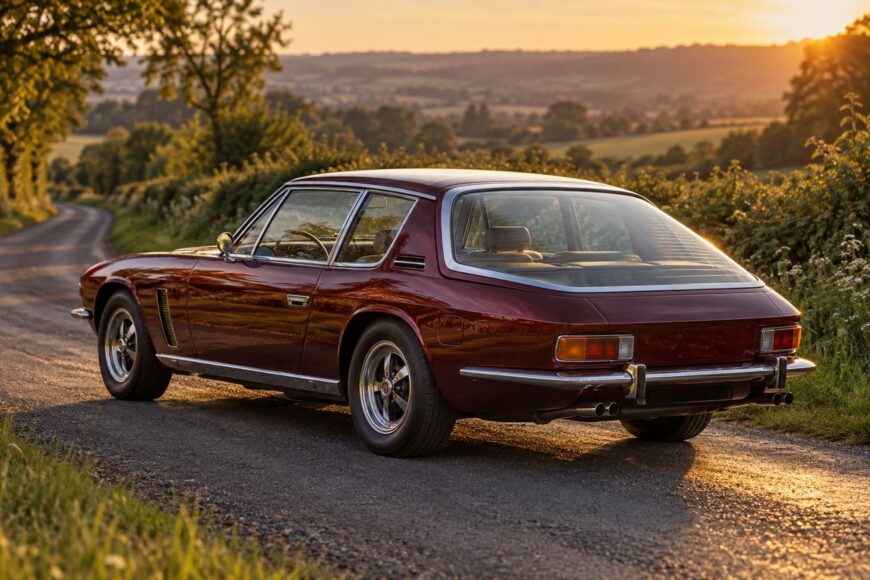
The Jensen Interceptor is an elegant British grand tourer powered by American Chrysler muscle. Its long body, formal cabin, and West Bromwich assembly suggest a traditional British sports car, yet its character comes from large-displacement V8 torque, substantial mass, and long-distance intent rather than lightweight agility.
That combination creates the car’s appeal and its ownership risks. Fuel consumption can approach 20.5 L/100 km for a 7.2-liter version, parts and expertise may come from two different markets, and restoration quality varies between surviving examples. Version confusion adds another problem: an Interceptor I, II, III, or FF cannot be judged by the badge alone.
A sound purchase therefore depends on specification, structure, documentation, and mechanical condition. The headline engine size matters, but it does not replace a careful inspection of the body, restoration history, and exact equipment fitted to the car.
- What the Jensen Interceptor Actually Was
- Chrysler V8 Power: 6.3, 7.2, and the Numbers Problem
- Why It Feels Like a Grand Tourer, Not a Lightweight Sports Car
- Buying One: The Restoration and Specification Traps
- Jensen Interceptor Versions: The Numbers That Actually Differ
- Myths That Distort the Interceptor’s Appeal
- Who Should Own a Jensen Interceptor?
- Frequently asked questions
- How much would a Jensen Interceptor be worth?
- Was the Jensen Interceptor fast for its time?
- Why can two Jensen Interceptors with the same badge feel so different?
What the Jensen Interceptor Actually Was
Jensen produced the Interceptor from 1966 to 1976 as a British coupe and grand tourer. Assembly took place in components came from Chrysler. That division of labor defined the car: British coachwork and presentation were paired with an American V8 powertrain and automatic-transmission technology.
The Interceptor was designed to cover distance quickly and comfortably. Its role demanded strong acceleration, a stable high-speed character, and a substantial level of equipment. Those priorities explain why it should be assessed as a grand tourer rather than compared directly with a small, lightweight sports car.
The American mechanical content was central to the model’s identity. Early production cars used a 6.3-liter Chrysler V8, while later versions adopted the 7.2-liter Chrysler 440 V8. This arrangement can simplify the search for some engine-related parts, although body panels, trim, and model-specific components remain tied to the British car.
The 1965 prototype belongs in a separate category. It is commonly listed with 241 hp and a mass of 1270 kg, figures that are not transferable to the production Interceptor. The prototype’s weight and performance can create a misleading impression if they are used to describe the heavier series-built cars.
Chrysler V8 Power: 6.3, 7.2, and the Numbers Problem
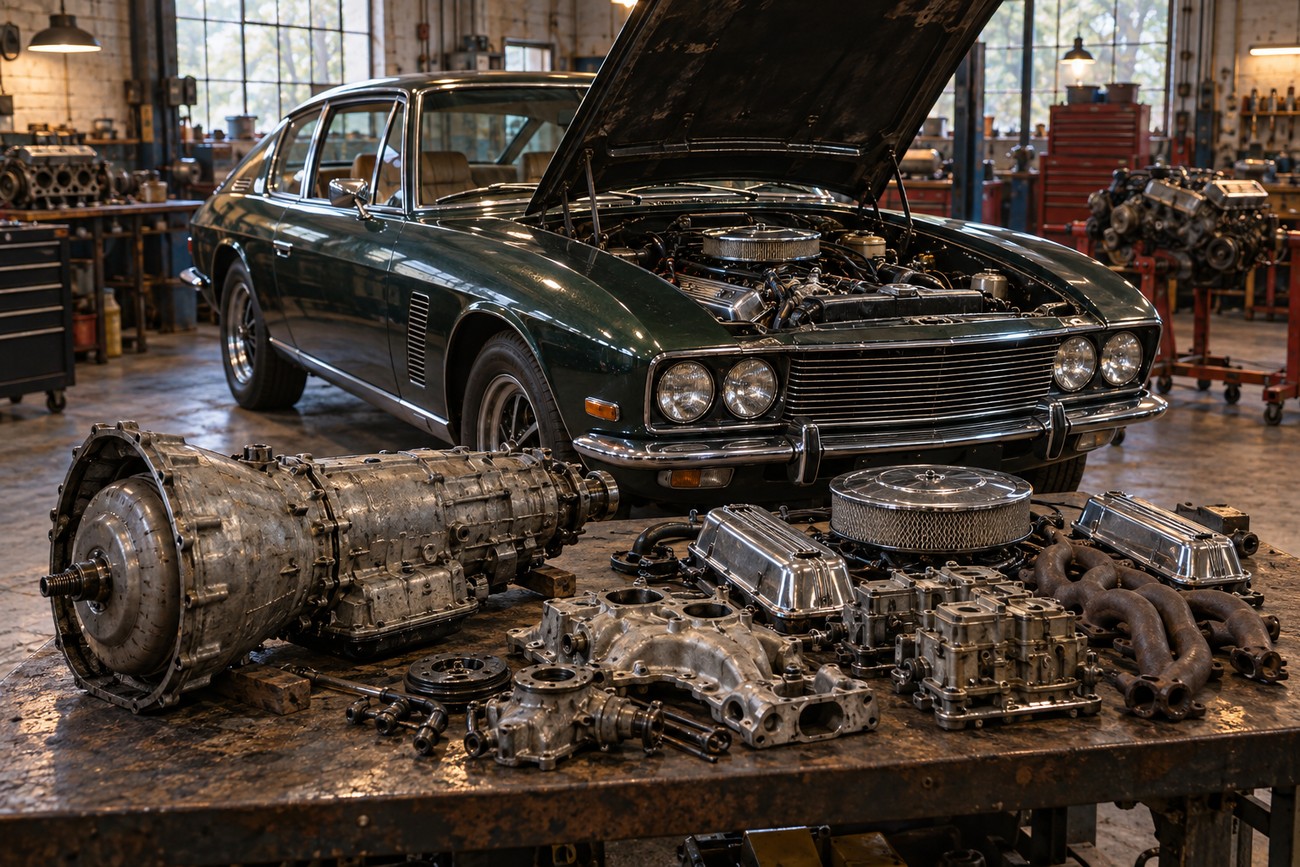
The early production Interceptor used a 6.3-liter Chrysler V8. Published output is variously quoted as 325 gross hp or approximately 330 hp, depending on the source, measurement method, and model year. The disagreement is a reminder that period power figures cannot always be compared directly with later ratings measured under different conventions.
Later Interceptor II and III versions are associated with the 7.2-liter Chrysler 440 V8 and a three-speed Chrysler TorqueFlite automatic. Published figures for this specification include 385 hp and 664 Nm. The torque figure explains much of the car’s road character: the engine delivers force in a way that suits effortless high-speed touring and decisive overtaking.
Reference data for a 7.2-liter car commonly lists a mass of approximately 1837 kg and a top speed of 228 km/h. Published 0–96 km/h times for the Interceptor III 7.2-liter vary from approximately 6.9 to 7.6 seconds. Specification, test method, vehicle condition, and transmission behavior all influence the result.
These figures are useful for identifying the car’s broad capability, but they are poor substitutes for inspecting an individual example. A tired engine, incorrect carburetion configuration, slipping transmission, poor ignition setup, or unsuitable modifications can make a supposedly identical Interceptor feel entirely different from the reference specification.
Why It Feels Like a Grand Tourer, Not a Lightweight Sports Car
The Interceptor’s mass shapes every aspect of its behavior. A 7.2-liter version is commonly listed at approximately 1837 kg, so its mass creates substantial inertia to overcome when changing direction or braking. The result is a car with impressive straight-line authority and a more deliberate response than a small sports car.
That character suits the grand-tourer brief. The Interceptor gathers speed with the broad, muscular delivery associated with a large American V8, while its size and weight encourage smooth inputs and flowing roads. Drivers expecting razor-sharp turn-in or delicate balance may find the car less agile than its performance figures suggest.
Fuel use is the unavoidable cost of this formula. Approximately 20.5 L/100 km is associated with the 7.2-liter version, and real consumption depends on traffic, tuning, driving style, and mechanical condition. Even when the car is used as intended, fuel cost remains a central part of the ownership budget.
The weight also affects practical use. Parking, narrow roads, tire selection, braking condition, and suspension health matter more than they would in a lighter classic. A well-sorted Interceptor can be a compelling long-distance machine, but it rewards realistic expectations rather than comparisons with lightweight sports cars.
Buying One: The Restoration and Specification Traps
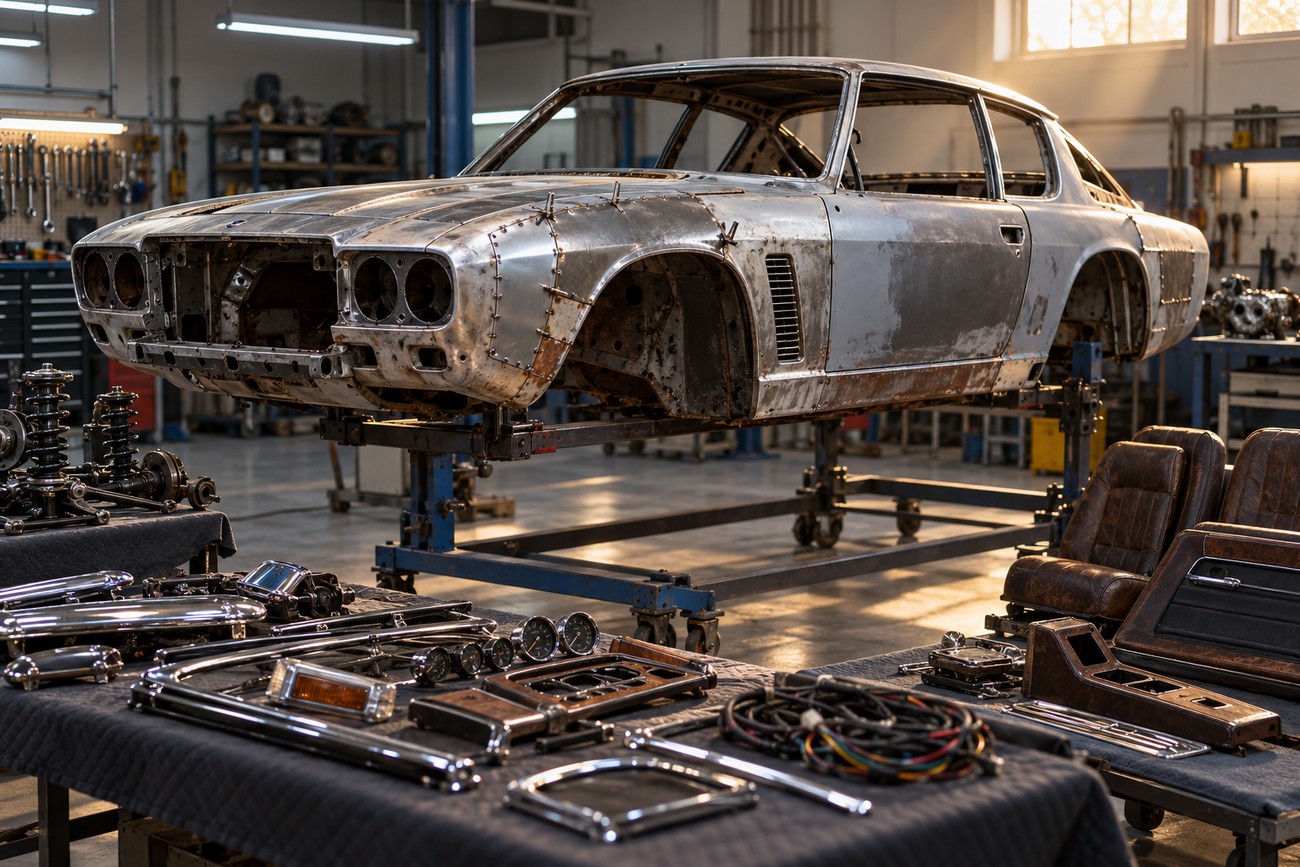
Start with the exact identity of the car. Interceptor I, II, III, and FF should not be treated as interchangeable specifications, because engines, equipment, and mechanical details changed across the range. A short advertisement may mention only “Interceptor V8” while leaving the most important differences unstated.
The body deserves priority over the excitement of the engine bay. Rare British coachwork can require specialized repair, careful panel work, and model-specific trim. A car with a strong Chrysler V8 may still need expensive structural or cosmetic correction, and a fresh paint finish can conceal the quality of the work beneath it.
Verify body structure, restoration history, and factory specification before spending time on engine output. A strong Chrysler V8 can distract a buyer from expensive or incorrect coachwork.
Parts sourcing reflects the car’s mixed origins. American-market suppliers may help with some engine and transmission requirements, while British sources are more relevant to body, trim, and Jensen-specific components. The combination is manageable for an organized owner, but it rewards research and can complicate a rushed restoration.
Originality and correct specification generally matter more to collector value than simply installing a larger or more powerful V8. An undocumented engine swap, altered fuel system, non-original interior, or poorly executed restomod may improve personal usability while reducing the car’s appeal to buyers seeking a correctly represented example.
Inspection should therefore cover the following areas:
- Structural condition and the quality of previous body repairs.
- Evidence supporting the stated series, engine, transmission, and equipment.
- Restoration invoices, photographs, and records of major work.
- Signs of modifications that are absent from the advertisement.
- Mechanical condition, including the engine, TorqueFlite transmission, cooling system, suspension, steering, and brakes.
- Completeness and originality of trim, interior components, and model-specific parts.
Jensen Interceptor Versions: The Numbers That Actually Differ
The comparison below shows representative published figures rather than every factory variation. Disputed output and acceleration figures are labeled accordingly, and the 1965 prototype should be kept separate from production cars.
| Version or specification | Engine | Published output | Torque | Mass | Transmission | Top speed | 0–96 km/h |
|---|---|---|---|---|---|---|---|
| 1965 prototype | Prototype specification | 241 hp | Not stated here | 1270 kg | Not stated here | Not stated here | Not stated here |
| Early production Interceptor | 6.3-liter Chrysler V8 | 325 gross hp or approximately 330 hp, depending on source and measurement method | Not stated here | Not stated here | Varies by specification | Not stated here | Not stated here |
| Later Interceptor II/III 7.2-liter specification | 7.2-liter Chrysler 440 V8 | 385 hp | 664 Nm | Approximately 1837 kg | Three-speed Chrysler TorqueFlite automatic | 228 km/h | Approximately 6.9–7.6 seconds for published Interceptor III figures |
The table shows why a badge-level description is inadequate. The prototype’s 1270 kg mass is dramatically different from the approximately 1837 kg figure associated with the later 7.2-liter specification, so prototype performance cannot be used as a general description of the production model.
The early 6.3-liter output figures also require careful wording. A gross horsepower rating and a figure presented under another measurement convention may describe the same broad engine capability while producing different numbers. The year, market specification, and source methodology should be recorded before a buyer treats any figure as definitive.
Even within the later 7.2-liter group, acceleration is best understood as a range. Approximately 6.9–7.6 seconds from 0–96 km/h is a useful indication of the car’s potential, yet it says little about a particular example with unknown maintenance, modifications, or restoration quality.
Myths That Distort the Interceptor’s Appeal
The Interceptor is often described as a fully British sports car, which oversimplifies its construction. Its body design and assembly were British, but key mechanical components came from Chrysler. That British-American combination is precisely what gives the car its distinctive identity.
Engine size alone also fails to identify the car. Early production examples used the 6.3-liter Chrysler V8, while later versions used the 7.2-liter Chrysler 440 V8. Series, equipment, fuel-system configuration, transmission, modifications, and condition can all matter when two cars carry the same basic badge.
Published power figures should be read with their measurement method attached. The early 6.3-liter engine is variously quoted at 325 gross hp or approximately 330 hp, while later 7.2-liter references commonly list 385 hp. These numbers are informative only when the source, year, and rating convention are understood.
The same caution applies to acceleration. Published Interceptor III 7.2-liter times range from approximately 6.9 to 7.6 seconds from 0–96 km/h. That variation does not undermine the car’s performance; it places the figures in context and reinforces its role as a heavy, powerful GT rather than a lightweight sports car.
Who Should Own a Jensen Interceptor?
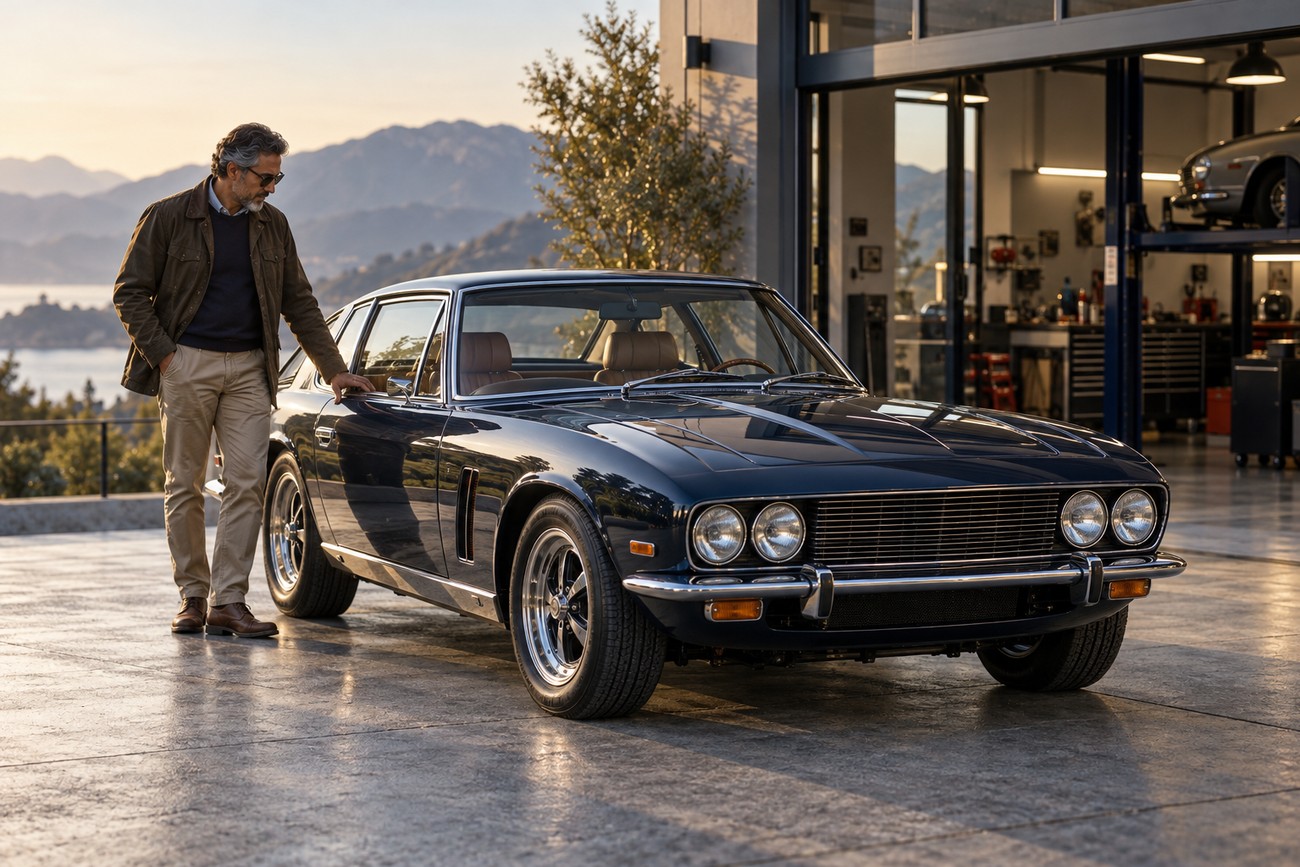
The Interceptor suits an owner who values dramatic styling, relaxed high-speed travel, and the forceful character of a large Chrysler V8. It has a presence that many technically faster cars lack, and its grand-tourer layout makes sense on open roads. The experience depends heavily on finding a properly sorted example.
Budgeting must include fuel, specialist bodywork, and mixed-market parts sourcing. A car that appears mechanically usable may still need work on corrosion, trim, electrical systems, suspension, brakes, or previous restoration repairs. Cosmetic presentation alone is weak evidence of overall condition.
Collector appeal depends on correct specification, originality, documentation, and restoration quality. A more powerful replacement engine does not automatically improve value, particularly when it changes the car’s identity or conceals unresolved problems elsewhere. The best example is usually the one with the clearest history and the most credible workmanship.
The Interceptor can be a usable classic, but it is rarely a low-risk classic. Treat it as a heavy and powerful GT with British coachwork and Chrysler mechanical requirements. That approach leaves room for its considerable character while protecting you from paying a premium for an attractive but incorrectly specified restoration.
Frequently asked questions
Jensen Interceptors vary significantly by series, engine, specification, condition, and restoration quality. The answers below focus on value, performance, and the reasons different examples can feel so different on the road.
Published figures provide useful context, but they cannot replace inspection of the individual car. Documentation, structure, mechanical condition, and originality remain central to any assessment.
These distinctions are especially important when comparing early 6.3-liter cars with later 7.2-liter Interceptor II and III examples.
How much would a Jensen Interceptor be worth?
There is no reliable universal value because Interceptors differ substantially in series, specification, condition, and restoration quality. A correctly represented car with documented work, sound structure, original equipment, and a credible history will generally command more confidence than a cosmetically impressive example with uncertain repairs or modifications.
Assess value in this order: confirm the exact series, verify the engine and equipment, inspect the body structure, review restoration records, and then judge presentation and mechanical condition. Engine size alone is a poor valuation guide, especially if a larger or different V8 has replaced the correct specification.
Was the Jensen Interceptor fast for its time?
Yes, the 7.2-liter Interceptor was a rapid grand tourer for its period. Published references include a 228 km/h top speed and approximately 6.9–7.6 seconds from 0–96 km/h for Interceptor III examples, depending on the source, specification, and vehicle condition.
Those figures describe strong straight-line performance rather than lightweight sports-car behavior. The approximately 1837 kg mass gives the car stability and momentum while limiting the delicate responses associated with a much smaller machine.
Why can two Jensen Interceptors with the same badge feel so different?
Series, engine specification, carburetion configuration, transmission behavior, modifications, and restoration quality can all change the driving experience. A 6.3-liter early car and a 7.2-liter Interceptor II or III may share the Interceptor name while delivering different power, weight, equipment, and road manners.
Mechanical condition is equally important. Ignition setup, fuel-system tuning, cooling performance, suspension, steering, brakes, and the quality of previous repairs determine how faithfully a car performs its intended role. Two visually similar cars can therefore differ more in use than their advertisements suggest.







