
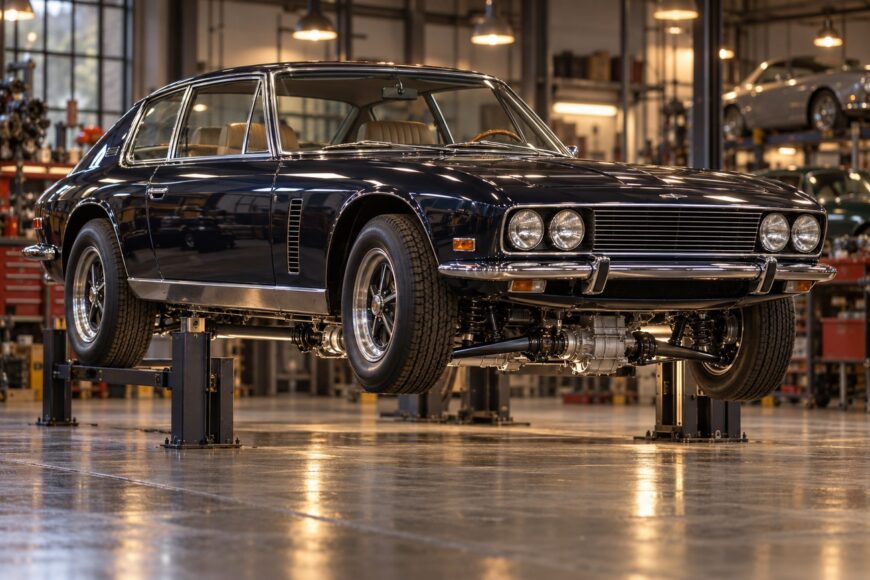
The Jensen FF introduced a landmark combination of permanent all-wheel drive and anti-lock braking, yet became a rare, expensive, and difficult-to-maintain GT rather than a commercial breakthrough. Its achievement was engineering integration: Ferguson Formula traction and Dunlop Maxaret braking were fitted to a series-production passenger car in 1966, long before this combination became familiar.
The FF was a fast road car, not an early SUV. Its four-wheel drive was intended to improve stability on paved roads, while its mechanical ABS offered a period solution to hard braking. The gap between that technical ambition and ownership reality defines the car today: historically important, quick, and distinctive, but demanding far more scrutiny than an ordinary classic coupe.
- Why the Jensen FF Was a Breakthrough, Not Just an Interceptor
- How Ferguson Formula AWD and Maxaret ABS Worked
- A Fast Road GT, Not an Early SUV
- Why Such Advanced Engineering Failed to Sell
- The Ownership Reality: Rare Systems, Rust, and Specialist Repairs
- Myths, Limits, and the FF’s Lasting Legacy
- Frequently asked questions
- How many Jensen FFs are left today?
- What is a Jensen FF worth today?
- Was the Jensen FF the first AWD production car?
- What engine was in the Jensen FF, and what does that mean for ownership?
Why the Jensen FF Was a Breakthrough, Not Just an Interceptor
Jensen produced the FF from 1966 to 1971. It shared its broad styling and grand-touring role with the Interceptor, but the comparison ends quickly once the structure is examined. FF stands for Ferguson Formula, the name given to its permanent all-wheel-drive system, and the car required different underbody hardware, a longer wheelbase, and a dedicated braking installation.
The crucial distinction is historical. The FF is credited as the first series-production passenger car with permanent AWD and ABS. It was not the first vehicle with anti-lock braking: Maxaret technology had already been used in aviation, trucks, and racing vehicles. Jensen’s achievement was bringing both systems together in a road-going passenger car that customers could buy through normal production channels.
Approximately 320 cars were built. One published breakdown gives 195 Mk I cars, 110 Mk II cars, and 15 Mk III cars, although that should be treated as a source-specific figure rather than a universally certain census. The small total explains why the FF is encountered as a specialist collector car rather than as a common variant of the Interceptor.
How Ferguson Formula AWD and Maxaret ABS Worked
The Ferguson Formula system used a transfer case and a self-locking center differential. Torque was divided approximately 37 percent to the front axle and 63 percent to the rear, giving the FF a rear-biased character while retaining drive at both ends. This was permanent AWD, so the front axle and its associated shafts, differential, and joints worked on every journey.
Dunlop Maxaret was a mechanical ABS with no individual wheel-speed sensors or electronic control unit. It compared the relative speeds of the front and rear propeller shafts. When the system detected a speed relationship associated with wheel lock, a valve reduced brake pressure and then restored it, producing the pulsing action expected from an anti-lock system.
That description can sound more modern than the experience actually was. Maxaret allowed a degree of slip and operated within a narrower range of conditions than later electronic systems. Its pedal response could feel abrupt or unusual, particularly when adjustment, wear, or calibration was wrong, so the presence of an ABS badge does not guarantee contemporary braking behavior.
The arrangement was clever because it avoided a sensor at every wheel, but it also made diagnosis specialized. A fault could involve the mechanical valve, the shaft-speed relationship, the drivetrain, or basic brake adjustment. Treating Maxaret as a simple add-on braking component is one of the quickest ways to misread the FF.
A Fast Road GT, Not an Early SUV
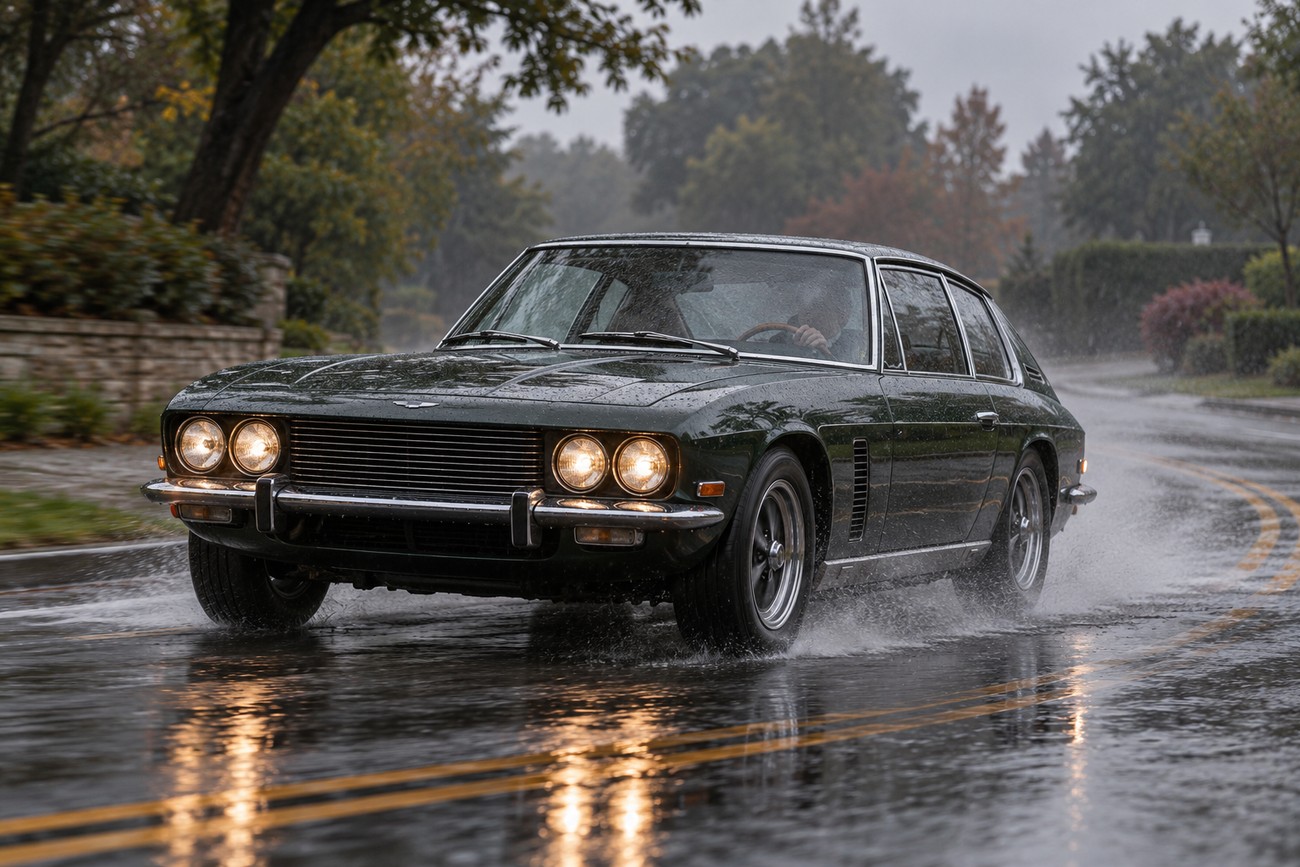
Jensen designed the FF for high-speed road stability and braking confidence on hard surfaces. Its all-wheel drive could help the car maintain traction in poor weather and cornering, yet the system was never intended to turn the coupe into an off-road vehicle. The transfer case, suspension, body, and ground clearance were not designed for repeated impacts, deep mud, or rough tracks.
Power came from a 6.3-liter Chrysler V8 displacing 6,277 cm³. Output was approximately 325 hp and 576 N·m, delivered through a three-speed Chrysler TorqueFlite automatic. Period figures put top speed at approximately 209 km/h, with 0–96 km/h taking approximately 8.4 seconds.
The extra hardware changed the car’s proportions and behavior. The FF’s wheelbase was approximately four inches longer than the Interceptor’s, partly to accommodate the drivetrain, and the additional mass and mechanical losses were the price of permanent traction. It remained a substantial GT with a thirsty V8, rather than becoming economical, lightweight, or rugged through the addition of AWD.
Why Such Advanced Engineering Failed to Sell
The FF’s limited production reflected economics as much as public misunderstanding. Its price was approximately £5,340 in the late 1960s, placing it well above many conventional grand tourers. Buyers were being asked to pay for complex technology that was difficult to explain through appearance alone and that added weight, friction, and service requirements.
Permanent AWD also brought practical penalties. More shafts, differentials, and transfer-case components created additional mechanical losses, while the Chrysler V8 consumed fuel at a rate consistent with its size and performance. Servicing the engine was already a substantial undertaking; maintaining the unique drivetrain required knowledge that few general workshops possessed.
The result was a technological success without mass-market momentum. The FF demonstrated a direction that later high-performance GTs would follow, but its production total of approximately 320 cars made it an engineering landmark rather than a commercial template. Its influence was therefore much larger than its sales record.
The Ownership Reality: Rare Systems, Rust, and Specialist Repairs
Condition matters more than the FF’s famous specification. Corrosion in the body and frame can turn an apparently complete car into a major restoration project, while body panels and interior parts are scarce. Some repairs require custom fabrication or carefully selected Interceptor donor components, and those compromises can affect both cost and originality.
The drivetrain deserves a separate inspection from the engine. Ferguson Formula parts can be rare and expensive, and Maxaret work requires specialist knowledge. A car may have been converted to ordinary rear-wheel drive, or its ABS may have been disconnected, while still looking correct from a distance. Originality and function must therefore be checked independently.
Specialists verify propeller-shaft speed relationships, transfer-case condition, and Maxaret operation before attempting adjustments. Treating the FF like a conventional Interceptor can turn an incorrect diagnosis into further drivetrain or brake damage.
Cooling is another ownership concern. The Chrysler V8 operates in a confined Jensen engine bay, where heat can place additional stress on the cooling system, especially in hot climates and traffic. A buyer should also allow for high fuel consumption, expensive V8 service, and the difficulty of finding a workshop willing and able to handle both the engine and FF-specific systems.
A test drive should include braking behavior, driveline noise, vibration, and evidence that power reaches the front axle. Unpredictable pedal pulsing is not a charming period characteristic if it reflects a poorly adjusted or failing Maxaret system. Documentation, inspection access, and proof of specialist maintenance are more useful than a polished paint finish.
Myths, Limits, and the FF’s Lasting Legacy
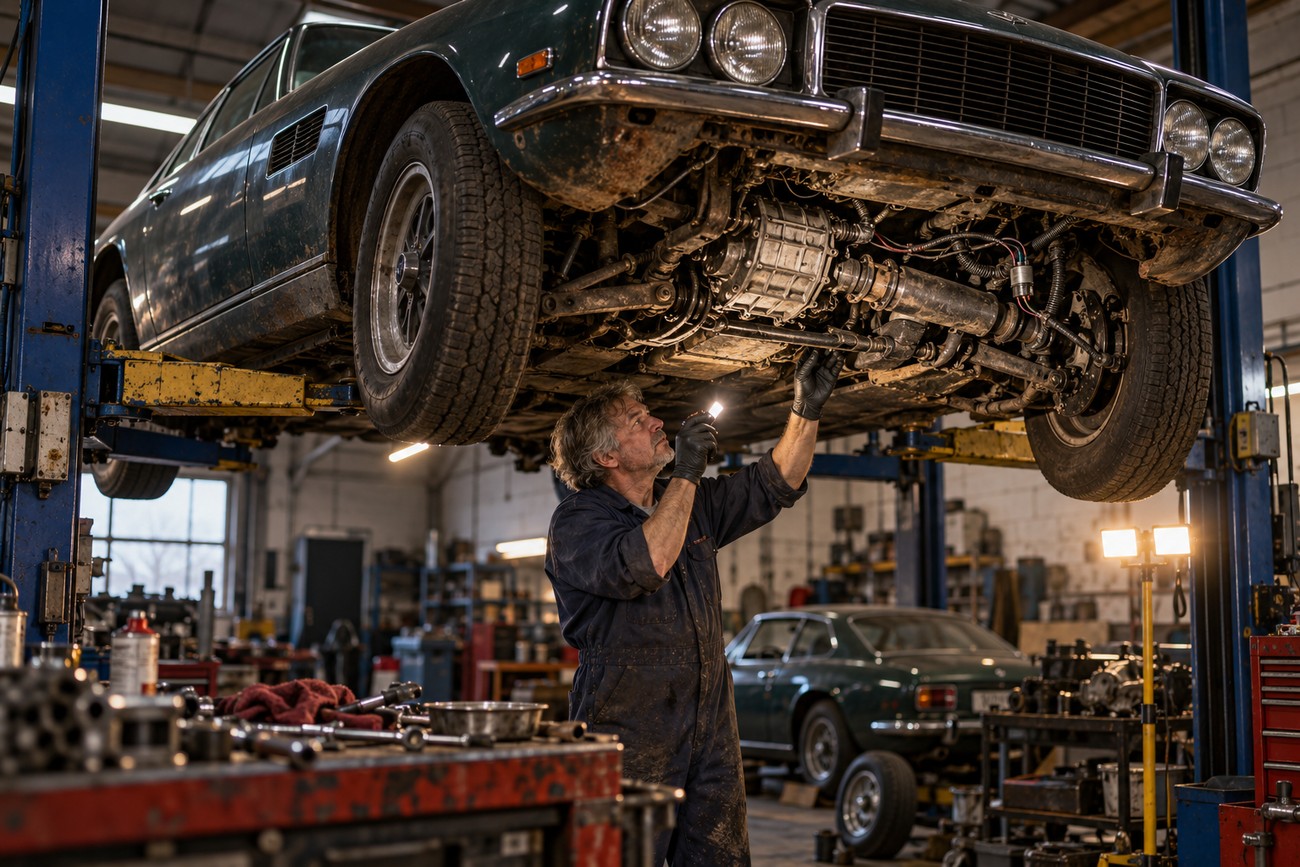
The most accurate claim is precise: the Jensen FF was the first series-production passenger car with permanent AWD and ABS. It was not the first AWD vehicle, and it was not the first vehicle with ABS. Maxaret’s earlier aviation, truck, and racing applications make the broader claim misleading.
Nor was the FF simply an Interceptor with front-drive hardware added. Its longer wheelbase, transfer case, center differential, front-drive hardware, and Maxaret installation produced a genuinely different car. The structure affected weight, service access, road behavior, and the range of specialists who could repair it.
Maxaret should also be judged in its period context. It was an inventive mechanical system, yet less precise and less consistent than later electronic ABS. Its operating envelope was narrow, and a driver should not expect the controlled response of modern anti-lock braking. Correctly maintained, it remains historically significant; incorrectly adjusted, it can be a liability.
The FF anticipated the full-time AWD GTs that became familiar decades later, particularly after the development of electronic ABS and modern control systems made the formula easier to manufacture and support. Its legacy is therefore real but selective: it proved the concept before the market was ready to accept the costs.
Frequently asked questions
Factory production, surviving-car numbers, and market value are different measures. The factory figure is approximately 320 cars, while the condition and originality of individual surviving examples determine their practical importance and value.
How many Jensen FFs are left today?
No single authoritative census establishes the exact number of surviving Jensen FFs. Registry counts can differ because cars move between countries, some are recorded by chassis or registration details, and incomplete or stored projects may be counted differently.
The approximately 320 cars built should therefore not be presented as a surviving-car total. A registry entry also does not prove that the Ferguson Formula system and Maxaret remain installed and operational.
What is a Jensen FF worth today?
A Jensen FF’s value depends heavily on originality, corrosion, restoration quality, and the condition of its AWD and ABS systems. A structurally sound car with documented, working Ferguson Formula hardware can be far more significant than a cosmetically attractive example with a rear-wheel-drive conversion.
Assessment should include the frame and body, interior completeness, drivetrain identity, transfer-case condition, and Maxaret operation. Restoration quality matters because scarce panels and custom work can conceal substantial future costs.
Was the Jensen FF the first AWD production car?
It is more accurate to call the FF the first series-production passenger car with permanent AWD and ABS. That wording excludes earlier AWD vehicles in other categories and avoids the separate myth that Jensen introduced ABS itself.
The distinction matters because the FF’s significance lies in the integration of both systems in a road-going passenger car. Its achievement was pioneering, even though production remained very limited.
What engine was in the Jensen FF, and what does that mean for ownership?
The FF used a 6.3-liter Chrysler V8, displacing 6,277 cm³ and producing approximately 325 hp and 576 N·m. Chrysler engine parts and routine V8 knowledge can be more accessible than FF-specific components, but fuel consumption and service costs remain substantial.
Engine maintenance is only part of the ownership calculation. Cooling demands in the confined engine bay must be addressed, while the Ferguson Formula drivetrain and Maxaret system require separate specialist inspection and repair expertise.







