
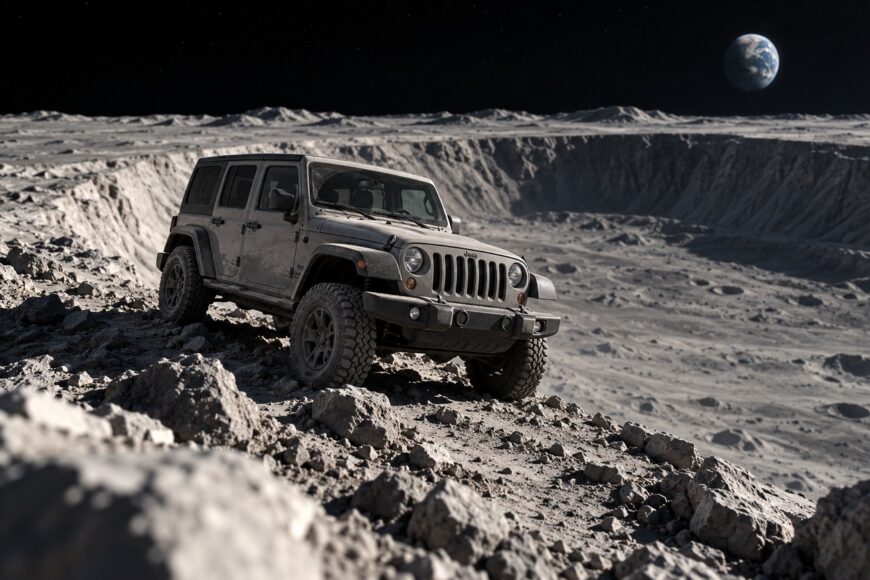
A Jeep Wrangler Rubicon crawling across a lunar crater makes a striking image: tires finding purchase on gray slopes, suspension working over a broken rim, and the vehicle inching toward the far side. Familiar off-road logic seems to favor it. Lunar gravity is lower, so the Jeep weighs less on the surface.
That lighter weight does not make a crater crossing easy. It also reduces the force pressing the tires into the ground, while vacuum, extreme temperatures, and abrasive dust threaten the machinery before driving technique can settle the question. A small, prepared stretch of uneven terrain might be negotiable by a suitably adapted vehicle. An unmodified Rubicon facing a steep natural crater is a different proposition.
- Could a Jeep Wrangler Rubicon Actually Cross a Lunar Crater?
- Why Low Lunar Gravity Does Not Make Off-Roading Easy
- What Lunar Vacuum and Temperature Would Do to the Wrangler
- Regolith, Tires, and the Maintenance Problem
- Crater Geometry Is the Real Test
- What a Moon-Ready Rubicon Would Need
- Frequently asked questions
- What would happen if a Wrangler stopped on the Moon during lunar night?
- What Jeep has the moon roof?
- What does the “A with a circle and exclamation point” symbol on my Jeep Compass mean?
- Which is more expensive, Rubicon or Wrangler?
- What is the rarest Jeep Wrangler?
Could a Jeep Wrangler Rubicon Actually Cross a Lunar Crater?
A factory Rubicon could not be driven across the Moon as delivered. A conventional combustion engine needs intake oxygen, which the lunar vacuum cannot supply. Even if an external power source solved that immediate problem, the tires, cooling system, seals, and other components would still face conditions outside their intended operating environment.
Set those survival problems aside for a limited thought experiment, and crater scale becomes decisive. A shallow depression with a firm, mapped, gently graded route might allow a suitably modified Wrangler-shaped vehicle to enter and leave without scraping its underside or losing stability. Calling that a crater crossing is defensible; treating it as evidence that the vehicle could tackle any crater is not.
A deeper natural crater may have loose material at its rim, a steep inner wall, and an exit that offers less grip than the descent. Each feature changes the available route. A wall that exceeds the vehicle’s safe climbing or stability limits remains impassable regardless of how slowly the driver approaches it.
The Rubicon’s off-road equipment addresses terrestrial obstacles. On the Moon, traction, vehicle geometry, thermal survival, and durability would govern success together. More engine power or a familiar badge cannot create a safe path across an unstable slope.
Why Low Lunar Gravity Does Not Make Off-Roading Easy
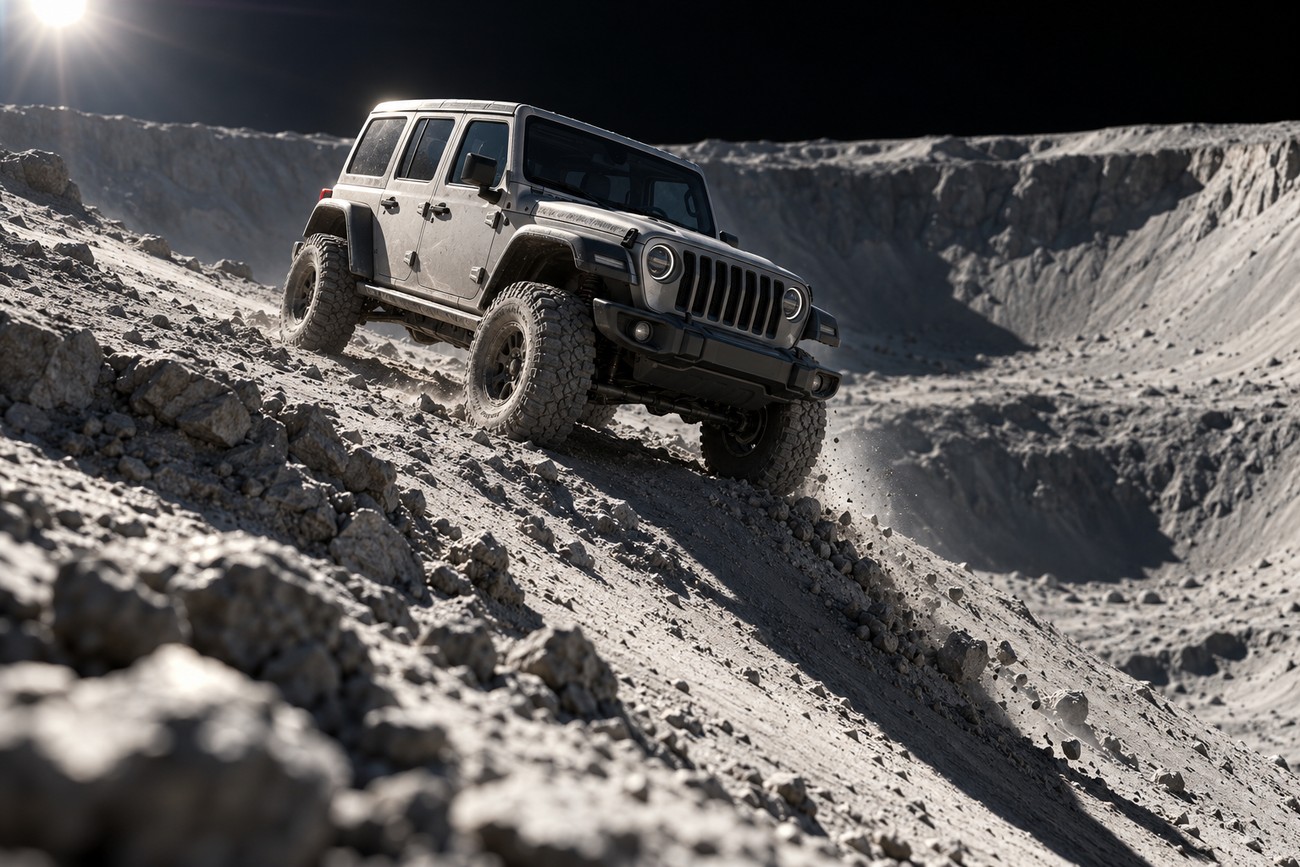
Lunar surface gravity is approximately 1.62 m/s², or about one-sixth of Earth’s gravity. The Wrangler would press on the ground with much less force, but its mass would remain the same. Accelerating, turning, or stopping that mass still requires forces the tires must transmit through the surface.
Lower gravity reduces both vehicle weight and the normal force available for tire traction. On a firm surface with otherwise unchanged conditions, the smaller downhill force on a slope can partly offset the smaller friction force. Real crater slopes complicate that comparison: loose regolith shifts under a loaded wheel, and a tire with little purchase cannot turn available torque into controlled motion.
Suspension behavior would also change. The springs and dampers are tuned around Earth’s gravity, while a lunar vehicle would settle differently on them and spend longer airborne after a bump. A wheel cresting a sharp rise could lose contact just when steering or braking force matters most.
This makes speed a poor substitute for grip. A brief burst of momentum might carry the vehicle over a small hollow, yet the landing could bounce it toward a crater wall or expose its underside to a ridge. Slow, planned movement would reduce some of that risk, provided the machine could operate reliably at crawling speed.
What Lunar Vacuum and Temperature Would Do to the Wrangler
The Moon has almost no atmosphere; convection is unavailable, and heat is lost mainly through radiation. That changes the cooling problem for an engine, transmission, and electronics. Components that normally pass heat to circulating air cannot rely on the same path, even when the vehicle is moving slowly.
Slow crawling is demanding on Earth because the drivetrain can produce heat while airflow remains limited. In vacuum, radiators and exposed housings would need a purpose-built way to move heat to surfaces that can radiate it away. A stronger fan would not solve the absence of surrounding air.
Lunar surface temperatures can range from approximately −173 °C at night to +127 °C during the day. Exposure varies with location, sunlight, and shade, so those figures are environmental limits rather than a constant temperature for every part. Either end of the range is far beyond what ordinary automotive operation can safely be assumed to tolerate.
Lubricants may change behavior in severe cold or vacuum, while polymers and seals can lose the flexibility needed to keep dust out and fluids in. Suspension components, hydraulic circuits, braking materials, and sensors would each require evaluation rather than a blanket assumption that terrestrial durability carries over. Electronics would need thermal protection during both operation and shutdown.
The Jeep Wrangler Rubicon is designed for terrestrial off-road use, not vacuum, lunar regolith, or extreme lunar thermal cycling. Even a short drive would need systems designed to start, work, reject heat, and survive a stop in that environment. Reaching a crater rim would mean little if the vehicle could not remain functional for the return trip.
Regolith, Tires, and the Maintenance Problem
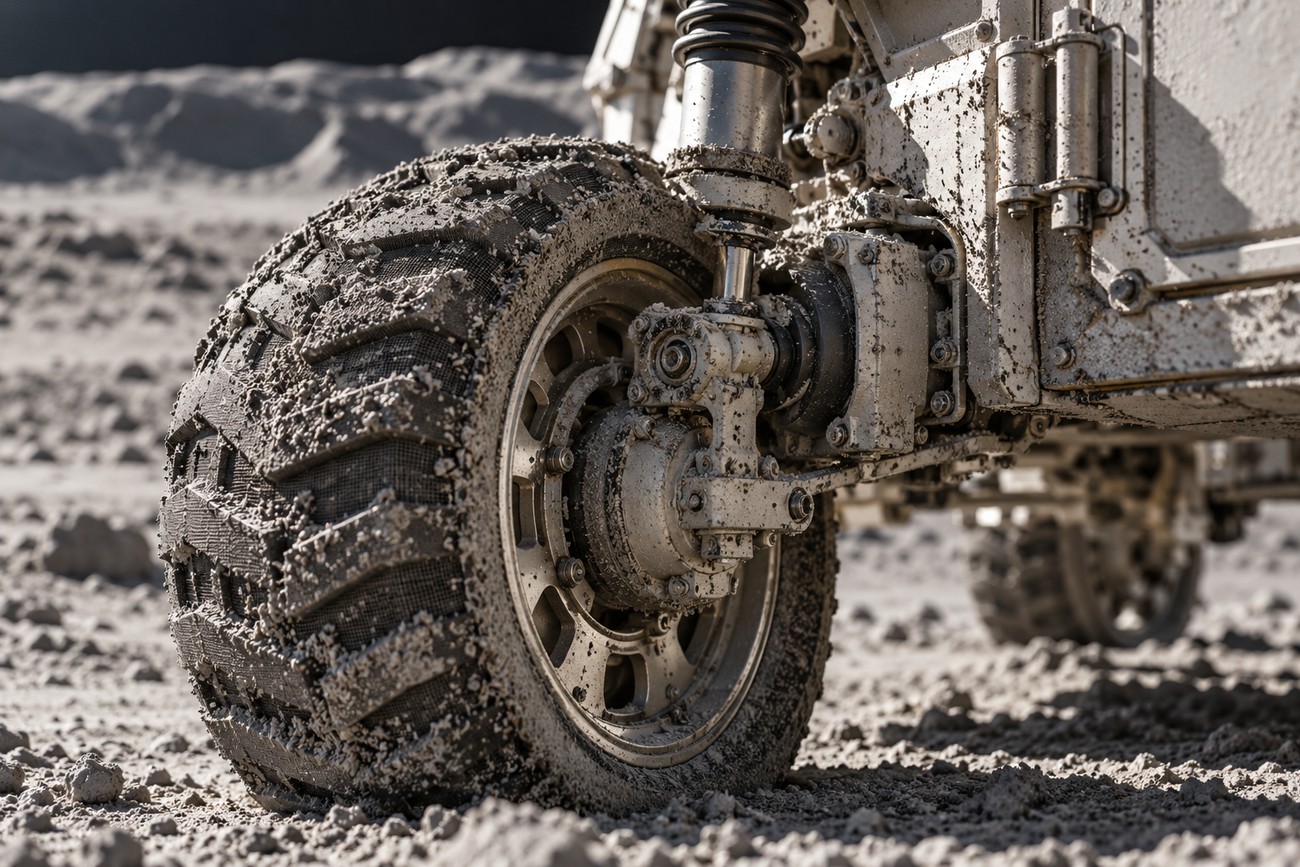
Lunar regolith is sharp, abrasive, and electrostatically clingy dust that can penetrate or contaminate mechanisms. Apollo experience showed how persistently it adheres to surfaces. For a vehicle, the concern extends beyond a dirty body: particles at seals, joints, hinges, brakes, and electrical connections can turn routine movement into accelerated wear.
Standard automotive pneumatic tires are not designed for lunar vacuum, severe thermal cycling, and abrasive regolith. Off-road tread may help on some loose Earth surfaces, but tread pattern cannot make rubber, sidewalls, and their supporting systems suitable for prolonged lunar exposure. Tire damage or changing material behavior would undermine any traction advantage the Rubicon normally has.
In abrasive loose material, continued wheel rotation can conceal a developing reliability problem: dust works into moving interfaces while slow, high-load crawling raises drivetrain heat. A vehicle may still be advancing when its remaining operating margin is shrinking.
Earth off-road crews can stop to inspect a seal, clean a brake, or replace a damaged tire. Those ordinary maintenance options would be severely constrained on a lunar route. Dust protection therefore has to be part of the vehicle design, alongside access for whatever servicing the mission can support.
Apollo lunar rovers demonstrate specialized lunar mobility, including wheels that did not depend on ordinary pneumatic tires. Their wheels, mass, speed, and mission requirements are not comparable to a Wrangler’s. Transferring that idea would require redesigning wheel loads, suspension behavior, and the surrounding vehicle systems, rather than simply fitting a different set of rims.
Crater Geometry Is the Real Test
A crater crossing has three separate geometric tests: getting over the near rim, traveling down and across the interior, and climbing out. Approach and departure angles matter at the rims; breakover clearance matters where the slope changes abruptly beneath the middle of the vehicle. Ground clearance measured on level terrain does not guarantee clearance across those transitions.
Wall slope, rim shape, regolith strength, center of mass, and underbody clearance all affect whether a line is safe. A wheel can sink into weak material near an edge, changing the vehicle’s angle before it reaches the descent. On a steep wall, a sideways slip or a wheel lifting at a terrain break can turn a traction problem into a rollover hazard.
Entering successfully does not prove the Jeep can leave. Gravity may help the vehicle move downhill on the descent, although loose soil can compromise control; the exit asks the tires to climb through that material. Even retracing the entry line could be unsafe if a disturbed patch sheds more regolith or offers a different rollover exposure on the return.
Route assessment would be difficult from the driver’s view alone. Small depressions, sharp breaks in slope, and weak-looking edges may be hard to judge against an unfamiliar landscape with few useful visual reference points. The Wrangler’s terrestrial clearance and suspension travel were not designed specifically for lunar crater geometry, and lower gravity can make loss of wheel contact at those breaks more consequential.
What a Moon-Ready Rubicon Would Need
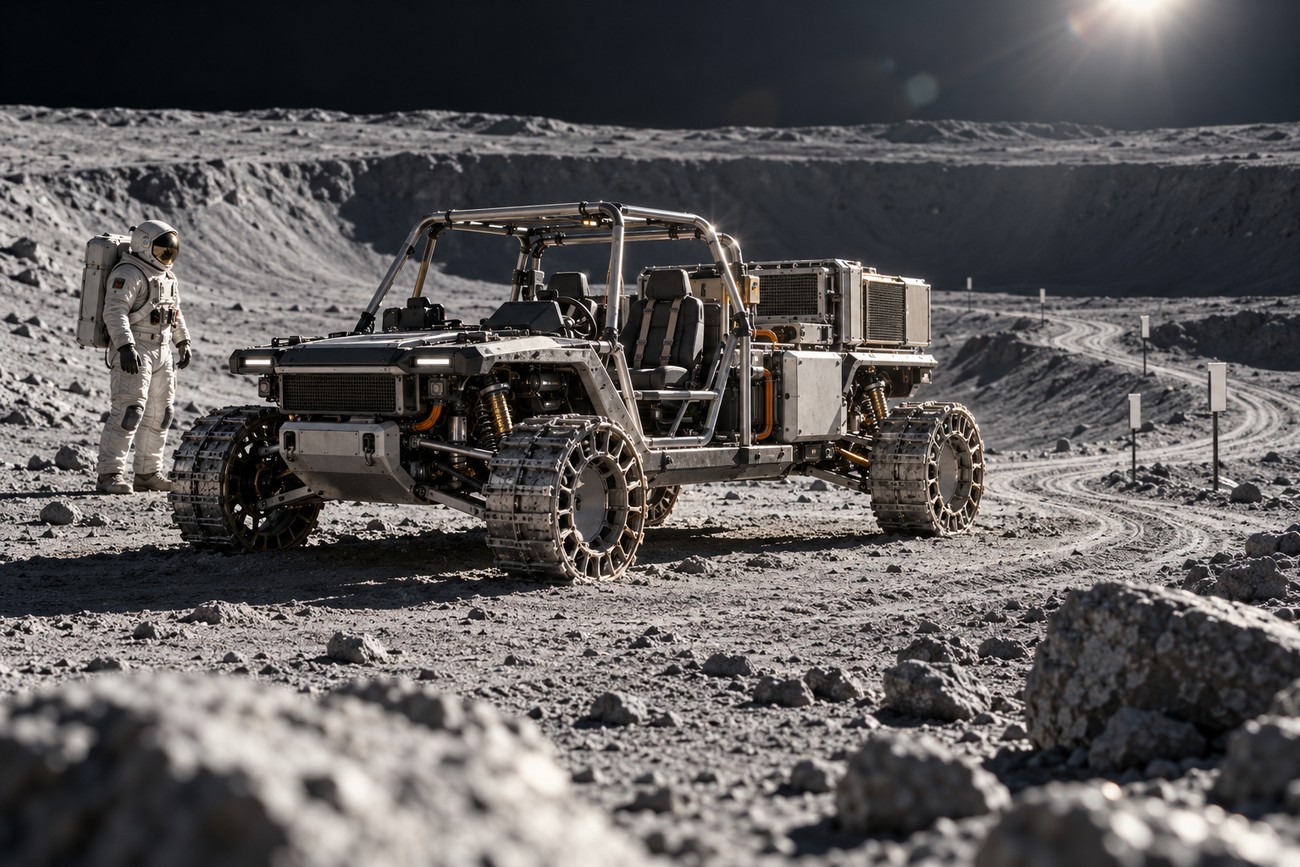
A lunar vehicle with a Wrangler-like body would require engineering changes well beyond an off-road accessory package. It would need a power system that works without atmospheric oxygen, vacuum-compatible wheels, controlled heat rejection, protected electronics, and seals and lubricants selected for the environment. Dust-resistant joints and brakes would matter as much as the ability to climb.
Its control system would also need to monitor temperatures, electrical health, wheel behavior, and signs of damage without depending on a roadside repair. Preserving operating life is a design goal: a machine that crosses one rough patch and fails before the next stop has not completed a useful route. Inspection and cleaning cannot be assumed available whenever conditions worsen.
Preparing the route could reduce risk more effectively than adding power. Mapping rim breaks, choosing firmer ground, and avoiding steep or unstable walls would give the vehicle a defined path and a plausible return. Such preparation does not make a serious natural crater harmless; it changes which terrain is being attempted.
A heavily redesigned rover styled after a Wrangler might cross selected lunar terrain. Apollo lunar rovers show that purpose-built mobility can work there, not that a conventional Jeep can work unchanged. The official Rubicon package is intended for Earth off-road use, and a factory Rubicon should not be treated as moon-ready.
Frequently asked questions
What would happen if a Wrangler stopped on the Moon during lunar night?
An unprotected Wrangler would face a lunar night environment that can reach approximately −173 °C, with no ordinary atmospheric warming and no simple assumption that it could restart. Batteries, fluids, seals, and electronics would need active thermal protection designed for the stop, as well as for driving. There would also be no conventional roadside assistance to recover a vehicle that failed to restart.
What Jeep has the moon roof?
Jeep has offered glass roof or sunroof options on some models, but availability depends on the model, year, trim, and market. “Moonroof” is often used informally for a glass sunroof. If you are comparing vehicles, check the exact equipment listing rather than assuming the term describes a standard feature.
What does the “A with a circle and exclamation point” symbol on my Jeep Compass mean?
It commonly indicates that the automatic engine stop/start system needs attention or is unavailable because of a fault. The exact meaning depends on the model year and how the light appears, so check the accompanying dashboard message and the owner’s manual. If the warning persists, a diagnostic check can distinguish a system fault from a temporary operating condition.
Which is more expensive, Rubicon or Wrangler?
Rubicon is a trim of the Jeep Wrangler, rather than a separate model to compare with every Wrangler. A new Rubicon generally costs more than a base Wrangler in the same market, but options, model year, condition, and local pricing can change a particular comparison. Compare like-for-like listings before drawing a price conclusion.
What is the rarest Jeep Wrangler?
There is no single reliably universal answer without specifying a generation, market, and definition of rarity. Limited editions, unusual factory configurations, and surviving examples can produce different answers. A rarity claim is most useful when it names the exact variant and supports it with production records.







