
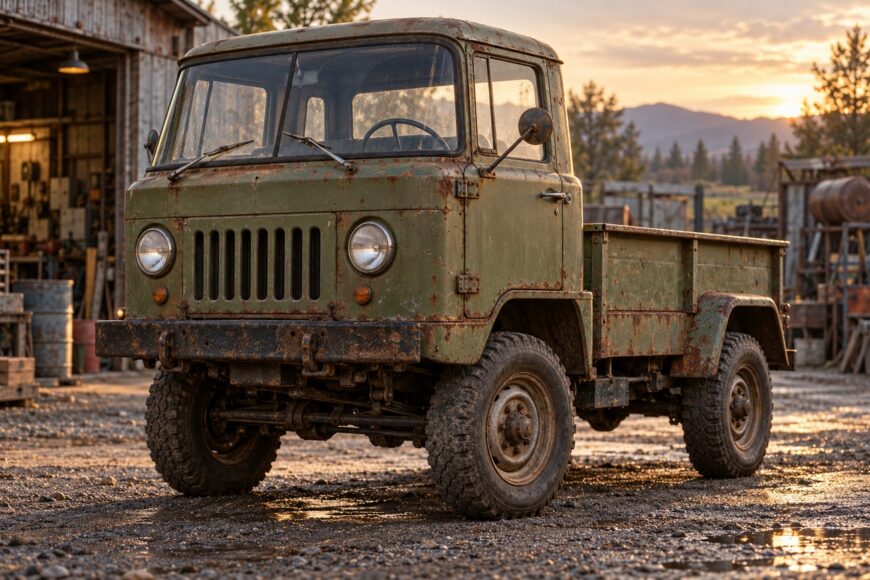
The Jeep FC-170 is an unusual four-wheel-drive pickup built with the cab over the engine. Its compact wheelbase and approximately 9-foot cargo bed give it a distinctive working-truck proportion: useful bed length in a short overall package, combined with a high cab and a rearward load. That layout is central to its appeal and its compromises.
Produced by Willys from 1957 through 1965, the FC-170 can look like a simple, capable Jeep with a larger box. Buying one on appearance alone is risky. Rare body and drivetrain parts, structural cab rust, replacement axles, mixed components, and an advertised payload figure that does not apply universally can turn an attractive truck into a difficult restoration.
- What the Jeep FC-170 Actually Is
- FC-170 Specifications at a Glance
- Why FC-170 Payload Ratings Are Easy to Misread
- The Restoration Problems Owners Underestimate
- How to Inspect an FC-170 Before Buying
- Originality, Usability, and the FC-170 Ownership Choice
- Frequently asked questions
- How many Jeep FC trucks were made?
- How can I tell whether an FC-170 has its original axles?
- Why are FC-170 body panels often harder to replace than mechanical parts?
What the Jeep FC-170 Actually Is
The FC-170 was a Willys truck designed around a cab-over-engine layout and four-wheel drive. The driver sits above and slightly ahead of the engine, which keeps the truck compact for its carrying capacity. This arrangement also places major service points inside a tightly packaged cab, making routine mechanical work less straightforward than on a conventional pickup.
Production ran from 1957 through 1965. The truck used an approximately 103–103.5-inch wheelbase, or about 2.62–2.63 meters, with an overall length of approximately 181.5 inches. Those dimensions help explain why the FC-170 has such a large-looking cargo area relative to the distance between its axles.
The standard bed was approximately 9 feet long, extending well beyond the short wheelbase. That overhang is one of the FC-170’s defining features, especially for owners who value its period utility and distinctive proportions. It also means that load placement, rear axle condition, tire specification, and braking performance matter greatly when the truck is carrying weight.
The FC-170 should be understood as a period commercial vehicle rather than a modern heavy-duty hauler. Four-wheel drive can improve traction on loose or uneven surfaces, yet it does not increase the legal or safe load capacity of a particular chassis. A truck with a sound frame and correct running gear may be highly usable for its age while still requiring conservative speeds and careful loading.
FC-170 Specifications at a Glance
The figures below describe common factory-era references and approximate dimensions. GVWR varies by configuration, so the table should be read alongside the identification plate and the actual axles, wheels, and tires fitted to the truck.
| Item | FC-170 reference |
|---|---|
| Production period | 1957–1965 |
| Engine | Willys Super Hurricane inline-six, 226 cubic inches, approximately 3.7 liters |
| Advertised output | Approximately 105 hp and 190 lb-ft |
| Wheelbase | Approximately 103–103.5 inches, or about 2.62–2.63 meters |
| Overall length | Approximately 181.5 inches |
| Standard bed length | Approximately 9 feet |
| Suspension | Dependent suspension with leaf springs |
| Ground clearance | Approximately 8.8 inches |
| Common GVWR reference | Approximately 7,000 lb for some FC-170 configurations |
| Higher GVWR reference | Up to approximately 9,000 lb for certain dual-rear-wheel or reinforced configurations; not universal |
Why FC-170 Payload Ratings Are Easy to Misread
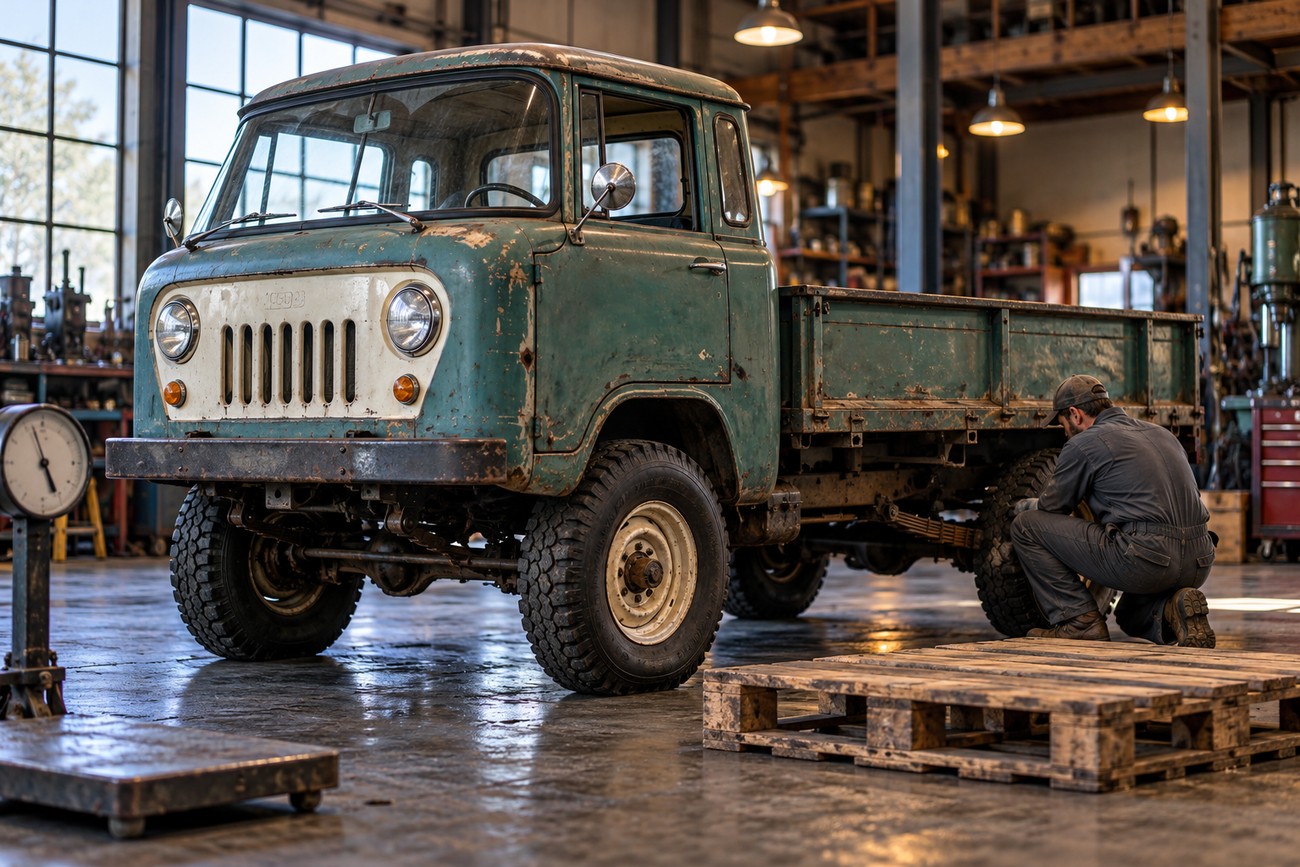
Some advertising materials cite a 3,510-lb payload for the FC-170. That figure is often repeated as if it were universal permission to place that much cargo in any truck wearing the FC-170 name. It is safer to treat it as a configuration-specific advertising claim until the individual truck’s data plate and running gear have been checked.
Payload is calculated from GVWR after accounting for the truck’s own weight. The result is also constrained by axle capacity, wheel and tire ratings, suspension condition, and the actual distribution of the load. A truck with a nominal GVWR of approximately 7,000 lb cannot automatically be treated like a dual-rear-wheel or reinforced version associated with a rating of up to approximately 9,000 lb.
Restored trucks create additional uncertainty because the parts may no longer match the original specification. An adapted rear axle, different wheels, modern tires, or a replacement engine can alter the practical and mechanical limits without changing the badge or the seller’s description. Check the plate, weigh the vehicle in its current condition, identify the axles, and assess the tires before treating any payload number as meaningful.
Overloading affects more than spring sag. It increases stopping distance, stresses steering components, reduces stability, and places additional load on the transmission, transfer case, driveshafts, and axles. The FC-170’s short wheelbase and long bed make load position especially important, while its period brakes and steering were designed around the standards of their time.
The Restoration Problems Owners Underestimate
Engine access is a basic ownership concern. The Super Hurricane inline-six sits under or within the cab-over structure, so work that would be accessible from the front of a conventional pickup can require removal of covers, interior pieces, or other surrounding components. A running engine is useful evidence during a purchase inspection, yet it does not prove that future service will be simple.
Parts availability is another dividing line between an affordable project and a prolonged fabrication exercise. Original transmission, axle, brake, and body parts can be difficult to source, and parts listed for a CJ, FC-150, or later Jeep are not automatically interchangeable. A catalog match based only on the Jeep name can lead to incorrect dimensions, mounting patterns, or brake components.
Identify the axle and the cab structure before ordering drivetrain parts. An adapted axle can change the brakes, wheels, and parts compatibility, while cab repairs may require hand-fabricated panels rather than a catalog replacement.
Specific Timken axles deserve direct inspection because their presence affects parts sourcing and repair decisions. Some trucks retain original axles, while others have received more available replacements or adapted assemblies. The word “original” in a sales listing has little value until axle markings, housings, brakes, hubs, and the rest of the fitted parts agree with the truck’s configuration.
Cab rust can consume more time than a tired engine. Inspect the floor, sills, pillars, cab mounts, and the frame sections beneath the cab, then look for distortion around the steering-column and body-mounting areas. Outer panels may appear presentable while the load-bearing structure underneath has already suffered serious corrosion.
A seller may call a truck restored because it runs, even though the engine, transmission, axles, wiring, and brakes come from different vehicles. Such a mixture can be practical for a driver, but it reduces factory originality and makes future parts selection harder. The correct question is whether the truck is a coherent, documented build for its intended use.
How to Inspect an FC-170 Before Buying
Start with identity and configuration rather than paint. Compare the VIN or other identifying numbers and factory markings with the paperwork, and treat the advertised model year as a clue rather than proof. Restored trucks can carry mixed components, and a clean exterior can conceal a chassis assembled from several sources.
Next, locate the GVWR plate and record its information before discussing payload. Identify the rear axle type, wheel arrangement, engine, transmission, and transfer case. Photograph casting numbers and tags where possible; those details are more useful for parts research than a general statement that the truck has “factory running gear.”
Inspect the cab floor, inner sills, pillars, mounts, and the frame beneath the cab. Pay particular attention to the point where the steering shaft exits the cab and to areas where corrosion may weaken the relationship between the cab, frame, and steering system. A patch over thin metal is not equivalent to sound structure, especially where mounts or steering loads are involved.
Only after the structure has passed inspection should you evaluate the engine as the main project. Check the brakes, steering, leaf springs, wiring, axle condition, and driveshafts first. A non-running engine can be rebuilt or replaced; a severely rusted cab, compromised frame, or incomplete brake system may define the entire project budget and safety plan.
Originality, Usability, and the FC-170 Ownership Choice
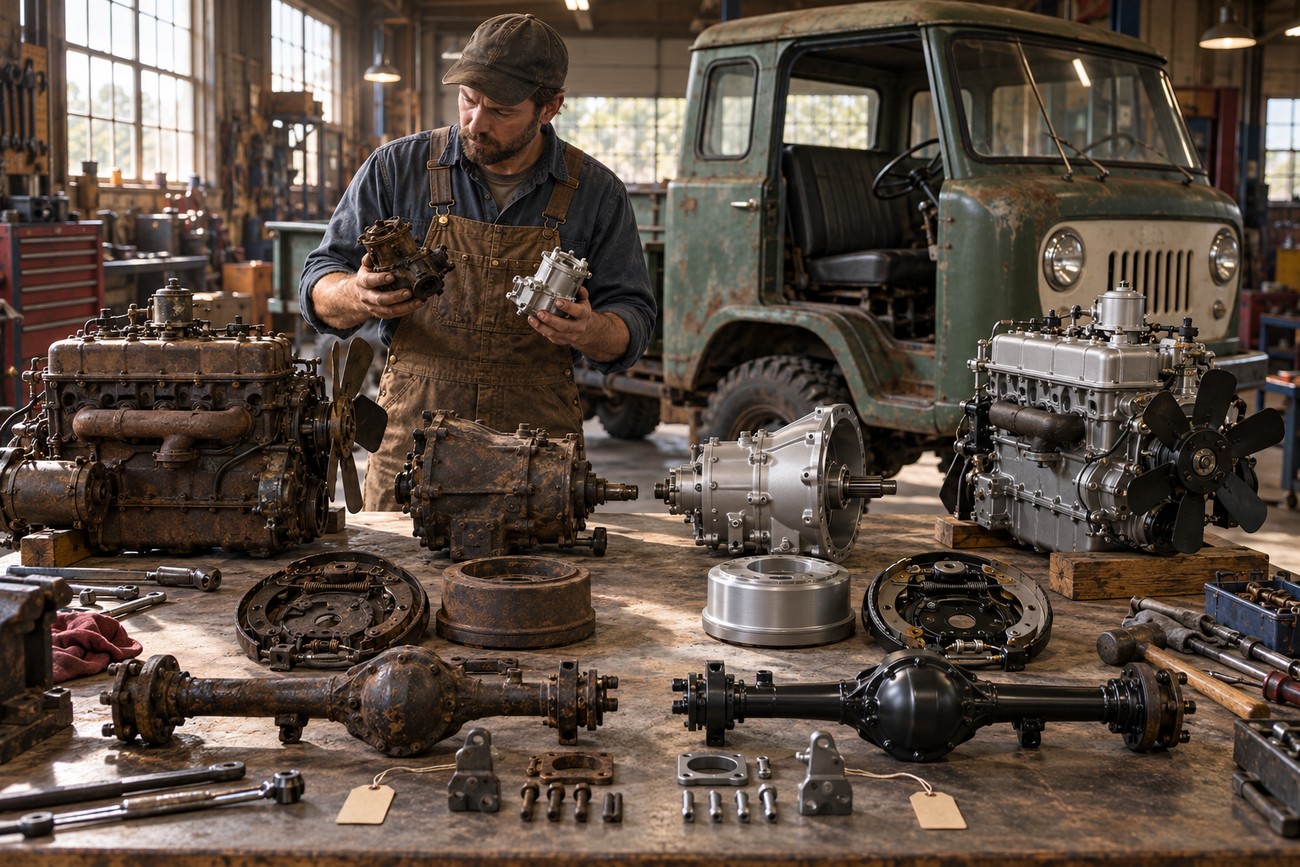
The restoration goal should be decided before parts are purchased. A historically correct truck may justify rebuilding its original engine, transmission, axles, and brakes, even when that route requires more research and specialist work. A practical driver may benefit from replacement components, provided the changes are documented and the resulting system is engineered as a complete, serviceable package.
CJ, FC-150, and later Jeep parts can sometimes help, yet their presence in a Jeep catalog does not make them plug-and-play FC-170 components. Dimensions, mounting points, brake arrangements, wheel patterns, and steering details must be compared individually. An inexpensive substitute becomes costly when it requires undocumented modifications or leaves the truck with mismatched service parts.
Original load capacity also says little about safe operation in modern traffic. Period braking, steering, tires, lighting, and suspension condition deserve attention before regular road use, particularly at contemporary traffic speeds. The truck’s ability to find traction on a rough surface should never be confused with its ability to stop, turn, or remain stable under a heavy load.
Forward Control specialist communities are often more useful than general Jeep forums for this model. Their archives may contain drawings, donor-part references, axle identification information, and fabrication solutions for rare cab panels. That knowledge can help determine whether a proposed repair preserves the truck’s character, improves serviceability, or simply creates another undocumented combination.
Frequently asked questions
How many Jeep FC trucks were made?
A reliable total production figure is not established by the available information. Published numbers may differ depending on whether they cover every Forward Control variant or only the FC-170, so a precise total should not be presented without a clearly defined factory source.
How can I tell whether an FC-170 has its original axles?
Compare the axle type and identifying marks with the truck’s stated configuration, then inspect the hubs, brakes, wheels, and fitted service parts for consistency. Originality should be supported by matching component details or documentation; a seller’s use of the word “original” is insufficient on its own.
Why are FC-170 body panels often harder to replace than mechanical parts?
FC-170 cab panels and glass serve a small specialist market, so replacement supply is limited. A damaged structural or exterior panel may require hand fabrication, careful repair of the remaining metal, or a donor cab, while mechanical parts may offer more opportunities for adaptation.







