
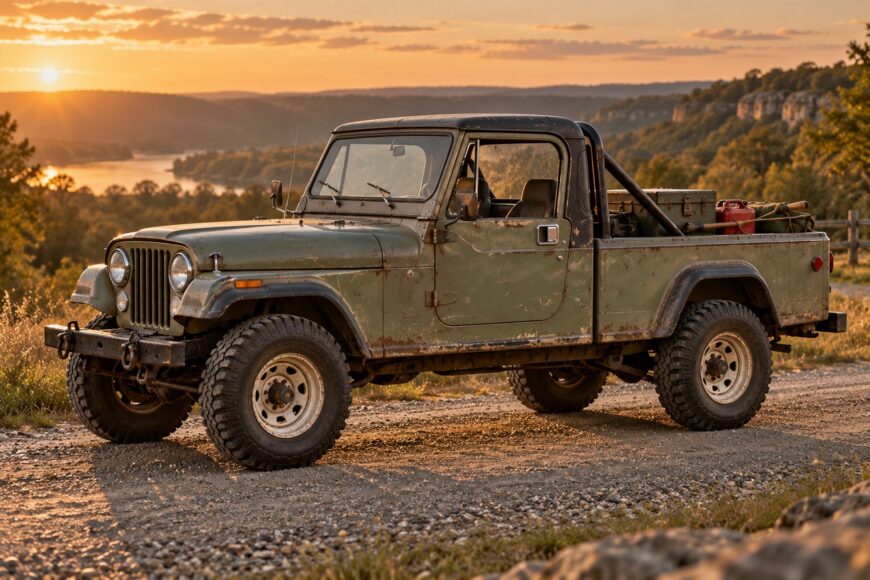
The Jeep CJ-8 Scrambler offers more usable length and better straight-line stability than a CJ-7, while giving up some of the compactness that makes a short-wheelbase CJ effective off-road. Its 103.5-inch wheelbase settles the truck on pavement and makes room for a useful cargo bed, but it also needs more room to turn and reduces breakover clearance on tight trails.
That combination makes the Scrambler unusually appealing and easy to misjudge. A polished body can conceal frame corrosion, mixed axles and transmissions, incorrect identification, or a CJ-7 conversion wearing Scrambler-style parts. CJ-8-specific panels and cargo-area hardware can also turn a seemingly simple repair into an expensive sourcing exercise, so a sound purchase begins with verification rather than appearance or rarity claims.
- What the CJ-8 Scrambler Actually Is
- CJ-7 vs. CJ-8: Dimensions and Configuration
- How the Long Wheelbase Changes Driving
- Engines, Driveline, and the Utility Compromise
- Rust, Parts, and Restoration Traps
- Buying a Scrambler: Verify the Truck Before the Price
- Frequently asked questions
- How much longer is a CJ-8 than a CJ-7?
- How much is a Jeep Scrambler worth?
- What does “matching-ish” mean on a Scrambler listing?
What the CJ-8 Scrambler Actually Is
The CJ-8 Scrambler is the long-wheelbase counterpart to the CJ-7. Its wheelbase measures 103.5 inches, compared with 93.5 inches for the CJ-7, a 10-inch increase without abandoning the basic CJ architecture. The result is a two-door, open-bed mini-pickup built on a CJ-based platform.
That body format explains much of the model’s character. The bed adds practical carrying space for tools, camping equipment, or light loads, while the open cargo area retains the exposed, utilitarian feel of a CJ. It is a compact truck in everyday use, although its frame, suspension, and four-wheel-drive layout remain closely related to the CJ family rather than to a conventional full-size pickup.
Production ran from 1981 through 1986 and totaled approximately 27,500 vehicles. Limited production helps explain the model’s appeal among collectors, but rarity alone says little about the condition of an individual truck. Storage history, rust repair, documentation, and the quality of later work matter more than the production figure.
A factory CJ-8 should be distinguished from a CJ-7 conversion. A conversion may use a replacement bed, extended frame, altered driveshafts, and reproduction panels, and some can be well executed. VIN records, identification plates, frame details, body construction, and consistent factory-style proportions provide stronger evidence than a seller’s description or a familiar exterior silhouette.
CJ-7 vs. CJ-8: Dimensions and Configuration
The useful distinction is the relationship between wheelbase, total length, and working space. Overall-length references commonly place the CJ-8 at approximately 177–177.5 inches, although equipment and source differences produce small variations.
| Feature | CJ-7 | CJ-8 Scrambler | Practical effect |
|---|---|---|---|
| Wheelbase | 93.5 inches | 103.5 inches | The CJ-8 has a 10-inch longer wheelbase, improving stability while reducing tight-trail agility. |
| Overall length | Shorter CJ layout | Approximately 177–177.5 inches | Figures vary slightly by reference and equipment. |
| Body format | Two-door CJ utility body | Two-door, open-bed mini-pickup | The Scrambler provides a separate exposed cargo area. |
| Maneuverability | More compact turning envelope | Larger turning envelope | The CJ-7 is easier to place on narrow trails and in tight urban spaces. |
| Cargo usefulness | Rear passenger and utility space | Longer open cargo bed | Dirty, wet, or bulky equipment can be kept outside the cabin. |
| Stability | More responsive, short-wheelbase feel | More settled in a straight line | The longer platform is generally calmer on pavement and faster dirt roads. |
| Payload and towing | Configuration-dependent | Configuration-dependent | Claims must be checked against year, engine, transmission, market, and equipment. |
How the Long Wheelbase Changes Driving
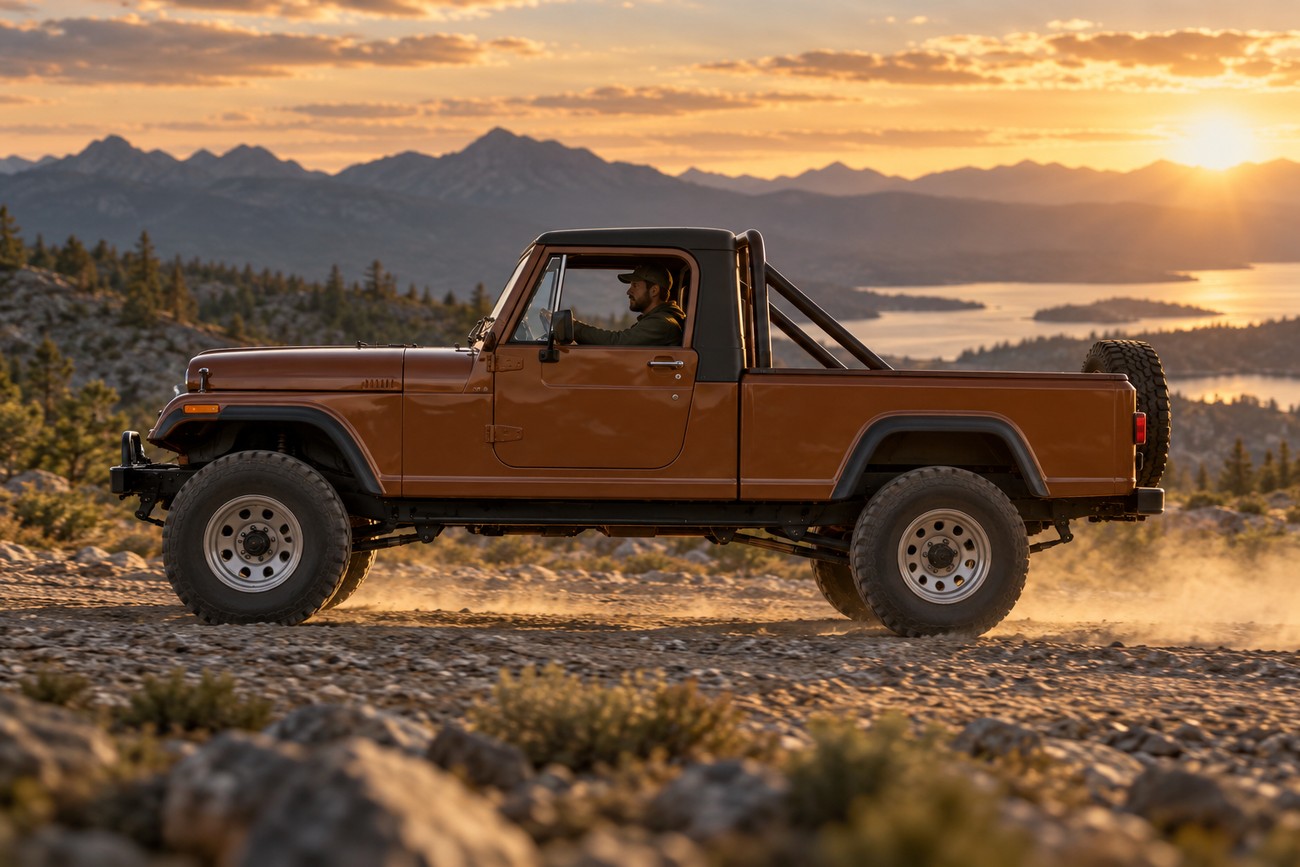
The longer wheelbase gives the Scrambler a more planted feel in a straight line than a CJ-7. On pavement and open gravel roads, it can track with less short-wheelbase nervousness, and the bed makes the vehicle more useful for work. That advantage is most noticeable when the suspension, steering, and tires are in good condition.
Tight terrain exposes the cost of the extra length. The Scrambler needs more room to turn, and its longer center section is more vulnerable on steep breakover angles. It can still be a capable trail vehicle because of its four-wheel-drive architecture, solid axles, rigid frame, and short overhangs, but a narrow, stepped trail favors the shorter CJ-7.
Road manners also depend heavily on setup. Owners commonly describe these Jeeps as noisy, sensitive to crosswinds, and prone to vibration, with comfort limited by thin insulation, basic seating, and an exposed cargo area. The bed can carry equipment efficiently, but without a sound cover or proper storage arrangement, it also exposes cargo to weather and unwanted attention.
Large tires often magnify every weakness. Oversized tires can dull acceleration, overload steering components, worsen braking response, and make the gearing feel too tall. Worn leaf springs, loose steering, poor alignment, or incorrect driveshaft angles can make a sound Scrambler seem fundamentally unstable when the real problem is its maintenance and modification history.
A useful inspection drive should include straight-line braking, steering corrections, vibration under acceleration, and low-speed turning. Changes in vibration with throttle position can point toward driveline geometry, while wandering and delayed steering response may indicate worn linkage, springs, or axle-related parts. Those observations are more valuable than a test drive limited to a short, smooth street.
Engines, Driveline, and the Utility Compromise
CJ-8-era applications included a 4.2-liter inline-six and a 2.5-liter four-cylinder. Other engine and transmission combinations may appear by market or model year, so a listing should be treated as a starting point rather than a complete specification. The engine in the truck should be identified alongside the transmission, transfer case, axles, and major accessories.
The model’s off-road identity comes from its four-wheel-drive architecture, rigid frame, solid axles, and short overhangs. Those features provide durability and useful articulation potential, while the longer wheelbase adds stability under load and on faster unpaved roads. They do not eliminate the need for correct gearing, healthy springs, and a properly set-up steering system.
The four-cylinder can suit a lighter, closer-to-original truck used at moderate speeds, while the inline-six generally feels more relaxed in a Scrambler carrying cargo. Neither engine should be judged in isolation. Tire diameter, axle gearing, transmission choice, and vehicle weight determine whether the truck feels responsive or labored.
Payload and towing claims depend heavily on year, engine, transmission, market, and equipment. Seller or enthusiast figures without a specific configuration should be treated cautiously. A buyer should verify the relevant documentation and inspect the brakes, frame, hitch installation, cooling system, and driveline before treating the truck as a working hauler.
Rust, Parts, and Restoration Traps
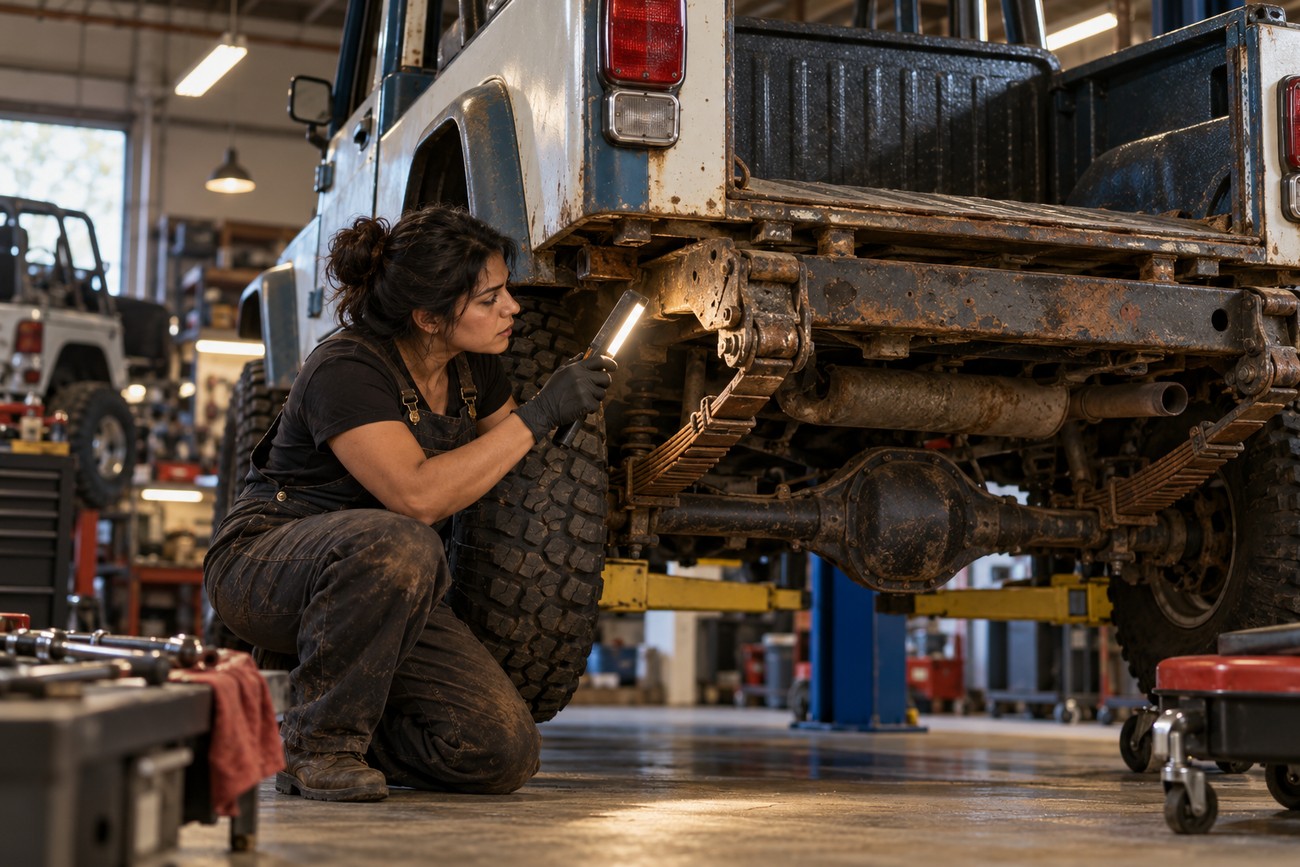
Rust inspection should begin underneath the truck. Check the frame sections, body mounts, floor panels, spring hangers, body attachment points, and the structure supporting the cargo bed. Fresh undercoating can hide repairs or perforation, so a small probe, strong light, and access to the inside of the floor are more useful than a clean-looking underside.
Corrosion and storage history generally tell you more than recorded mileage. A low-mileage CJ-8 that spent years outdoors may need extensive structural work, while a higher-mileage example kept dry may retain a more credible frame and body. The cost of correcting hidden rust can exceed the value of cosmetic improvements that initially attract attention.
Many mechanical and running-gear parts overlap with CJ-7 or related CJ applications. That helps with brakes, suspension service, engine work, and some drivetrain repairs. Compatibility still requires checking the year and exact arrangement, especially for driveshafts, exhaust routing, mounts, and parts affected by the longer platform.
CJ-8-specific body panels, cargo-area components, trim, and mounting solutions are less forgiving. A replacement panel may be scarce, expensive, or difficult to align, and a previous owner may have modified the bed to make another part fit. Early or transitional vehicles can also carry small interior, electrical, or equipment differences that do not match a catalog listing perfectly.
Restoration quality is easiest to judge where paint cannot help: inside frame rails, behind body mounts, around spring hangers, beneath the bed, and at patched floor seams. A truck assembled from several donors may work well, yet require careful documentation so future repairs do not follow the wrong year or configuration.
Buying a Scrambler: Verify the Truck Before the Price
Start with identity. Compare the VIN, identification plates, title or registration documents, frame evidence, body construction, and wheelbase before discussing originality or value. A CJ-7 conversion may be a legitimate custom project, but it should be described and priced as a conversion unless the evidence supports factory CJ-8 status.
Next, establish the truck’s structural condition. Inspect the frame and spring hangers from multiple angles, lift carpets and bed coverings, check body mounts, and look for seams that indicate replacement metal. Examine the bed as both a practical component and a source of structural attachment points, including its supports, floor, tailgate area, and connection to the body.
Then identify the drivetrain as a complete system. Mixed axles, transmissions, transfer cases, driveshafts, accessories, seats, panels, and wiring are common after restorations. Individual substitutions are not automatically a problem; the concern is whether the parts work together, are appropriate for the intended use, and can be serviced with reliable information.
Originality is not binary. A coherent, period-correct “matching-ish” truck with documented substitutions may be more credible than a glossy example assembled from unrelated donor vehicles. That judgment should include workmanship, mechanical consistency, evidence of rust repair, and whether the modifications are reversible or clearly recorded.
There is no single fixed value for a Scrambler. Market worth depends substantially on rust, documentation, factory identity, originality, engine, body panels, and restoration quality. Compare the cost of correcting structural and driveline faults before paying for paint, rare trim, or a seller’s claim that the truck is unusually collectible.
Frequently asked questions
Wheelbase is the simplest starting point for comparing the CJ-8 with a CJ-7, but total length is a separate measurement. Value depends on the condition and identity of the individual truck, not just the Scrambler name. Listings may also describe a vehicle as “matching-ish,” which calls for a closer look at its components and documentation.
How much longer is a CJ-8 than a CJ-7?
The CJ-8 wheelbase is 10 inches longer: 103.5 inches versus 93.5 inches for the CJ-7. That wheelbase difference affects turning behavior, breakover geometry, ride stability, and cargo layout.
Total vehicle length is a separate measurement. References commonly cite approximately 177–177.5 inches for the CJ-8, with small differences caused by equipment and source conventions. A listing that quotes only overall length may therefore be difficult to compare directly with another truck.
How much is a Jeep Scrambler worth?
No single reliable value can be assigned without inspecting the truck. Start with factory CJ-8 identity, frame and body rust, documentation, engine and drivetrain consistency, originality, rare body panels, and the quality of structural and cosmetic restoration.
A sound conversion can be useful, while a factory truck with severe corrosion can require more money than its rarity justifies. The strongest comparison is between similar-condition examples after accounting for repairs, missing parts, and unresolved mechanical work.
What does “matching-ish” mean on a Scrambler listing?
“Matching-ish” describes a coherent, period-correct vehicle that retains appropriately matched components but is not fully factory-original. It may have a replacement engine, later accessory, repaired body panel, or other documented deviation from the original build.
That can be preferable to a cosmetically perfect truck built from unrelated donor parts. The important questions are whether the major systems suit one another, whether the substitutions are disclosed, and whether the truck can be maintained without guessing which year or configuration each part came from.







