
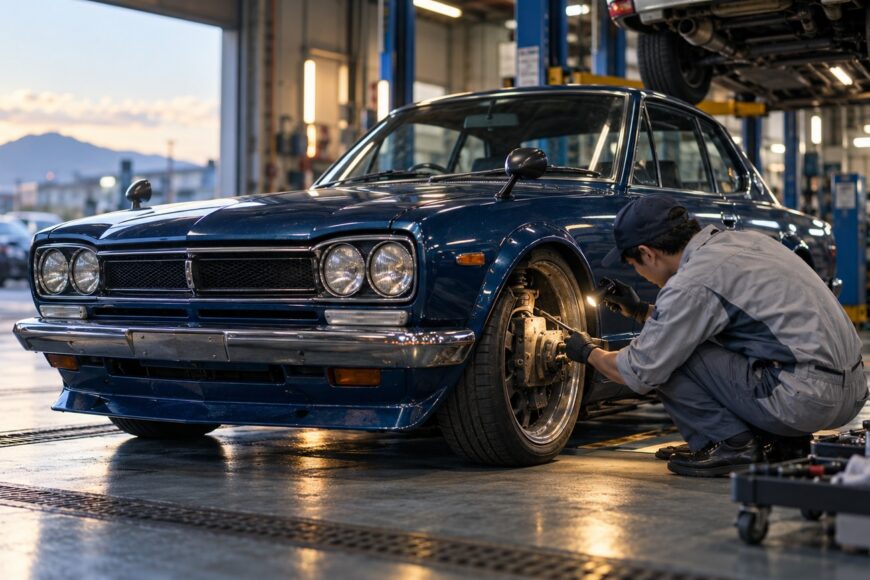
An older Nissan Skyline can look like a bargain when its purchase price is modest and the seller advertises fresh shaken. That certificate may remove an immediate administrative obstacle, yet it says far less about the car’s remaining mechanical life. The inspection bill and the repair bill are separate decisions, and a low price for one does not make the other predictable.
For an owner, the issue is whether the car can be prepared for inspection at a controlled cost. For a buyer, it is whether the promised inspection status reflects documented work or simply a recent pass. The Skyline’s weight, registration date, engine and emissions equipment, modifications, corrosion, and maintenance history all matter before a reliable budget can be discussed.
- What shaken proves—and does not prove—about an old Skyline
- Identify the car before accepting a shaken quote
- What inspectors check beyond whether the engine runs
- When a modified Skyline no longer matches its paperwork
- Skyline shaken costs: mandatory charges, service, and repairs
- Prepare a repair estimate before choosing DIY or a shop
- Buying a Skyline with fresh shaken: verify the work, not the claim
- If shaken has expired, plan transport before inspection
- Frequently asked questions
- How much does importing a Nissan Skyline from Japan add to shaken costs?
- What should I ask a distant seller to photograph before traveling to see the car?
- What is the Japanese shaken inspection?
- How much would it cost to import a Nissan Skyline from Japan?
What shaken proves—and does not prove—about an old Skyline
For an ordinary passenger Skyline, shaken is generally renewed every two years after the initial inspection period. The process checks applicable safety, emissions, and construction requirements at the time of inspection. It is a legal and technical checkpoint for the vehicle’s current condition, rather than a scheduled restoration of every aging component.
The inspection can identify a brake problem, excessive play in steering or suspension, an emissions issue, an unsuitable light, or a defect under the car. A pass means the vehicle met the requirements applied during that inspection. It does not establish how much service life remains in the body, turbocharger, gearbox, differential, wiring, or other systems that may still be functioning within the inspection criteria.
Age alone does not make a Skyline fail. An older car in sound condition and a suitable configuration may pass, while a newer example can require work because of worn tires, damaged glass, leaking components, or an alteration that does not match the applicable requirements. The inspection result follows the actual vehicle and its paperwork, rather than the model name or registration year by itself.
A valid certificate therefore should not be described as a two-year reliability warranty. It does not confirm that hoses, seals, fluids, fuel-system parts, cooling components, or electrical connections have been renewed as preventive maintenance. The sensible interpretation is narrower: the car satisfied the relevant inspection checks at a particular time, subject to the information and condition presented then.
Identify the car before accepting a shaken quote
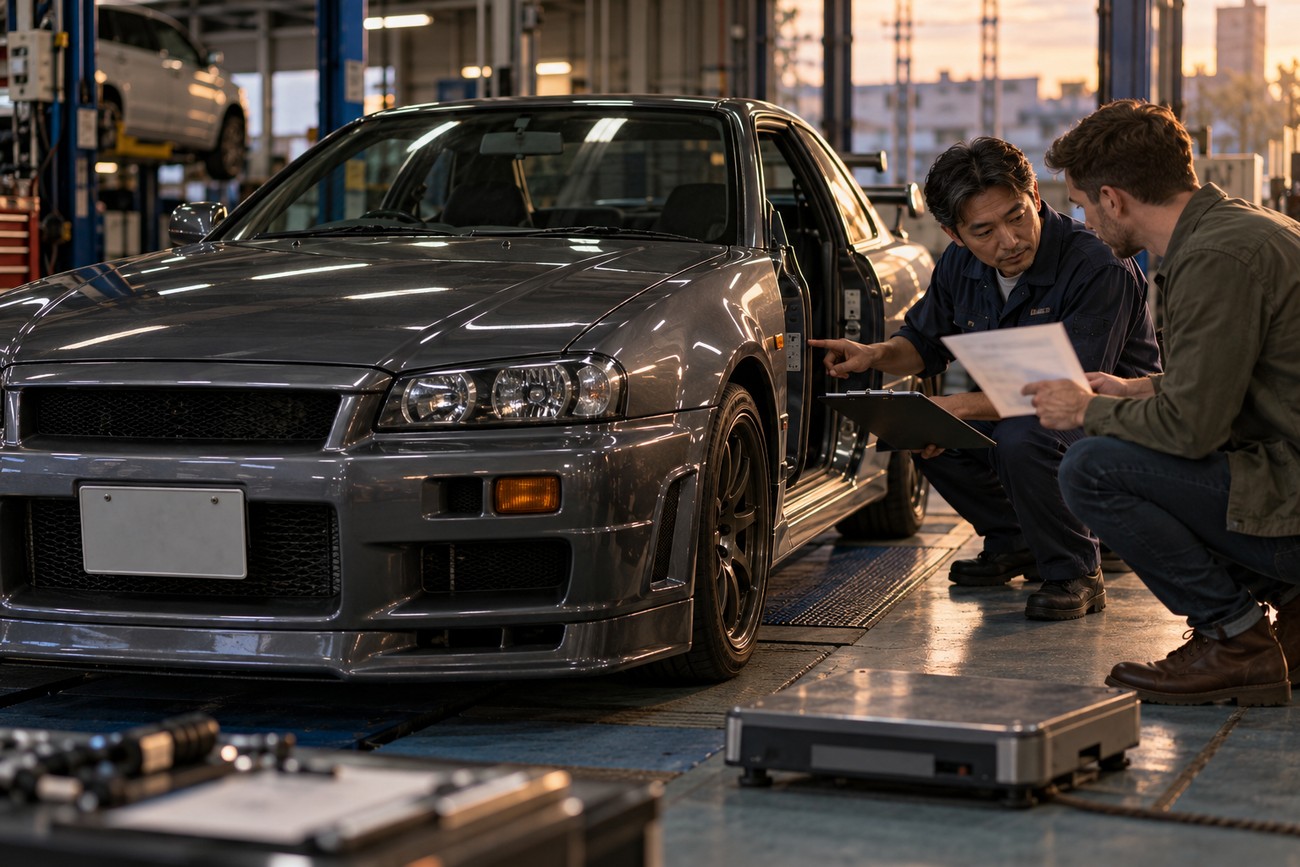
Start with the 車検証 and establish the vehicle’s documented identity before comparing prices. Record the documented weight, first registration date, engine details, emissions equipment, and the next shaken expiry date. These details affect compulsory charges and may also determine how much preparation is needed before the vehicle is presented.
The older-car tax burden can be higher, so a figure taken from an advertisement for a generic passenger car may be misleading. A kei-car calculation is even less useful for a Skyline because the vehicle belongs to a different weight and tax category. The badge alone cannot tell a service how much the mandatory bill will be, since the calculation depends on documented vehicle details and applicable rates.
Engine type and emissions equipment deserve specific attention on an older or imported car. A catalyst, exhaust arrangement, or other component may have been changed during tuning or repair. The inspection provider also needs to know about wheels, suspension, lighting, seats, steering components, and other alterations before giving a meaningful preparation opinion.
Check the next shaken expiry date against the 車検証 rather than relying on a seller’s description. “Fresh shaken” can refer to a recently completed inspection, while “shaken remaining” may cover a vehicle with only a limited period left. The date should be reconciled with the documents and with invoices or work records, especially if the car is being bought remotely.
Body condition belongs in this identification stage because repair planning can change the entire calculation. Surface damage on a panel has a different consequence from corrosion around the underside, brake lines, suspension mounts, or structural areas. A price based only on weight and insurance is incomplete if the car also needs welding, replacement parts, or specialist work before it can be presented.
What inspectors check beyond whether the engine runs
A Skyline may start cleanly and drive strongly while still failing an inspection item. The checks extend across brakes, tires, lighting, glass, steering, suspension, seat belts, emissions, leaks, exhaust condition, and the underside. Each group can create a different type of cost, from a straightforward replacement to a difficult corrosion repair.
Brakes and tires should be assessed as systems rather than by appearance alone. Uneven braking, worn friction material, damaged hoses, inadequate tread, or an unsuitable tire and wheel combination can require work before presentation. A workshop inspection should also look for seized or leaking components, because a short road test may not reveal every problem that matters on the test equipment.
Lighting and glass can cause preparation delays when parts are nonstandard or difficult to source. The condition, position, color, and operation of lamps need to be considered alongside the vehicle’s configuration. Cracks, damaged glazing, or a replacement unit with an unsuitable specification may require correction even when the engine and transmission operate normally.
Steering, suspension, and seat belts require attention to play, mounting condition, damage, and operation. On a lowered or modified Skyline, the issue may involve the relationship between ride height, wheels, suspension parts, and the documents. A loose component or deteriorated mounting can be more significant than a noisy but noncritical trim piece.
Emissions and exhaust checks cover more than whether the car sounds acceptable. The catalyst, exhaust routing, silencer, visible smoke, leaks, and related equipment can affect compliance. Oil, coolant, fuel, or brake-fluid leaks also deserve inspection, while the underside should be checked for corrosion and damage around structural zones, brake lines, suspension mounts, and other load-bearing areas.
Cosmetic rust on an outer panel may be repairable without changing the inspection plan. Rust around a structural area, brake line, suspension mount, or underside can require substantially more investigation and work. The available research does not support treating any one Skyline generation as having a universal defect; the relevant question is where corrosion exists on this particular car and how it affects safety or compliance.
When a modified Skyline no longer matches its paperwork
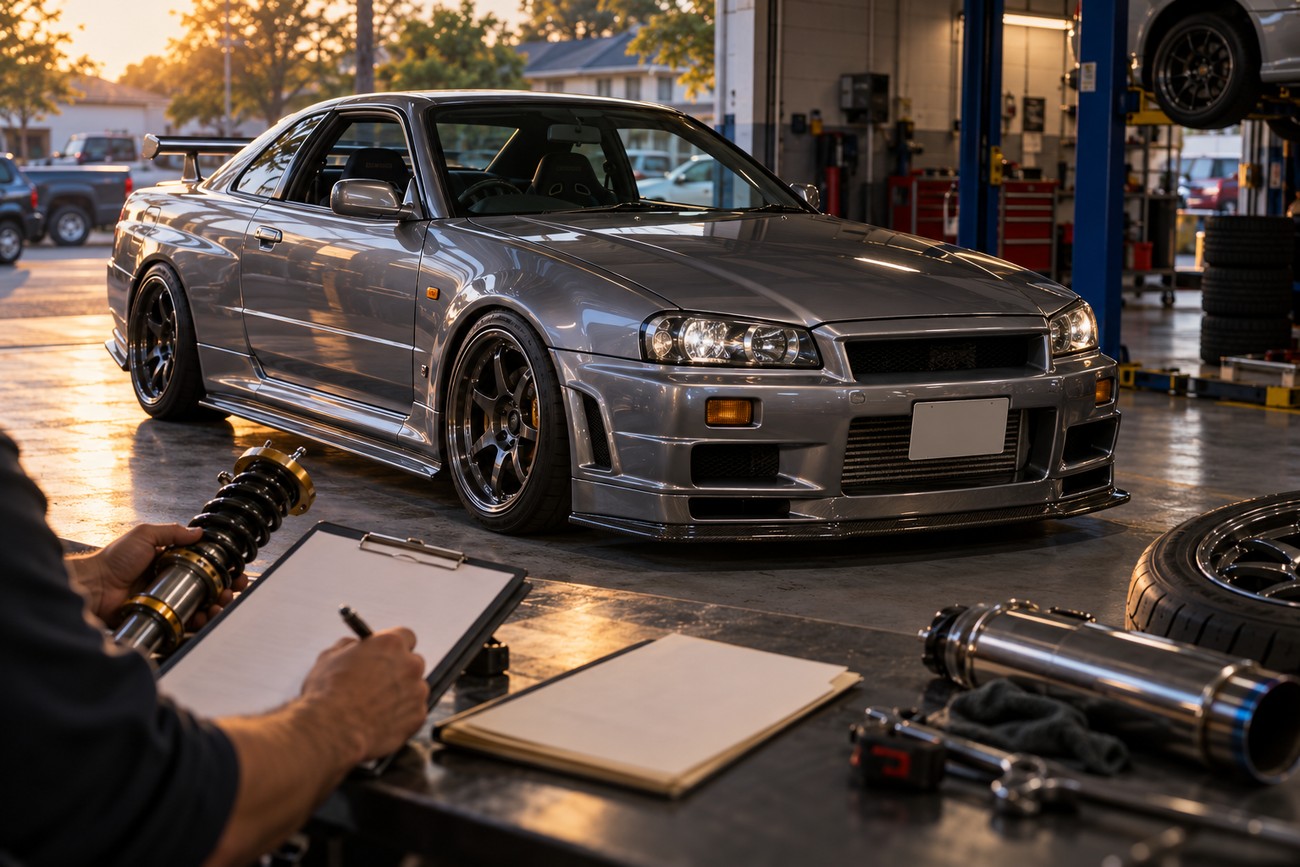
Modifications should be reviewed before an appointment is booked. Wheels and tires, ride height, lamps, exhaust, seats, steering wheel, and suspension parts are practical starting points. Compare the installed equipment with the car’s documents and with the requirements applied by the intended inspection provider.
An aftermarket component does not automatically mean failure. Its effect depends on the actual design, installation, dimensions, operation, and documentation. A seller’s statement that a modification is acceptable is only a claim until the specific vehicle and setup have been checked by the provider that will handle the inspection.
Problems often arise when a car has been built for appearance or performance and the owner assumes that every item can remain in place. A nonstandard lamp may need a different arrangement, a loud or altered exhaust may require correction, and wheels or lowered suspension may need to be replaced or adjusted. Seats and steering components also deserve review because their installation and relationship to the vehicle’s safety equipment matter.
Returning a Skyline to a suitable configuration can involve parts, labor, alignment, and a second inspection appointment. The cost is therefore more than the price of a replacement component. Ask the provider to identify which changes are acceptable as installed, which need documentation or correction, and which should be removed before the car is submitted.
The safest sequence is to send photographs and specifications in advance, then confirm the setup in person if the provider requests it. Keep the original wheels, exhaust, lights, seats, or other parts if they are available, but do not assume that reinstalling them will solve every issue without a further check. The actual vehicle, its documents, and the applicable requirements have to agree.
Skyline shaken costs: mandatory charges, service, and repairs
The total is best understood as several separate layers. Published prices below describe different scenarios for a standard passenger car, rather than a quote for a particular Skyline.
| Cost component | DIY presentation | Shop route | What changes the amount |
|---|---|---|---|
| 24-month Jibaiseki compulsory insurance | Applies | Applies | The applicable insurance rate for the 24-month policy. |
| Weight tax | Applies | Applies | Documented weight, first registration date, vehicle category, age-related treatment, and applicable rates. |
| Inspection fee | Applies | Applies | The inspection route and current official fee structure. |
| Inspection or service labor | Some labor may be avoided | Usually charged | Provider, scope of checks, adjustment work, diagnostics, and whether re-inspection is needed. |
| Repairs required for a pass | Owner must arrange and pay for them | May be quoted and completed by the shop | Brakes, tires, lights, exhaust, leaks, corrosion, suspension, modifications, and parts availability. |
| Optional preventive maintenance | Separate owner decision | Separate quoted work | Age, service history, condition, and the owner’s intended use; it is outside the basic pass requirement. |
| Published standard-car service scenario | Not comparable to DIY totals | Roughly ¥75,000–¥115,000 in one published range | Scope, vehicle details, labor, and repairs included by that provider; not a Skyline-specific quote. |
| Another published standard-car service scenario | Not comparable to DIY totals | Roughly ¥100,000–¥150,000 in another range | Different provider assumptions and included work; not a fixed total for an old Skyline. |
| Published self-presentation example | Approximately ¥46,000 in that example | Not a shop estimate | Different scope and owner responsibility; it does not include the same labor or repair assumptions as serviced totals. |
The compulsory portion consists of 24-month Jibaiseki insurance, weight tax, and the inspection fee. The actual bill then adds any service or diagnostic labor, necessary repairs, and, where relevant, transport and optional preventive work. A Skyline’s documented weight and first registration date are especially important when checking the mandatory calculation.
The published service ranges of roughly ¥75,000–¥115,000 and ¥100,000–¥150,000 describe standard-car service scenarios. An approximately ¥46,000 self-presentation example has a different scope and should not be added to, or directly compared with, those service totals. None of these figures is a guaranteed price for a specific Skyline.
Prepare a repair estimate before choosing DIY or a shop
Begin by collecting the car’s documents and a clear description of its current configuration. Confirm the documented weight, first registration date, engine and emissions equipment, inspection expiry, and modifications. This gives the provider enough information to distinguish a routine administrative calculation from a car that needs specialist preparation.
Next, request a pre-inspection assessment rather than asking only for the cheapest shaken package. The check should cover the underside, brakes, tires, lights, steering, suspension, seat belts, glass, exhaust, emissions-related equipment, leaks, and corrosion. If the car has been modified or imported, send photographs and parts information before the appointment so the provider can flag issues that a basic estimate might omit.
Ask for a written estimate with three separate categories: compulsory payments, work required for the vehicle to pass, and optional preventive maintenance. This distinction is useful when the owner has a limited budget. It also prevents a necessary brake or exhaust repair from being confused with sensible replacement of an aging hose or fluid that may not be an immediate inspection requirement.
A written estimate should show the difference between a defect that blocks a pass and age-related work that protects future use. Approving the cheapest inspection package without that separation can leave the owner believing the car is fully prepared when the estimate only covered the administrative route.
Self-presentation can reduce some service labor, but it does not remove weight tax, Jibaiseki insurance, the inspection fee, or the need to correct noncompliant parts. The owner also takes responsibility for identifying defects and arranging repairs. A failed attempt can add transport, re-inspection, and further workshop costs, so DIY is most realistic when the vehicle has already been assessed and its configuration is straightforward.
Transport should be included in the calculation if the car cannot legally be driven to the shop or inspection site. A low advertised price may exclude diagnostics, repairs, preventive work, and recovery after a failed inspection. Compare the complete written scenarios rather than choosing the smallest headline figure.
Buying a Skyline with fresh shaken: verify the work, not the claim
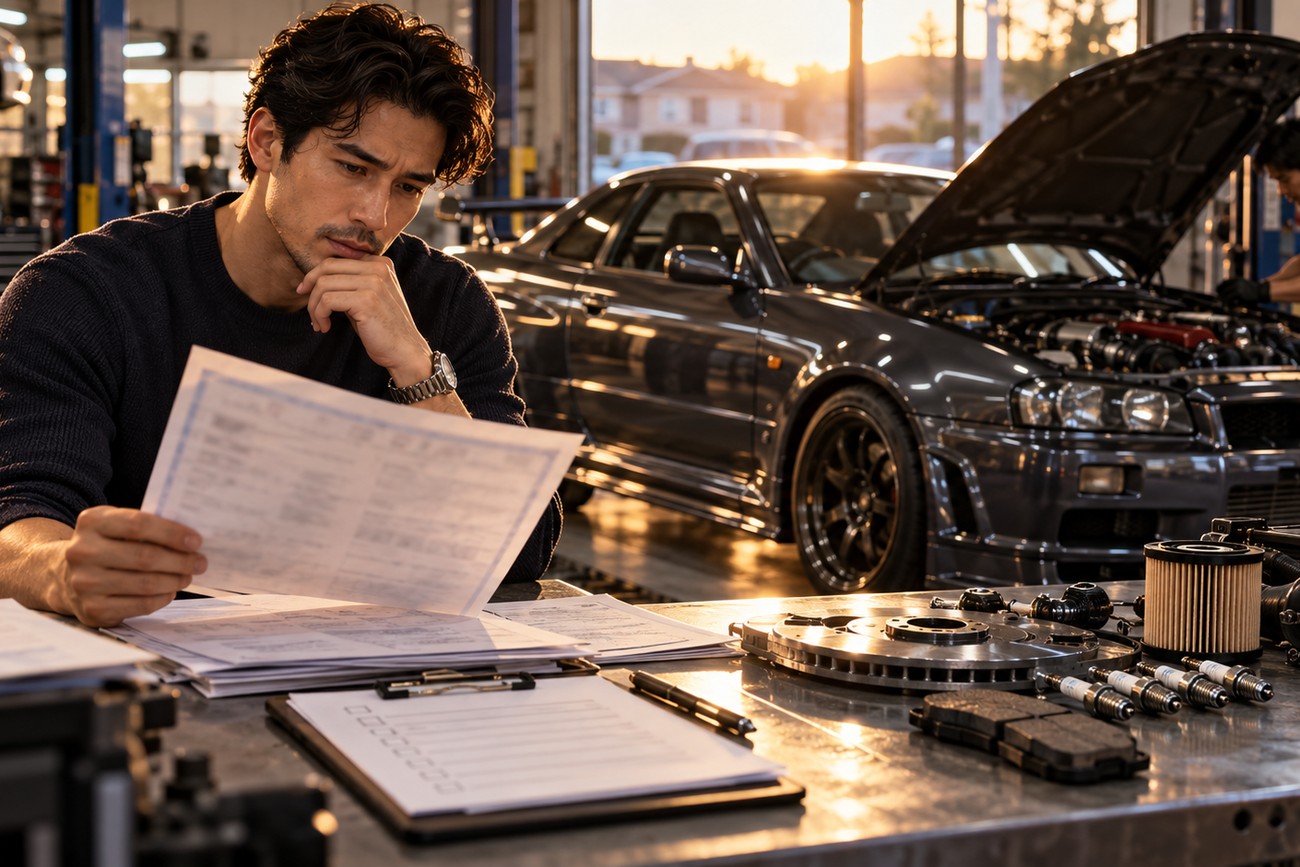
車検付き generally indicates that the vehicle has current inspection status or is being sold with shaken arranged under the stated terms. It does not prove that the seller renewed every age-sensitive component. The buyer should treat the phrase as a document and timing issue first, then investigate the actual work performed.
Confirm the next shaken expiry date using the 車検証. Request invoices, inspection records, and a list of parts replaced as part of the inspection preparation. An invoice for a pass-related repair tells you more than a general statement that the car was “serviced,” although even a detailed invoice cannot establish the remaining life of every component.
Look specifically for evidence concerning brakes, tires, exhaust, leaks, corrosion, suspension, and modifications. Ask whether the car was returned to a standard configuration for inspection and whether any parts were refitted afterward. A vehicle may have passed with an acceptable setup while still requiring further work for normal ownership, export, or local rules in the destination country.
Age-related needs sit outside the narrow purpose of shaken. Hoses, fluids, seals, fuel-system components, cooling parts, and electrical connections may deserve attention even when they were not listed as inspection failures. The absence of an invoice is not proof that the work was skipped, but it is a reason to price the uncertainty rather than accepting the seller’s description as evidence.
A recent pass should also be reconciled with the physical car. Check for leaks, corrosion, worn interior safety equipment, nonstandard wheels, altered lighting, exhaust changes, and signs of neglected maintenance. The right buying decision may still be to proceed, provided the missing work is identified and reflected in the negotiated budget.
If shaken has expired, plan transport before inspection
Do not drive a car on public roads with expired shaken without a lawful basis. The expiration date should be checked in the 車検証, and paying the inspection charges does not itself make a vehicle legal to drive before it has been properly renewed. There is no established general 30-day grace period after expiry on which an owner can rely.
Arrange a lawful way to move the Skyline to a workshop or inspection location. Depending on the circumstances, that may involve suitable transport or another route confirmed with the relevant provider and authorities. The practical point is to confirm the permitted method before moving the car, rather than assuming that an appointment or insurance payment creates road-use permission.
The delay can affect more than scheduling. Add transport, preliminary diagnosis, compliance repairs, possible re-inspection, and compulsory shaken payments to the budget. If the vehicle has been sitting unused, the assessment should also consider leaks, tires, brakes, battery condition, and corrosion that may have developed or become apparent during storage.
A seller’s promise to arrange shaken after purchase should be recorded in writing, including who pays for failed preparation and transport. If the car’s status is unclear, the cost and risk of moving it belong in the buying decision before money changes hands.
Frequently asked questions
How much does importing a Nissan Skyline from Japan add to shaken costs?
Importing a Skyline does not produce one universal shaken surcharge. Japanese shaken costs cover the vehicle’s inspection route, compulsory insurance, weight tax, inspection fee, preparation, and repairs in Japan; shipping, customs, destination-country registration, and local compliance are separate cost groups.
The destination matters because local rules may require different lighting, emissions equipment, documentation, or modifications. An imported car may also need transport to a specialist, translation or administrative work, and repairs before it can be registered abroad. A reliable total therefore requires the destination country, the vehicle’s documented details, and its actual configuration.
What should I ask a distant seller to photograph before traveling to see the car?
Ask for clear images of the 車検証 information showing the next shaken expiry date, along with invoices or inspection records for recent work. Request photographs of the underside, brake and suspension areas where visible, exhaust, engine bay, tires, wheels, lights, interior safety equipment, and any corrosion or repairs.
Also ask the seller to photograph every nonstandard part, including lowered suspension, exhaust, lamps, seats, steering, and wheel markings. Photos can reveal inconsistencies and save a wasted journey, but they cannot replace an in-person inspection of structural corrosion, play, leaks, operation, or the accuracy of the seller’s description.
What is the Japanese shaken inspection?
Shaken is Japan’s periodic vehicle inspection system. For an ordinary passenger Skyline, it is generally renewed every two years after the initial inspection period and checks applicable safety, emissions, and construction requirements at the time of inspection.
It is not a full maintenance service or a guarantee of future reliability. A passed inspection confirms compliance with the checks applied on that occasion; it does not certify the remaining life of the body, turbocharger, gearbox, differential, or electrical systems.
How much would it cost to import a Nissan Skyline from Japan?
No fixed import total can be quoted without knowing the destination country and the vehicle. The budget may include the purchase price, Japanese preparation, shipping, insurance during transport, customs or duties, port and handling charges, destination registration, local inspections, taxes, and repairs or modifications required for local compliance.
Japanese shaken figures should not be treated as the import total. Even the approximately ¥46,000 self-presentation example is a limited Japanese inspection scenario, while published service examples of roughly ¥75,000–¥115,000 and ¥100,000–¥150,000 apply to different standard-car assumptions. None is a universal Skyline import price.







