

The Iso Grifo has a compelling formula: an Italian grand tourer with a Chevrolet V8 under its long hood. Its low, sculpted body promises continental elegance, while the engine supplies the easy torque that makes a GT satisfying on an open road.
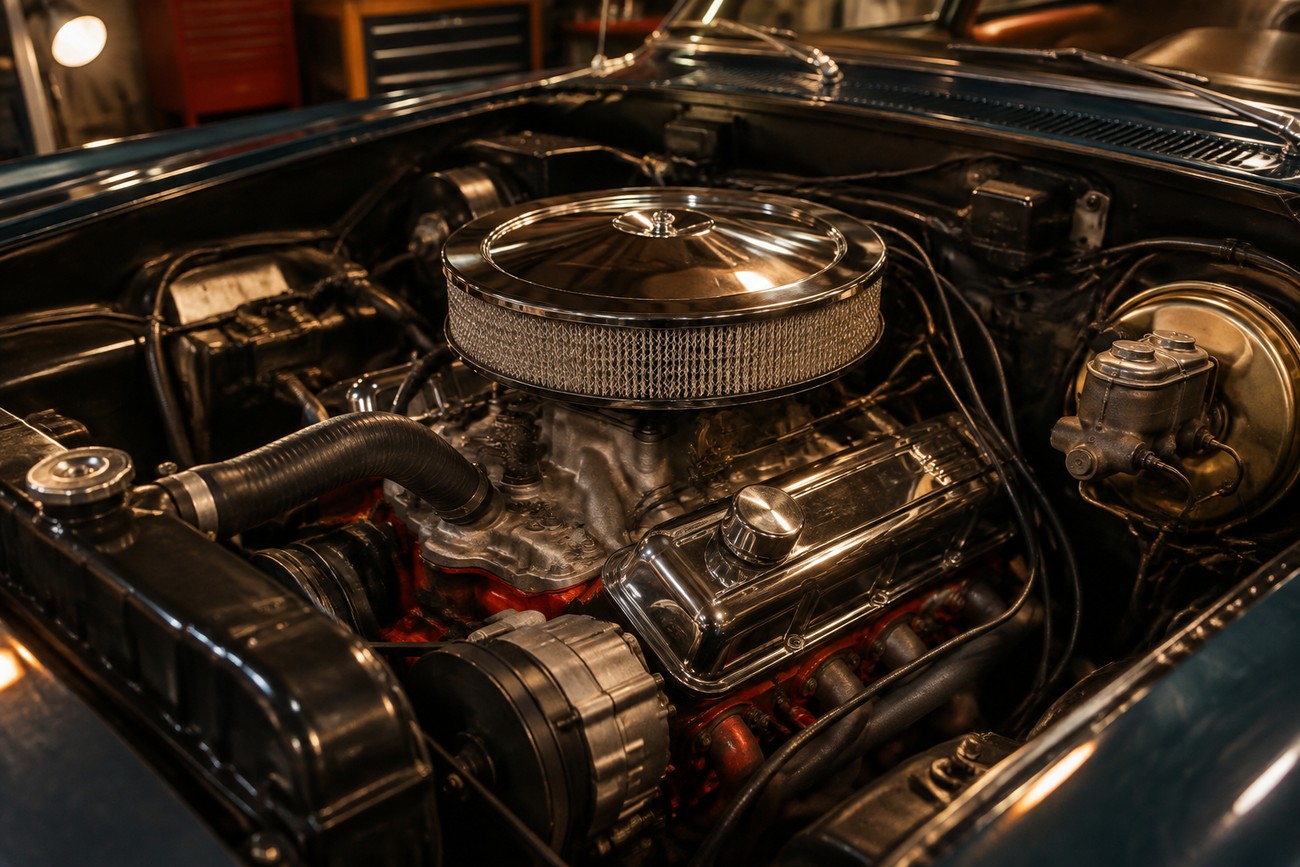
That familiar V8 is also the source of a costly misunderstanding. Iso built the Grifo in small numbers, and almost everything surrounding the engine belongs to a rare, hand-built car. Its appeal lies in the way those parts work together; so do the challenges of buying and maintaining one.
- An Italian grand tourer, not a rebodied Corvette
- Road Grifo, later V8s and A3/C: the differences that matter
- How the Grifo drives beyond its headline horsepower
- The affordable-engine myth and the expensive parts around it
- Originality, production totals and the price of provenance
- What to check before buying an Iso Grifo
- Frequently asked questions
- How should an Iso Grifo be insured?
- What should an owner keep with the car’s history file?
- Where can owners look for hard-to-find Grifo trim?
- How should a Grifo be prepared for a long tour?
An Italian grand tourer, not a rebodied Corvette
Iso Rivolta produced the Iso Grifo from 1965 to 1974. The company paired an Italian GT body and chassis with a Chevrolet V8, bringing together two useful strengths: distinctive coachwork and an engine with a broader service base than many exotic alternatives. The result was conceived as a complete grand tourer, rather than a shortcut to building a sports car.
The Grifo’s long hood, low roofline, and restrained surfaces give it a visual identity separate from the Corvette. Its proportions place the engine’s presence at the center of the design without making the car look like a race machine dressed for the street. That matters on a car meant to cover distance as well as attract attention when parked.
“Corvette heart” describes the broad engine connection, not mechanical interchangeability across the whole vehicle. The Grifo has its own body, chassis, installation details, and driving character. A mechanic who knows a Chevrolet V8 will have a useful starting point, but that knowledge alone will not settle a cooling fault or source a damaged piece of Italian trim.
Road Grifo, later V8s and A3/C: the differences that matter
Grifo specifications changed, and surviving cars may have changed again since leaving the factory. Engine size alone cannot establish a car’s original identity.
| Version | Intended use and distinction | Identification caveat |
|---|---|---|
| Early road Grifo | Road GT, generally with a Chevrolet 327 V8 of 5.4 liters; early figures are commonly listed at 300-plus horsepower. | Check the individual specification rather than treating one power rating as universal. |
| Later road specifications | Road GTs associated with larger Chevrolet V8s; 427 and 454 units appear among later specifications and modified cars. | Establish when and how a particular engine was installed. |
| Grifo A3/C | Much rarer, aluminum-bodied competition offshoot. | A distinct competition car, not a trim level of the regular road Grifo. |
How the Grifo drives beyond its headline horsepower

The V8’s broad torque suits the Grifo’s purpose. You can enjoy its response without chasing the top of the rev range, while the low seating position and long view over the hood make the engine feel central to the experience. Early road-car figures are commonly listed at 300-plus horsepower, although ratings vary substantially by year, specification, and source.
Traffic reveals a less glamorous side. Cooling performance and heat management deserve attention, particularly on a restored car whose radiator, fan arrangement, or surrounding installation may have been altered. A temperature gauge that looks reassuring during a brief drive on an open road tells you little about a slow crawl on a warm day.
On imperfect surfaces, suspension condition, brake setup, and tire choice have a strong influence on confidence. An older GT can feel unsettled if its components are tired or poorly matched, even when the engine delivers cleanly. A proper road test should include ordinary bends, rougher pavement, braking, and low-speed running; a polished finish cannot demonstrate how the car behaves through any of them.
The affordable-engine myth and the expensive parts around it
Basic Chevrolet V8 service parts can be relatively accessible. That is a meaningful advantage when routine engine work is due, and it helps explain the Grifo’s enduring appeal to drivers who intend to use their cars. It does not make ownership cheap.
The installation around the engine is the dividing line. Cooling components, exhaust routing, mountings, accessories, and wiring are not automatically Chevrolet bolt-on items. A readily sourced engine part may still need to work with scarce Grifo-specific hardware, and an improvised replacement can create another fault elsewhere in the system.
Body, chrome, trim, and interior pieces pose a different problem: a replacement may be hard to find. Repairing an existing part or reproducing it accurately calls for skilled labor and a sound reference. Those costs become substantial when a restoration is incomplete beneath otherwise attractive paint.
For a prospective owner, the useful distinction is between an engine that can often be serviced and a whole car that requires specialist care. Body repairs, fit problems, and missing details can consume far more time than work on the V8. A lower-priced project needs to be judged against that exposure, rather than against the availability of Chevrolet parts.
Originality, production totals and the price of provenance
Some sources cite roughly 400–413 road Grifos, but the total varies with counting methods and incomplete records. Prototypes, later changes, and questions about what belongs in a road-car tally make an exact figure less useful than a clear account of the individual car. The Grifo is rare; precise production claims deserve qualification.
Original specification can be difficult to establish with equal certainty. Engines, gearboxes, axles, and interior components have been changed on surviving cars, while factory documentation is incomplete. A claim of matching numbers should be tested against the available records, with any gaps acknowledged rather than filled by assumption.
Collectors therefore look beyond fresh paint and a desirable engine. Period records, documented restoration work, specification-correct components, and any substantiated competition history can distinguish cars that look much alike in photographs. A thoughtfully modified Grifo may be enjoyable to drive, yet its value need not follow that of a well-documented, authentic example.
Provenance also makes future decisions easier. Knowing when a component changed helps an owner order the right parts and helps the next buyer understand what the car represents. An attractive restoration with little supporting evidence leaves both parties paying to resolve uncertainty.
What to check before buying an Iso Grifo
Begin with identity and records. Compare the car’s identifying details with registrations, earlier photographs, invoices, and any available history of major components. Ask a specialist familiar with Iso history and construction to assess what the paperwork supports; incomplete archives and later changes may prevent a definitive claim about original specification.
Next, inspect corrosion, previous structural repairs, and body geometry before assigning much weight to the finish. Look at panel alignment in more than one position, and examine the evidence behind any account of a completed restoration. A clean engine bay and fresh upholstery say little about the quality of metalwork beneath them.
Only then move through the mechanical installation: cooling system, wiring, mountings, and the quality of work around the engine. Take a thorough road test that includes slow traffic, braking, and uneven roads, watching for heat buildup and inconsistent behavior. If inspection access or the car’s history is limited, price that uncertainty as a real risk rather than treating the restoration photographs as proof.
Frequently asked questions
Owning a rare GT also involves decisions outside the workshop. Insurance, records, parts sourcing, and trip preparation all benefit from a car-specific approach. The aim is to preserve both the Grifo’s usability and a clear account of its condition over time.
How should an Iso Grifo be insured?
Discuss agreed-value cover with an insurer familiar with collector cars, supported by a current specialist appraisal. Keep dated photographs of the exterior, interior, engine bay, and any existing imperfections, along with evidence of significant work. Those records can help establish the car’s condition if a claim arises; confirm the policy’s terms for use, storage, and repairs.
What should an owner keep with the car’s history file?
Keep prior registrations, restoration invoices, dated photographs, component records, and correspondence together. Note which papers relate to original equipment and which document later changes. A well-organized file helps a future mechanic understand the car and gives a buyer a clearer basis for assessing it.
Where can owners look for hard-to-find Grifo trim?
Specialist networks and owner clubs are useful starting points for locating original pieces or identifying someone able to reproduce them from an existing pattern. Before fitting a reproduction, check its shape, finish, and mounting points against the car. A piece that looks right on a bench may still fit poorly once installed.
How should a Grifo be prepared for a long tour?
Make a meaningful test run before departure, then check fluids and tire condition. Carry a small kit of car-specific spares selected for the individual installation, and identify suitable assistance along the route. Planning stops and support in advance is more useful than assuming a general repair shop will have the parts this rare GT needs.







