

The hum starts on the road, grows louder for a few seconds, and disappears the moment you pull over. You step out expecting to find a loose wheel or a broken exhaust part, yet the car looks completely normal. That is how an older Chevrolet Impala earns its haunted-car reputation.
An intermittent noise can feel mysterious because the condition that creates it may vanish with speed, load, steering angle, or road surface. Ignoring it can allow a worn part to deteriorate; replacing parts by guesswork can cost money without fixing the sound. The useful first step is to record exactly when the noise appears and what the car is doing at that moment.
- Why an Impala can sound haunted
- Match the noise to what the car is doing
- What a used Impala’s history can hide
- Reproduce the sound without creating a new risk
- When the noise means stop driving
- Get a diagnosis, not a pile of replacement parts
- Frequently asked questions
- Why does my Impala click after I turn it off?
- What if the noise returns right after a repair?
Why an Impala can sound haunted
Mechanical noise depends on movement and force. A tire may hum at one speed and quiet down at another, while a loose exhaust support may rattle only when the engine moves under acceleration. Suspension sounds often need a particular road surface, and steering-related noises may appear only at a certain angle or during low-speed parking maneuvers.
Temperature and moisture can change the result as well. Rubber components become less flexible in cold weather, dampness can alter belt noise, and a metal shield or exhaust hanger may shift as the system heats up. A repeatable pattern helps narrow the search, although it does not identify the failed part by itself.
Chevrolet Impala production ended in 2020, so many used examples now have substantial age, mileage, or a history of previous repairs. Age alone does not prove a fault, and Impala model years and versions use different engines and steering equipment. The car’s actual configuration and repair history matter more than a general model reputation.
Possible sources include tires, wheel bearings, suspension, steering, exhaust, mounts, and engine-driven accessories. A sound from one area can travel through the body and seem to come from somewhere else. That is why a noise description is a starting clue rather than a confirmed diagnosis.
Match the noise to what the car is doing
Use the table as a way to describe a symptom for a technician. Each item is a possibility, and a safe observation is more useful than reaching toward moving parts or crawling under the vehicle.
| Sound and trigger | Plausible systems to inspect | Safe observation to record |
|---|---|---|
| Hum or growl at one speed, especially around a narrow speed range | Tires, wheel bearings, or tire-related wear | Note the speed, road surface, and whether the sound changes on a different safe route. |
| Knock heard mainly over bumps or broken pavement | Suspension joints, bushings, mounts, or loose hardware | Record whether the noise occurs over small bumps, larger dips, or only when one side of the car moves. |
| Groan, squeak, or click while turning at parking speed | Steering components, steering assist equipment, suspension parts, or tires | Note the steering angle, vehicle speed, and whether the sound occurs in both directions. |
| Rumble, vibration, or clunk during acceleration | Engine or transmission mounts, exhaust supports, drivetrain components, or tires | Record whether it appears during gentle acceleration, stronger acceleration, or changes in gear. |
| Squeal or chirp under the hood that comes and goes | Drive belt, tensioning components, or engine-driven accessories | Note cold-start conditions, rain or humidity, air-conditioning use, and whether the sound fades after a short time. |
What a used Impala’s history can hide
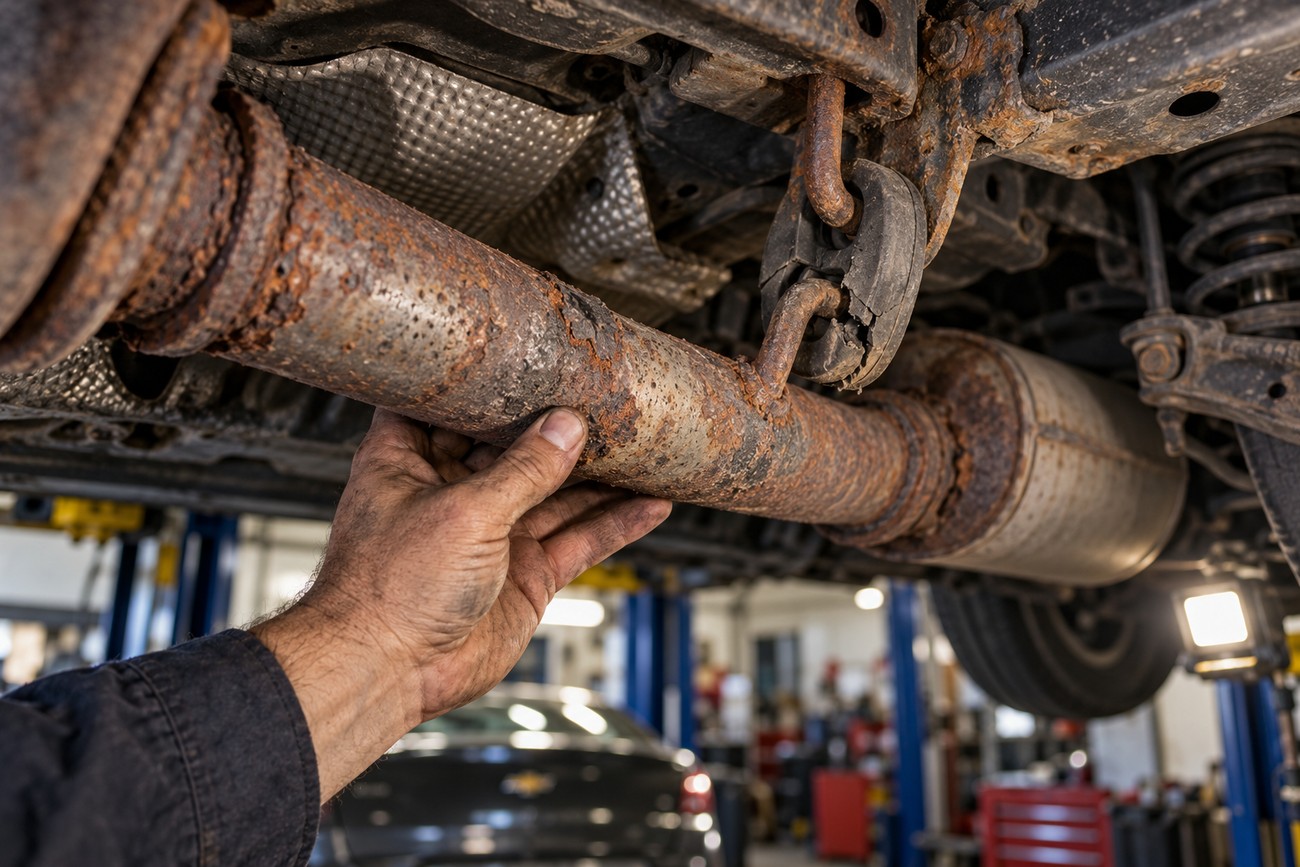
Exhaust damage is easy to miss when the car is quiet at idle. Corrosion, a cracked resonator or pipe, and loose rubber hangers can allow the exhaust to move or vibrate only under load. An aftermarket exhaust or an older repair may also change the way vibration travels through the body, even if the vehicle is described as having its original equipment.
Engine and transmission mounts can create a similar illusion. A mount may look acceptable while the engine is idling, then allow excessive movement during acceleration or gear changes. The resulting thump or low rumble can be mistaken for a transmission failure before the mounts and exhaust clearances have been checked.
Suspension components can be equally deceptive. Worn bushings, tired dampers, loose fasteners, or poor-quality replacement parts may produce small knocks that are absent on a smooth road. A lift inspection can show obvious damage, yet a road test may still be needed because some components make noise only when loaded in the direction created by a real bump.
A groan during steering deserves a model-year-specific inspection. Steering equipment and engine configurations vary by Impala model year and version, so a blanket claim about one universal power-steering pump or setup is unreliable. The sound may involve steering assist, a suspension component, a tire, or a mount, and sound alone cannot separate those possibilities.
Reproduce the sound without creating a new risk
Keep a short noise log rather than relying on memory. Write down the approximate speed, whether you were accelerating, braking, or coasting, the steering input, the road surface, and the temperature or moisture. Also record whether the car had just started, had warmed up, or had been parked for a while.
Describe the sound in practical terms: hum, growl, knock, squeal, scrape, click, vibration, or metallic rattle. Note where it seems loudest from the driver’s seat, while accepting that sound can travel through the floor, subframe, or body. Include what makes it stop, such as releasing the accelerator, straightening the steering, leaving a rough road, or reducing speed.
A passenger can make an audio recording during a safe, repeatable route. The driver should keep both attention and hands available for driving, and the route should avoid abrupt swerves or other deliberate maneuvers. A recording supports diagnosis, although it cannot prove which component is responsible.
A road test under the conditions that produce the noise may reveal a problem missed during a stationary or lift-only inspection. If the car feels unstable, vibrates severely, pulls during braking, or produces grinding, stop the test. Reproducing a symptom is useful only while the vehicle remains predictable and safe.
When the noise means stop driving
A faint, stable rattle with normal steering, braking, and handling usually calls for a prompt inspection rather than panic. Schedule it before the sound becomes louder, more frequent, or harder to reproduce. A car can remain drivable while a mechanical problem is developing, so normal movement is not proof that continued driving is harmless.
Pull over safely and arrange an inspection or tow after a sudden loud grinding or banging sound, severe new vibration, or a component that appears to drag. Changed steering or braking requires the same caution. Do not continue a diagnostic drive simply because the engine still runs.
Exhaust fumes inside the cabin are another stop-driving symptom. Open windows may reduce the immediate smell, yet they do not correct the source or make the vehicle suitable for continued use. Have the exhaust system and cabin ventilation path checked before driving farther.
Noise severity can be misleading. A quiet click may be harmless system activity, while a moderate hum may reflect a bearing, tire, or other part that needs attention. The decision should consider changes in control, vibration, fumes, and the sound’s progression, rather than volume alone.
Get a diagnosis, not a pile of replacement parts

Bring the noise log and recording to a repair shop. Ask for a road test under the conditions that produce the symptom, followed by a targeted inspection of the likely system. A clean OBD scan does not rule out mechanical noise from tires, bearings, bushings, exhaust supports, or mounts because many such faults do not create an electronic fault code.
Ask the technician to explain what evidence links the proposed repair to the sound. Useful evidence may include visible looseness, abnormal movement, contact marks, damaged rubber, uneven tire wear, or a change observed during a controlled test. This approach reduces the chance of replacing a strut, hub, resonator, or pump simply because it is a familiar suspect.
A bumps-only knock can disappear when suspension components are unloaded on a lift. Repeating the customer’s route before replacing parts can reveal which side and which type of load produces the sound.
More than one source may contribute to what you hear. A tire hum, an exhaust rattle, and a worn mount can overlap, with one repair making the remaining noise easier to notice. Diagnose and repair verified safety issues first, then reassess the vehicle before deciding whether any comfort-related work is worthwhile.
Sound-deadening can reduce what reaches the cabin, but it cannot repair a loose hanger, worn bearing, damaged bushing, or failing mount. Use it after the mechanical condition is understood. A written repair order should state the observed fault and the work performed, giving you a clear basis for a follow-up if the symptom returns.
Frequently asked questions
Why does my Impala click after I turn it off?
Brief clicking after shutdown can come from cooling metal, normal actuator movement, or another system completing a short operating cycle. The timing matters: a few clicks that fade as the vehicle cools are different from a persistent sound that continues for a long period or appears with other electrical symptoms.
If the clicking is frequent, lasts unusually long, returns while the car is parked, or is accompanied by a weak battery, dim lights, or difficulty starting, request an inspection. Avoid assuming the noise is harmless from its sound alone, and arrange help sooner if there is a burning odor, smoke, or unusual heat.
What if the noise returns right after a repair?
Document the return before authorizing more parts. Record the same conditions as before, keep the repair order, and tell the shop whether the sound is unchanged, quieter, or different in location. A follow-up inspection may show that the repaired component was only one of several sources, or that the original symptom needs to be reproduced under a specific load.
Ask the shop to compare the returning symptom with the original findings and to explain the next test. A recurring noise does not automatically prove that the first repair was unnecessary. It does mean the diagnosis should be revisited, especially if steering, braking, vibration, grinding, dragging, or cabin exhaust fumes are now involved.







