
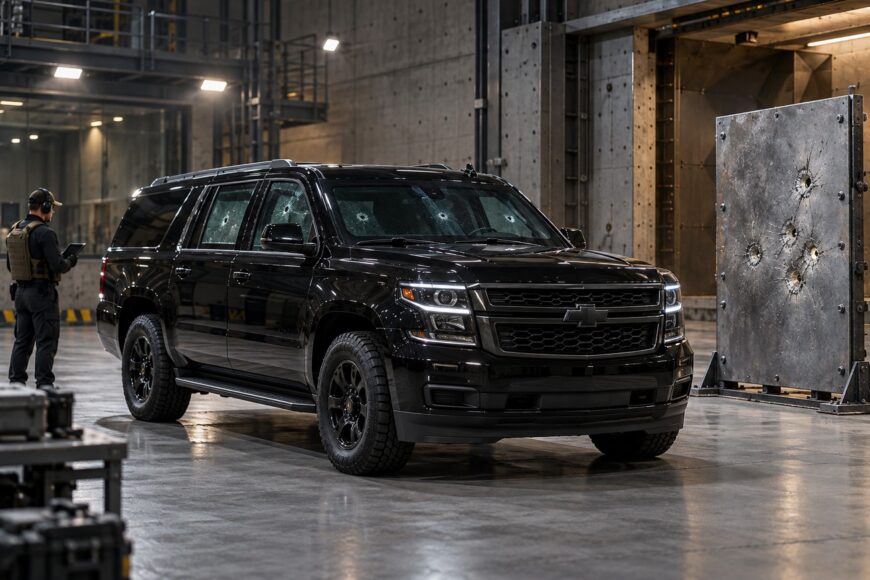
An armored Chevy Suburban can provide substantial ballistic protection, but “bulletproof” does not mean universally invulnerable. Its protection applies to specified ammunition, test conditions, impact locations, and covered areas. A vehicle built for handgun threats is fundamentally different from one designed around rifle or armor-piercing threats.
The buyer’s real decision concerns the complete conversion. Protection level, added mass, chassis capacity, braking performance, hidden gaps, and the quality of the test documentation all matter. A Suburban carrying certified armor materials is not automatically a certified armored vehicle in its final configuration.
- Is an Armored Chevy Suburban Actually Bulletproof?
- Armor Levels: B4, B6, B7, NIJ III, and NIJ IV
- What a Properly Armored Suburban Must Protect
- The Weight Penalty: Chassis, Brakes, Handling, and Run-Flat Tires
- The Weak Points Owners Discover After Conversion
- How to Verify an Armored Suburban Before You Buy
- Frequently asked questions
- How much does it cost to bulletproof a Chevy Suburban?
- What is the most bulletproof SUV?
Is an Armored Chevy Suburban Actually Bulletproof?
An armored Suburban can resist the threats stated in its test documentation. That documentation should identify the ammunition, projectile velocity, firing distance, number of impacts, protected zones, and acceptable deformation. Without those details, “bulletproof” is a broad marketing description rather than a useful technical specification.
Ballistic protection also has physical limits. A rating does not promise resistance to every weapon, unlimited repeated hits in one location, or protection through every opening. The result can also include spall, glass fragmentation, panel deformation, and injury risk even when penetration is prevented.
A complete package may include armor steel or composites in the doors and body, ballistic glass, roof and floor protection, door-to-pillar overlaps, reinforced hinges, locks, window frames, and protection around other critical components. The quality of the transitions matters as much as the strength of a large flat panel.
Configurations advertised for the Suburban range from CEN B4/B6 through B7. That range describes particular finished vehicles and equipment packages. It does not mean every armored Chevy Suburban has the same protection, and a label applied to one build should not be transferred to another vehicle.
Armor Levels: B4, B6, B7, NIJ III, and NIJ IV
These labels provide orientation, though they come from different testing systems. CEN, VPAM, and NIJ use different methods and threat definitions, so B6 does not equal NIJ III and B7 does not equal NIJ IV without reviewing the specific test protocol.
| Label | Common orientation | Buyer warning |
|---|---|---|
| CEN B4 | Typically associated with lower-level ballistic protection, often aimed at handgun threats. | Confirm the exact ammunition, test method, glass rating, and protected areas. |
| CEN B6 | A higher advertised protection level, commonly associated with rifle threats in armoring discussions. | It is not a direct synonym for NIJ Level III. |
| B7 | A heavy protection label advertised for some Suburban conversions and commonly associated with stronger rifle-threat protection. | It is not a direct synonym for NIJ Level IV without the specific protocol. |
| NIJ Level III | Commonly associated with 7.62×51 mm FMJ rifle ammunition. | This does not automatically certify the vehicle, its glass, or every body area. |
| NIJ Level IV | Commonly associated with.30-06 AP ammunition. | A claim about the finished vehicle requires documentation showing what was tested. |
The comparison becomes unreliable when advertising treats these systems as a conversion chart. A supplier may use a familiar label to communicate a general threat category while leaving out the shot pattern, distance, velocity, or deformation criterion that gives the rating its meaning.
Ask whether the report covers a material sample, an individual glass panel, a door assembly, or the completed Suburban. Those are different claims. A certified sample can demonstrate the capability of a material without proving that the installed vehicle has no weak seams or incompatible components.
What a Properly Armored Suburban Must Protect
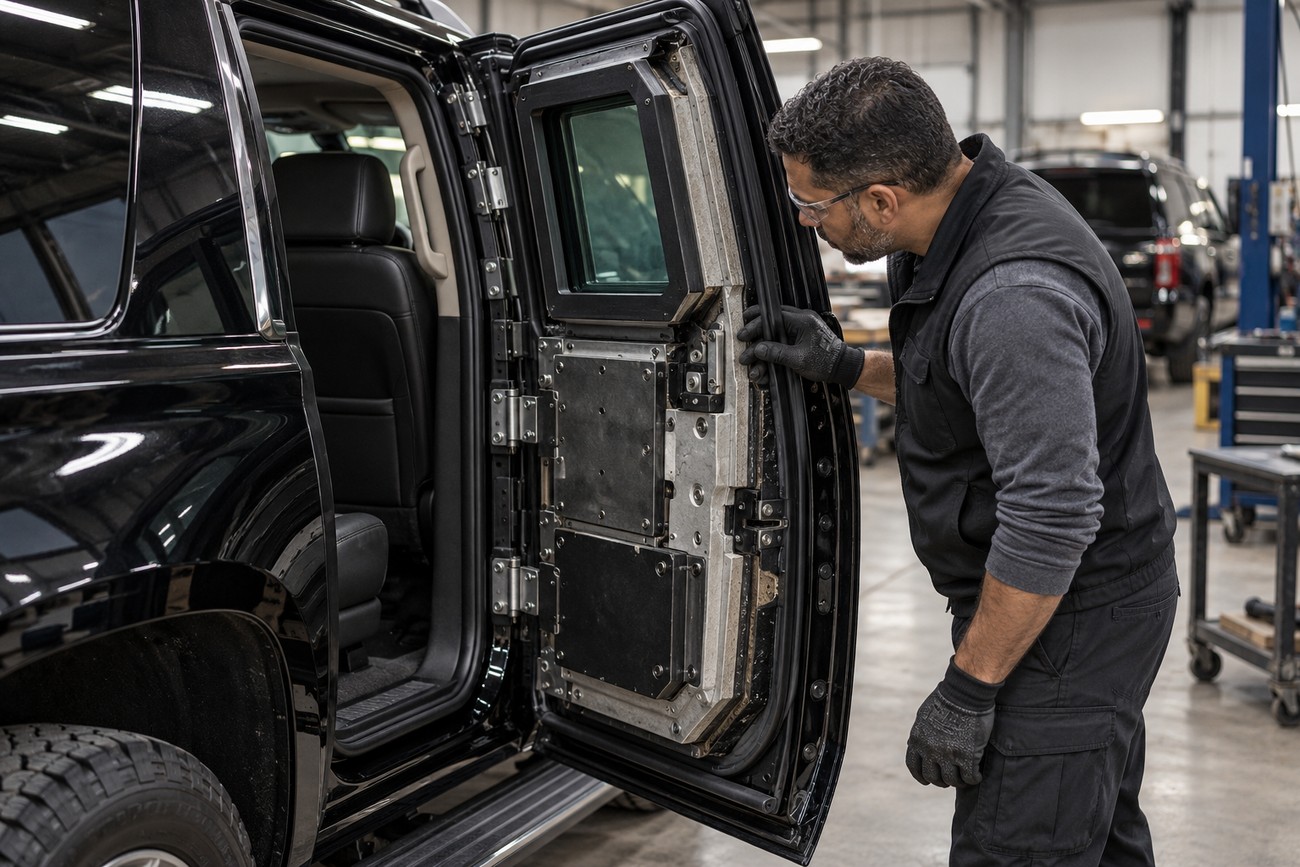
Thick doors alone do not make the cabin secure. A proper package should address the doors, ballistic glass, roof, floor, pillars, firewall, window frames, hinges, locks, and the areas where armored parts meet ordinary bodywork. Any exposed transition can become the practical weak point of an otherwise strong conversion.
Door protection depends on the overlap between the door and the body pillar. A heavy armored door with an inadequate overlap can leave a vulnerable line around the opening. The same principle applies around the glass, door frame, rear hatch, roof edge, and firewall, where different materials and moving parts have to work together.
Glass creates a separate engineering problem. Ballistic windows are thicker and heavier than factory glass, and their frames, seals, regulators, and mounting points must support that load. Some configurations limit window movement, and fully opening windows are unavailable in some armored builds.
Materials certified in isolation do not certify the finished Suburban in its final configuration. Buyers should request drawings or inspection access for the floor, roof, pillars, door overlaps, glass surrounds, and other covered zones. A conversion that protects only the most visible panels may provide a reassuring appearance while leaving important paths around the cabin exposed.
The Weight Penalty: Chassis, Brakes, Handling, and Run-Flat Tires
Armor changes the vehicle’s operating limits. Heavy configurations may add approximately 545–1135 kg, depending on the protection level, glass, floor, roof, and additional equipment. That mass affects acceleration, braking, cornering, fuel economy, tire loading, suspension travel, and the amount of payload left for passengers and luggage.
Suburban 1500, 2500, and 3500 models have different payload and axle-load reserves. Some installers recommend 2500 or 3500 platforms for B7 or NIJ IV builds, while others advertise those levels on a 1500. The relevant question is whether the final vehicle remains within its gross vehicle weight rating, axle limits, tire ratings, and braking capacity.
Professional heavy conversions may require reinforced suspension, upgraded brakes, stronger wheels, and run-flat inserts. These are functional safety equipment, not cosmetic options. If a seller presents the armor package without explaining how the chassis systems were recalculated, the specification is incomplete.
Run-flat inserts can allow continued movement after a puncture, though they commonly make the ride harsher. “Up to 50 miles” may appear as an advertising reference, but actual range depends on speed, load, conditions, and insert condition. It should never be treated as a universal guarantee after a tire has been damaged.
The Weak Points Owners Discover After Conversion
Ownership complaints often concern the mechanical consequences of the conversion rather than the armor plate itself. Heavy doors and thick glass can accelerate wear on hinges, locks, window regulators, and seals. A door that closes normally when new may require more adjustment as hinges and latches carry the additional load.
Large ballistic glass can reduce visibility and light transmission. The effect depends on panel thickness, tint, curvature, and the specific installation, while restricted window movement can affect ventilation and daily usability. These details matter in parking areas, toll lanes, emergency exits, and any situation requiring quick communication through a window.
The conversion may also alter electrical systems, cooling, sensors, brake electronics, and the compatibility of factory safety systems. Added panels and altered body structures can affect wiring routes, thermal management, camera views, and access to service components. A vehicle that looks factory-standard from outside may have substantially different maintenance requirements underneath.
Service planning should include suspension, brakes, tires, wheel alignment, door mechanisms, seals, and mounting points. Factory service intervals may be insufficient for a heavily modified vehicle. Independent owner reviews with verified protection measurements are limited, and many public specifications come from armoring companies, so a buyer should separate documented tests from testimonials and sales language.
How to Verify an Armored Suburban Before You Buy
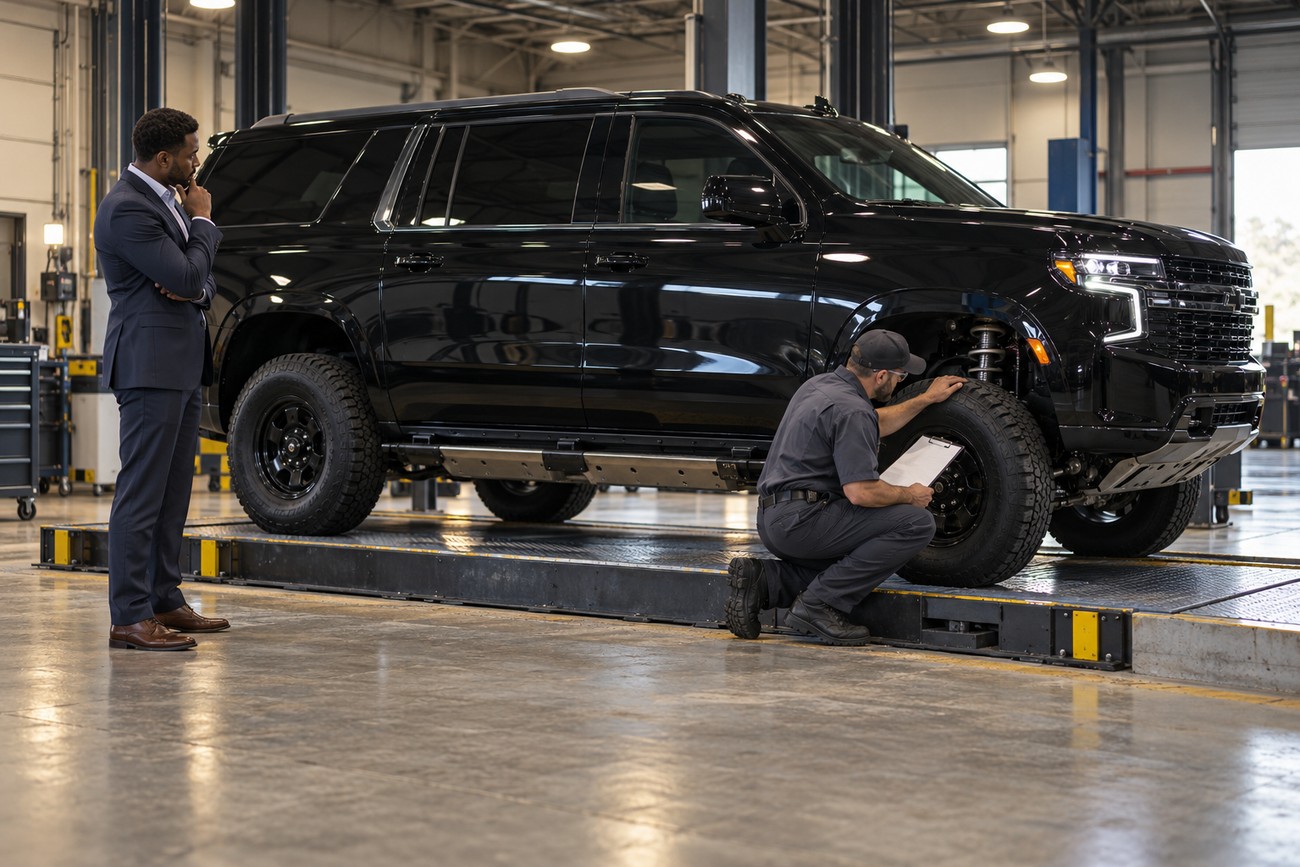
Start with the completed vehicle, not the brochure. Require documentation identifying the exact Suburban configuration, the armor and glass installed, the test ammunition, velocity, distance, number of shots, protected zones, and residual-deformation criteria. “Bulletproof,” “B6,” and “certified materials” do not by themselves prove that the complete vehicle was tested.
Compare the final weight with the vehicle’s gross vehicle weight rating and each axle rating. Then check tire load indexes, wheel capacity, braking hardware, suspension components, towing restrictions, and the payload remaining for occupants, fuel, and luggage. A conversion can appear within its overall weight limit while still placing excessive load on one axle.
Inspect the protection itself, especially on a used vehicle. Look for evidence of corrosion, repairs to armor, disturbed trim, damaged seals, cracked or delaminated glass, and worn run-flat inserts. Ask for records covering materials, installation, maintenance, and any collision or ballistic damage.
The inspection should include the floor, roof, pillars, door overlaps, hinges, locks, glass surrounds, firewall, hatch, and other transition zones. Confirm that the windows, doors, cameras, sensors, climate system, and safety equipment operate as intended. A short road test should assess braking, steering response, suspension noise, tire behavior, and alignment.
Finally, obtain an independent inspection from a technician familiar with armored vehicles. Ask the installer to explain the service schedule and the replacement process for specialized glass, run-flat components, suspension parts, and door hardware. If the seller cannot show how the protection claim connects to the final mass and the test report, treat the advertised level as unverified.
Frequently asked questions
An armored Suburban has no single universal “bulletproof” specification. The useful answer depends on the threat, the tested configuration, the chassis, and the areas actually protected.
The same model name can cover substantially different conversions. These answers focus on the buying decisions that marketing labels often leave unclear.
How much does it cost to bulletproof a Chevy Suburban?
There is no reliable single price because the quote changes with the protection level, ballistic glass, roof and floor coverage, chassis, run-flat system, and additional equipment. A lighter handgun-oriented conversion has a different engineering and service burden from a heavy rifle-threat build.
Ask for a line-item specification rather than a single conversion figure. It should identify the armor materials, glass, suspension and brake work, wheel and tire system, electronics changes, testing, and ongoing maintenance requirements. The cheapest quote may omit coverage, documentation, or load-capacity work that another supplier includes.
What is the most bulletproof SUV?
There is no universal winner. The suitable SUV depends on the threat scenario, payload reserve, tested configuration, serviceability, and intended use. A vehicle with a higher advertised level may be a poor choice if its final mass leaves inadequate axle capacity or if replacement parts and qualified service are difficult to obtain.
Compare complete, documented vehicles rather than model names. Check the test protocol, protected zones, chassis reserve, braking system, run-flat design, visibility, and maintenance support. The best choice is the vehicle whose tested protection and operating limits match the buyer’s actual risk and daily use.







