
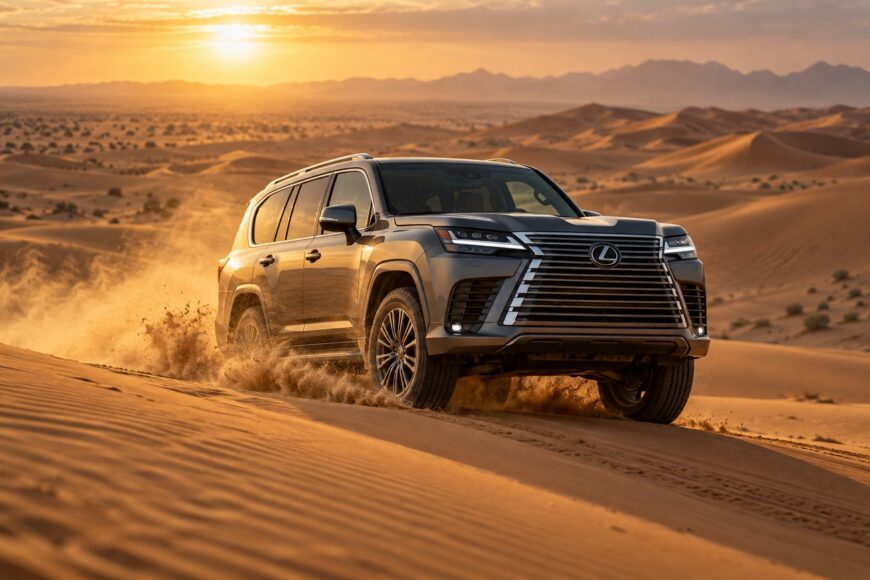
The Lexus LX has the traction, power, ground clearance, and cabin comfort needed for Dubai sand, but its weight, size, and repair costs can work against it. It is a capable desert SUV when the terrain and driving style suit it; it is not automatically the easiest vehicle for aggressive dune driving.
The real answer depends on the dunes, tire choice, pressure, preparation, and driver. Permanent four-wheel drive and Sand mode help the vehicle manage loose ground, yet neither system can replace a suitable line, controlled momentum, or recovery support. A well-prepared LX in experienced hands can be reassuring and comfortable, while the same vehicle driven too quickly or stopped on a soft incline can become difficult to recover.
- Is the Lexus LX Good for Dune Bashing in Dubai?
- Why the Lexus LX Works Well on Dubai Sand
- Where the LX Struggles: Weight, Size, and Geometry
- How to Prepare and Drive an LX in the Dubai Desert
- Lexus LX 570, LX 600, and LX 700h: What Changes in the Dunes
- Should You Use an LX for a Dubai Desert Trip?
- Frequently asked questions
- Which Lexus model is the best choice in the UAE for desert driving?
- What is the price of a Lexus LX in Dubai?
- Which Lexus model is the best in the UAE?
Is the Lexus LX Good for Dune Bashing in Dubai?
Yes, the Lexus LX is good for many types of Dubai dune driving, particularly medium sand and longer dune waves. Its full-size, body-on-frame construction and permanent four-wheel drive provide a solid platform, while the engine and automatic transmission provide the steady pull needed at low speed. Passengers also benefit from a quiet, spacious cabin during the drive back from the desert.
The limitation is its physical size. The LX is approximately 5.1 m long, nearly 2.0 m wide, and can weigh close to 2.7 tonnes. Those dimensions are manageable on open lines, where the driver has room to plan a climb and descent, but they demand more care in narrow dune corridors, tight turns, and sharp transitions.
A lighter specialist SUV may change direction more easily and regain momentum sooner after a mistake. The LX can still cross soft sand confidently, but it rewards smooth inputs rather than abrupt throttle, late braking, or a last-second change of direction. Its mass carries momentum well when the line is correct and becomes a liability when the vehicle loses that momentum.
The LX should therefore be judged together with its driver or crew. An experienced driver with properly prepared tires can use its traction and comfort effectively. A beginner may find the quiet cabin and smooth suspension reassuring while failing to notice speed, body movement, or a poor approach to a crest.
Why the Lexus LX Works Well on Dubai Sand

Sand driving depends more on controllable traction and predictable power delivery than on peak horsepower alone. The LX’s permanent four-wheel-drive system keeps all four wheels driven, which is useful when the sand changes from firm tracks to loose sections. Its automatic transmission also allows the driver to concentrate on the line and throttle instead of managing a clutch.
Current LX models offer a Sand setting within Multi-Terrain Select, alongside Dirt, Mud, Deep Snow, and Rock modes. Sand mode can adjust how vehicle systems respond to wheel slip and throttle input, making it a useful starting point for loose terrain. It remains an assistance function rather than an automatic recovery system.
The current LX 600 uses a 3.5-liter twin-turbo V6 rated at 415 hp in official regional specifications. The LX 700h uses a hybrid powertrain rated at 457 hp in official regional specifications. Both figures provide ample road and desert power, although the practical advantage in dunes comes from how smoothly that power can be applied at low speed and how well the driver manages heat and traction.
Space is a genuine desert advantage for families and groups. The LX can carry passengers and equipment in a more relaxed environment, with less fatigue from noise, dust, and heat before the return journey. That comfort matters after the off-road section, although it should not be confused with proof that the vehicle is suitable for every dune line.
Where the LX Struggles: Weight, Size, and Geometry
The main challenge is mass. An LX weighing close to 2.7 tonnes needs more energy to climb out after it stops on loose sand, especially on an incline. A lighter vehicle may recover momentum with less effort, while the LX can dig in more quickly if the driver keeps adding throttle after forward movement has already disappeared.
Its length, wheelbase, and turning radius also affect line choice. A long vehicle needs more space to set up for a climb, turn around, or position itself before a descent. Large overhangs increase the chance of contacting a crest when the approach or departure angle is wrong, particularly when the driver follows a track without checking how the ground changes beyond it.
Published reference material for the LX 570 commonly gives approximately 29° of approach angle, 20° of departure angle, 23° of breakover angle, and up to 700 mm of wading depth. The same model is commonly described as weighing approximately 2.6–2.7 tonnes, with about 225–226 mm of ground clearance. These figures vary with model year and specification, and wading depth is not a measure of dune performance.
Quiet suspension and strong sound insulation can remove useful warnings from the driver’s senses. In an LX, visual checks of the crest, slope, and vehicle attitude matter more because speed and body movement may feel less dramatic than they really are.
Luxury components create another practical concern. A bumper, side step, suspension part, or underbody panel can be expensive to replace even when the contact looks minor from inside the cabin. That is why a driver who is happy to accept cosmetic risks in a basic desert vehicle may find the LX stressful to use on sharp, technical lines.
How to Prepare and Drive an LX in the Dubai Desert
Tire preparation comes before the drive modes. Correctly reduced tire pressure increases the tire’s footprint and helps it float over loose sand, while road pressure can encourage digging and reduce compliance. The exact pressure must follow the tire, vehicle load, tire construction, and operator’s guidance; a copied number from another SUV is not a reliable setting.
Tire type matters as well. Suitable all-terrain or mud-terrain tires can materially improve loose-sand performance compared with road-focused tires, provided they are in good condition and correctly adjusted. A powerful LX on unsuitable tires may perform worse than a less powerful vehicle that has been prepared properly.
Build momentum before a climb and preserve it with steady throttle. This does not mean attacking a dune at high speed. The safer technique is to choose the entry line early, avoid sudden steering corrections, and accept a controlled retreat when the vehicle no longer has enough speed to crest. Stopping on a soft incline makes the LX’s weight harder to overcome.
Set the tire pressure and identify the exit line before entering a dune. Sand mode can support the vehicle after the plan is in place, but it cannot restore momentum once a heavy SUV has already buried its tires.
Plan descents before crossing a crest. The surface on the far side may be softer, steeper, or more uneven than the approach suggested, and braking and steering are less predictable on sand than on firm ground. Leave space in a convoy, avoid following another vehicle so closely that its line becomes your only view, and keep recovery equipment and an experienced support vehicle available for difficult terrain.
Sand driving also uses fuel at a higher rate than normal road travel because of wheel slip, soft surfaces, and repeated climbs. One cited mixed-cycle reference for the LX 570 is 15.7 L/100 km, but that is a road-cycle figure from a single source, not a desert-use estimate. Start with enough fuel for the planned route and reserve, especially when traveling away from paved roads.
Lexus LX 570, LX 600, and LX 700h: What Changes in the Dunes
The versions share the basic full-size LX concept, but their specifications vary by model year and market. The table separates confirmed regional outputs from commonly associated LX 570 and rental-card figures, without treating them as direct test results.
| Version | Desert-relevant specification | Sand assistance | Practical implication |
|---|---|---|---|
| LX 570 | Approximately 2.6–2.7 tonnes and about 225–226 mm of clearance; 6- or 8-speed automatic depending on year and market. Some 2020 Dubai rental listings state 367 hp, 4WD, a 6-speed automatic, and 0–100 km/h in 7.7 seconds. | Published LX equipment and model-year specifications vary; rental-card details should not be treated as universal factory specifications. | A proven full-size platform with useful clearance, but its age, weight, tires, and exact condition matter greatly when renting or buying. |
| LX 600 | 3.5-liter twin-turbo V6 rated at 415 hp in official regional Lexus specifications. | Multi-Terrain Select includes Sand, Dirt, Mud, Deep Snow, and Rock. | Strong, controllable power and modern assistance can help on loose ground, while size and mass still govern maneuvering and recovery. |
| LX 700h | Hybrid powertrain rated at 457 hp in official regional Lexus specifications. | Multi-Terrain Select includes Sand, Dirt, Mud, Deep Snow, and Rock. | Higher output does not remove the effects of weight, balance, heat, tire pressure, or difficult dune geometry. |
Should You Use an LX for a Dubai Desert Trip?

The LX suits an experienced driver, a guided group, or a family that values space and a comfortable return journey after the desert section. It is particularly sensible on open routes with medium sand and longer dune waves, where the driver can use its traction and momentum without constant tight maneuvering.
It is a poorer fit for a novice who wants easy, aggressive dune play without learning sand technique. The large body, substantial mass, and expensive exterior and suspension components leave less room for casual mistakes. Someone worried about rental damage, insurance exclusions, or contract restrictions should check those conditions before leaving the paved road.
Four-wheel drive does not prove that a vehicle is excellent on every dune. A rental listing that quotes 7.7 seconds from 0–100 km/h describes road acceleration, not loose-sand behavior. Sand mode can support the vehicle’s systems, but incorrect pressure, excessive speed, poor trajectory, and stopping at the wrong point can still cause the LX to sink or require recovery.
The best use of an LX is deliberate rather than dramatic. Prepare the tires, select a route that matches the driver’s ability, keep recovery support available, and treat a difficult dune as optional. Under those conditions, the LX offers a strong balance of desert capability and passenger comfort, even though a lighter specialist SUV may be easier in narrow or highly aggressive terrain.
Frequently asked questions
The right Lexus for desert use depends on how much space, comfort, maneuverability, and driving involvement you need. These answers separate vehicle choice from assumptions based on badges or advertising claims.
Which Lexus model is the best choice in the UAE for desert driving?
The LX is the Lexus choice for maximum cabin space, full-size comfort, and serious four-wheel-drive capability. It works well as a prepared vehicle with an experienced driver on suitable Dubai terrain, especially when passengers want a comfortable trip before and after the sand.
The largest Lexus is not automatically the easiest tool for tight dunes. If the route involves narrow lines, sharp crests, or aggressive short climbs, its length and mass may be less convenient than a lighter vehicle. The best choice therefore depends on the route and driver, rather than on the highest output figure.
What is the price of a Lexus LX in Dubai?
There is no single Dubai price because purchase and rental costs change with model year, trim, condition, season, insurance terms, and mileage limits. A newer, higher-trim vehicle and a short-term rental during a busy period can have a different cost structure from an older vehicle or a longer booking.
For a desert trip, check more than the headline rate. Confirm whether off-road use is permitted, how damage is assessed, whether recovery is covered, and whether tire or underbody damage is excluded. Rental permission for dune bashing is contract-specific and should never be inferred from a listing that only says 4WD.
Which Lexus model is the best in the UAE?
The best Lexus depends on the main use. For desert trips combined with family travel and long-distance comfort, the LX is the most relevant Lexus format because it combines a body-on-frame platform, permanent four-wheel drive, and a spacious cabin.
If the priority is easy maneuvering in tight dunes, the largest and heaviest vehicle may not be the simplest option. Choose according to the balance between daily use, passenger space, desert frequency, and driver experience, then verify the exact model-year equipment and tires.







