
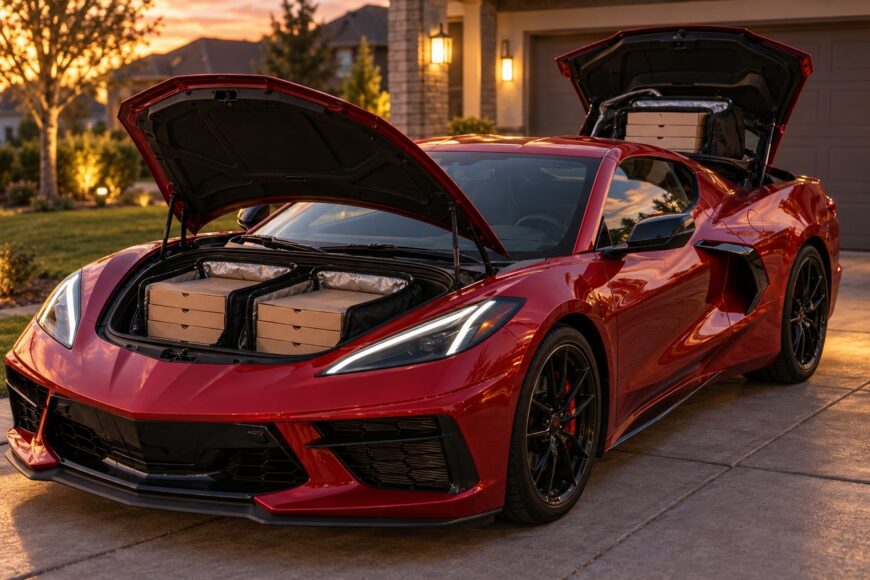
A Corvette can physically carry pizza, yet it may be a poor delivery tool. Its storage volume is usable, while low clearance, high running costs, difficult access, and tiring ergonomics become liabilities during repeated city stops.
The practical decision is therefore about profit, reliability, customer service, and fatigue. A sports car rarely shortens urban deliveries because traffic, parking, and route logistics matter more than acceleration.
For occasional peak-hour work, a Corvette can be workable. For full-shift delivery, fuel, insurance, wear, and repair exposure can outweigh its cargo capacity and any occasional customer tip.
- Can a Corvette Physically Handle Pizza Delivery?
- C6, C7, and C8: Which Corvette Fits Delivery Best?
- Why the Corvette Can Destroy Delivery Profit
- The Daily Problems That Do Not Show Up in the Cargo Spec
- Four Mistakes That Make Corvette Delivery Even Worse
- When a Corvette Actually Makes Sense for Delivery
- Frequently asked questions
- What’s the best pizza delivery car?
- What does business-use insurance mean for a Corvette used in delivery work?
- Which Corvette should you stay away from for pizza delivery?
Can a Corvette Physically Handle Pizza Delivery?
Yes, a Corvette can carry several dozen pizza boxes when they are stacked carefully in thermal bags. C6, C7, and C8 Corvettes are two-door coupes or convertibles and effectively two-seat vehicles with no rear seats, so the storage areas must handle both food and delivery equipment.
The C6 offers approximately 634 L of cargo volume. The C7 provides approximately 425–444 L, while the C8 has approximately 356–358 L combined across the front and rear storage areas. Those figures are sufficient for many orders, but volume alone does not describe how easy the space is to use.
Pizza boxes need a level surface and stable stacking. Thermal bags help protect food quality, and hot and cold items should be separated. The C6 and C7 hatchback-style rear access can make bags easier to organize, while the C8 requires more deliberate use of both storage compartments.
Heat management also matters. Food should not be packed against areas that become hot, and bags should not be wedged where ventilation is restricted. The Corvette solves the basic capacity problem; it does not provide the upright, quick-access loading layout of a typical delivery hatchback or sedan.
C6, C7, and C8: Which Corvette Fits Delivery Best?
The C6 has the most listed cargo volume, but every generation involves low loading height, limited cabin utility, and no rear-seat flexibility. Stock ground clearance is approximately 100–130 mm, with lower clearance possible on Z06, ZR1, and modified cars.
| Generation | Storage | Access and loading | Clearance concern | Delivery practicality |
|---|---|---|---|---|
| C6 | Approximately 634 L | Generous rear storage, but low and wide access; careful stacking remains necessary | Low nose and limited clearance can cause problems at curbs and steep driveways | The strongest Corvette option for cargo, though still costly and awkward for full shifts |
| C7 | Approximately 425–444 L | Useful rear access, with less total space than the C6 | Low front end and vulnerable approach angles require caution | Usable for occasional work, with poorer rear visibility than many sedans |
| C8 | Approximately 356–358 L combined across the front and rear storage areas | Two storage areas improve separation, but each compartment has its own shape and access limits | Low clearance and expensive body or aero components increase scraping concern | Suitable for smaller or selective orders rather than continuous mass delivery |
For a driver choosing only by cargo capacity, the C6 is the practical winner. Its extra space does not remove the need for thermal bags, level placement, or careful loading, and it does not turn the car into an efficient work vehicle.
The C7 and C8 can carry normal delivery orders, but their smaller or divided storage areas make organization more important. A driver should test real pizza bags in the car before buying, including the space needed for drinks, sides, and cold items.
Why the Corvette Can Destroy Delivery Profit
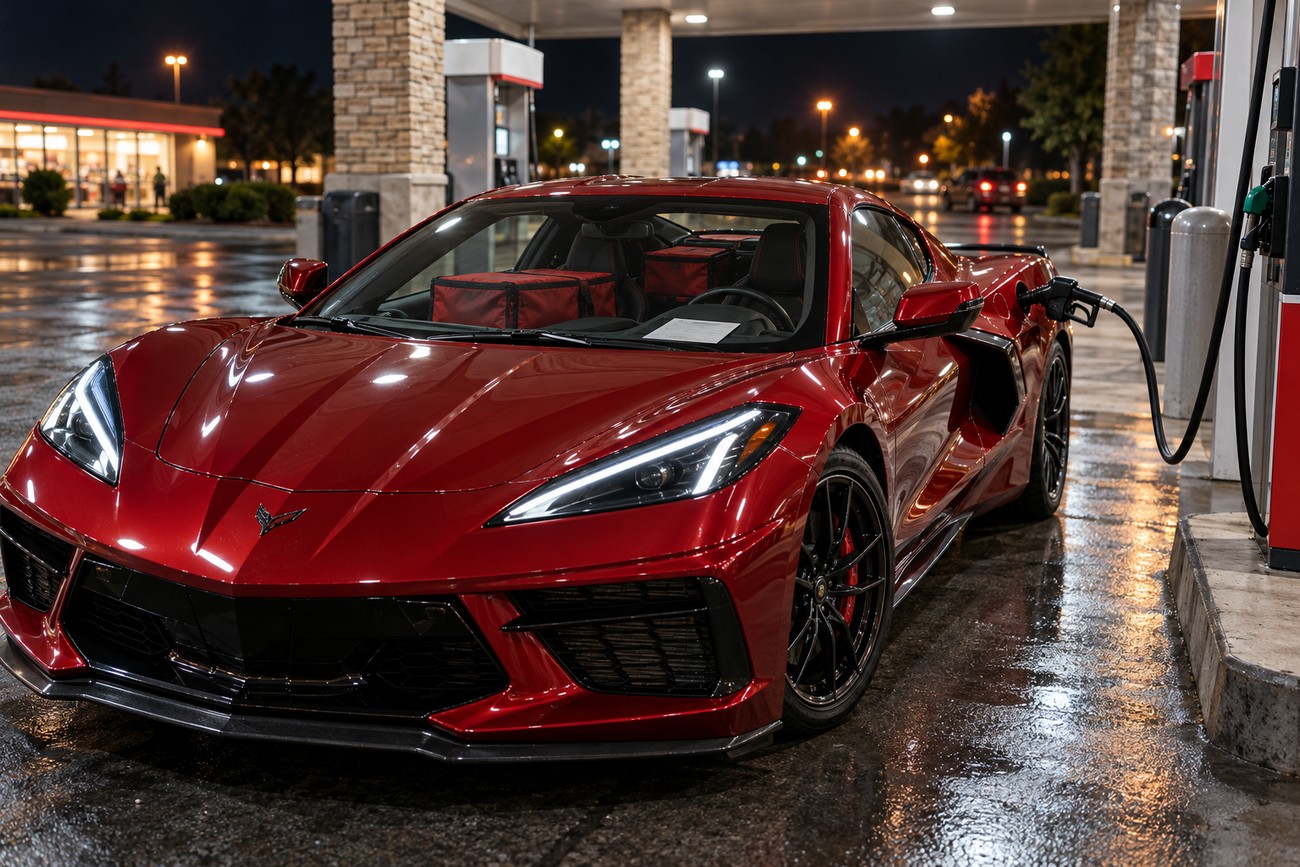
Active urban V8 driving can use approximately 15–20 L/100 km. Frequent starts, short trips, idling, and repeated acceleration make neighborhood delivery less favorable than steady highway driving, so the fuel bill can take a substantial share of delivery income.
Insurance creates a second cost layer. Sports-car insurance is noticeably more expensive than coverage for typical mass-market sedans or hatchbacks, and many delivery services may require business-use insurance even when they do not formally prohibit Corvettes.
Using an ordinary personal policy without confirming work use can create a coverage problem after a crash. The driver should disclose delivery activity, confirm the permitted use in writing, and check platform or restaurant requirements before accepting orders.
Urban delivery also exposes tires, brakes, wheels, suspension, and aero parts to repeated curb approaches, potholes, and parking errors. Original suspension, wheel, body, and aerodynamic components can make a minor work-related incident expensive, especially on a high-performance configuration.
The Daily Problems That Do Not Show Up in the Cargo Spec
Stock clearance is approximately 100–130 mm, and it can be lower on a Z06, ZR1, or modified car. A long nose and low front end make steep residential driveways, restaurant curbs, speed bumps, and informal parking spaces more stressful than they are in a normal delivery car.
Rear visibility is worse than in many sedans because of the small rear glass and broad pillars, especially in C7 and C8 models. Tight parking spaces require more caution, and reversing near customers, pedestrians, or delivery entrances offers little practical advantage over using a taller, more visible car.
Approach steep driveways and restaurant curbs diagonally, keep the thermal bag level, and reject a route setup that requires repeated bumper-scraping compromises.
Low seating and firm suspension can create fatigue or back discomfort during six- to eight-hour shifts. Getting in and out at every stop is a repeated physical task, and the inconvenience becomes more noticeable as the shift progresses.
The low center of gravity and firm suspension can help keep pizza stable when driven smoothly. That benefit depends on disciplined inputs and does not compensate for the car’s low clearance, difficult access, or higher operating burden.
Rear-wheel drive and wide tires can make icy or slippery residential roads more difficult. A conspicuous sports car can also attract attention and increase concern about theft from the cabin or cargo areas, particularly during unattended stops or late-night work.
Four Mistakes That Make Corvette Delivery Even Worse
Ignoring business-use insurance is the most serious mistake. A personal policy may be designed for commuting and ordinary personal driving, so a driver who assumes it automatically covers paid delivery can face a coverage dispute after a work-related crash.
Lowering the suspension or adding an aftermarket splitter reduces the margin already available at curbs and driveways. The result is more scraping, greater repair exposure, and slower approaches at locations where a delivery driver is already under time pressure.
Carrying boxes directly on carpet or loose cargo surfaces creates avoidable food-quality problems. Thermal bags, level stacking, separation of hot and cold items, and sensible ventilation are necessary to reduce shifting, cooling, and heat buildup during the route.
Aggressive driving for sound or speed raises fuel use, brake and tire wear, and accident risk. It can also create a poor impression at customer homes and lead to noise complaints in residential neighborhoods, while offering little meaningful time advantage in congested city work.
When a Corvette Actually Makes Sense for Delivery
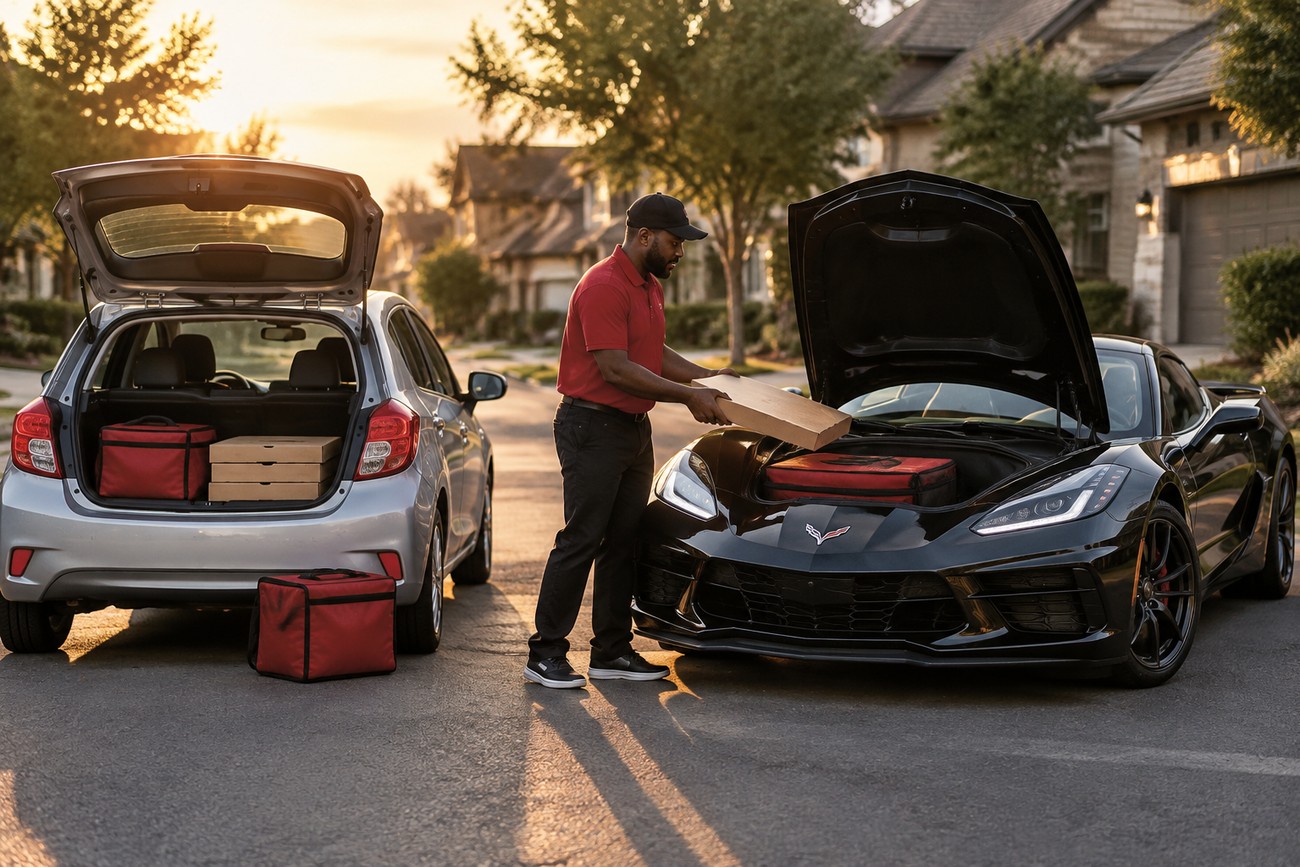
A Corvette can make sense for occasional peak-hour work, longer premium orders, or a driver who already owns the car and accepts its costs. Some drivers use one mainly during busy periods or for higher-value trips, where fewer stops reduce the burden of repeated loading and parking.
A two-car setup is more rational for many owners. An economical vehicle can handle short, frequent orders, while the Corvette is reserved for selected routes, favorable weather, or shifts where the driver values personal enjoyment alongside supplemental income.
Customer attention and extra tips are possible, but they are inconsistent and should not be included as guaranteed revenue. Some customers may enjoy seeing the car; others may see it as irrelevant, and conversations about the vehicle can slow handoffs.
The clear recommendation is to avoid using a Corvette for full-shift pizza delivery unless the costs are carefully accepted in advance. For occasional supplemental work, a stock, well-maintained example with confirmed business-use insurance and practical cargo equipment can be workable.
Frequently asked questions
These answers focus on the selection and insurance checks that matter before putting a Corvette into paid delivery work.
What’s the best pizza delivery car?
The best pizza delivery car is the one with low fuel and insurance costs, easy cargo access, comfortable entry, dependable winter behavior, and affordable repair risk. Horsepower should be a minor consideration because urban delivery time is usually controlled by traffic, parking, and route logistics.
Before choosing, test the actual thermal bags, check loading height, sit in the car for a realistic shift, and compare how easily it handles wet or icy residential roads. A practical hatchback or sedan will usually fit the delivery job better than a performance car.
What does business-use insurance mean for a Corvette used in delivery work?
Business-use insurance means the policy recognizes that the vehicle is being used while performing paid delivery work. Ordinary personal-use coverage may cover commuting and private trips without covering deliveries, so a driver should confirm the distinction with the insurer before accepting orders.
Ask whether the policy covers the specific delivery activity, platform, or restaurant arrangement, and confirm the answer in writing. Many services do not formally ban Corvettes, but business-use requirements can increase the premium or affect claim handling.
Which Corvette should you stay away from for pizza delivery?
Avoid heavily lowered cars, cars with vulnerable aftermarket aero, and high-performance Z06 or ZR1 configurations unless a detailed inspection confirms that they can handle the intended routes. These versions can have less clearance and greater exposure to expensive suspension, wheel, body, and aerodynamic damage.
Screen the car for previous scraping, modified suspension, damaged splitters, uneven tire wear, and difficult loading access. A stock, well-maintained example is the safer choice for occasional delivery, even though it remains less economical than a conventional delivery vehicle.







