
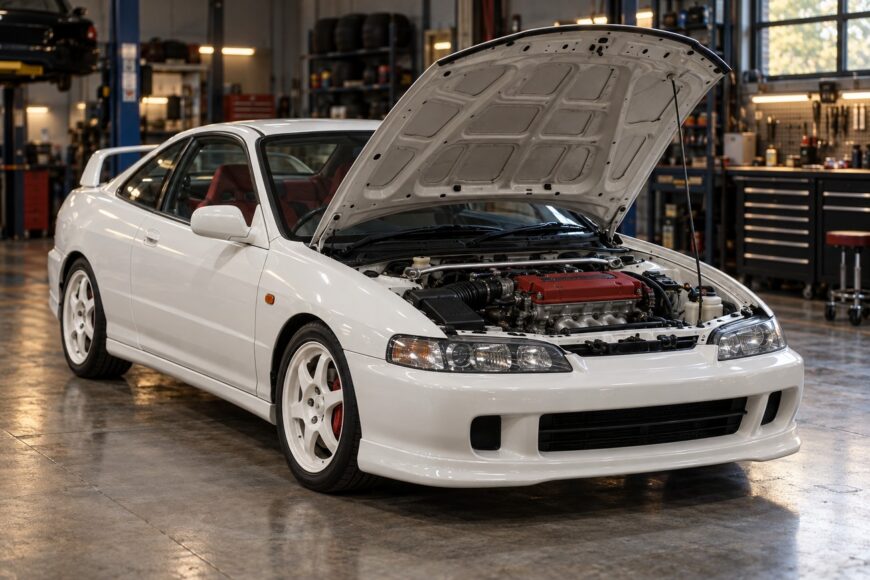
The DC2 Integra Type R has a strong reputation: a lightweight Honda with a hand-finished engine that rewards commitment and revs where ordinary road cars run out of breath. That reputation can create disappointment, though. At low rpm, a stock B18C Type R may feel modest beside a modern turbocharged engine, while a poorly chosen head modification can make the car slower and less usable.
The appeal lies in the complete package. The engine, manual gearbox, differential, relatively light body, and carefully developed chassis produce the character owners remember. Understanding what Honda actually hand-finished, and what later tuning claims exaggerate, is essential before buying, modifying, or judging one of these cars.
- What Honda hand-finished—and what the legend exaggerates
- The B18C Type R’s figures explain only half the drive
- Why a bigger port can make a Type R slower
- When VTEC feels wrong, check the basics before modifying
- Chassis balance beats an aggressive parts list
- Buying one: the body and history can cost more than the engine
- Frequently asked questions
- How much is a DC2 Integra Type R worth?
- How can I verify that a DC2 is a genuine Type R?
- What records should come with a modified DC2?
What Honda hand-finished—and what the legend exaggerates
The DC2 Integra Type R was produced from 1995 to 2001. Its Type R engine belongs to Honda’s B-series family, with factory preparation that included careful finishing of components and head work. That description matters because it explains the engine’s consistency without turning it into a wholly separate design created by hand-porting alone.
Factory hand-finishing is best understood as disciplined preparation within a production engine program. Port shapes, component balance, clearances, and assembly quality all contribute to the result. A polished-looking port is only one visible detail, and it says little about how well the entire intake and exhaust path works together.
The same caution applies to aftermarket “hand-ported” heads. A successful job preserves suitable port geometry, maintains useful flow speed, and matches the head to the cams, intake, exhaust, and ECU calibration. The visual quality of the work cannot establish a guaranteed horsepower gain.
Market and year differences also matter. DC2 Type R specifications and equipment were not identical everywhere, so claims about a single universal engine specification or factory process should be checked against the vehicle’s market documentation and component combination.
The B18C Type R’s figures explain only half the drive

The Japanese-specification B18C Type R is commonly cited as a 1.8-liter DOHC VTEC engine producing about 200 hp at 8,000 rpm and 178 Nm at 7,500 rpm. Figures differ by market and year, so Japanese output should not be presented as a universal specification for every DC2 Type R.
Those figures also describe a narrow part of the driving experience. Useful power arrives high in the rev range, which means the engine can feel subdued during ordinary city driving. A modern turbocharged car with similar displacement may deliver stronger low-rpm response, even when the Honda becomes more rewarding as the revs rise.
VTEC is only one element in the result. The manual gearbox keeps the engine in its useful range, the differential helps manage front-wheel-drive traction, and the relatively light body reduces the work required from the powertrain. Chassis response and gearing turn the engine’s willingness to rev into speed that the driver can use.
This is why peak output alone gives a poor picture of a DC2. Specifications, equipment, and weight vary by market and year, while the car’s defining character comes from the interaction of all those systems rather than from a single switch-over point in the cylinder head.
Why a bigger port can make a Type R slower
Head work begins with geometry, not maximum size. The port must guide air cleanly from the manifold to the valve, preserve appropriate cross-sectional area, and support useful flow speed across the rev range. A larger opening can reduce air velocity and weaken mid-range response if it exceeds what the engine’s displacement, camshafts, and operating range can use.
The manifold connection deserves particular attention. A step, mismatch, or abrupt change at the port-to-manifold joint can disturb the flow even when the head looks carefully polished. The intake, exhaust, cams, compression, and engine management then determine whether the revised head produces a measurable improvement on the car.
A fitted ported head without proper calibration may deliver little benefit or reduce performance. Fuel and ignition requirements can change with the airflow characteristics, and camshaft or manifold choices can shift where the engine makes useful power. Combining B-series components also requires checks of head, intake, ECU, and sensor compatibility.
For that reason, claims that aftermarket hand-porting guarantees a substantial gain are unsubstantiated without setup-specific measurements. A sensible evaluation compares before-and-after results under controlled conditions and considers drivability, mid-range response, and consistency alongside peak power.
When VTEC feels wrong, check the basics before modifying
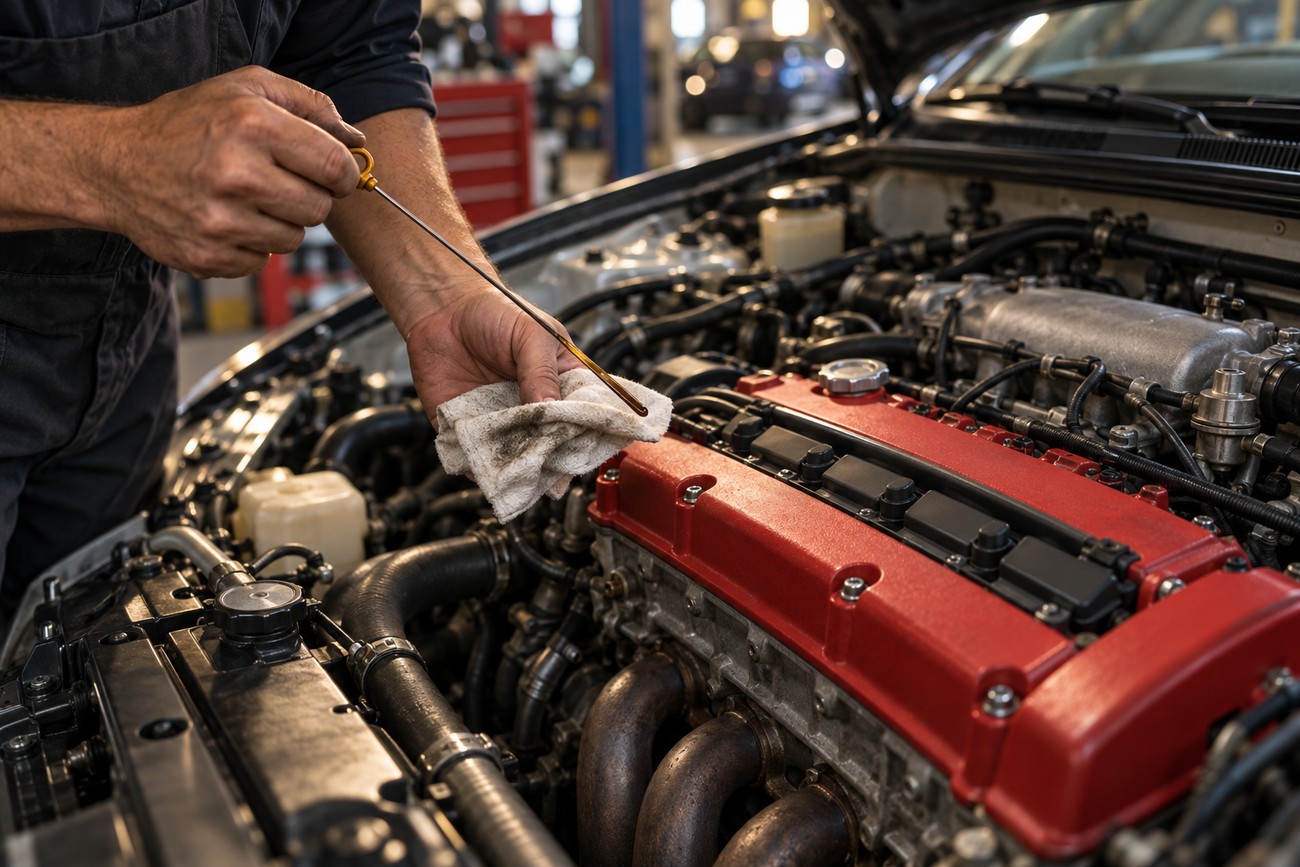
The B18C Type R’s high-rpm operation makes oil condition and oil-system health especially important. Oil level, service history, pressure, and the condition of relevant components deserve attention before another performance part is installed. High-rpm use leaves less room for neglect to remain harmless.
Poor VTEC engagement can be associated with oil-pressure problems, sensor faults, calibration issues, or worn components. A weak sensation at the expected changeover point can also be confused with the engine’s normal high-rpm character, especially if the driver expects a dramatic surge at every throttle opening.
A proper diagnosis should therefore begin with inspection and testing rather than assumptions. Oil condition and level can be checked first, followed by pressure verification, sensor and wiring checks, and confirmation that the ECU calibration suits the installed hardware. The exact fault requires evidence from the individual engine.
Maintenance often produces a larger improvement than another part when the underlying system is neglected. Keeping the lubrication system healthy protects the engine’s intended operating range and helps separate a genuine VTEC fault from a tired, poorly calibrated, or simply misunderstood setup.
Chassis balance beats an aggressive parts list
The DC2’s engine is easiest to appreciate when the chassis can place its power accurately. Worn bushings, tired dampers, damaged suspension components, or incorrect alignment can make the car feel nervous and reduce front-end confidence. Correct geometry may improve real-world pace more than an expensive engine modification.
Front-wheel drive also places limits on how cleanly torque reaches the road. Wheelspin and torque steer can appear when traction is poor or the setup is poorly matched, although individual cars behave differently according to tires, alignment, differential condition, suspension tuning, and power delivery.
Stiffer mounts, coilovers, polyurethane components, and a light flywheel can sharpen certain responses while substantially reducing comfort. Noise and vibration increase, ride quality suffers, and an aggressive combination can make a road car tiring without delivering a meaningful advantage outside a track environment.
The strongest DC2 builds preserve the relationship between engine response, gearing, differential action, and suspension control. Modifications should serve the intended use. A car that remains predictable and compliant can exploit its available power more effectively than one overwhelmed by harsh parts and compromised alignment.
Buying one: the body and history can cost more than the engine
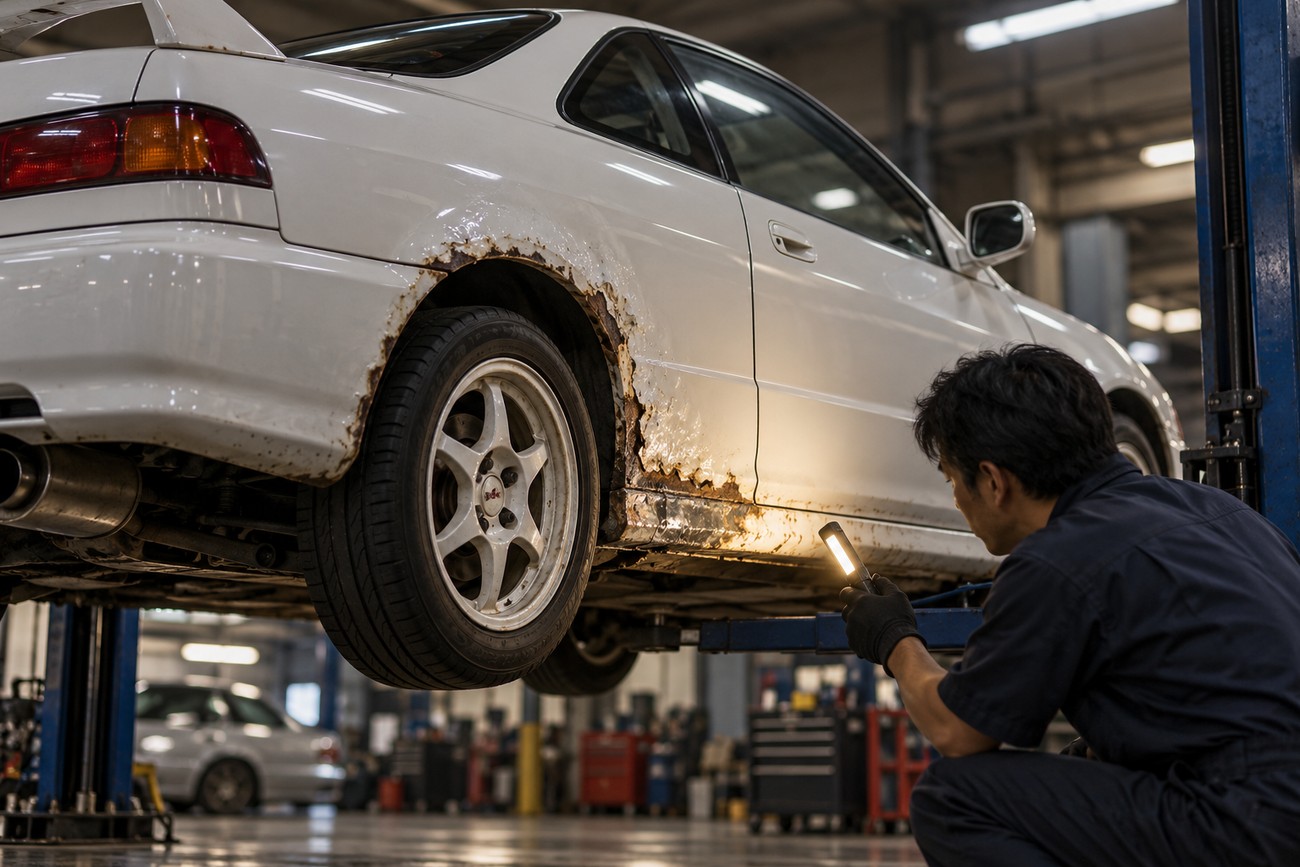
Inspection should begin with the body, not the engine bay. Check for corrosion, repaired accident damage, uneven panel gaps, signs of altered geometry, and evidence that the car has been rebuilt after a major impact. A clean-looking engine does not prove that the shell is straight or structurally sound.
Next, establish the car’s history. Track use, engine swaps, wiring changes, and undocumented suspension work can affect both reliability and value. Compare the installed components with the claimed market specification, since DC2 Type R equipment and details vary by market and year.
Age adds a separate layer of work. Even a well-preserved car may need attention to suspension rubber, bushings, fuel-system components, cooling-system parts, and other aging materials. These jobs can arrive together after purchase, turning an apparently usable car into a broader restoration project.
Original Type R parts can also be scarce and expensive. Missing trim, engine components, wheels, interior pieces, or market-specific equipment may be difficult to replace with correct parts. Restoration cost therefore depends on originality, documentation, corrosion, and repair needs as much as on the engine specification.
Weight should be treated as a market- and equipment-dependent detail rather than a universal number. A careful buyer verifies the vehicle identity, specification, service records, underside condition, and repair history before assigning value to a claimed Type R conversion or modified example.
Frequently asked questions
Value depends on the car’s condition and history, not its Type R badge alone. Market-specific details matter when checking whether an example is genuine. For a modified car, records help establish what was installed and how the work was completed.
How much is a DC2 Integra Type R worth?
There is no reliable universal price. Compare current sales of cars from the same market, then separate examples by originality, documented condition, corrosion, crash repairs, track history, and the work required to make them usable.
A modified car should be assessed on the quality and documentation of the build rather than on the cost of its parts. A lower-priced example may require scarce Type R components or extensive body and suspension restoration, while a more expensive car with clear records and sound structure may represent the lower-risk purchase.
How can I verify that a DC2 is a genuine Type R?
Use a market-specific vehicle identification process. Check the vehicle identifiers and paperwork against the relevant market specification, then compare the engine, gearbox, differential, brakes, suspension, interior, wheels, and body details for consistency. Equipment and specifications differ by market and year.
Badges alone are weak evidence. Look for signs of conversion, swapped wiring, inconsistent castings or labels, replacement panels, and undocumented changes. Specialist inspection and original registration or import paperwork can help resolve discrepancies that photographs cannot.
What records should come with a modified DC2?
Useful records include invoices identifying the machine work, parts specifications for the head, cams, intake, exhaust, and fuel system, plus ECU calibration files or dyno documentation. The paperwork should show what was installed and how the combination was tuned.
Inspection, registration, import, and emissions documents may also matter, depending on the market. A build with clear modification records is easier to assess, maintain, and insure than one described only through verbal claims about a ported head or Type R conversion.







