
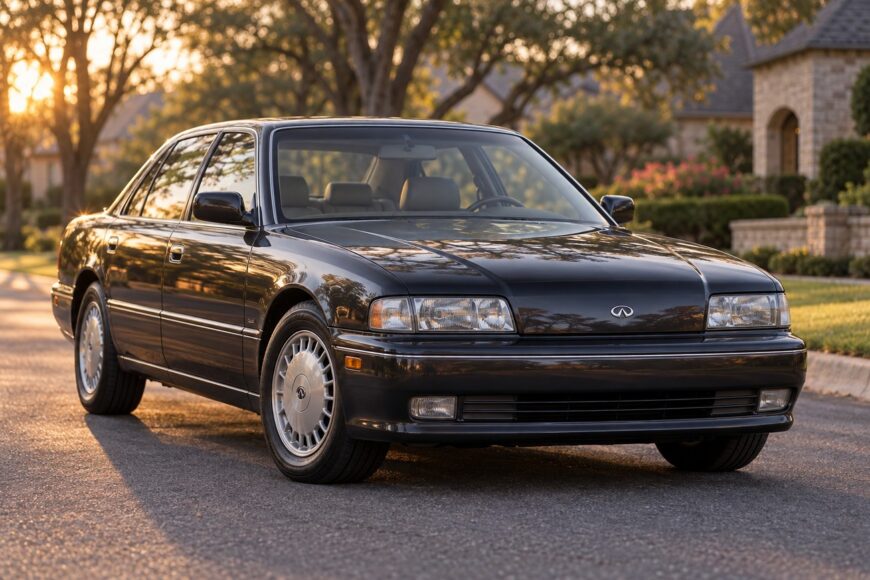
A luxury sedan usually announces itself with a prominent grille. The original Infiniti Q45 did the opposite: its smooth front end made the car recognizable precisely because it lacked a conventional one. That decision gave Nissan’s new luxury brand an identity of its own, while the V8 and rear-wheel-drive layout gave the design substance.
For a used-car buyer, the striking nose is only the beginning of the story. The Q45 was produced from 1989 to 2006 in three generations, and an aging example can demand far more attention than its original specification suggests. Its appeal is real, but so are the consequences of neglected cooling, tired electrical equipment, or repairs made without the right parts.
- Why the original Q45 had no conventional grille
- Infiniti Q45 generations: which car are you looking at?
- The V8 performance behind the unconventional face
- Luxury equipment versus the realities of age
- What to inspect before buying a Q45
- The ownership costs a low asking price can hide
- Frequently asked questions
- Why was the Infiniti Q45 discontinued?
- What is the average price of an Infiniti Q45?
- Why did a Q45 have a 4.1-liter engine?
Why the original Q45 had no conventional grille
The early G50’s grilleless appearance was intentional. Where many luxury sedans used a large grille to signal prestige, Infiniti gave its flagship a low, smooth nose. The result looked restrained from a distance and unusual up close, especially beside more traditional rivals.
That front end did not mean the V8 had been denied cooling air. A conventional upright grille is one way to admit airflow, rather than the only way. The useful distinction is between a styling feature you can see and the cooling system beneath it, whose condition on a surviving car must be assessed separately.
The grilleless look became shorthand for the Q45 because it belonged to the model’s formative years, when Infiniti needed to establish a recognizable face. It also helps explain why the original car still draws attention among collectors of Japanese luxury sedans. The shape was a deliberate alternative to familiar flagship cues, rather than an unfinished design awaiting a grille.
That description has limits. It identifies the early G50 front end, not every Q45 built through 2006; later generations changed the car’s appearance as well as its mechanical specification. Anyone searching for the “Q45 without a grille” should confirm that an advertised car is the early model, rather than relying on the badge alone.
Infiniti Q45 generations: which car are you looking at?
The Q45 ran from 1989 to 2006 as the G50, Y33, and F50. Calling the F50 the second generation skips the Y33 and can lead to confusion over engines, parts, and the car’s character.
| Generation | V8 engine | Distinguishing context |
|---|---|---|
| G50, first | 4.5-liter VH45DE | The original Q45; early cars have the signature grilleless front end. |
| Y33, second | 4.1-liter VH41DE | Retained the Q45 badge despite the smaller-displacement V8. |
| F50, third | 4.5-liter VK45DE | Introduced in 2001 with a different engine and a later luxury-sedan design. |
The name is therefore a poor substitute for identification. “Q45” does not guarantee a 4.5-liter engine, and two cars with that displacement—the G50 and F50—use different V8s. Establish the generation before comparing performance claims or ordering a component.
These distinctions matter most when a seller’s description is thin. A photograph can help place the car, but its identification details and service records should settle what you are inspecting. That small step prevents a discussion about the wrong engine from becoming an expensive parts search.
The V8 performance behind the unconventional face
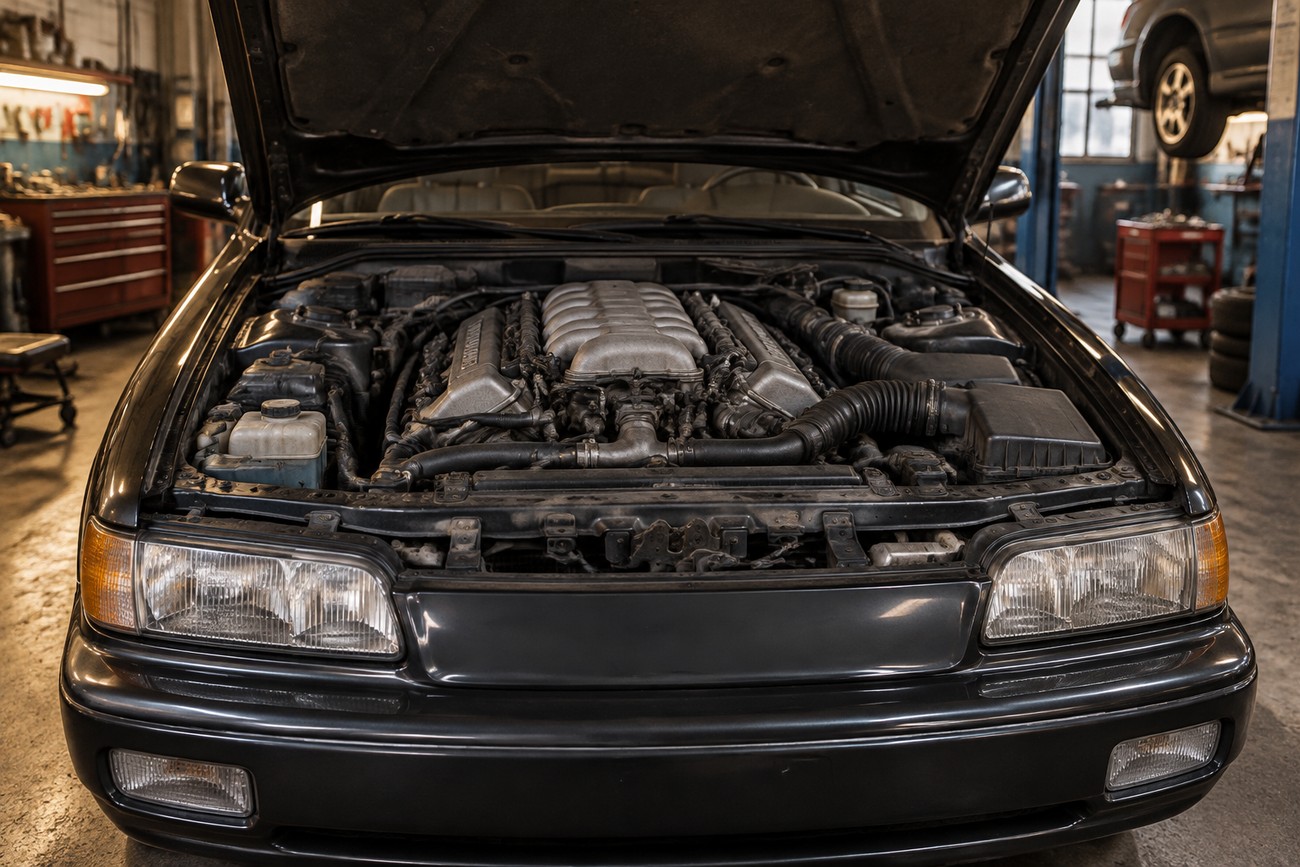
The first Q45 had more to offer than a memorable front end. Its naturally aspirated 4.5-liter VH45DE V8 drove the rear wheels, giving the large sedan the layout expected of a serious luxury flagship. Smooth power delivery and substantial road presence were central to its appeal, rather than incidental bonuses attached to unusual styling.
In U. S. specification, the G50 was quoted at 278 hp and 396 Nm; some catalogs give its output as 280 hp. Period specifications put its 0–100 km/h time at approximately 7.7 seconds and curb weight at around 1,833 kg. Those figures describe the car as specified, not the acceleration or weight of every example still on the road.
The third-generation F50 brought a different 4.5-liter V8, the VK45DE, quoted at 340 hp and 451 Nm. It offered a stronger headline output, yet that number cannot tell a buyer whether it will be the more satisfying Q45 to own. Engine response, transmission behavior, maintenance history, and the condition of the whole car shape the experience.
There is a useful historical distinction here: the early G50’s achievement lay in combining its V8 and rear-wheel drive with a distinct identity for a new luxury marque. The later F50 can be judged on its own merits without treating the power increase as proof that the original was merely a preliminary version. For a used buyer, a healthy lower-output car may make a better flagship than a stronger one awaiting extensive work.
Luxury equipment versus the realities of age
The Q45 was conceived as a well-equipped Japanese alternative to established luxury flagships. Leather upholstery, Bose audio, power seats with memory, and a powered steering column are all associated with the model, although the exact equipment depends on year and specification. Check the individual car rather than assuming an item appeared on every Q45.
Such features mattered because they made the sedan feel complete without asking the owner to overlook its unconventional exterior. Seat and steering adjustments also affect daily use in ways that an engine specification cannot convey. On an aging car, however, a feature listed in an old brochure has value only if it remains present and works properly.
Test each adjustment, audio function, and switch during an inspection. A cabin can appear tidy while a powered function operates intermittently, and missing or damaged trim may be harder to resolve than worn service items. Parts availability varies by component and local market, so an apparently small defect deserves a realistic repair plan before purchase.
Previous work can alter that calculation further. Neatly fitted replacement pieces and properly functioning controls inspire more confidence than improvised wiring or loose interior panels, even when both cars look complete in photographs. On a surviving Q45, the quality of care since new often matters more to usability than the length of its original equipment list.
What to inspect before buying a Q45
Begin with the car’s identity and maintenance history. Confirm whether it is a G50, Y33, or F50, then compare service records with its present condition. The three generations have different V8 engines, so a vague claim that “Q45 parts fit” is no basis for planning repairs.
Next, inspect the body and cabin for completeness, damage, and evidence of improvised work. Check that lights, interior fittings, seat controls, and other electrical functions operate consistently. A missing trim piece or altered wiring may take more effort to put right than its size suggests, depending on what can be sourced locally.
Confirm the generation and assess the quality of earlier repairs before pricing scarce electrical or interior parts. A replacement estimate is of little use until you know whether the original component, its wiring, or a previous repair is responsible.
Examine the cooling system with the same care as the visible finish. Look for leaks or signs of neglected hoses and connections, and ask how cooling work was documented. These are age-related checks for a V8 sedan, not a claim that every Q45 has a particular cooling defect.
A road test should include the automatic transmission in ordinary driving and, where appropriate, varied speeds and loads. Note hesitation, harsh engagement, or behavior that warrants further diagnosis; also listen and feel for suspension wear over uneven surfaces. An independent inspection by someone able to assess the car’s systems is a sensible next step before agreeing to buy.
Finally, weigh the findings together instead of treating a clean engine bay or advertised horsepower as a verdict. A documented, complete car with coherent repairs offers a clearer starting point than a more powerful example with unanswered faults. Condition, maintenance history, and the availability of needed parts should guide the buying decision.
The ownership costs a low asking price can hide
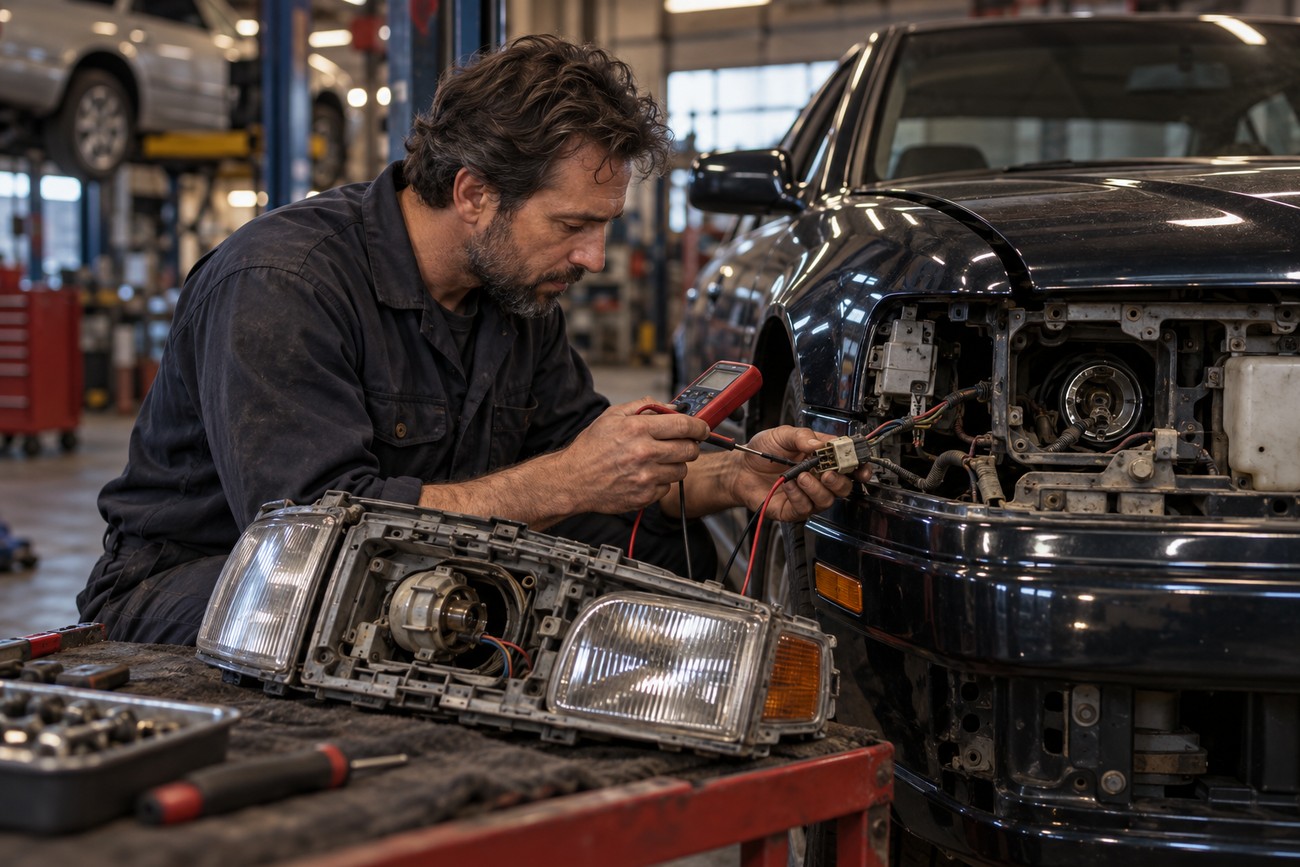
Fuel is a predictable consideration with any large V8 luxury sedan, especially for regular city use. Routine upkeep also deserves room in the budget before a fault appears. Neither expense means a Q45 is inherently unreliable; both belong in the cost of operating the kind of car it is.
Repair bills are less predictable. Aging electrical components may require diagnosis rather than an obvious replacement, while a damaged lamp, cabin fitting, or other model-specific part can depend on local availability. Two cars with similar asking prices may therefore carry quite different amounts of unfinished work.
A low purchase price becomes misleading when it is compared only with the price of a better-kept car. Compare the total work needed to reach the condition you want, including any faults found in the cooling system, transmission, suspension, or interior. Where a part is scarce, establish whether a suitable replacement can actually be obtained before treating a repair estimate as settled.
The F50’s higher quoted output does not make it automatically cheaper to own than an earlier Q45. Nor does the original G50’s reputation remove the effects of age and past repairs. The soundest purchase is the car whose condition and likely costs you can understand, even if another example carries a lower asking price.
Frequently asked questions
The Q45 badge covered three distinct generations, which is why brief descriptions can leave important questions unresolved. Its end date, engine naming, and market value each need a little context. None can be settled from the grilleless design alone.
Why was the Infiniti Q45 discontinued?
The Q45 model line ended in 2006. That establishes when production stopped; it does not establish a single cause. In particular, the early grilleless design cannot responsibly be presented as the reason the entire three-generation line ended, and the supplied facts do not support attributing its discontinuation to one mechanical flaw.
What is the average price of an Infiniti Q45?
There is no supported current average price to quote without a dated sample from a defined location and market. Asking prices would also need to be separated from completed transactions, then compared across generation and condition. For an individual car, use comparable local listings as a starting point and account for documented repairs still needed before deciding whether its price is attractive.
Why did a Q45 have a 4.1-liter engine?
The second-generation Y33 retained the Q45 name while using a 4.1-liter VH41DE V8. The badge had become the model name, so it should not be read as a dependable statement of engine displacement across the full production run. The first-generation G50 and third-generation F50 each used a 4.5-liter V8, but those engines were different from one another as well.







