
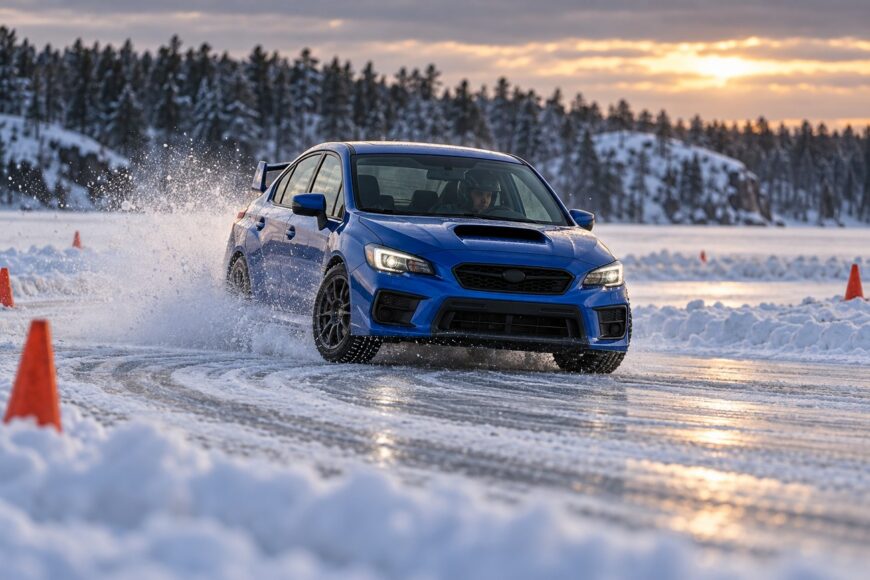
A Subaru WRX can accelerate impressively on Minnesota ice and still fail to turn, stop, or remain consistent. Symmetrical AWD sends useful power to the tires on corner exit, but it cannot create grip during braking or corner entry. If the front tires are overloaded, the car will push wide regardless of how confidently it launches.
The real decisions begin with compliant studded tires, sensible alignment, suspension compliance, and throttle technique. Heat management, inspection, and the rules of the local club matter just as much. Engine power is well down the list, especially when the surface changes from compacted snow to smooth black ice or a rutted, wet line.
A WRX is a capable starting point, not an ice-racing setup in factory trim. Minnesota events are local and variable, so the best preparation is the one that matches the organizer, class, surface, and session length.
- What the WRX AWD System Helps With—and What It Cannot Fix
- Minnesota Ice Tracks: Rules, Ice Conditions, and Season Reality
- Tires, Pressures, and Alignment: The WRX’s Real Ice Setup
- How to Drive a WRX on Ice Without Plowing Wide
- Cold-Weather Preparation, Heat Management, and Trackside Checks
- The True Cost of Ice Racing a WRX
- Frequently Asked Questions
- Which Subaru is best for driving in snow and ice?
- What year should you avoid when buying a used Subaru WRX STI?
- How do you know when a studded ice-racing tire is finished?
What the WRX AWD System Helps With—and What It Cannot Fix
Subaru WRX symmetrical AWD helps traction on corner exit. That advantage is easy to feel: the car can put power down earlier than a two-wheel-drive car when the tires have enough grip to use it. It also helps the car leave slow corners with fewer wasted wheelspin corrections.
AWD does not remove the grip limits during braking and cornering. All four tires still have to transmit braking force, lateral force, or a combination of both. If you enter too quickly, overload the front tires, or add throttle before the car has rotated, the WRX can understeer and continue toward the outside of the corner.
On ice, tires and suspension setup matter more than rated engine power. A powerful engine may make the car feel exciting, but extra output cannot compensate for a tire that cannot bite or a suspension that loses contact over an ice ridge. The WRX’s weight and its behavior during transitions also remain relevant, particularly on longer straights and during rapid changes from braking to turning.
The claim that AWD makes a WRX nearly indestructible on ice is a costly misunderstanding. AWD helps acceleration, while braking and corner entry remain limited by available tire grip. A driver who uses the drivetrain advantage to carry more speed into the next corner usually discovers the limitation at the least useful point: when there is no room left to slow or rotate the car.
Minnesota Ice Tracks: Rules, Ice Conditions, and Season Reality
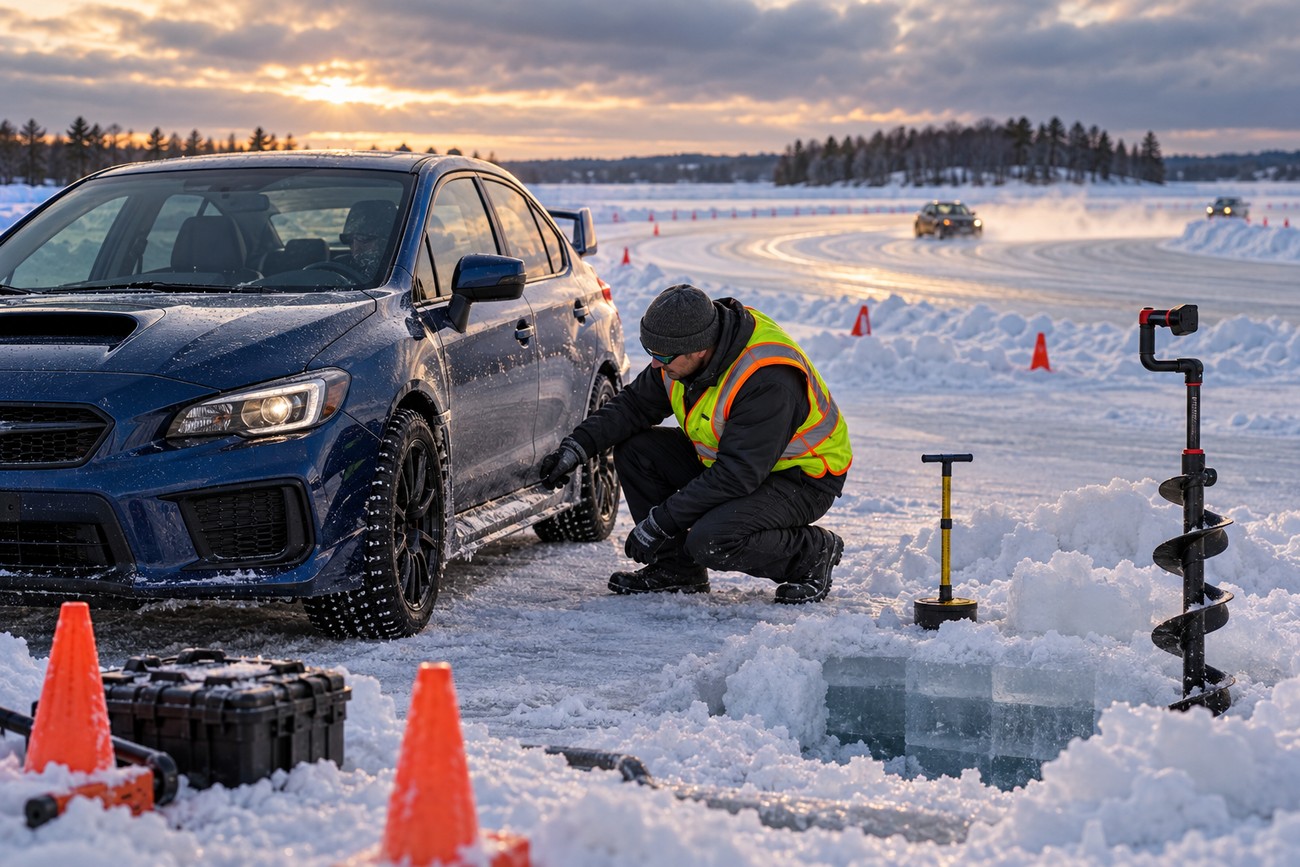
Amateur ice racing in Minnesota commonly follows local club or series rules rather than one statewide standard. Rules vary by organizer, class, lake, and track, so equipment that is acceptable at one event may be restricted at another. Check the current regulations before buying tires, drilling panels, or changing exterior equipment.
Minnesota ice tracks operate only when ice thickness and weather conditions are sufficient. The season can change substantially from one winter to the next, and a venue may alter its schedule or surface preparation as conditions develop. A legal car is still unusable if the event cannot safely operate on the lake.
Common organizer requirements can include a helmet, headlight protection, tow points, and a technical inspection. Local rules may also limit stud type or height, noise, and exterior body elements. These details can affect tire choice and preparation, so inspecting the car after it is modified is too late.
Ask the organizer about the class, stud dimensions, required safety equipment, recovery points, and inspection procedure. Also confirm whether the event expects a street-registered car, a competition-prepared car, or something between the two. That short exchange can prevent an expensive set of tires or body changes from becoming unusable on event day.
Tires, Pressures, and Alignment: The WRX’s Real Ice Setup
Minnesota ice racing commonly uses studded tires. Ordinary winter tires can be useful for reaching the venue, but they do not provide the same race behavior as compliant studded tires. Without reliable stud engagement, the WRX cannot fully exploit its AWD traction on a hard ice surface.
On ice, stud length, stud count, and stud protrusion matter—not just winter-tire tread. More aggressive hardware is not automatically faster. Excessively aggressive or long studs can violate rules, reduce predictability, and wear faster, especially when the surface includes hard irregularities or patches of snow.
High tire pressure can reduce the contact patch, making the car more nervous and reducing available grip. Pressure changes should be made in small steps, with the same reference conditions and a clear observation of what changed. A pressure setting that helps on a smooth, cold surface may be a poor compromise on a rutted or wet section.
Alignment, including camber and toe, strongly affects turn-in stability. A car that feels vague on entry may have an alignment problem rather than a lack of engine response. Check the condition of the suspension before adjusting angles, because worn joints or loose fasteners can make any alignment setting misleading.
Small pressure and alignment changes are most useful when tested between comparable surfaces. If a change appears to restore front grip only when the driver lifts earlier or uses less throttle, it may have exposed a driving error rather than solved the setup.
A stiff suspension can make the car bounce over ice irregularities and lose contact. Some compliance is valuable because the tires need to remain loaded across bumps, ridges, and changing surface texture. The aim is predictable contact, not the firmest possible body control. There is no universal AWD setup for every Minnesota track.
How to Drive a WRX on Ice Without Plowing Wide
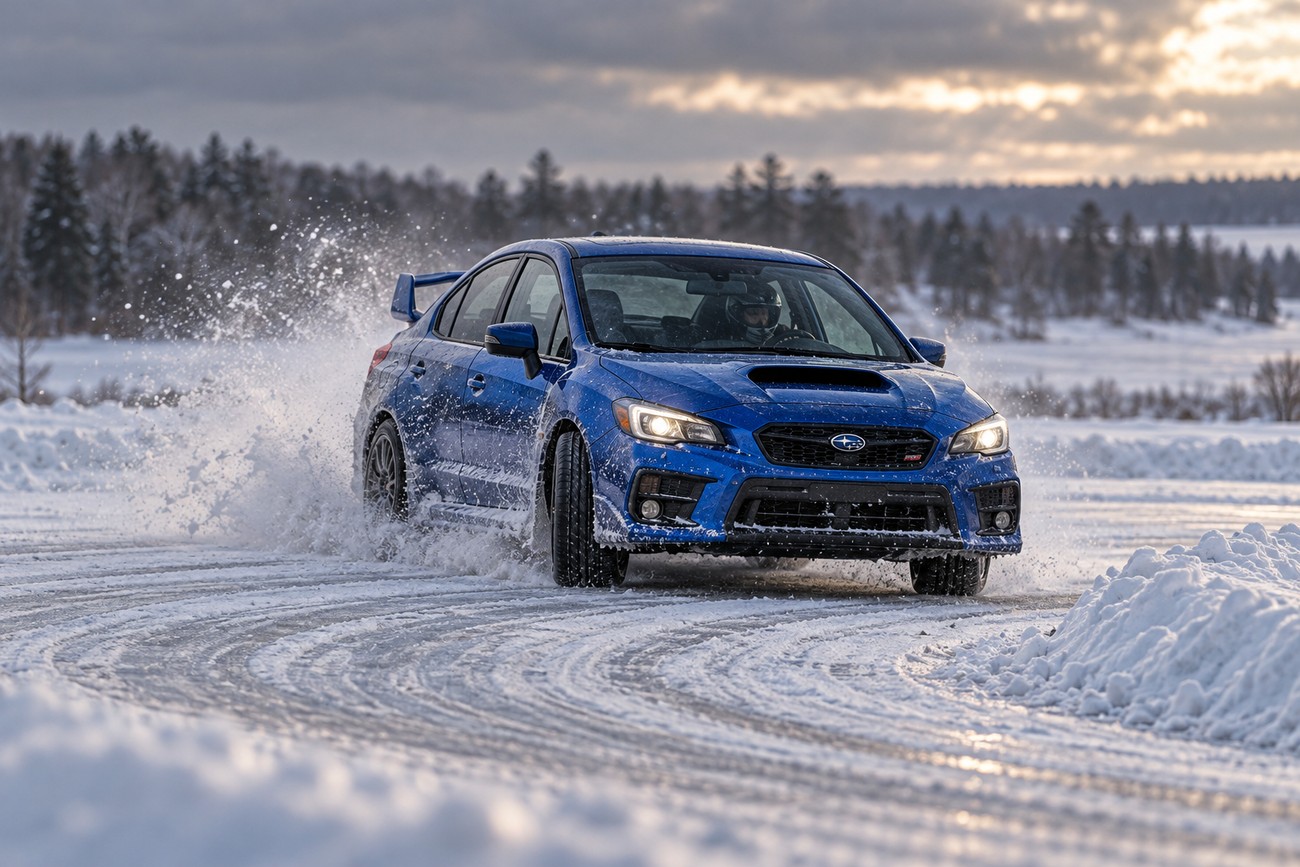
A WRX can understeer when front grip is insufficient or the driver applies too much throttle. The usual symptom is familiar: the steering wheel is turned, the car continues outward, and adding more steering produces little improvement. More steering angle can overload the front tires further, so the useful correction often begins with reducing the demand on them.
Smooth throttle and early steering correction can be faster than an aggressive turn-in. Brake in a controlled manner, establish the line before the corner tightens, and use the accelerator progressively as the car rotates. The goal is controlled weight transfer rather than a sudden request for maximum traction from every tire at once.
Ice racing requires throttle modulation and trajectory correction rather than constant aggressive throttle. That differs from a rally time-attack habit in which a driver may hold a committed throttle position and accept larger slides. On ice, a small lift can restore front grip, while a gentle steering correction can prevent a slide from becoming a wide exit.
Compacted snow, smooth black ice, and rutted or wet ice require different lines and setup compromises. A snow-covered surface may reward a different entry speed and steering angle than polished ice, while ruts can unsettle the car if you attack them with a stiff suspension and abrupt inputs. There is usually no single ideal setup for every Minnesota ice surface.
Cold-Weather Preparation, Heat Management, and Trackside Checks
AWD does not prevent brake overheating or differential heat buildup. Individual runs may be short, but longer sessions increase thermal load as the car repeatedly accelerates, brakes, and changes direction. A firm pedal at the start of the day does not guarantee the same pedal after continuous running.
Short cooling pauses can be more useful than continuous running. Use them to let the brakes and drivetrain shed heat, inspect the car, and reassess any new noise or change in pedal feel. Avoid treating a brief pause as proof that a problem has disappeared; a soft pedal, fluid smell, or drivetrain noise deserves attention before the next run.
Cold affects tires, plastics, seals, the battery, and clutch behavior. The battery may be less forgiving during starting, while brittle plastic and seals can suffer from impacts or rough handling. Clutch engagement and fluid behavior may also feel different before the car has reached normal operating temperature.
Before running, inspect wheel and suspension fasteners, coolant level, visible fluid leaks, and the braking system. Confirm that tow points and headlight protection remain secure, and check that nothing has loosened during transport. A tire that looks acceptable in the paddock can still have damage around the bead, sidewall, or wheel.
After the session, look for cracked wheels, suspension play, fresh leaks, damaged underbody parts, and loose fasteners. Impact loads can reveal problems that were hidden before the car reached the ice. If the steering, braking, or drivetrain feels different, end the day and inspect the cause rather than trying to drive through it.
The True Cost of Ice Racing a WRX
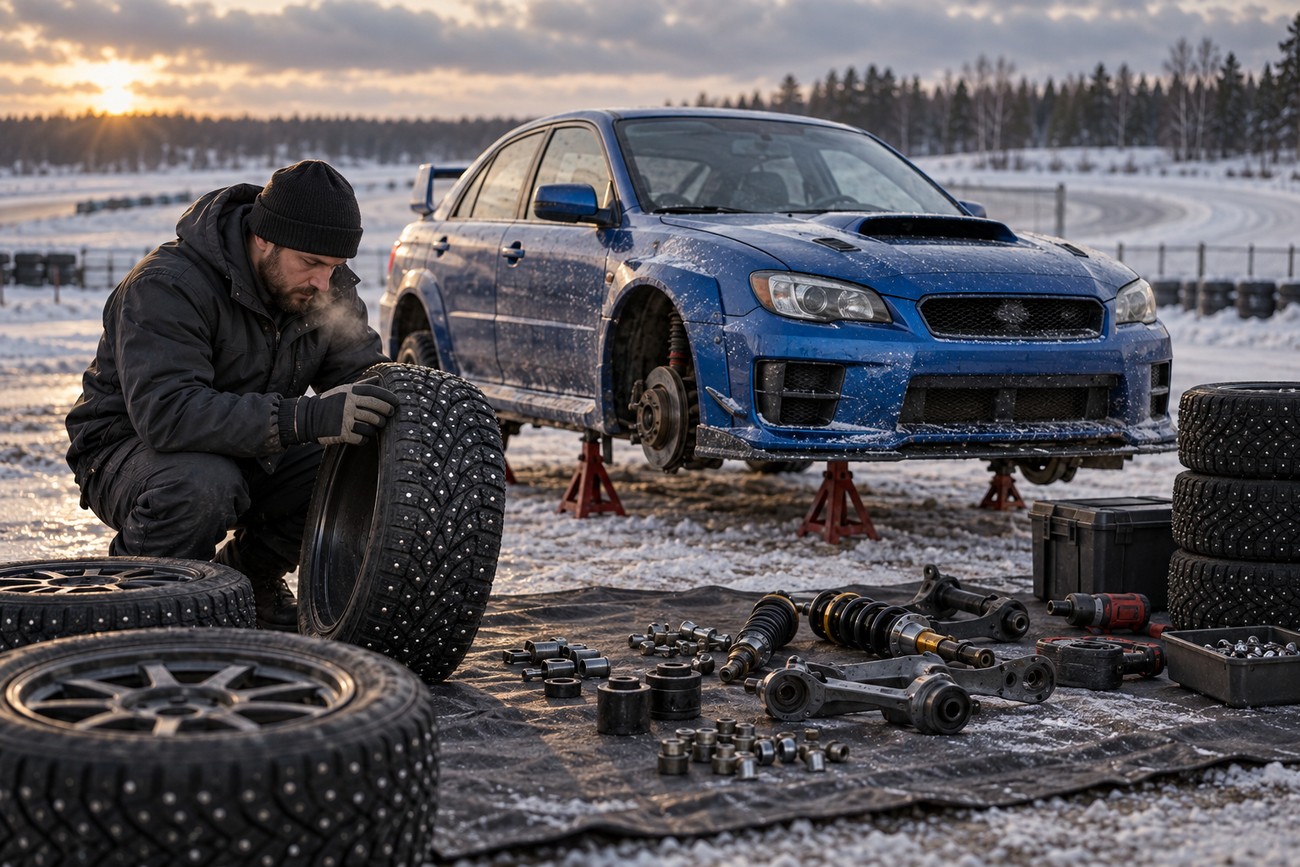
Ice racing is rarely inexpensive once the car is prepared properly. Studs and tire rubber can wear or pull out much faster than newcomers expect, particularly when the surface is abrasive, uneven, or partly snow-covered. Tires and studs can become the main recurring expense.
The budget also includes transport, event logistics, replacement consumables, and suspension repairs. A WRX that hits ruts repeatedly may need attention to wheels, bushings, joints, or alignment even when the engine and transmission appear healthy. Those costs are easy to miss if the preparation budget includes only the first set of tires.
Normal wear should be separated from damage that ends the day. Gradual stud loss or tread wear is a replacement concern, while a cracked wheel, loose suspension component, fluid leak, or changed brake feel is a safety concern. Continuing to run can turn a repairable problem into drivetrain or body damage.
Plan for an inspection after every event, including checks of the wheels, suspension play, fasteners, and leaks. Cold and impact loads can produce delayed damage that appears after the car has been washed or returned to the road. A simple record of tire condition and alignment changes also helps distinguish setup issues from developing mechanical faults.
Frequently Asked Questions
Which Subaru is best for driving in snow and ice?
There is no single universally best Subaru for every snow-and-ice use case. For ice racing, prioritize compliant studded-tire availability, a drivetrain suited to the class, reliable cooling and braking systems, and a body and suspension that can tolerate the event. For road use, ground clearance, winter-tire availability, weight, reliability, and ease of ownership may matter more than peak performance.
Choose around the intended use rather than the badge. A lower, heavier performance model may work well on a prepared track but be less practical on rough winter roads. A higher-clearance Subaru may be easier to live with while giving up some response and class eligibility. Local rules should be checked before assuming a particular model is suitable for competition.
What year should you avoid when buying a used Subaru WRX STI?
There is no responsible blanket blacklist of model years based on the information available here. Screen the individual car for maintenance records, drivetrain condition, corrosion, previous impact damage, and modifications. A heavily modified example with poor documentation can be a worse purchase than a less fashionable car with careful maintenance and a clean inspection.
Pay particular attention to signs of hard use: inconsistent fluid levels, unexplained drivetrain noise, worn suspension components, cooling problems, and changes that do not match the intended class rules. Have the car inspected before purchase, including the engine bay, transmission, differentials, clutch operation, wheels, and underbody. The intended use should determine whether the car’s modifications are an advantage or a liability.
How do you know when a studded ice-racing tire is finished?
Replace a studded ice-racing tire when it has substantial missing or pulled studs, irregular wear, casing damage, or sidewall problems. A tire can look acceptable from a distance while damaged shoulders, exposed casing, or uneven contact make it unpredictable on ice.
Rule compliance is also a replacement criterion. A tire with aggressive or altered studs may no longer meet the organizer’s limits even if its tread remains usable. Check the full set for consistent condition, and remove any tire with structural damage rather than trying to balance its behavior with pressure changes.







