
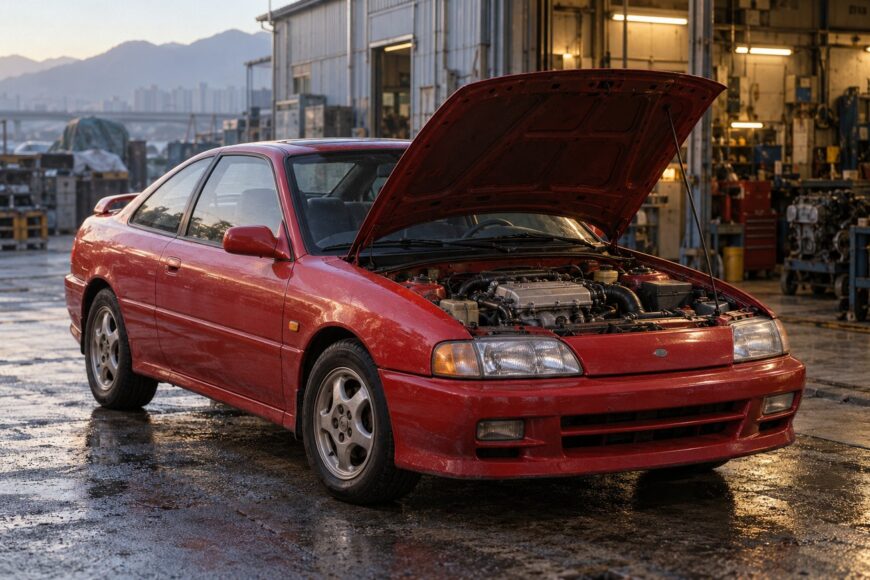
The Hyundai Scoupe Turbo is historically important for a reason that its modest output can obscure: it showcased Hyundai’s first in-house engine, yet produced only about 115–116 hp. That combination makes the car more significant as an engineering milestone than as a traditional high-performance coupe.
The relevant car belongs to the facelift era that began after the end of 1992. Its Alpha G4EK-TC engine marked Hyundai’s move away from earlier Mitsubishi-era powertrain dependence, while surviving cars now present a very different challenge. You are buying a roughly 30-year-old turbocharged coupe whose condition, parts supply, and engine identity matter more than the original brochure figures.
- Why the Scoupe Turbo Mattered to Hyundai
- The Alpha G4EK-TC: What Hyundai Actually Built
- Scoupe Generations and Engine Context
- Performance: Quick Enough, but Not a Fire-Breathing Coupe
- The Real Weak Points of a Thirty-Year-Old Scoupe Turbo
- Buying One: Avoiding the Mitsubishi–Alpha Parts Trap
- Myths, Numbers, and the Scoupe Turbo’s Lasting Significance
- Frequently asked questions
- Why do some sources list the Scoupe Turbo at 114 bhp, while others say 115 or 116 hp?
- Does the 6.9 L/100 km figure represent what an owner should expect today?
- Was every 1992–1996 Scoupe equipped with the G4EK-TC turbo engine?
- Why is the five-speed manual important when evaluating a Scoupe Turbo?
Why the Scoupe Turbo Mattered to Hyundai
Hyundai identifies Alpha as the first engine developed in-house by Hyundai Motor Company. That statement gives the Scoupe a place in the company’s technical history beyond its compact coupe styling or period performance. The facelift-era car made the new engine visible to customers in a production vehicle rather than leaving the achievement as an internal engineering exercise.
Earlier Scoupe versions are associated in some accounts with Mitsubishi-era engines. The Alpha-powered facelift car therefore represents a transition in Hyundai’s industrial development: the company was gradually taking responsibility for the design and calibration of its own powertrains. That distinction is essential because references often use “Scoupe Turbo” as though every year and market shared the same engine story.
Hagerty describes the new 1,495 cm³ engine as appearing after the late-1992 facelift and identifies the Scoupe MVTi as the first Korean production turbo motor. The wording varies across historical sources, and some accounts treat the production debut of Alpha in the Scoupe as the decisive milestone. Hyundai’s official position remains the clearest technical reference: Alpha was its first in-house engine.
The car’s historical value consequently exceeds its speed. It was an early Korean technology showcase, built during the period when Hyundai was moving from licensed or externally influenced engineering toward independent development. That makes an original, correctly identified example interesting even when its performance seems ordinary beside later turbocharged cars.
The Alpha G4EK-TC: What Hyundai Actually Built
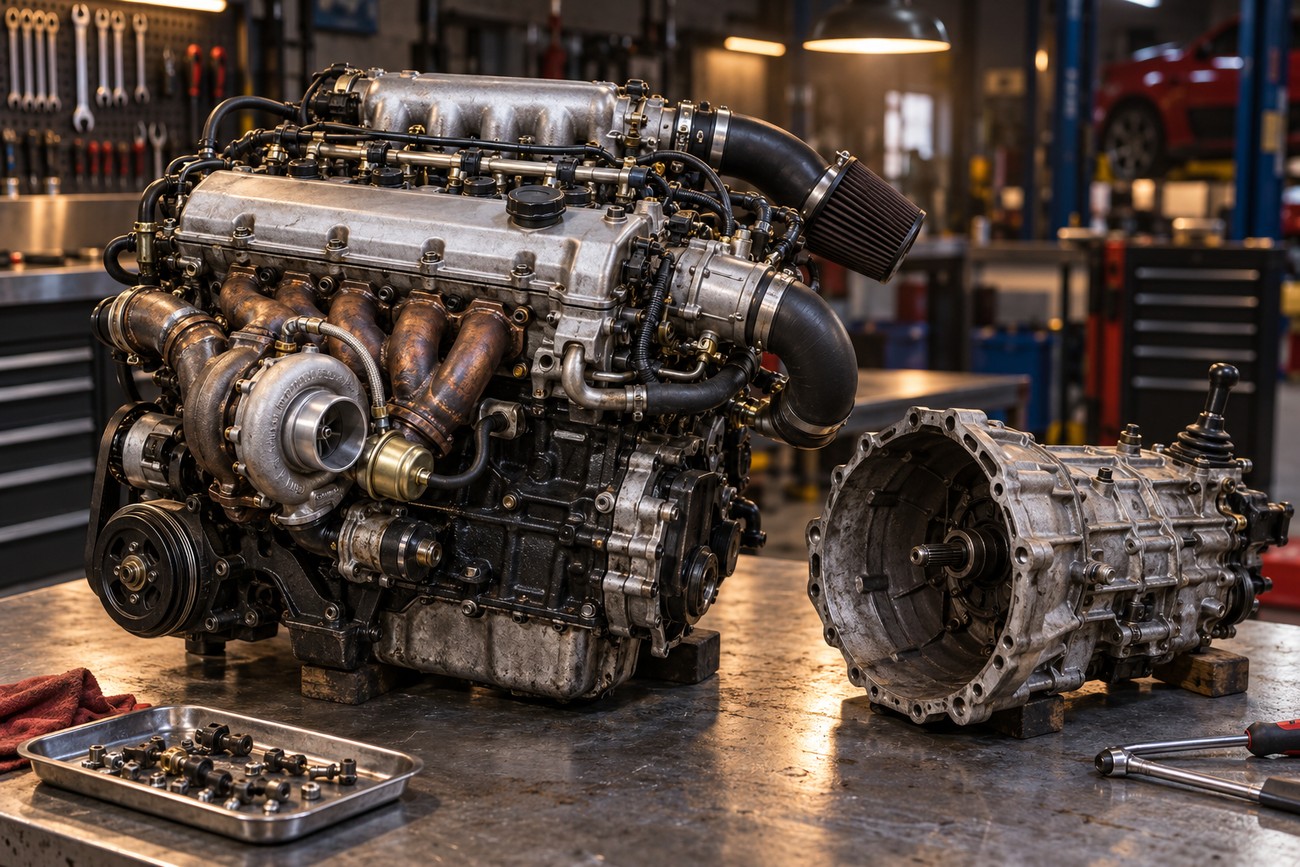
The Alpha G4EK-TC is a 1.5-liter turbocharged inline-four with three valves per cylinder and a 7.5:1 compression ratio. Factory-listed output is 116 hp at 5,500 rpm, with 170 N·m at 4,300 rpm. The turbo version was paired with a five-speed manual transmission, an important detail when identifying cars and researching replacement parts.
Published specifications also give 115 hp or 114 bhp, while torque appears as either 167 N·m or 170 N·m. Those variations can reflect market conventions, rounding, and different power measurement standards rather than several unrelated engines. A buyer should record the market, model year, engine code, and source before treating a specification sheet as definitive.
The low compression ratio suited the turbocharged application, while the three-valve layout shows how transitional the design was. Alpha was a major step for Hyundai’s engineering independence, yet the G4EK-TC was not an exotic racing motor or an unusually powerful sports-car engine. Its significance lies in what it represented for the manufacturer.
A catalog mixed-cycle fuel-economy figure of 6.9 L/100 km is sometimes quoted alongside the engine data. That number describes a test result under a particular standard and vehicle condition. It says little about a neglected turbo system, worn injectors, leaking vacuum plumbing, or an engine that has spent decades in short-trip use.
Scoupe Generations and Engine Context
The pre-facelift and facelift cars should be treated as separate powertrain stories. The Alpha transition is associated with the facelift introduced after the end of 1992, while market and trim differences affect the published specifications.
| Scoupe context | Engine-development story | Turbo and transmission context | Why identification matters |
|---|---|---|---|
| First-generation or pre-facelift applications | Associated in some accounts with Mitsubishi-era engines and the earlier Hyundai powertrain relationship | Do not assume the Alpha turbo specification applies | Parts, engine data, and performance claims may refer to a different application |
| Facelift-era cars, introduced after the end of 1992 and sold during the updated 1992–1996 period | Associated with the Alpha engine, Hyundai’s first engine developed in-house | Scoupe Turbo context: Alpha G4EK-TC and five-speed manual transmission | Market, model year, and trim still need verification before ordering parts |
Performance: Quick Enough, but Not a Fire-Breathing Coupe
Hyundai Group claimed that the naturally aspirated Alpha Scoupe reached 0–100 km/h in 10.4 seconds and was 0.6 seconds quicker than a cited Japanese competitor. That was a useful marketing comparison, especially for a company establishing credibility in engine development. It did not turn the Scoupe into a hard-edged sports car.
For the turbo version, Hagerty gives a period reference of 0–60 mph in 9.2 seconds and a 121 mph top speed. These figures place the car in the “moderately quick” category for its era. The five-speed manual helps the driver keep the engine in its useful range, but the car’s character depends heavily on how quickly the turbocharger builds boost.
Owners and enthusiasts commonly describe weak response below boost, followed by a more useful surge once the engine is revving. That delivery can feel engaging in a light coupe, though it also makes the car seem slower in ordinary traffic than the specification suggests. Modern turbo engines typically provide broader low-speed torque, so the Scoupe’s period calibration can feel distinctly narrow.
A surviving example may be much slower than the published test car. A tired turbocharger, leaking intake or vacuum hose, poor ignition, fuel-delivery fault, or unstable boost control can reduce the engine’s useful mid-range. Road impressions therefore need to be read alongside mechanical inspection rather than treated as a direct measure of the original design.
The Real Weak Points of a Thirty-Year-Old Scoupe Turbo
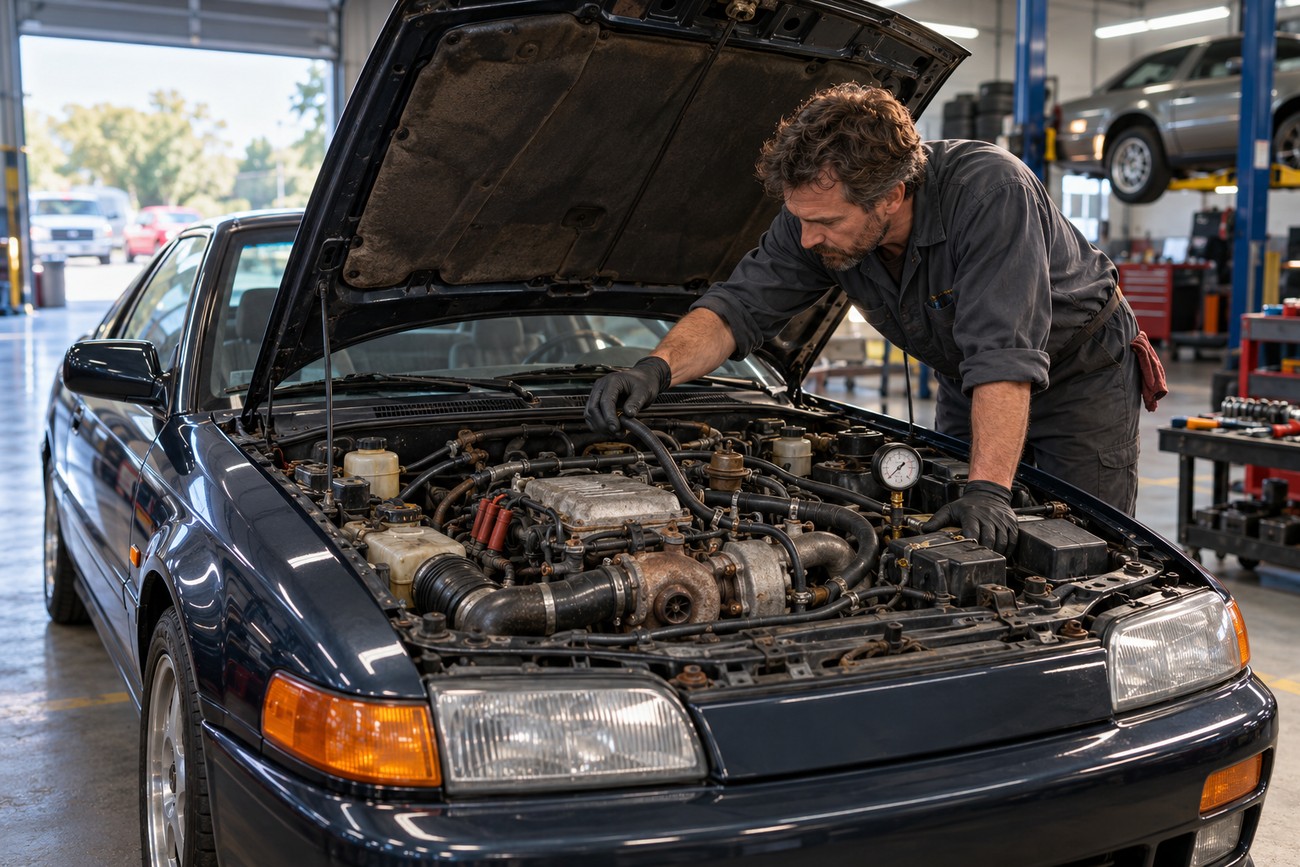
The primary ownership risk is age-related deterioration across the turbo, vacuum, fuel, ignition, sealing, and boost-control systems. A sound design can still behave badly when its rubber hoses have hardened, its seals leak, and its fuel or ignition components have been replaced with uncertain parts. The original power rating is a poor predictor of how a particular car drives today.
Common complaints include tired turbochargers, leaking vacuum hoses, unstable boost, and fuel-system problems. Noise and vibration are also part of the ownership reality, along with limited everyday refinement by modern standards. A car that feels harsh or unusually loud may need diagnosis rather than romanticizing as “character.”
Technicians usually check the complete boost-control chain before condemning the turbocharger itself: vacuum routing, actuator movement, hose condition, intake leaks, and fueling can all produce weak or unstable boost.
Parts supply adds another layer of difficulty. Original assemblies and model-specific components can be hard to source because the Scoupe Turbo was a niche, relatively low-volume application. An apparently cheap car may become expensive when several small, age-damaged systems need to be rebuilt at once.
Compression, turbo condition, vacuum plumbing, fuel delivery, and ignition should be checked before purchase. Evidence of improvised repairs deserves close attention, especially around boost hoses, wiring, and engine-management components. The most desirable example is usually the one with a coherent maintenance history and unaltered systems, even if its cosmetic condition is less than perfect.
Buying One: Avoiding the Mitsubishi–Alpha Parts Trap
Begin with the identity of the car rather than the seller’s description. Confirm the model year, market, engine code, trim, and transmission, then compare those details with the parts catalog being used. Early Mitsubishi-era applications and later Alpha-era cars are frequently discussed together online, which makes an apparently matching component a potential mistake.
The turbo version’s five-speed manual transmission is useful for identification and for understanding its driving character. Automatic-market cars may share some broad mechanical features while differing in calibration, gearing, or service parts. Treating every transmission and engine combination as interchangeable can create problems during both restoration and diagnosis.
A sensible inspection sequence starts with compression and cold-start behavior, then moves through oil leaks, turbocharger condition, boost delivery, vacuum hoses, fuel supply, ignition, cooling, and signs of overheating. The inspection should include a road test long enough to reveal whether boost arrives consistently. No single acceleration run can compensate for missing maintenance records.
- Verify the engine code and production period.
- Inspect compression, oil leaks, and evidence of previous internal repairs.
- Check turbocharger noise, shaft condition where accessible, and boost behavior.
- Trace every vacuum and intake hose for cracks, incorrect routing, or improvised joins.
- Test fuel delivery, ignition components, cooling, and charging systems.
- Confirm that replacement parts match the Alpha-era or earlier application.
Do not use the catalog output as a promise of present-day performance. A healthy 116-hp car and a neglected example with unstable boost can feel like different vehicles. The cost of making the second car reliable may exceed the apparent saving at purchase.
Myths, Numbers, and the Scoupe Turbo’s Lasting Significance
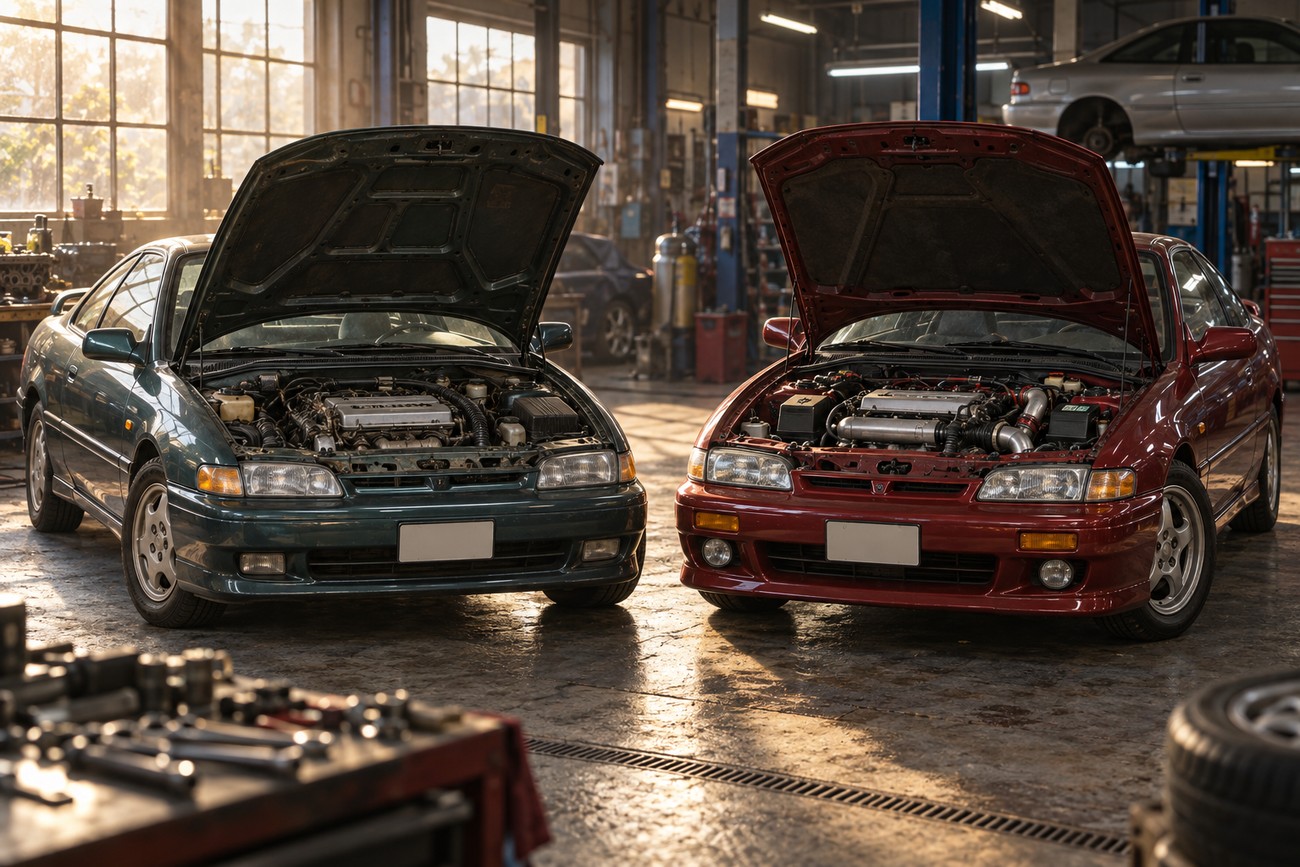
The early Scoupe was not fully Hyundai-developed from the beginning. The Alpha-era car belongs to a later stage of the model’s history, associated with the facelift introduced after the end of 1992. Confusing the first-generation car with the updated Alpha version produces incorrect assumptions about engines, power, and parts.
“Turbo” also does not mean high output or effortless tuning. The production engine delivered approximately 114–116 hp, modest by modern standards, and its age makes diagnosis more important than modification. Increasing boost on a car with unknown fueling, ignition, hoses, or turbo condition can magnify existing faults.
The 114 bhp, 115 hp, and 116 hp figures are not automatically evidence of different engines. BHP and hp terminology, rounding, market catalogs, and measurement standards can produce small reporting differences. Torque references of 167–170 N·m follow the same pattern.
Collectors tend to value the Scoupe Turbo as an early Korean engineering transition and a niche technology experiment. Its importance comes from placing Hyundai’s first in-house engine in a production coupe at a visible moment of industrial change. As a fast sports coupe, it is modest; as a surviving record of Hyundai’s move toward independent powertrain development, it is considerably more compelling.
Frequently asked questions
The Scoupe’s specifications are easy to misread because the model spans different powertrain eras and markets. These answers separate reporting conventions from mechanical differences.
Why do some sources list the Scoupe Turbo at 114 bhp, while others say 115 or 116 hp?
Those figures can describe the same turbo application. BHP and hp are closely related reporting terms, while catalogs may round the measured result differently or use market-specific conventions. The commonly cited range is 114 bhp, 115 hp, or 116 hp, so the difference alone does not prove that a car has a different engine.
Does the 6.9 L/100 km figure represent what an owner should expect today?
No. The 6.9 L/100 km figure is a catalog mixed-cycle value recorded under a defined test procedure. An aged turbo car with unknown maintenance, leaking vacuum hoses, poor fueling, ignition faults, or unstable boost may consume substantially more, and driving conditions also change the result.
Was every 1992–1996 Scoupe equipped with the G4EK-TC turbo engine?
No. The facelift period alone does not prove that a car has the G4EK-TC. Trim, market, engine choice, and transmission varied, so the engine code and vehicle documentation should be checked directly. A seller’s use of “Turbo” or “Alpha” is insufficient evidence without supporting identification.
Why is the five-speed manual important when evaluating a Scoupe Turbo?
The five-speed manual is the key transmission context for the turbo version and helps confirm which specification you are researching. It also shapes the car’s response by allowing the driver to keep the engine near its useful boost range. Automatic-market cars should be investigated separately because their gearing, parts references, and driving character may differ.







