
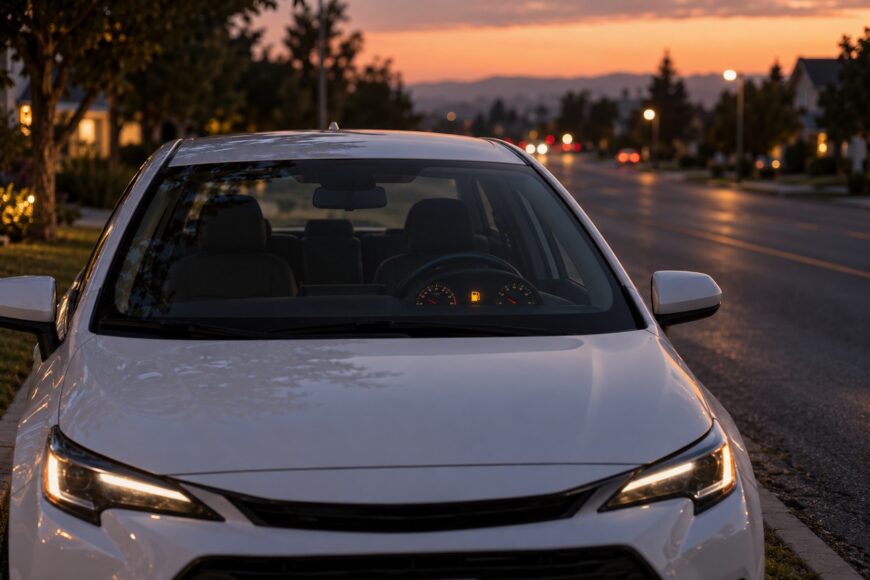
A Toyota Corolla’s fuel light or zero-mile display does not give you a guaranteed remaining distance. The usable range depends on the generation, engine, fuel-tank specification, recent fuel consumption, traffic, temperature, vehicle load, and driving speed. A calm highway drive and a winter commute can leave very different distances available from the same physical amount of fuel.
The number shown as distance to empty is a calculated estimate, while a safe reserve is a decision you control. Once the warning appears, treat it as a prompt to refuel at the first suitable station. Waiting for the display to reach zero turns an estimate into an uncertain roadside risk.
- How Far Can a Toyota Corolla Go on Empty?
- Why Corolla Empty-Tank Range Varies So Much
- What the Fuel Light and Distance-to-Empty Display Really Mean
- What Happens When the Display Reaches 0 Miles to Empty?
- How to Estimate Your Corolla’s Remaining Range More Honestly
- What to Do When the Corolla Fuel Light Comes On
- Frequently asked questions
- Why can a Toyota Corolla’s miles-to-empty number drop faster than the odometer?
- Why does my Corolla’s range estimate look strange immediately after refueling?
- What should I do if my Toyota Corolla runs out of fuel before reaching a station?
How Far Can a Toyota Corolla Go on Empty?
There is no single “empty-tank distance” for every Toyota Corolla. Owner reports for some versions commonly mention about 30–40 km of displayed range when the low-fuel warning appears. That figure describes what the car may calculate under particular conditions, rather than a fixed reserve that applies to every Corolla.
Some owners also report driving approximately 20–90 km after the distance-to-empty display reaches zero. This wide spread is the important detail: it shows how variable the estimate and the remaining usable fuel can be. It does not create a dependable 20–90 km allowance for your car.
A zero display means the vehicle’s calculated range has been exhausted. Fuel may still be present in the tank, yet the car can run out immediately afterward because the calculation cannot establish how much distance remains under changing conditions. Hills, congestion, idling, cold weather, and faster driving can consume the remaining fuel quickly.
The practical answer is to plan for a fuel stop when the warning appears, rather than testing the maximum distance. If the nearest station is close, drive smoothly and avoid unnecessary detours. If the route is uncertain, choose the safer station even if it means leaving the main road briefly.
Why Corolla Empty-Tank Range Varies So Much
Search results often show a Corolla full-tank range of approximately 625–1,483 km. That is a broad catalog range covering different generations, markets, engines, tank specifications, and rated consumption figures. It should never be read as the expected range of one particular Corolla after its fuel light comes on.
Open catalog figures for Corolla fuel consumption range from approximately 2.9 to 14.9 L/100 km across the versions and markets represented. Such a span can include highly efficient configurations, larger or more powerful engines, different test cycles, and vehicles with substantially different operating requirements. The figure for your exact engine and market matters far more than the broad model name.
Transmission type, hybrid configuration where applicable, vehicle weight, wheel and tire choice, and the condition of the car also influence consumption. A compact hybrid driven gently in mild weather follows a different fuel-use pattern from a conventional gasoline Corolla carrying passengers through winter traffic. Even two cars from the same generation can produce different results.
Catalog range begins with a full tank and rated fuel consumption. It does not describe the safe distance available from the moment the low-fuel warning appears. Real driving can also diverge from the test result because traffic, speed, heating or air conditioning, road gradient, and short journeys change the amount of fuel used.
What the Fuel Light and Distance-to-Empty Display Really Mean
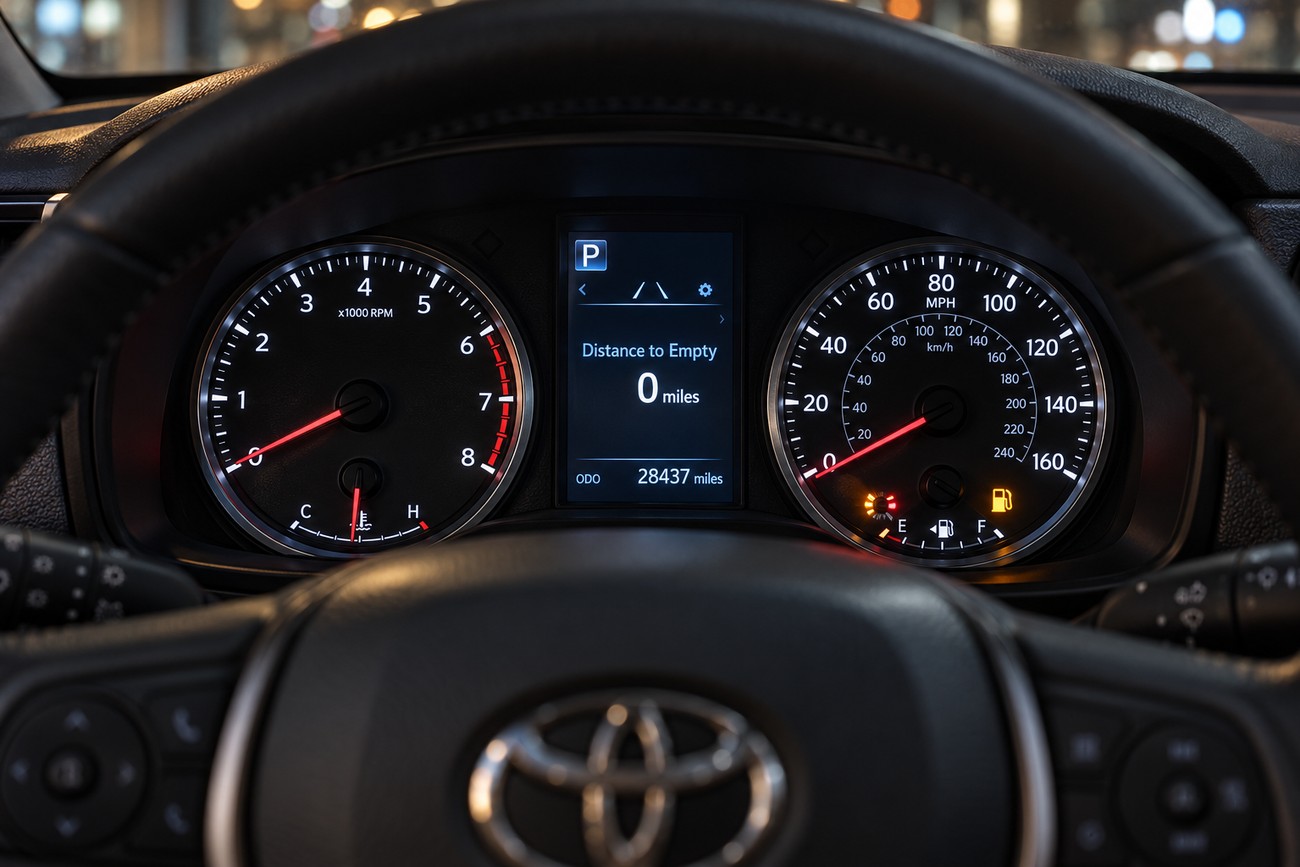
The fuel gauge, warning light, and distance-to-empty display provide related information, but they do not measure the tank with laboratory precision. The gauge is not a precise linear measurement of the fuel remaining. Its segments can stay unchanged for a time and then fall more quickly as the fuel level drops.
Owner reports for some Corolla 150 vehicles commonly mention about 8 L remaining when the last fuel-gauge segment begins blinking. This is an approximate observation, not a Toyota specification for every Corolla 150. Tank design, sensor calibration, model year, and market can change the point at which the warning appears.
In the same owner reports, the distance-to-empty display often shows about 30–40 km around the reserve warning. The system calculates that estimate from recent fuel consumption, so it can react to the driving you have just done. A recent highway average may produce a more optimistic number than a short period of stop-and-go traffic, even when the physical fuel level has changed only slightly.
The first fuel warning is best treated as the refueling point. Trying to reconcile the needle, blinking segment, and distance-to-empty figure into an exact fuel volume usually creates false confidence, because each indication has a different limitation.
The displayed range can therefore change nonlinearly. After several kilometers of congestion or climbing, the estimate may fall by more than the distance driven. After a long, steady downhill or highway section, it may appear to stabilize or decline more slowly. These movements reflect changing consumption assumptions, not fuel being removed according to the number on the screen.
What Happens When the Display Reaches 0 Miles to Empty?
When the display reaches 0 miles to empty, the car has used up its calculated usable range. That does not prove that every drop of fuel has physically disappeared from the tank. It does mean that the vehicle can no longer give you a meaningful guaranteed distance, and the engine may stop at any point.
Some owner reports describe another 20–90 km after the display reaches zero. The range is anecdotal, highly variable, and dependent on the particular vehicle and conditions. It is not a specification, and it should not be treated as a safety margin for planning a journey.
Running until the engine stops creates a real risk of being stranded in traffic, on a shoulder, or in an area without immediate assistance. It can also place unnecessary stress on the fuel-delivery system. The fuel pump relies on the surrounding fuel for cooling and operates in a system that is not intended to serve as a repeated test of the tank’s absolute limit.
The sensible response to a zero-mile reading is to refuel at the first safe opportunity. If the car is still moving, reduce unnecessary load on the engine by avoiding hard acceleration and high speed. These measures may help you reach a nearby station, but they cannot turn the remaining distance into a reliable promise.
How to Estimate Your Corolla’s Remaining Range More Honestly
Your own recent fuel consumption is the most useful starting point for a rough estimate. Owner reports include approximately 4.7–5.5 L/100 km in favorable highway driving, while reported city and winter figures reach approximately 9–13+ L/100 km. Those conditions can produce dramatically different results from the same amount of fuel.
To make a conservative estimate, use the higher consumption figure that matches the journey ahead. If the warning appears before a winter city trip, a highway average is a poor basis for planning. If you have just left a congested area for an open road, the range may improve, yet it is still safer to calculate using recent mixed or urban driving until the estimate has settled.
A simple calculation is to divide the approximate fuel remaining by your recent consumption and multiply by 100. For example, a vehicle with about 8 L remaining and consumption of 10 L/100 km would produce a theoretical result of roughly 80 km. That result remains an estimate, because the 8 L figure may not apply to your version and the fuel consumption may change before the station.
The calculation becomes less useful as the tank approaches empty. Fuel pickup, road angle, and the behavior of the gauge can make the last part of the tank harder to interpret, especially on slopes or during sharp changes in direction. Use the estimate to choose a station, then keep a meaningful buffer for traffic, weather, and detours.
What to Do When the Corolla Fuel Light Comes On
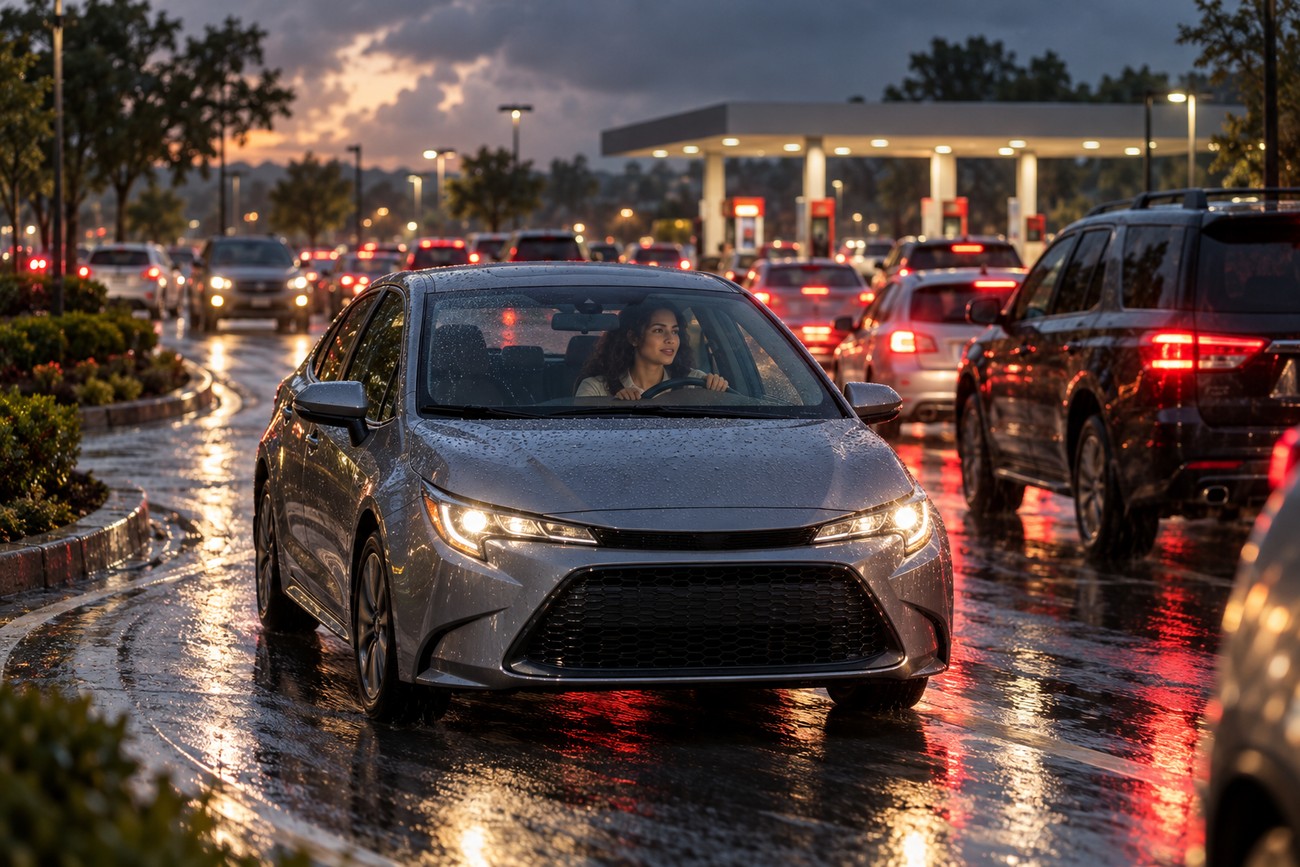
The fuel warning is an alert that the remaining fuel is low, not proof that the tank is empty. Locate the nearest suitable fuel station and account for the route rather than relying on a station’s straight-line distance. A station a few kilometers away can require a longer drive if roads are closed, traffic is heavy, or access is limited.
- Reduce speed smoothly and avoid hard acceleration.
- Allow for traffic, cold weather, hills, vehicle load, and climate-control use.
- Use the distance-to-empty display as an estimate, not a guaranteed route distance.
- Refuel before the display reaches zero whenever possible.
- Keep roadside assistance details available if the warning appears in a remote area.
Do not deliberately drive to zero to learn your Corolla’s true reserve. Do not assume that another Corolla will behave the same way, even if it has the same model badge. Engine, tank, calibration, maintenance condition, and recent driving history can all change the result.
Relying only on the needle is also risky because the gauge is not linear. The warning light and distance-to-empty display can each provide an incomplete picture, and their readings may not appear to agree. Treat the earliest clear warning as the point at which you make a fuel-stop decision, rather than trying to prove which indicator is most accurate.
Frequently asked questions
Why can a Toyota Corolla’s miles-to-empty number drop faster than the odometer?
The estimate reacts to a recent change in fuel consumption. A short period of traffic, idling, hills, or cold operation can make the displayed range fall by more than the distance driven because the system is revising its expected fuel economy for the remaining journey.
This does not mean the display has measured a sudden loss of fuel. It means the calculation has become less optimistic. A steady highway section may produce the opposite effect, although the revised number still remains an estimate rather than a guaranteed distance.
Why does my Corolla’s range estimate look strange immediately after refueling?
The fuel and consumption calculations may not normalize immediately after a refill. The first post-refueling reading can reflect the previous driving conditions, the amount added, and the system’s process for updating the fuel-level and consumption information.
For that reason, the initial range figure should not be treated as a settled baseline. Allow the car to update its readings during normal driving, then compare the result with your actual fuel use over a longer period.
What should I do if my Toyota Corolla runs out of fuel before reaching a station?
Move the vehicle to a safe location if possible, switch on the hazard warnings, and contact roadside assistance or the relevant local service. Stay clear of moving traffic and follow local safety guidance, particularly on a highway shoulder.
Do not keep repeatedly cranking the engine while waiting for fuel. Repeated attempts will not create a dependable reserve and can place additional strain on the vehicle’s systems. Once fuel is added, allow the car to restart normally and seek assistance if it does not run as expected.







