
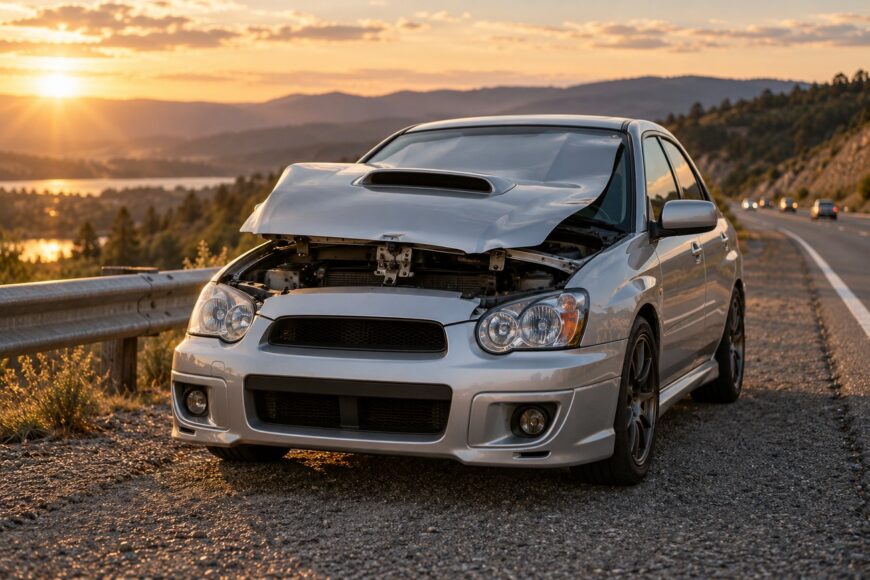
A hood that rises at highway speed can block the windshield before you understand what has happened. The immediate danger is the sudden loss of forward visibility, which can leave you with little time to maintain your lane, reduce speed, and reach a safe stopping place.
The hood may look closed, and the secondary safety hook may appear reassuring. However, the Subaru Impreza relies on a primary latch plus a secondary safety hook. If the primary latch has not fully engaged, airflow can lift the panel abruptly, even when the hood initially seems secure.
This event should be treated as a mechanical safety fault rather than an unavoidable aerodynamic characteristic of the Impreza. A repeat incident requires inspection of the latch, striker, hinges, release cable, front-panel geometry, and any damage caused when the hood lifted.
- Why a Subaru Impreza Hood Can Fly Up at Highway Speed
- What to Do If the Hood Opens While You Are Driving
- How to Close and Check the Impreza Hood Correctly
- Why the Hood Keeps Popping Up After a Repair
- What to Inspect After a Hood-Opening Incident
- Common Mistakes, Myths, and Prevention
- Frequently Asked Questions
- What should I check before opening the hood after the car has stopped?
- How do I lift the hood on a Subaru Impreza without damaging the latch?
- How can I get a Subaru Impreza hood latch unstuck?
Why a Subaru Impreza Hood Can Fly Up at Highway Speed
The hood is held down by a primary latch and a secondary safety hook. The primary latch is the component expected to carry the normal retention load. The secondary hook is a backup restraint intended to limit movement if the first release is operated accidentally or the primary latch does not hold as intended.
If the primary latch is only partly engaged, the hood can look closed while remaining vulnerable to airflow. Aerodynamic load increases approximately with the square of vehicle speed, so the force acting on a marginally secured panel rises sharply as the car accelerates from local-road speeds to highway speeds. A small alignment or closure error can therefore remain unnoticed in town and become dangerous on the highway.
Once the leading edge begins to lift, the airflow can enter the gap and raise the panel farther. The secondary hook may slow or limit that movement, but it is a backup restraint only; it does not guarantee that an incompletely latched hood will stay safely down at highway speed.
Impreza hoods may be aluminum or steel, depending on the generation and trim. That material affects the panel’s mass, movement, and possible damage to the windshield, hinges, or roof area. It does not establish the cause of the opening. The likely cause must be determined from the latch, striker, alignment, and surrounding components.
What to Do If the Hood Opens While You Are Driving

If the hood starts vibrating or its leading edge begins to shake, treat that movement as a critical warning. Do not continue at highway speed to reach a preferred destination, and do not try to pull the interior release, reach through the steering area, or hold the hood down while the vehicle is moving.
Keep both hands available for steering, avoid sudden steering inputs, and reduce speed smoothly. Use whatever forward visibility remains through the lower part of the windshield or around the panel while maintaining lane awareness. Signal early and move toward a safe stopping place, such as a wide shoulder or another area clear of moving traffic.
After the hood has fully lifted, visibility may disappear almost instantly. The main immediate danger is loss of the road view through the windshield rather than the hood simply striking the roof. Brake progressively, avoid abrupt lane changes, and use hazard warning lights once the vehicle is under control and safely stopped.
Do not reopen the hood beside fast-moving traffic unless there is no safer option. If the panel is bent, under tension, or cannot be released normally, arrange roadside assistance. A secondary hook that held the hood partly down does not prove that the primary latch is serviceable, so the vehicle should not return to highway use without an inspection.
How to Close and Check the Impreza Hood Correctly
Close the hood only while the vehicle is stationary and the latch area is free of obvious debris, ice, or a displaced component. Keep tools, hands, and loose objects clear of the latch. If the panel or front structure looks bent after an incident, avoid forcing it into position because pressure can worsen an alignment problem.
Normal closing practice is to lower the hood from a small height rather than pressing it down gradually or slamming it repeatedly. Allow the panel to settle into the latch, then confirm that the primary latch has captured the striker. The exact service guidance for a particular Impreza generation should take priority where it differs.
Operate the release mechanism and manually verify the secondary-hook action. A single click, a flush-looking hood, or resistance at the first stage does not confirm complete primary-latch engagement. After closing, gently check the front edge without applying force that could mask a defective latch.
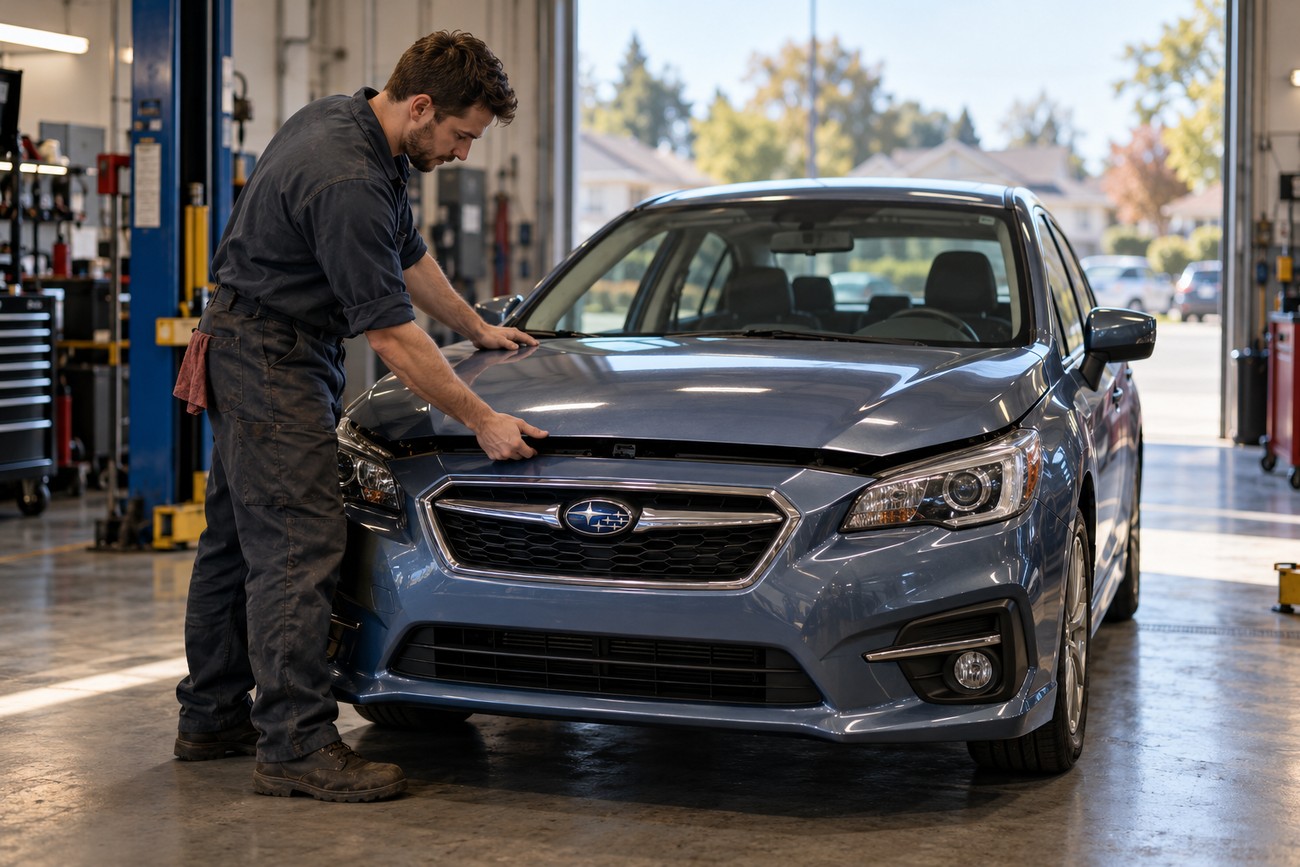
Compare the gaps at the left and right sides. Uneven gaps, a hood that sits high on one corner, a need to slam the panel, or a need to press harder than usual indicate a possible latch, striker, hinge, support, or front-panel problem. The hood should not be approved for fast driving simply because it stayed down during a brief stationary check.
Why the Hood Keeps Popping Up After a Repair
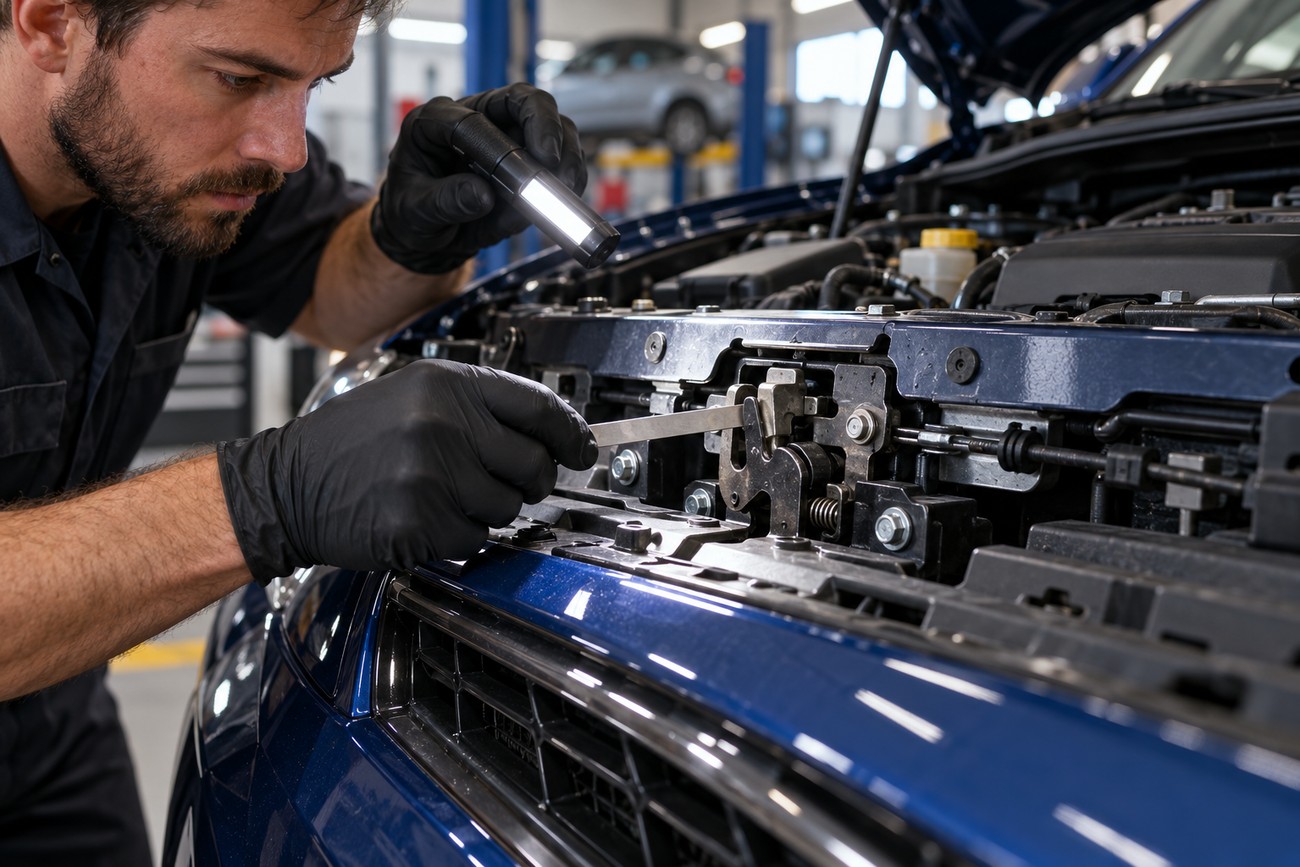
Repeated incomplete closure is more often linked to latch wear, incorrect adjustment, a bent striker, shifted front-panel geometry, hinge problems, or non-factory repair than to poor Impreza aerodynamics. Work around a radiator, grille, bumper, or front crash structure can move the latch relationship by millimeters, which may be enough to prevent reliable engagement.
The release cable also deserves attention. A hood-release lever that feels unusually stiff, unusually light, or inconsistent from one operation to the next can indicate a cable or latch problem. The mechanism may move far enough to appear functional while still failing to return fully to its locked position.
Latch-to-striker alignment and front-panel geometry should be checked together after front-end work; replacing the latch alone can leave the underlying position error unchanged.
Dirt, ice, road salt, and temperature changes may contribute to sticking or restricted latch movement. They should be treated as possible contributors rather than a confirmed root cause without inspection. Cleaning and suitable lubrication may restore movement when contamination is the issue, but they will not correct a bent striker, worn latch, shifted panel, or damaged cable.
What to Inspect After a Hood-Opening Incident
An opening event can damage more than the latch. Inspect the hood skin, hinges, striker, front panel, release cable, seals, windshield, wiper arms, and nearby paint or roof areas. The secondary hook may limit the panel’s travel, but it cannot prevent hood deformation or glass damage once the hood has lifted into the airflow.
Windshield chips or cracks, bent wiper arms, disturbed hinges, fresh paint marks, and uneven panel gaps may appear after the event. Some damage is subtle, especially around the latch mounting area. A hood that closes at a standstill can still have incorrect geometry or insufficient engagement when the vehicle moves.
Any front-end repair should include a proper check of latch-to-striker alignment and the surrounding structure. The inspection should also confirm that the seals are seated and that the cable releases and returns the latch correctly. If the panel, hinges, or front panel are distorted, adjustment alone may not restore safe retention.
A stationary visual check does not reproduce highway aerodynamic loading or prove that the hood will remain stable over uneven pavement. Professional measurement or adjustment is appropriate after an opening incident, especially if the windshield, wipers, hood, hinges, or front structure show any damage.
Common Mistakes, Myths, and Prevention
City driving is not proof of highway safety. A hood may remain apparently secure over short, slow trips while the greater aerodynamic load at highway speed exposes incomplete primary-latch engagement. Vibration or shaking at the leading edge is already a reason to reduce risk and stop; it is not a harmless warning that can be monitored for several more miles.
The secondary hook is not a complete safeguard. It is a backup restraint and is not designed to substitute for complete primary-latch engagement. Its presence can prevent an immediate full opening in some circumstances, but it cannot guarantee that the hood, windshield, or hinges will avoid damage.
Pressing down harder is not a reliable repair for misalignment, wear, or a bent striker. It can make the panel appear flatter while leaving the locking surfaces only partly engaged. Similarly, accepting one click without checking the latch, hook, and side gaps confuses a visible closing sound with verified retention.
After front-end intervention, verify closure while stationary, then have the vehicle inspected before normal highway use. A carefully controlled check over suitable uneven surfaces may reveal movement that a flat driveway does not, but a test drive is never a substitute for correcting the latch or body geometry. If the hood pops up again, stop driving it and arrange a proper repair.
Frequently Asked Questions
The answers below separate safe roadside handling from diagnosis. The secondary hook should always be treated as backup, while complete primary-latch engagement remains the essential condition for secure closure.
What should I check before opening the hood after the car has stopped?
Secure the vehicle well away from moving traffic, select park or neutral as appropriate, apply the parking brake, and use hazard warning lights where conditions require them. Allow hot engine components to cool where necessary. Before pulling the interior release, look for a sharply bent hood, visible tension in the panel, smoke, fluid leaks, or a latch area that appears displaced.
Do not force a jammed release or stand directly in the panel’s path if the hood is under tension. If the vehicle stopped on a dangerous shoulder, or if the hood, windshield, or front structure is damaged, remain in a safe position and request roadside assistance instead of attempting an inspection in traffic.
How do I lift the hood on a Subaru Impreza without damaging the latch?
Use the interior hood-release control first, then move to the front of the vehicle only after it is safely parked and the release has operated. Locate the secondary safety hook through the normal access point and move it as intended to release the hood. Lift the panel by its approved leading edge or handle area, keeping fingers clear of the latch mechanism.
Do not pry against the hood, grille, or front panel with a tool. If the interior release does not produce normal resistance, or the secondary hook will not move, stop rather than applying force. A bent or seized mechanism needs diagnosis, and levering against it can damage the striker, paint, grille, or hood.
How can I get a Subaru Impreza hood latch unstuck?
Cleaning and appropriate lubrication may help when dirt, ice, or road salt is restricting an otherwise undamaged mechanism. The hood should be supported safely, and the latch should be operated carefully through its full range rather than forced. Remove contamination only when access is safe and the parts show no sign of structural distortion.
A bent, worn, or misaligned latch requires adjustment or replacement, not more force. Inspect the striker, hinges, release cable, and front-panel position as well. If the latch has already allowed the hood to lift, or the hood remains uneven after closure, do not rely on lubrication alone or drive at highway speed before the fault is corrected.







