
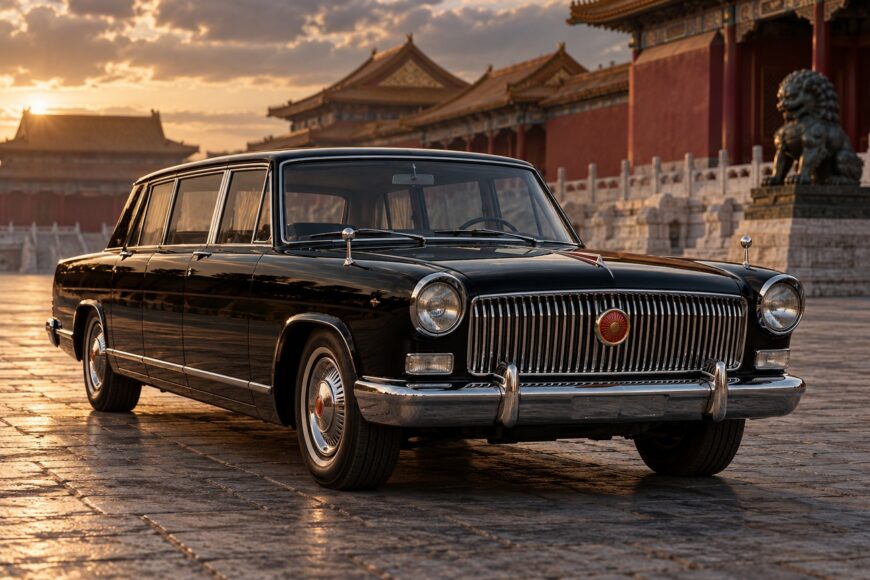
The Hongqi CA770 occupies an unusual place in automotive history. It was China’s symbolic state limousine, built by China’s First Automobile Works (FAW) for senior officials, formal motorcades, and foreign delegations. Its long body, V8 engine, and three-row cabin projected national prestige at a time when very few Chinese citizens could encounter such a car in ordinary life.
The same qualities that make the CA770 historically important also make it a difficult classic. It was produced in small numbers, its engineering reflects substantial influence from American limousines of the 1950s and 1960s, and surviving specifications are not perfectly consistent. Restoration can involve rare mechanical parts, uncertain documentation, deteriorated trim, difficult registration, and specialist knowledge required by a car that was never designed as a mass-market daily vehicle.
- Why the Hongqi CA770 Became China’s Red Flag Limousine
- Hongqi CA770: Key Specifications at a Glance
- Design, V8 Engineering, and the American Connection
- CA770, CA770A, and CA770B: Versions, Protocol Use, and Historical Value
- Owning and Restoring a Hongqi CA770: The Real Risks
- What the CA770 Gets Wrong About Modern Luxury
- Buying, Authenticating, and Valuing a CA770 Today
- Frequently asked questions
- How much does a Hongqi CA770 cost today?
- What car does Xi Jinping drive?
- Why are Hongqi CA770 scale models often inaccurate?
Why the Hongqi CA770 Became China’s Red Flag Limousine
The CA770 was developed by China’s First Automobile Works as a national and state representative car. Its intended users were senior Chinese leaders, government departments, and official protocol services. Foreign delegations encountered the model in ceremonial settings, where its size and formal appearance mattered as much as its mechanical specification.
That restricted role shaped the car’s meaning. In China, the CA770 is remembered less as a private luxury sedan than as a visible object of the political era associated with Mao and the leaders who followed him. Ownership history, government use, and survival in original form can therefore carry more cultural weight than leather trim or engine output.
Total production is commonly estimated at approximately 1,600 examples. This explains why the CA770 was never a widely seen Chinese equivalent of a Cadillac or Mercedes-Benz limousine. Most cars served state institutions, official garages, or museums, while ordinary private buyers had little practical access to them.
Its chronology requires careful wording. The model is commonly cited as having been produced from approximately 1966 to 1999, while specialist catalogues often place the main series in the 1960s–1980s, with later small-batch or protocol cars. Those dates may describe different production phases and definitions of “CA770,” so an exact year range should be checked against the individual car’s documentation rather than repeated as an unquestioned fact.
Hongqi CA770: Key Specifications at a Glance
The figures below describe the commonly reported CA770 specification. Power figures and some layout details vary between historical and museum descriptions, so the table is a useful guide rather than a substitute for inspecting a particular chassis.
| Item | Reported specification | Practical note |
|---|---|---|
| Body | Three-row, four-door sedan | Formal limousine body with seating for approximately 7–8 passengers |
| Length | Approximately 5.98 m | Creates major storage, parking, and turning-radius demands |
| Width | Approximately 1.99 m | Wide for many historic and modern urban garages |
| Height | Approximately 1.62 m | Some protocol versions may differ in stance and equipment |
| Mass | Approximately 2.7 tonnes | Places substantial loads on brakes, suspension, and tires |
| Engine | Approximately 5.6-litre gasoline V8 | Original engine condition and specification should be verified |
| Power | Approximately 160–220 hp | Reported output varies by year or version |
| Torque | Approximately 420 Nm | Useful for moving the heavy body at low speed |
| Drivetrain | Front-engine, four-wheel-drive layout | Supplied technical and museum descriptions identify four-wheel drive |
| Top speed | Approximately 160 km/h | Historical top-speed figure, not a recommendation for modern road use |
Historical specifications are not perfectly consistent across surviving cars. Differences may reflect production changes, protocol conversions, incomplete records, or the use of figures from related versions.
Design, V8 Engineering, and the American Connection
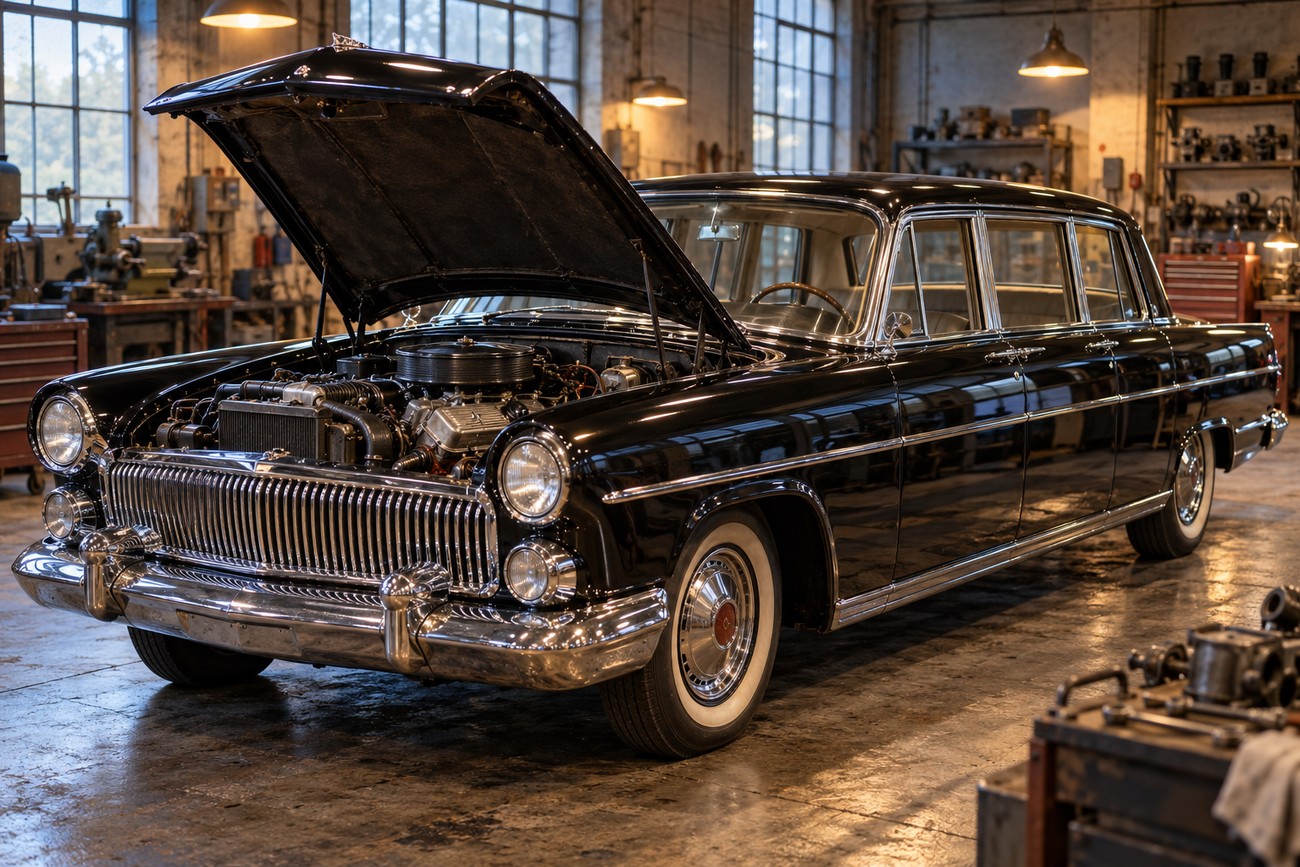
The CA770’s visual language is formal and deliberately imposing. The long hood, upright cabin, broad fenders, and three-row arrangement give it the proportions expected of a state limousine. These dimensions helped the car appear ceremonial in a convoy, although they make the vehicle cumbersome in a contemporary city.
Historical accounts and limited-source descriptions report substantial influence from American limousines of the 1950s and 1960s, including Chrysler-related solutions. This should be treated as a qualified historical interpretation rather than a fully documented claim that every component was copied from one specific American model. The practical point for restorers is that some mechanical ideas and fittings may be easier to understand through period American-car references than through modern Hongqi literature.
The 5.6-litre V8 supplied the expected authority for a heavy parade car, yet the driving experience should not be confused with that of a modern luxury sedan. Noise, heat, steering effort, braking response, seat ergonomics, and suspension behavior belong to an earlier engineering period. The third row also has practical limits: its existence confirms the body layout, but access and usable space can be less generous than the designation suggests.
Low-volume construction adds another complication. Many cars were produced in small batches and effectively built or finished by hand, so surviving examples can differ in trim, fittings, wiring, mechanical details, and interior treatment. A restorer who assumes that one photographed CA770 is a universal reference may reproduce the wrong specification while believing the work is authentic.
CA770, CA770A, and CA770B: Versions, Protocol Use, and Historical Value
The CA770A and CA770B were variants produced in the 1960s–1970s for government and diplomatic duties. They belong to the same broad family, but the labels should not be treated as cosmetic badges alone. Production changes, official conversions, and protocol requirements could affect the car’s equipment and mechanical setup.
Parade and standard protocol versions could differ in ride height, provisions for a platform or ceremonial fittings, and suspension-related modifications. Those details may be difficult to see in a side photograph. Variant identification should therefore use period records, chassis and engine information, mechanical details, and surviving fittings rather than appearance alone.
Historical provenance can materially alter the significance of a car. A CA770 associated with Deng Xiaoping from 1978–1992 is preserved as a museum exhibit, giving the model a concrete connection to state history. That example demonstrates the importance of documented use; it does not mean that every former government car has comparable provenance or collector value.
For buyers, the distinction has a direct financial consequence. Ordering parts based on a photograph of a similar car can produce incorrect suspension, trim, or drivetrain components. A complete but less glamorous car with reliable documentation may be more historically useful than a heavily modified example presented simply as a “presidential” or “official” limousine.
Owning and Restoring a Hongqi CA770: The Real Risks
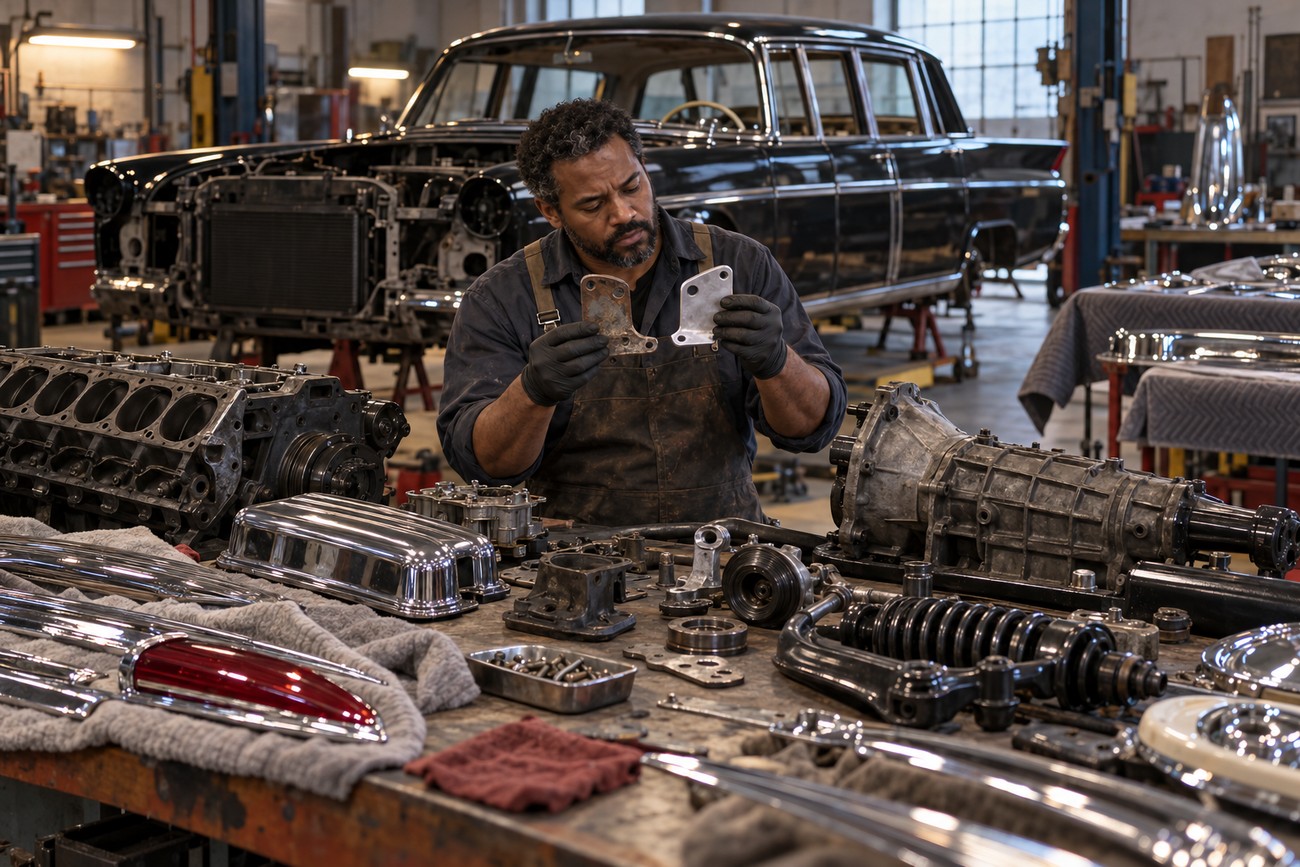
Restoring a CA770 begins with parts research rather than paintwork. Original components for the V8, transmission, and suspension are extremely difficult to source. Restorers may need to order through China, fabricate missing pieces, or investigate compatible period-American components. Complete factory documentation is also not readily available in English or Russian, which makes basic tasks such as identifying fasteners, wiring routes, and version-specific parts unnecessarily difficult.
Body and trim condition deserve the same scrutiny as the engine. Chrome and decorative pieces can suffer severe corrosion, and rebuilding a damaged part may require specialist plating, machining, or reproduction work. A car that looks complete in photographs may have missing brackets, repaired ornaments, incorrect interior fittings, or trim that is too damaged to reuse.
Exact variant identification should come before parts ordering. Restorers often measure worn components and compare period-American alternatives because original-looking CA770 parts are not automatically interchangeable between cars.
Cooling is another practical concern. Owners report overheating risks during slow parade-style driving in hot weather, when the V8 receives little natural airflow and the heavy body is moving at low speed. Old wiring and electrical systems can create intermittent faults that are difficult to diagnose, especially where previous repairs have mixed original and replacement components.
The four-wheel-drive system and transmission also narrow the pool of capable repairers. A general classic-car shop may handle bodywork or upholstery while lacking the experience to rebuild the drivetrain correctly. Fuel consumption is high by modern standards, although the supplied evidence does not establish a single official figure. Climate-controlled storage is important because moisture accelerates corrosion in the body, chrome, wiring, and interior materials.
A former government vehicle is not automatically a reliable vehicle. State cars benefited from controlled garages, planned routes, limited mileage, and dedicated maintenance practices. Those conditions may explain why a particular survivor is in good shape, yet they do not remove the need for a complete mechanical inspection or turn the CA770 into an inexpensive daily driver.
What the CA770 Gets Wrong About Modern Luxury
The CA770 can look like a grand luxury car while offering a very different ownership experience. At approximately 5.98 m long and approximately 2.7 tonnes, it requires more space than many modern full-size cars. Its turning radius, wide body, and low-speed maneuvering demands make narrow streets, underground garages, and tight storage areas persistent problems.
The V8’s size is part of the car’s identity, but it also brings high fuel use by modern standards. The available historical material does not establish one dependable official consumption figure, so precise claims should be treated cautiously. Owners should budget around the car’s mass, age, and engine design rather than expect modern efficiency.
Safety is another clear dividing line. The CA770 lacks the active and passive safety systems expected in a contemporary luxury vehicle. Its historic importance does not provide modern crash protection, and its brakes, tires, lighting, belts, and steering should be assessed with that limitation in mind before any road use.
Comfort is similarly period-specific. The ride and cabin may feel spacious from the outside, yet third-row access can be restricted, seating ergonomics are old-fashioned, and climate control is not equivalent to current systems. The limousine’s prestige came from controlled ceremonial use and visual authority; it was never proof that every passenger would experience modern first-class comfort.
Buying, Authenticating, and Valuing a CA770 Today
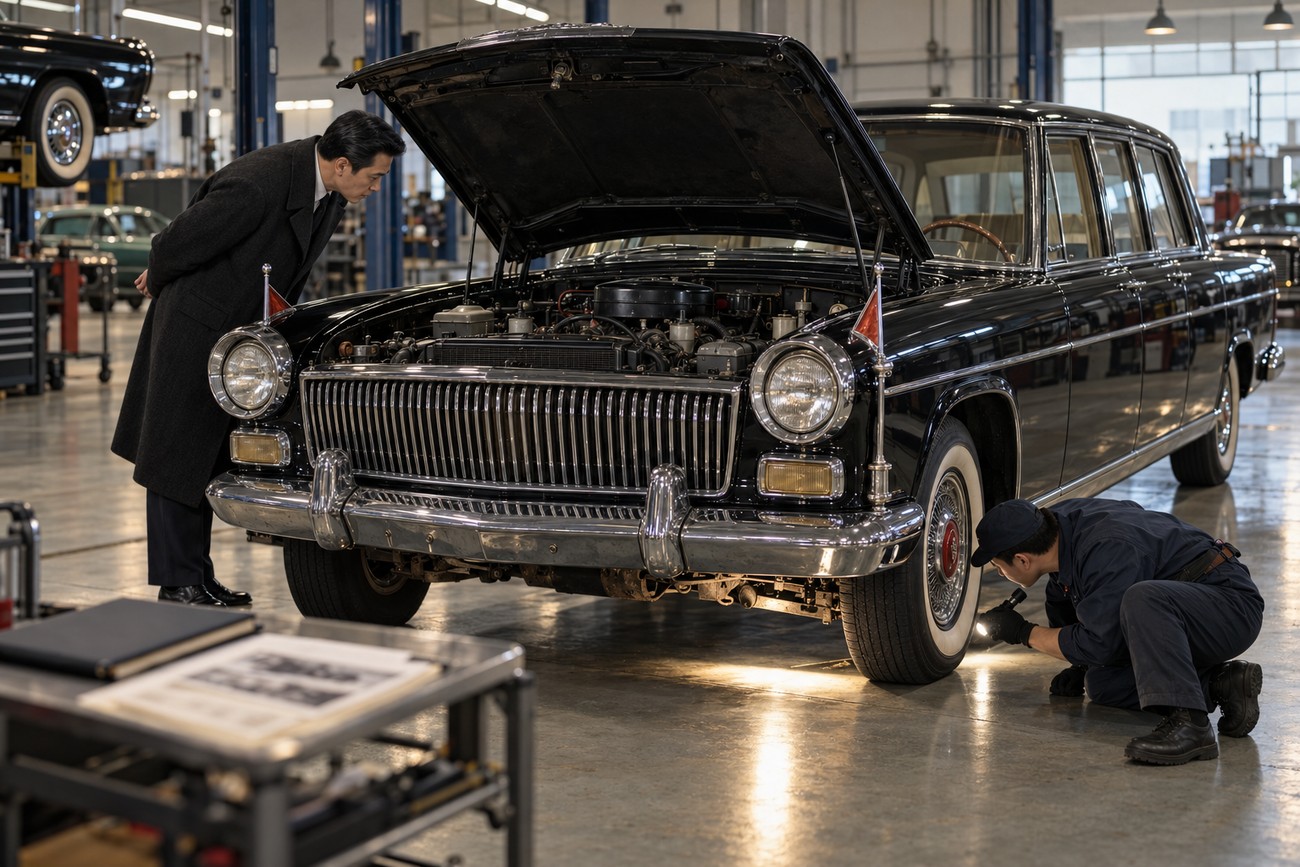
A serious inspection should begin with identity and provenance. Confirm the production year claimed by the seller, the exact variant, chassis and engine identity, restoration history, and any evidence of government or diplomatic use. The approximately 1,600-car production total makes surviving documentation unusually important, especially because cars were built in small batches and may have been altered during later service.
Mechanical inspection should cover corrosion, trim completeness, cooling performance, wiring, the V8, transmission, four-wheel-drive system, suspension, brakes, and signs of overheating. A fresh paint finish can conceal structural repairs, while a polished engine bay can hide incorrect wiring or non-original parts. The inspection should also establish which components are missing before a purchase price is compared with the cost of restoration.
Legal status is a separate issue from mechanical condition. Registration in Europe and the CIS can be complicated by limited regulatory familiarity with the model and by chassis identification that does not follow modern VIN conventions. Requirements differ by country, so buyers should confirm import, inspection, title, and registration procedures before committing to transport or restoration.
No single reliable current market price is established by the supplied evidence. Condition, provenance, completeness, variant, legal status, and the quality of restoration determine the meaningful comparison. A documented, complete survivor may be more valuable to a serious collection than a visually attractive car with uncertain history, mixed parts, and no credible explanation of its previous ownership.
Frequently asked questions
How much does a Hongqi CA770 cost today?
There is no stable public price benchmark for the Hongqi CA770. Approximately 1,600 examples were produced, and surviving cars differ greatly in condition, completeness, provenance, variant, restoration quality, and legal status.
A running car with documented state history may belong to a different market from a cosmetically restored car with uncertain identity. Buyers should compare the cost of verification, transport, registration, parts, and specialist restoration rather than rely on a generic model label or an isolated asking price.
What car does Xi Jinping drive?
A precise personal-car claim is unreliable because senior-leadership transport is organized through protocol vehicles, security-managed motorcades, and official fleet arrangements. Publicly photographed vehicles do not necessarily establish personal ownership or a permanent individual choice.
The CA770’s historic association with Chinese leaders should therefore remain a historical fact about the model. It should not be presented as evidence that the CA770 is currently used by China’s leadership.
Why are Hongqi CA770 scale models often inaccurate?
Many scale models simplify proportions, interiors, chrome fittings, and underbody details. They may also combine features from the CA770, CA770A, and CA770B, producing a miniature that does not represent one specific surviving car.
That problem reflects the real vehicle’s low-volume history. Surviving CA770s can differ in trim and equipment, while model makers may rely on one photograph or an incomplete museum reference. A miniature should therefore be judged as a representation of a particular source car, not automatically as a precise factory specification.







