
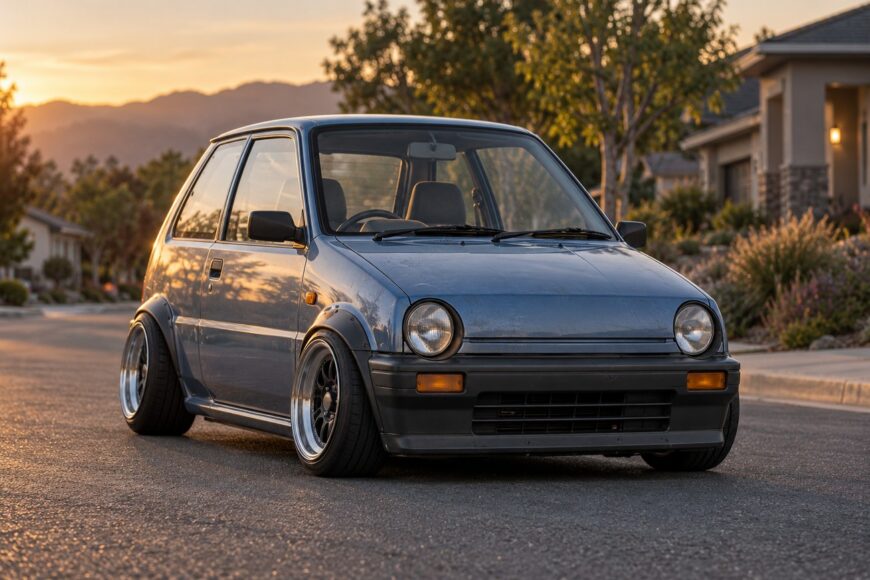
The Honda Today is a tiny kei car with a visual contradiction: set low, pushed wide, and fitted with aggressive wheels, it can suggest a miniature Lamborghini. Under the body, however, it remains a lightweight Japanese city car whose performance and construction depend heavily on its generation, engine, transmission, and modification history.
That tension defines the buying decision. The rare shape and dramatic stance attract attention, while corrosion, hardened seals, scarce parts, weak three-speed automatic performance, and poorly engineered suspension changes can turn the same car into an expensive restoration. A clean, correctly identified example is a specialist purchase; a fashionable project is not automatically a sound one.
- Why the Honda Today Looks Like a Tiny Lamborghini
- Honda Today Generations and Versions at a Glance
- The JA4 RS Is Quick for a Kei Car—Not a Lamborghini
- What to Check Before Buying a Honda Today
- The Hidden Cost of the Lamborghini Stance
- Honda Today Myths: Four-Wheel Drive, Power, and Weight
- Frequently asked questions
- What is the top speed of a Honda Today?
- Which car is called a poor man’s Lamborghini?
Why the Honda Today Looks Like a Tiny Lamborghini
“Lamborghini stance” is a custom visual description, not a Honda factory trim level or a verified performance claim. It usually refers to the Today’s unusually low, wide presentation after modification, especially when the wheels sit close to the arches and the body appears broad over a very short chassis.
That appearance may come from wide wheels, spacers, custom fenders, body kits, or air suspension. The original Honda is a small kei car designed around compact dimensions, low weight, and modest power. Its proportions can look dramatic because the cabin is upright and the body is narrow, not because the platform was engineered as a supercar rival.
Ride height changes the visual balance immediately. A lowered Today can appear planted even when the suspension geometry, tire contact patch, and wheel clearance have become worse. Large wheels may also make the brakes and body look more substantial while adding loads that the original hubs, steering components, and suspension were never intended to carry.
Wide exterior parts deserve careful inspection. An overfender can hide repaired accident damage, corrosion around the arch, or a wheel that is already contacting the inner structure. Check the metal beneath the styling before treating a dramatic stance as evidence of a well-built car.
Honda Today Generations and Versions at a Glance
The Today name covers substantially different cars, so identify the body code before comparing performance or ordering parts. JW1–JW4 were produced from 1985 to 1993, while JA4/JA5 were produced from 1993 to 1998.
| Generation and codes | Engine details | Transmission | Drivetrain | Dimensions and caveats |
|---|---|---|---|---|
| JW1–JW4, 1985–1993 | Engine and fuel system vary by version; early cars are not equivalent to later 656 cm³ models | Depends on specification | JW3 front-wheel drive; JW4 four-wheel drive | Pre-1990 and post-1990 specifications differ; verify the individual car |
| JA4/JA5, 1993–1998 | Late versions used the three-cylinder Honda E07A, 656 cm³; outputs varied | Five-speed manual or three-speed automatic | JA4 front-wheel drive; JA5 four-wheel drive | Late-generation dimensions: 3295 mm long, 1395 mm wide, 2330 mm wheelbase |
The 1990 kei-car rule change increased the permitted length to 3295 mm and engine displacement to 656 cm³. That change helps explain why a later Today should not be treated as a direct mechanical equivalent of an earlier JW-series car.
Late cars used the three-cylinder Honda E07A, 656 cm³, but equipment, fuel system, power output, and drivetrain still varied. The stated power range is approximately 42–58 hp, depending on version. JA4/JW3 are front-wheel-drive variants, while JA5/JW4 are four-wheel-drive variants.
The JA4 RS Is Quick for a Kei Car—Not a Lamborghini
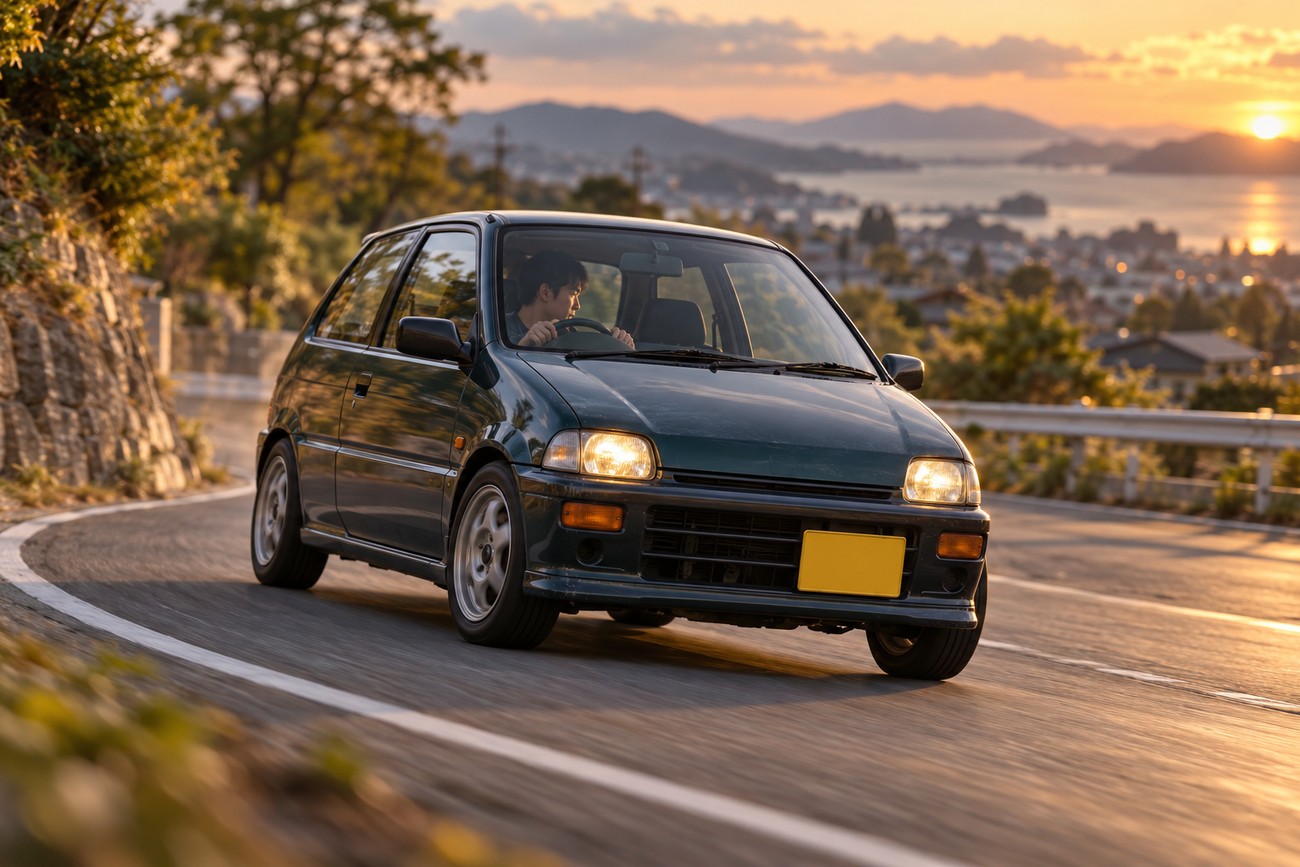
The JA4 RS is listed at 58 hp at 7300 rpm and 59.8 N·m at 6200 rpm. Those figures belong to that specific version and should not be applied to every Honda Today. Other versions produced approximately 42–58 hp, including lower-output and carbureted configurations.
In a light kei car, modest power can still feel lively around town. Real acceleration depends on vehicle mass, final-drive ratios, gear spacing, tire diameter, and engine condition. A healthy manual RS can therefore feel much more energetic than a tired lower-output car, even when both carry the Today badge.
Late versions were available with a five-speed manual or a three-speed automatic. The automatic has fewer ratios to keep the engine in its useful rev range, which can restrict highway acceleration and make sustained cruising less relaxed. For buyers who regularly use faster roads, the manual is usually the more convincing specification.
The JA4 RS tire specification was 155/65 R13. Replacing it with a much wider or heavier wheel may alter steering effort, clearance, gearing, hub loads, and suspension wear. The visual gain can be immediate, while the mechanical penalty may only appear after the car has covered some distance.
What to Check Before Buying a Honda Today
Start with identity, not appearance. Verify the VIN, body code, engine type, drivetrain, and paperwork before relying on an advertisement. A seller’s description may use “Today,” “RS,” or “660” loosely, while the parts and specifications depend on the exact car.
JW3/JW4 and JA4/JA5 have different body parts, powertrains, and compatibility considerations. Confirm the code on the vehicle and compare it with the registration documents and available catalog information. This is especially important if the car has been imported, modified, or assembled from parts.
Inspect the structure for corrosion around the arches, sills, floor, suspension mounting areas, and windscreen openings. Hardened seals can allow water into the cabin, while aged wiring may create faults that are difficult to trace. Original replacement parts can also be scarce, so a low purchase price may conceal a long search for usable components.
Assess the engine rather than accepting the advertised power figure. Check starting behavior, compression where appropriate, oil pressure, cooling-system condition, overheating evidence, and exhaust smoke. On carbureted versions, vacuum leaks, blocked jets, and incorrect warm-up adjustment can produce poor running; injection-equipped cars require their own sensor and wiring checks.
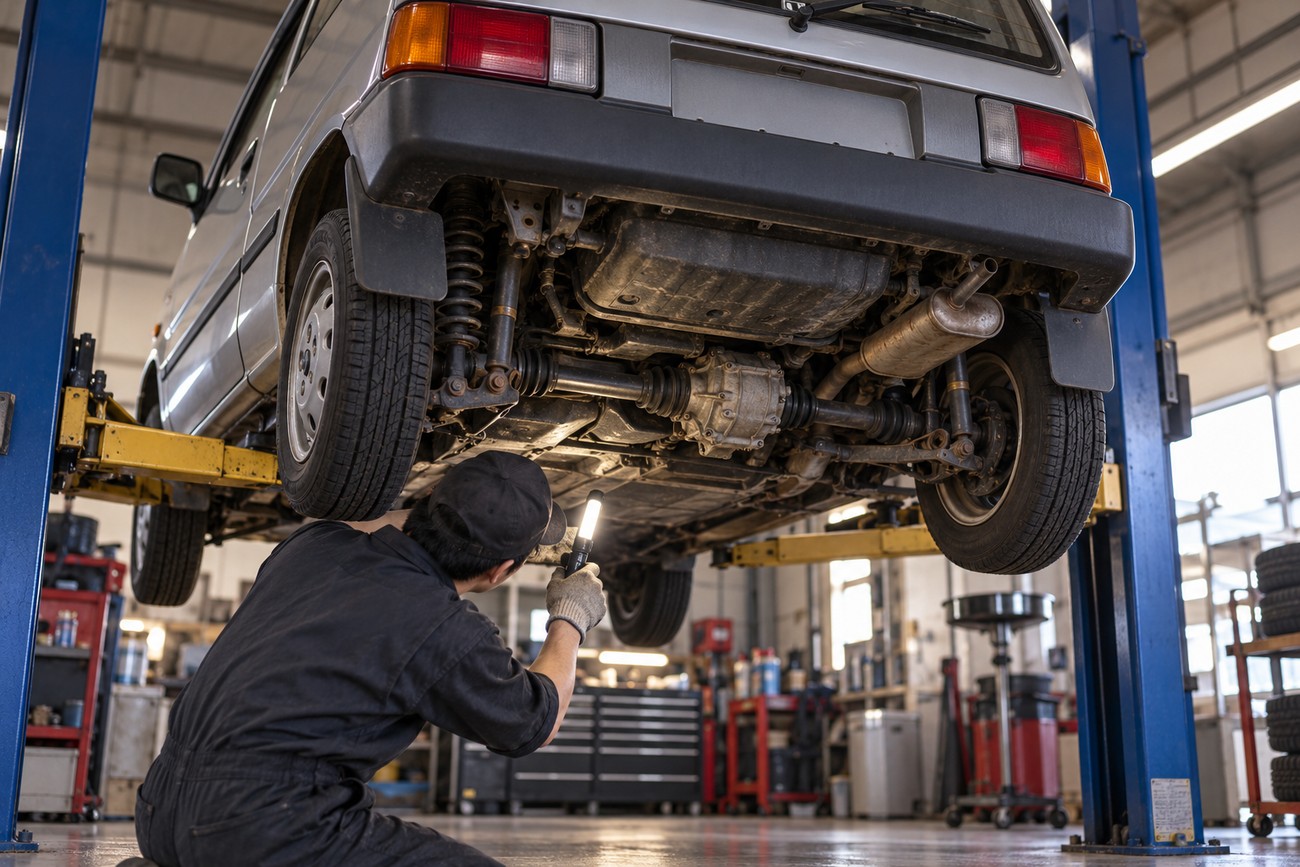
Look underneath for worn ball joints, tie rods, driveshafts, subframes, exhaust damage, and evidence of bottoming out. Check tire wear across the entire tread, especially the inner edges. Owner complaints about particular weaknesses should be treated as leads for inspection rather than as confirmed model-wide statistics, because the available brief does not provide a sufficiently verified owner-review dataset.
The Hidden Cost of the Lamborghini Stance
Stance modifications change loads and geometry, even when the engine remains standard. Wheel width and offset matter more than diameter alone, because they determine where the tire sits relative to the hub, bearing, steering arm, strut, and body. Spacers add another interface that must be correctly fitted and maintained.
Oversized wheels can increase stress on hubs, steering components, and suspension parts. Extreme lowering reduces bump travel and can cause repeated impacts through the suspension, subframes, exhaust, or driveshafts. The result may be premature wear, poor alignment, and a car that looks controlled while skipping over uneven surfaces.
A low and wide stance does not automatically improve handling. Excessive negative camber, incorrect toe, reduced suspension travel, and tire contact with the arch can reduce usable grip and make the car less predictable. Inner-edge tire wear is often a geometry problem, not proof that the setup is properly tuned.
On JA4 cars, the condition and adjustment of the independent rear suspension influence both tire wear and the visual width of the car. The advertised mass range is approximately 620–760 kg, depending on body, drivetrain, and equipment. That lightness makes wheel and suspension changes noticeable, because added unstrung weight and altered geometry represent a larger share of the original design.
Honda Today Myths: Four-Wheel Drive, Power, and Weight
Not all Honda Today models are identical 660 cm³ cars. The 1990 kei-car rule change increased permitted length to 3295 mm and engine displacement to 656 cm³, but earlier cars, different fuel systems, and different equipment remain part of the range. Engine output varies, with approximately 42–58 hp depending on version.
JA5/JW4 four-wheel-drive versions can offer additional traction in appropriate conditions, but four-wheel drive does not make the Today an off-road vehicle. It does not guarantee high ground clearance, an off-road transmission, or a sports transmission. Underbody clearance, tires, suspension travel, and structural condition still set the practical limits.
Power claims also need a code attached to them. Some listings round the JA4 RS output to 60 hp, while the cited specification is 58 hp at 7300 rpm. That distinction matters when comparing an RS with a carbureted or lower-output version and when evaluating whether a modified car actually has the engine it claims to have.
Weight figures are commonly presented without enough context. The approximately 620–760 kg range applies to different bodies, drivetrains, and equipment levels, rather than every Today. An advertisement that uses the lightest figure as a universal specification can make performance comparisons and registration checks misleading.
Frequently asked questions
Top speed depends on the exact body code, engine, transmission, gearing, tire size, and mechanical condition. The “poor man’s Lamborghini” label describes a modified appearance, not a factory specification or performance category.
For any example, confirm its identity and inspect its modifications before relying on advertised specifications or enthusiast descriptions.
What is the top speed of a Honda Today?
There is no single dependable top-speed figure for the entire Honda Today range. The answer depends on the generation, engine and fuel system, transmission, final-drive gearing, tire size, vehicle condition, and whether the car remains mechanically standard.
Before quoting a figure, identify the body code, engine specification, and transmission. A five-speed manual JA4 RS and a three-speed automatic or lower-output version should not be treated as equivalent, even if both are described simply as a Honda Today.
Which car is called a poor man’s Lamborghini?
“Poor man’s Lamborghini” is loose enthusiast shorthand rather than an official Honda Today designation. In this context, the phrase refers to a customized Today whose low ride height, wide wheels, fenders, and compact proportions create a Lamborghini-like visual impression.
It describes appearance, not a factory nickname, factory sports trim, or verified performance category. The comparison should therefore prompt an inspection of the modifications rather than an assumption that the car has unusual factory engineering.







