
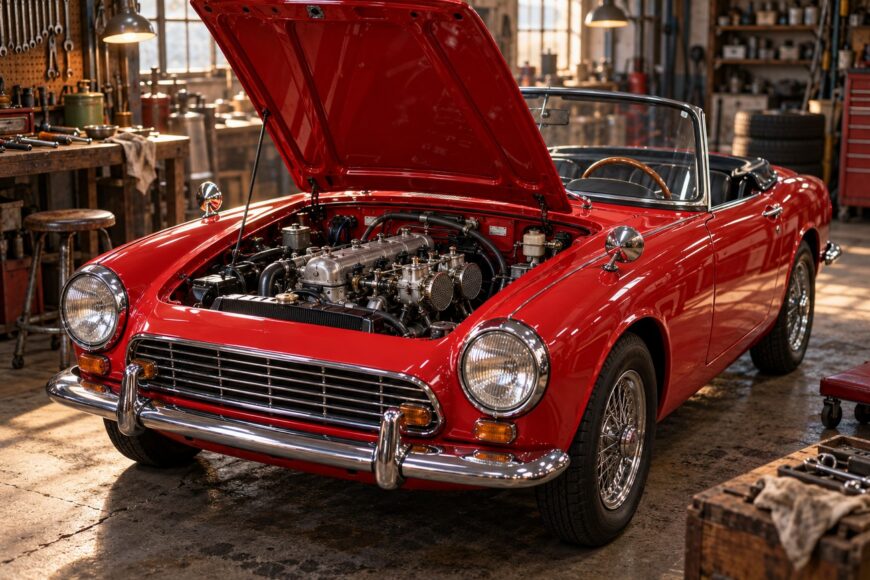
Honda’s tiny S800 produced 70 hp at 8,000 rpm, yet its low-speed torque is modest, and its engineering carries a distinctly motorcycle-influenced flavor. That apparent contradiction defines the car: it is a small sports machine whose performance depends on revs, accurate tuning, and an enthusiastic driver rather than effortless thrust.
The decisive ownership choice is the drivetrain. Early cars used roller-chain rear drive with independent rear suspension, while later versions adopted a driveshaft and conventional rear axle. The early car preserves the more unusual engineering, whereas the later car is generally easier to service and live with. Either way, the S800 is a thrilling, demanding classic rather than a simple lightweight roadster.
- What Makes the Honda S800 a Motorcycle-Engined Roadster?
- Performance Comes From Revs, Not Low-End Torque
- Early Chain Drive vs. Later Driveshaft: Two Different S800s
- Buying and Inspecting a Honda S800
- The Ownership Traps Enthusiasts Underestimate
- Myths, Numbers, and the Real Character of the S800
- Frequently asked questions
- What is the average price of a Honda S800?
- Why does the later Honda S800 have a smaller luggage compartment?
- How much horsepower did the Honda S800 have?
- What is the rarest Honda ever made?
What Makes the Honda S800 a Motorcycle-Engined Roadster?
The motorcycle comparison is useful because the S800’s engine rewards the habits associated with high-revving Honda motorcycles: precise tuning, frequent use of the upper rev range, and a willingness to keep the engine working. Technically, however, the car does not use a motorcycle engine. It has a 791 cm³ inline-four DOHC automotive engine designed for the S800.
Its four small cylinders, each displacing roughly 198 cm³, help explain its quick-revving character. Two twin-choke Keihin carburetors feed the engine, and their synchronized operation is central to smooth running. A poorly adjusted set of carburetors can make the car seem fundamentally defective even when the mechanical parts remain sound.
Honda produced the S800 from 1966 to 1970 in two principal body styles: a roadster and a fastback coupe. The open car provides the most direct connection with the engine’s sound and the road, while the coupe adds a more enclosed body without changing the basic high-revving identity.
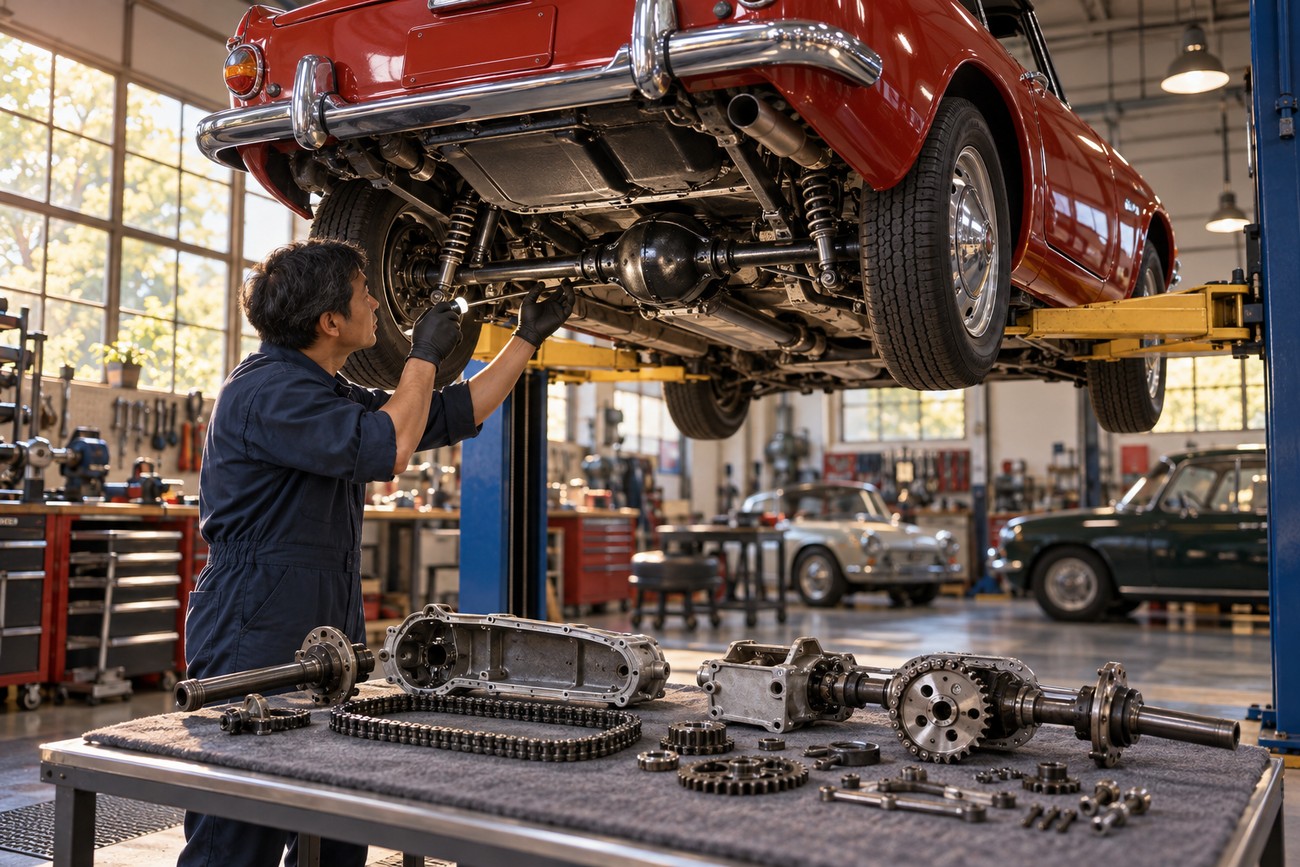
The motorcycle association also comes from the early rear-drive architecture. Honda initially used roller chains to drive the rear wheels and paired them with independent rear suspension, an unusual arrangement in a small automobile. That solution reflected Honda’s engineering background, though its noise and servicing demands later encouraged a more conventional drivetrain.
Performance Comes From Revs, Not Low-End Torque
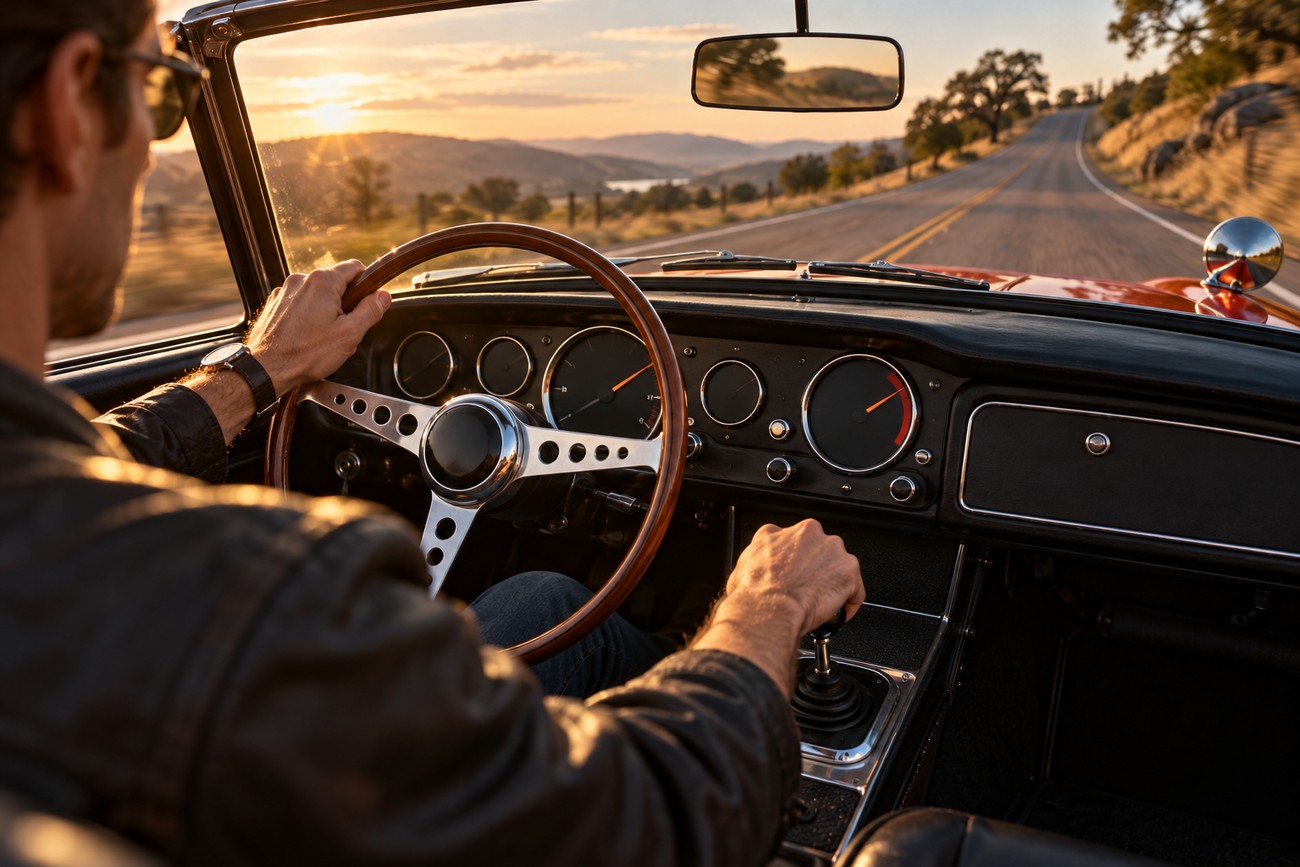
The headline figure is 70 hp at 8,000 rpm, with about 66 N·m of torque arriving at 6,000 rpm. Those figures describe where the S800 works best, rather than promising strong response from every engine speed. Below the useful rev range, the car can feel subdued; above it, the engine becomes much more animated, and the driver has a reason to use the four-speed manual transmission actively.
The synchronized four-speed gearbox makes that process manageable, although modern traffic exposes the limits of the small engine. Pulling away behind slow-moving vehicles or climbing a grade in a high gear can leave the S800 feeling unwilling. Keeping momentum and selecting the correct gear matter more than relying on a broad reserve of torque.
That character is also the source of the car’s appeal. A healthy engine should build its performance progressively as the revs rise, producing a mechanical sound and response that feel closer to a very light sporting machine than to a relaxed classic convertible. A driver who rarely uses the upper half of the rev range may miss the S800’s intended behavior and conceal problems that appear only under load.
Published top-speed figures require caution. Reference data gives about 97 mph, or 156 km/h, while some historical descriptions cite approximately 160 km/h. The difference can reflect the version tested, mechanical condition, gearing, test method, and period measurement practice, so neither number should be treated as a universal specification for every surviving car.
Early Chain Drive vs. Later Driveshaft: Two Different S800s
The drivetrain change divides the S800 into two distinct ownership experiences. Early cars combine roller-chain rear drive, independent rear suspension, and drum front brakes; later cars use a driveshaft, conventional rear axle, and disc front brakes.
| Area | Early S800 | Later S800 |
|---|---|---|
| Rear-drive layout | Roller-chain rear drive | Driveshaft with a conventional rear axle |
| Rear suspension | Independent rear suspension | Conventional rear-axle arrangement |
| Noise | More chain and final-drive noise, especially if worn or poorly adjusted | Quieter drivetrain operation |
| Servicing | Requires attention to chain lubrication, tension, and wear; suitable parts can be difficult to source | Generally easier to understand and live with, although original parts remain scarce |
| Front brakes | Drums | Discs |
| Practicality | Preserves the unusual rear suspension and chain architecture | Reduced drivetrain noise, with a slightly smaller luggage compartment |
| Enthusiast appeal | More distinctive engineering and stronger mechanical individuality | More practical for regular use and often the rational choice for touring |
The early configuration is fascinating because the chain drive is a working engineering solution, not a decorative curiosity. It also creates more inspection points: chain condition, lubrication, adjustment, sprocket wear, and the behavior of the independent rear suspension all affect the ownership experience. Noise alone does not identify a fault, but new, uneven, or worsening noise deserves investigation.
The later drivetrain reduced noise and simplified the car’s mechanical character, though the packaging change made the luggage compartment slightly smaller. That trade-off matters to owners who use the S800 for longer trips. A later car gives up some of the early version’s engineering drama while offering a more approachable combination of braking and rear-drive hardware.
Collectors should therefore identify the exact configuration before assigning value or planning restoration. An early chain-drive car is not automatically the superior purchase, and a later driveshaft car is not automatically less interesting. The right choice depends on whether originality and unusual design outweigh serviceability and regular usability.
Buying and Inspecting a Honda S800
Start by identifying the drivetrain version before judging the car’s price, originality, or mechanical condition. The early roller-chain and independent-rear-suspension arrangement has different components and different restoration concerns from the later driveshaft and conventional rear axle. The same-looking body can therefore conceal two substantially different projects.
A running engine is only the beginning of an inspection. Check compression across all four cylinders, oil pressure, cold and warm starting, and the quality of idle. Listen for abnormal noises from the valve gear, chain system, final drive, or transmission, and verify that the engine responds cleanly as the revs rise rather than merely surviving a short demonstration.
Four-cylinder S800 engines should be judged by even compression and synchronized carburetor operation across the entire rev range; a successful cold start proves little if one cylinder is weak or the carburetors are fighting each other.
The carburetors, ignition, and valve train must work as a system. Incorrect synchronization can produce an unstable idle, hesitation, and uneven loading between cylinders. Ignition errors or neglected valve adjustment can create similar symptoms, so replacing one component without establishing a baseline often leads to a long and expensive sequence of guesses.
Inspect the underside carefully, even if the paint and trim look presentable. Corrosion in the floor, sills, and suspension mounting areas can turn an apparently tidy car into a structural restoration. Examine repairs for proper alignment and sound metal, paying particular attention to areas where suspension loads enter the body.
Parts availability should influence the purchase decision before money changes hands. Original transmission, brake, drivetrain, and body components may take substantial time to locate, and fitting a later-version part to an early car can create compatibility problems. A complete, mechanically coherent car is often a better restoration starting point than a cheaper shell missing specialized components.
The Ownership Traps Enthusiasts Underestimate
The first trap is treating the S800 like an ordinary small car. Its engine is designed to make its best power high in the rev range, and prolonged low-rev driving can give the impression that the car is weak or poorly geared. In dense modern traffic, limited low-speed torque is a genuine inconvenience, especially when frequent stops prevent the driver from maintaining momentum.
The second trap is accepting a clean start as proof of health. A worn or badly adjusted engine may start, idle briefly, and still show poor compression, low oil pressure, unstable carburetion, or distress under sustained revs. A proper evaluation needs measurements and a road test, with attention to all four cylinders and to the transition from low speed into the upper operating range.
Early chain-drive cars add a separate maintenance burden. The roller chains need appropriate lubrication, correct tension, and regular checks for wear. Neglect can increase noise and accelerate damage to related components, while attempts to install later drivetrain parts without checking the suspension and braking differences may compromise both originality and function.
Rust and missing components are the expensive surprises. An exterior that presents well may conceal corrosion in the floor, sills, or suspension mounts, while an incomplete drivetrain or brake system can delay restoration for longer than the physical installation work. The S800’s rarity makes catalog research and parts sourcing part of the mechanical job.
Myths, Numbers, and the Real Character of the S800
Calling the S800 a motorcycle-engine roadster is understandable shorthand, yet it is technically inaccurate. The car uses a 791 cm³ automotive inline-four DOHC engine with two twin-choke Keihin carburetors. Its motorcycle connection lies mainly in Honda’s high-revving engineering approach and the early roller-chain rear-drive architecture.
The claim that every S800 used chains is also wrong. Early cars used roller-chain rear drive with independent rear suspension, while later cars received a driveshaft and conventional rear axle. The later arrangement reduced noise and changed the packaging of the luggage compartment, while also bringing disc front brakes in place of the early drums.
Top-speed claims need the same discipline. About 97 mph, or 156 km/h, appears in reference data, while some historical descriptions give approximately 160 km/h. Version, condition, gearing, and test method can all affect the result, so a single headline number cannot describe every S800 on the road today.
Finally, 70 hp does not mean strong acceleration at every engine speed. Peak power arrives at 8,000 rpm, and peak torque, about 66 N·m, at 6,000 rpm. The S800 rewards correct gear selection and a willing driver; its character comes from carrying speed and allowing the engine to rev, rather than from effortless low-end force.
Frequently asked questions
The S800’s value depends on its body style, drivetrain configuration, condition, and completeness. Its unusual engineering also makes inspection and parts availability important to ownership. The following answers address common questions about price, practicality, power, and rarity.
What is the average price of a Honda S800?
There is no reliable universal average that represents every Honda S800. Value depends on body style, early or later drivetrain, originality, corrosion, mechanical completeness, and the amount of restoration required.
A complete, structurally sound car with correct components can justify a different valuation from a visually attractive project missing chain-drive, brake, transmission, or body parts. Before comparing prices, establish whether the car is a roadster or fastback coupe, identify its rear-drive configuration, and budget for hidden corrosion and specialist parts sourcing.
Why does the later Honda S800 have a smaller luggage compartment?
The later car’s slightly smaller luggage compartment results from the packaging required by the driveshaft and conventional rear-axle arrangement. Replacing the earlier chain-drive and independent-rear-suspension layout changed how the rear mechanical components occupied space.
The trade-off brought a quieter, more conventional drivetrain and generally easier ownership. Buyers who need luggage capacity should inspect the actual car rather than assume that the body styles alone determine usable space.
How much horsepower did the Honda S800 have?
The Honda S800 was rated at 70 hp, produced at 8,000 rpm. That figure describes peak output and does not indicate the power available at low engine speeds, where the car has limited torque and can feel subdued in modern traffic.
What is the rarest Honda ever made?
There is no universal basis in the supplied data for calling the Honda S800 the rarest Honda ever made. Its limited production period, unusual engineering, and difficult parts supply make specification and condition important to collectors, yet rarity claims require a defined production count and a comparison with other Honda models.
For an S800 buyer, the practical question is whether the individual car is complete, structurally sound, correctly specified, and realistically restorable. Those factors have more direct value than an unsupported superlative.







