
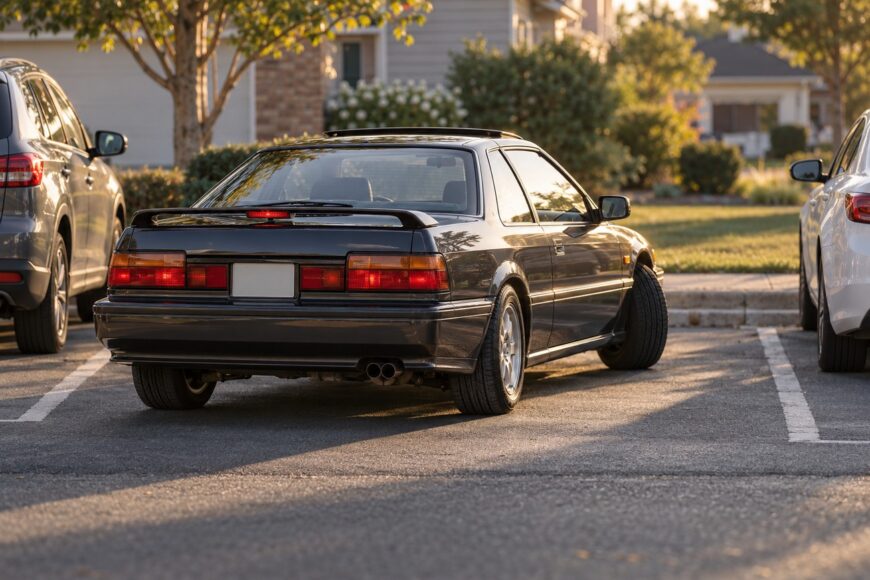
A Honda Prelude with 4WS has an appeal that ordinary front-wheel-drive coupes cannot quite reproduce. The rear wheels contribute to the car’s path, making a tight parking maneuver feel unusually compact and giving the chassis a different response during quicker lane changes. It is a genuine chassis feature rather than a trim badge added for appearance.
The used-car problem is that the badge may survive after the hardware has gone. Some cars advertised as 4WS have had the rear-steering assembly removed or replaced with a conventional setup, sometimes after suspension repairs. Four-wheel steering changes how the car steers; it does not change which wheels deliver power. A Prelude 4WS remains front-wheel drive, so the rear axle guides the car without driving it.
- How the Prelude Steers From the Rear
- Prelude 4WS Versions: BA5, BA8, and BB8
- What 4WS Changes on the Road—and What It Cannot Fix
- Buying a Prelude 4WS: Verify the Car, Not the Badge
- The Ownership Catch: Rare Parts and Complicated Repairs
- Is a 4WS Prelude Worth Choosing?
- Frequently asked questions
- What other cars had four-wheel steering?
- What should you do if the rear steering seems to stop working while driving?
- What is an advantage of four-wheel steering (4WS)?
- What cars had 4WS?
How the Prelude Steers From the Rear
During a tight, low-speed maneuver, the rear wheels can steer in the opposite direction from the front wheels. That shortens the car’s effective turning path and helps the nose rotate into a parking space or a narrow junction. The result is most noticeable when the car is moving slowly and the steering input is substantial.
During a gentler, faster directional change, same-direction rear steering can help the car move through the transition with less abrupt yaw. The rear axle follows the front axle’s general direction, which can make a lane change or sweeping bend feel more settled. This is a steering response aid, not a source of rear-wheel drive.
The early Prelude system is mechanically controlled. Its response depends on steering input and the operation of the mechanical linkage, so it should not be described as a system that switches between behaviors solely because the car reaches a particular road speed. Later versions use electronic control, with a different architecture and different diagnostic requirements.
That distinction matters to owners. A late electronically controlled car may need attention to its control hardware and sensors, while an early car may require closer examination of the mechanical mechanism, links, and adjustment. The shared 4WS name describes the result at the rear axle, but the systems across Prelude generations should not be treated as identical.
Prelude 4WS Versions: BA5, BA8, and BB8
The figures below apply to the specified listings and versions. They describe the original specification; they do not prove that a particular used Prelude still has a complete or functioning 4WS system.
| Version | System distinction | Listed specifications |
|---|---|---|
| Prelude 2.0 Si 4WS, E-BA5, 1987–1989 | Early mechanically controlled 4WS | 145 hp; 1,958 cc; four-speed automatic transmission; minimum turning radius 4.8 m |
| Prelude IV 2.3i 4WS | Prelude IV 4WS; exact system details vary by version | 160 hp listed for the 2.3i 4WS specification; other figures unspecified here |
| Prelude 2.2 SiR 4WS, E-BB8, 1996–1998 | Later 4WS generation; electronic control may apply to late versions | 200 hp; 2,156 cc; 2,585 mm wheelbase; minimum turning radius 4.7 m |
What 4WS Changes on the Road—and What It Cannot Fix
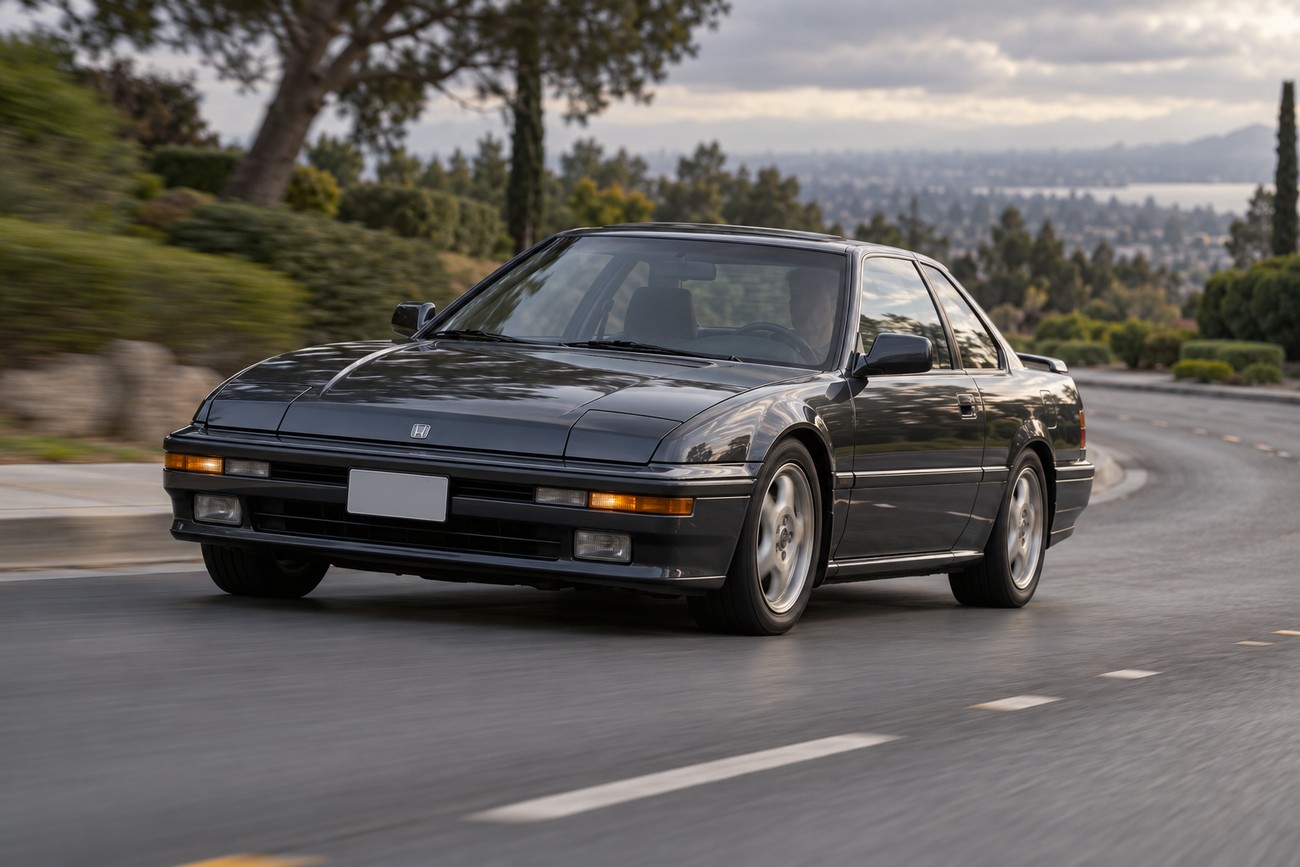
The clearest everyday benefit is maneuverability. Opposite-direction rear steering helps tighten a slow turn, so the driver may need less space to enter a parking bay or turn around on a narrow road. The effect is useful precisely because a Prelude remains a relatively long, low coupe rather than a small city car.
The same chassis can feel different once speed and steering input rise. Same-direction rear steering helps smooth a faster transition, giving the car a more coordinated change of direction. It does not remove the influence of front-wheel drive, tire grip, worn dampers, incorrect alignment, or a tired rear mechanism.
The listed minimum turning radius is 4.8 m for the E-BA5 2.0 Si 4WS and 4.7 m for the E-BB8 2.2 SiR 4WS. Those are version-specific catalog figures, not a promise that every surviving example will turn that tightly. A worn, altered, or malfunctioning car may behave differently even if its body and identification plate appear correct.
Tires and suspension geometry deserve attention before anyone judges the system. Uneven tire sizes, poor alignment, sagging springs, or play in the rear links can change the car’s path and steering feel. A tight-turn test can reveal that something is wrong, but it cannot by itself confirm every part of the 4WS mechanism or its full operating range.
Buying a Prelude 4WS: Verify the Car, Not the Badge
Begin with identity and original specification. Check the VIN, model code, market documentation, and period equipment information against the seller’s claim. A car described as BA5, BA8, or BB8 4WS deserves a physical inspection because badges, replacement body panels, and old advertisements can outlive the equipment they describe.
Look underneath the rear of the car for the actual 4WS assembly, steering links, and related mounting hardware. A conventional rear suspension setup or a simplified replacement indicates that the original rear-steering function has been removed. Also look for disconnected parts, damaged links, missing fasteners, and evidence that a previous suspension repair was left incomplete.
On later electronically controlled versions, the inspection must extend beyond the rear mechanism. The control hardware, wiring, and sensors form part of the system, so a mechanically complete rear axle does not automatically mean that 4WS is operating correctly. A specialist diagnosis may be needed where warning symptoms, missing components, or unclear repairs are present.
Arrange a condition check and a cautious road test before buying. Pay attention to steering effort, unusual rear-axle movement, binding, noises, and whether the car tracks consistently through slow and faster direction changes. Avoid treating a small turning circle as conclusive proof; the car needs a credible mechanical and, where applicable, electronic inspection.
The Ownership Catch: Rare Parts and Complicated Repairs
Age changes the risk calculation. The rear-steering mechanism adds links, joints, fasteners, and adjustment points that a conventional rear suspension does not have. Years of exposure can leave bolts seized, while previous suspension work may damage or disassemble parts that are difficult to replace correctly.
Owners report difficulty finding missing 4WS-specific components, including sensors and control hardware on relevant later versions. A repair can therefore become a parts search before the mechanical work begins. Used components may exist, though their condition and compatibility still need verification.
Restoring an incomplete car can require two kinds of work. The mechanical side may involve freeing seized fasteners, replacing worn links, and returning the rear assembly to its original configuration. Later electronically controlled systems can add diagnosis of the control unit, sensors, and wiring, so a fault cannot always be solved by inspecting the suspension alone.
Ground clearance also deserves a realistic place in ownership planning. Some Prelude 4WS listings give approximately 140–145 mm, though that range is not universal across every version. On poor roads, worn suspension and sagging springs become more consequential on a low car, increasing the chance of scraping and making the condition of the underbody especially important.
Is a 4WS Prelude Worth Choosing?

A functioning 4WS Prelude offers a distinctive driving experience that is difficult to recreate with a conventional rear suspension. Its steering behavior can make tight maneuvers more manageable and faster transitions feel more coordinated. That character is the main reason to choose one, rather than a guarantee of superior performance in every road condition.
The sensible buyer should value completeness over the lowest purchase price. A car with documented repairs, an intact rear-steering assembly, and evidence of correct operation is a stronger starting point than a cheaper example carrying the right badge after a rear-suspension conversion. Early mechanical systems and later electronically controlled systems also present different maintenance questions, so the exact version matters.
A conventional Prelude may suit someone who wants simpler ownership and easier diagnosis. A 4WS example makes sense for a buyer prepared to verify the system, budget time for specialist parts searches, and accept that catalog figures describe the original car rather than its present condition. If the rear steering has been removed, the car no longer delivers the intended 4WS function, regardless of its badge or body style.
Frequently asked questions
Four-wheel steering appeared on several cars, but their systems did not all work alike. In a used Prelude, the original specification and rear assembly matter more than the badge. If its steering behavior changes unexpectedly, a safe stop and inspection take priority over further testing.
What other cars had four-wheel steering?
Recognizable examples include the Nissan 300ZX and Mitsubishi 3000GT, as well as several other performance and luxury models from the same broad era. Their systems did not all operate alike: some used mechanical control, while others relied on electronic control or different rear-steering strategies.
The name 4WS therefore identifies a layout rather than one universal design. For a used car, the manufacturer’s system, generation, and original specification matter more than the label alone.
What should you do if the rear steering seems to stop working while driving?
Avoid testing the car at speed and reduce your pace smoothly in a safe place. If the steering feels abnormal, the car changes direction unexpectedly, or the rear feels unstable, stop driving when it is safe and arrange a diagnosis rather than assuming that the system has a predictable fallback mode.
Check for warning signs without working beneath an unsupported vehicle. A qualified inspection should cover the rear mechanism and, on later electronically controlled versions, the control hardware, sensors, and wiring.
What is an advantage of four-wheel steering (4WS)?
Its main advantage is the ability to use different rear-wheel steering directions for different maneuvers. Opposite-direction steering can reduce the space needed for a tight turn, while same-direction steering can make a faster directional change feel smoother.
The benefit depends on correct geometry and a functioning system. Four-wheel steering does not add driven wheels, and it cannot compensate for poor tires, worn suspension, or incorrect alignment.
What cars had 4WS?
Four-wheel steering appeared on a range of cars, including Honda Prelude 4WS models, the Nissan 300ZX, and the Mitsubishi 3000GT. Availability depended on the generation, market, engine, and trim, so a model name alone does not establish that every example had rear steering.
For a used-car purchase, confirm the original specification and inspect the physical rear assembly. A car may retain its model identity after its 4WS equipment has been replaced with a conventional setup.







