
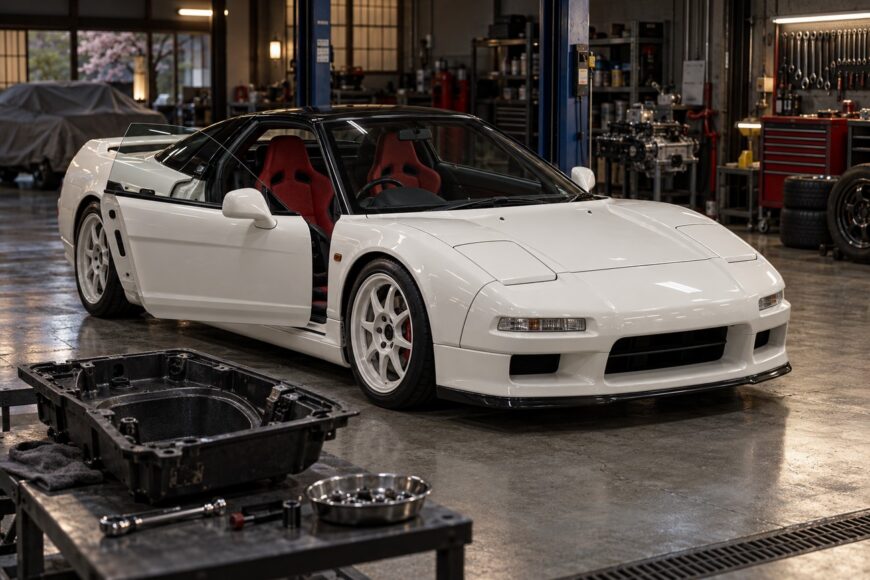
The Honda NSX-R is celebrated as a Senna-inspired lightweight, yet its most repeated claims are often simplified. Weight figures vary by generation, specification, and measurement method, while the Senna label does not prove direct involvement in developing every NSX-R version.
The meaningful engineering story lies in reduced mass, sharper chassis responses, revised aerodynamics, and a willingness to remove comfort equipment. The NSX-R retained the mid-engine layout, rear-wheel drive, naturally aspirated V6, and manual transmission. Its advantage came primarily from response and balance, rather than a major increase in factory power.
The 1992 NA1 and 2002 NA2 express that philosophy differently. The NA1 has unassisted steering and a particularly direct, heavy character. The NA2 adds carbon-fiber bodywork, a 3.179-liter C32B V6, and electric steering assistance, creating a more developed car whose feedback can feel less transparent.
- What Makes the Honda NSX-R More Than a Stripped NSX
- NA1 and NA2: Two Lightweight NSX-R Characters
- How Much of the Senna Story Is Actually Proven?
- The Driving Compromises Owners Actually Feel
- The Ownership Traps Hidden Behind the Lightweight Badge
- NSX-R Weight Claims, Power Myths and Specification Errors
- Frequently asked questions
- How much is a Honda NSX-R worth?
- What is the rarest NSX color?
- How much does a Honda NSX-R weigh?
What Makes the Honda NSX-R More Than a Stripped NSX
The NSX-R kept the essential NSX formula: a mid-engine layout, rear-wheel drive, a naturally aspirated V6, and a manual transmission. That combination gives the car a predictable traction balance and a direct connection between throttle input and rear-axle behavior. The R designation therefore describes a broader engineering treatment, not a separate powertrain concept.
Honda pursued performance by reducing the effort required to change direction, accelerate, and stop. Sound insulation, the spare wheel, some electrical equipment, and trim were removed. The result was a car that reacted more readily to steering and throttle inputs, while also transmitting more vibration and road noise to its occupants.
Chassis settings were equally important. Revised suspension tuning, steering changes, and special aerodynamic elements altered how the NSX-R loaded its tires and maintained stability at speed. The steering ratio is about 3.2 turns lock-to-lock, compared with about 3.5 turns for some standard NSX versions, so the driver makes smaller steering inputs for the same corner.
That approach explains why the NSX-R should not be judged by horsepower alone. A similar factory power output can feel more urgent when the car carries less mass and responds more quickly to control inputs. The sacrifice is clear in daily use: less isolation, more mechanical noise, and a narrower comfort margin on rough roads.
NA1 and NA2: Two Lightweight NSX-R Characters
The two generations share the same basic performance philosophy, but their hardware and feedback differ substantially. Published weights require care because equipment and measurement methods are not always consistent.
| Specification | 1992 NA1 NSX-R | 2002 NA2 NSX-R |
|---|---|---|
| Engine | Naturally aspirated V6 | 3.179-liter C32B naturally aspirated V6 |
| Stated mass | About 1,230 kg; approximately 120 kg below a standard NSX, depending on method and equipment | 1,270 kg in the Japanese specification; lower figures also appear in advertising and collector descriptions |
| Factory power | Close to standard NSX output in the period | 280 PS at 7,300 rpm |
| Steering assistance | No power assistance; very heavy at low speed | Electric assistance; lighter, with potentially less information through the wheel |
| Weight-saving hardware | Reduced insulation, equipment, and trim | Carbon-fiber bonnet, rear spoiler, aerodynamic elements, and removal of the spare wheel, insulation, equipment, and trim |
| Driving character | Rawer steering effort and a highly direct mechanical feel | More developed aerodynamics and lighter steering, with a different feedback balance |
The NA1’s reported mass of about 1,230 kg is approximately 120 kg less than that of a standard NSX, although the exact figure depends on equipment and measurement method. Its unassisted steering gives the car a demanding low-speed character. Heavy steering alone does not establish a fault on an NA1.
The NA2 used the 3.179-liter C32B V6, rated at 280 PS at 7,300 rpm, and the Japanese specification lists a mass of 1,270 kg. Carbon-fiber components helped reduce weight, while the rear spoiler and other aerodynamic elements improved aerodynamic control. The later car also removed or reduced several comfort-related items.
Electric assistance made the NA2 easier to maneuver, yet many drivers find the system less informative as cornering load rises. That difference matters when comparing cars in an advertisement or collection: the newer and more technically elaborate NSX-R is not simply a more powerful version of the NA1, and the two do not communicate their limits in the same way.
How Much of the Senna Story Is Actually Proven?
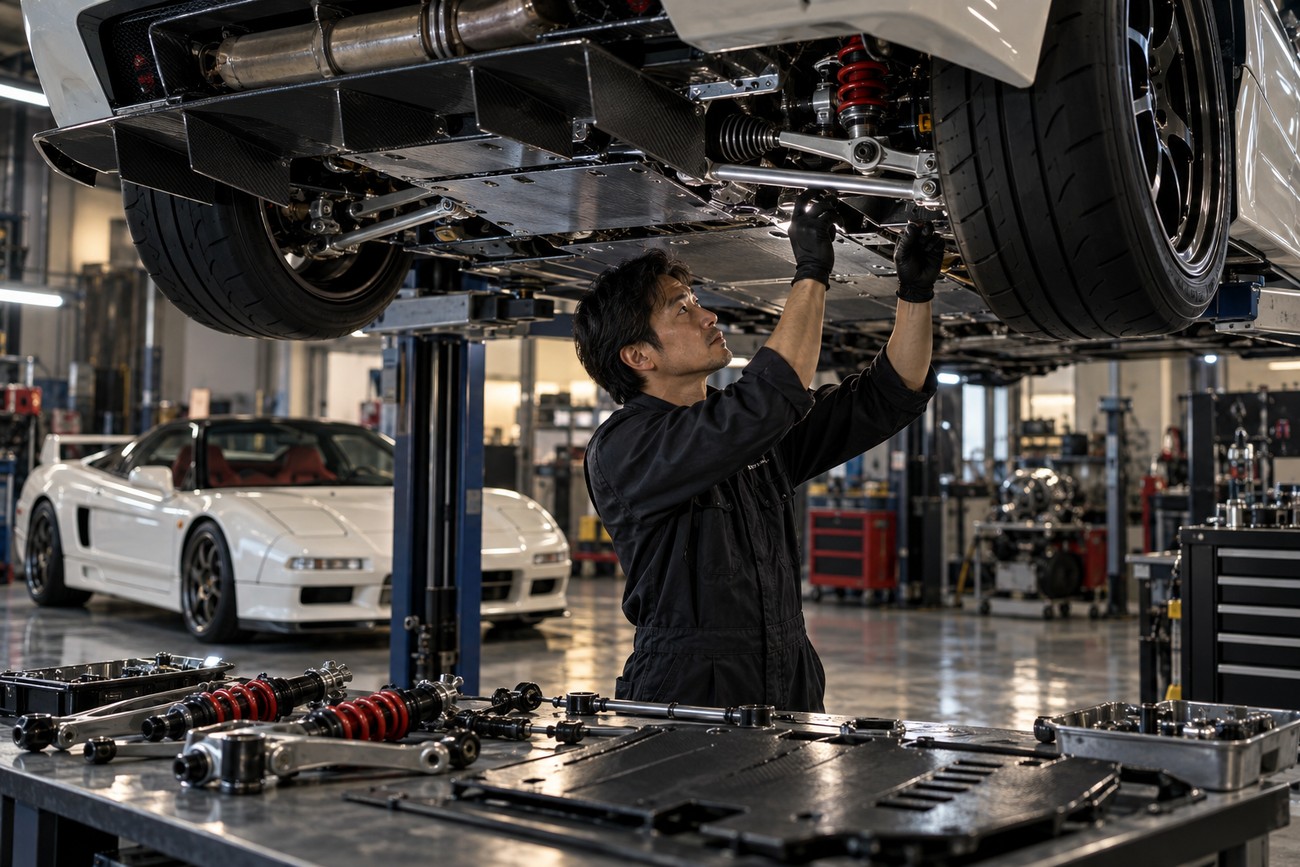
The Senna association has a credible background in the broader NSX story, particularly in the car’s development culture and the emphasis placed on chassis behavior. It remains too broad to treat “Senna-inspired” as proof that Ayrton Senna directly developed every NSX-R version or approved every detail of its specification.
For buyers and historians, the defensible identity of the NSX-R rests on tangible engineering changes. These include mass reduction, suspension and chassis tuning, steering changes, and special aerodynamic treatment. Those features can be inspected and compared; a simplified development myth cannot substitute for documentation.
A related claim says that NSX-R engines were hand-built to an unusually precise, race-level standard. The material supporting that statement here comes from a seller source rather than official factory documentation. It should therefore be treated as an unconfirmed description, especially when evaluating originality or paying a premium for a particular engine.
Documentation matters because the NSX-R is now judged as a collectible as well as a performance car. Factory records, market-specific specifications, equipment details, and a consistent ownership history carry more evidential weight than a familiar phrase repeated in an advertisement.
The Driving Compromises Owners Actually Feel
NA1 steering effort is the most obvious compromise. With no power assistance and a particular steering geometry, the wheel can feel exceptionally heavy during parking or tight urban maneuvering. That effort is a design characteristic, although abnormal friction, worn components, or poor alignment still require investigation.
The NA2’s electric assistance changes the workload without guaranteeing richer feedback. Its steering is lighter, but the wheel may transmit less of the increasing load as the car approaches the limit of a corner. Drivers comparing the generations should separate physical effort from information quality; they are different aspects of steering behavior.
Firm settings and limited sound insulation also shape ownership. The NSX-R can become tiring in town, over broken pavement, or during long trips where the road surface constantly loads the suspension. Removing insulation and comfort equipment improves immediacy, yet it leaves the cabin with more drivetrain, tire, and road noise.
Condition can overwhelm the theoretical differences between generations. Tires, alignment, dampers, bushes, and the steering system all influence turn-in, stability, and the amount of effort required at the wheel. A poorly maintained NSX-R may feel vague or harsh, while a correctly set-up example can reveal the balance that the specification promises.
The Ownership Traps Hidden Behind the Lightweight Badge
Low mileage and attractive paint provide an incomplete picture of an older NSX-R. Climate-control faults can cause cyclic shutdowns, with repairs sometimes involving failed solder joints in the control unit. An apparently minor electrical issue can therefore require diagnostic work and careful restoration rather than a simple switch replacement.
ABS also deserves a functional test, including repeated operation after the car reaches normal running conditions. Ageing sensors, control units, or wiring can make the system intermittent or cause it to switch off. A warning-free dashboard during a short inspection does not prove that the system will remain reliable in regular use.
Before judging paint and mileage, test the ABS, climate control, steering assistance, carbon-panel fit, and availability of rare trim. These checks can determine the real ownership risk more accurately than cosmetic presentation.
NSX-R-specific body and trim parts can be difficult and expensive to source. A small defect around a door hinge, a missing interior piece, or damage to a special aerodynamic component may require community sourcing, specialist fabrication, or a long search for the correct original part. Universal NSX replacements should never be assumed compatible without checking their mounting and specification.
Carbon-fiber panels and original aerodynamic parts increase the cost of recovering from even a modest accident. Age also affects rubber components, wiring, seals, and structural areas, including on cars that have spent most of their lives stored. The inspection should confirm the condition of these systems and the car’s documented specification before originality or mileage is given much weight.
NSX-R Weight Claims, Power Myths and Specification Errors
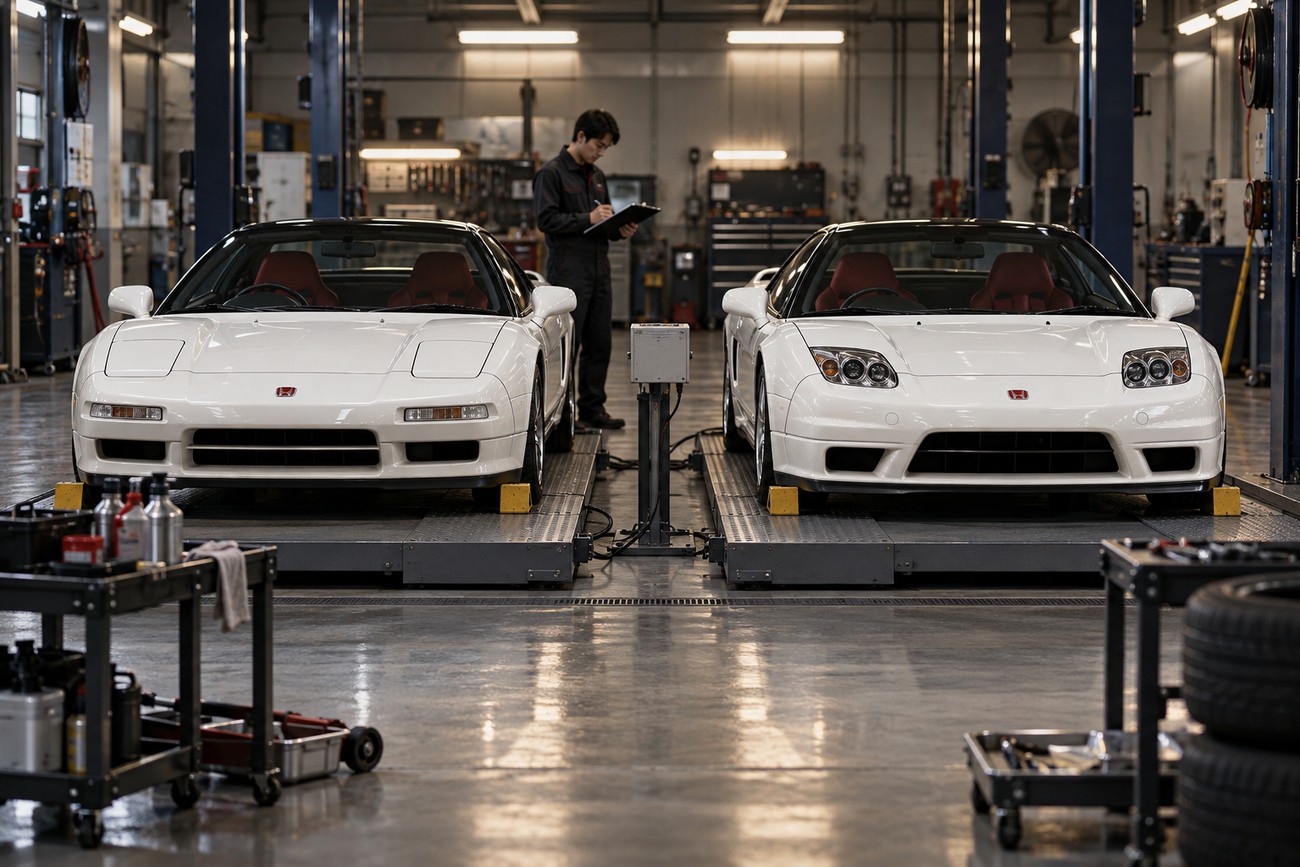
The 2002 NA2 is the clearest example of why weight figures need context. The official Japanese specification cited here lists 1,270 kg, while figures of 1,200 kg and 1,230 kg also appear in advertising and collector descriptions. Those numbers should not be treated as interchangeable without knowing the market, equipment, fluids, and measurement method.
The 1992 NA1 is commonly described as weighing about 1,230 kg, approximately 120 kg less than a standard NSX. That comparison is useful when the underlying specifications are equivalent. It becomes misleading when a dry or lightly equipped figure is compared with a road-ready weight that includes different fluids, tools, or equipment.
Weight reduction also does not automatically mean more factory power. The NSX-R’s performance gain came primarily from lower mass, sharper response, and revised chassis and aerodynamic settings. A power figure close to that of a standard NSX can still produce a substantially different experience once the car reacts more quickly to steering and throttle inputs.
Collectors should verify the generation, market specification, equipment list, and actual condition before accepting an advertised number. An original car with documented factory parts may have greater historical value than a lighter-looking example fitted with an undocumented exhaust, replacement wheels, or non-factory carbon components.
Frequently asked questions
The NSX-R’s specifications are easiest to understand when generation, market, equipment, and condition are considered together. The same discipline also applies to valuation and restoration decisions.
How much is a Honda NSX-R worth?
There is no single universal value for a Honda NSX-R. A meaningful valuation considers whether the car is an NA1 or NA2, its originality, documented factory specification, provenance, structural condition, and the quality of its maintenance history.
Modified cars require especially careful analysis. A replacement carbon panel, non-factory wheel, or undocumented drivetrain change may improve use but reduce confidence in the car’s identity as a factory NSX-R. Inspection records and evidence of correct rare parts can matter more than mileage alone.
What is the rarest NSX color?
The rarest NSX color can only be established reliably through production records, market-specific data, and credible historical documentation. Auction visibility is an unreliable guide because a color that appears frequently in public sales may simply be easier to photograph, export, or market.
Check the original build documentation, factory paint code, and evidence of any color change. A seemingly unusual finish may be a later repaint, while a less visible factory color may have stronger documented scarcity.
How much does a Honda NSX-R weigh?
A 1992 NA1 NSX-R is commonly stated at about 1,230 kg, approximately 120 kg below a standard NSX, with the exact figure dependent on equipment and measurement method. The 2002 NA2 is listed at 1,270 kg in the Japanese specification.
Lower NA2 figures of 1,200 kg and 1,230 kg also appear in advertising and collector descriptions. They should be checked against the car’s market specification, equipment, fluids, and actual weighing before being used for a purchase or valuation decision.







