
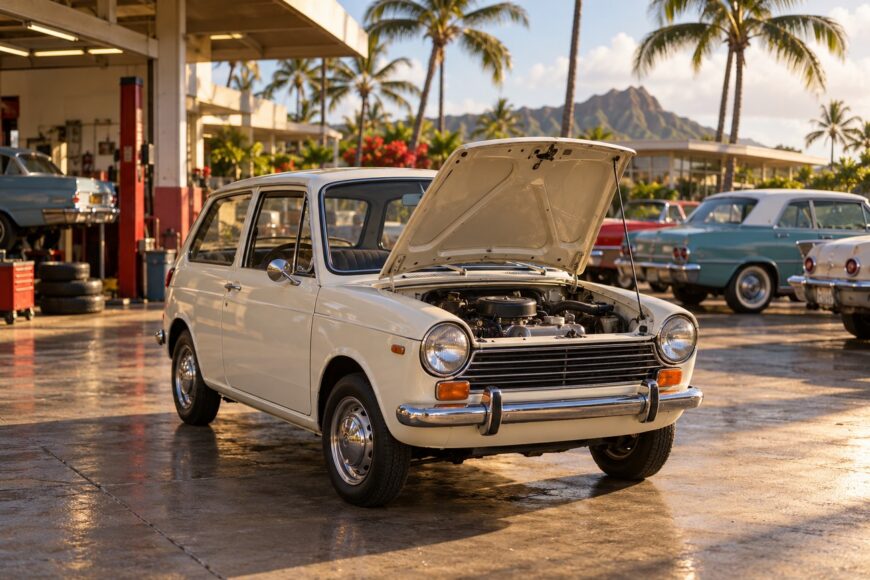
The Honda N600 was tiny by American standards, yet its importance to Honda in the United States was substantial. It became the company’s first automobile officially exported to the country, giving Honda a direct foothold in a market that demanded more speed, durability, and road confidence than Japan’s kei-car environment.
Its period figures remain appealing: low weight, front-wheel drive, economical fuel use, and a claimed top speed suitable for the highways of its day. A surviving N600 tells a more complicated story. Carburetion, cooling, brakes, rust, and parts availability now matter more than a brochure number, and two cars wearing the same badge can require very different decisions from a buyer or restorer.
- 1969 in Hawaii: Honda’s official U. S. car debut
- A small car adapted for American roads
- Honda N600 specifications: why the numbers disagree
- What an N600 feels like in modern traffic
- Buying and restoring one: inspect beyond the first start
- The N600’s legacy—and the limits of its rarity
- Frequently asked questions
- What is the average price of a Honda N600?
- How can I confirm that a replacement part fits my N600?
- How should I prepare an N600 for occasional use and storage?
- What should I check when insuring an N600 as a classic car?
1969 in Hawaii: Honda’s official U. S. car debut
Sales began in Hawaii in 1969 as a 1970 model, followed by mainland availability. That sequence reflected a cautious entry into the American market. Hawaii offered a manageable first step for Honda’s dealer organization and allowed the company to establish a sales and service presence before confronting the scale and speed of the continental United States.
The N600 was Honda’s first automobile officially exported to the United States. Privately imported S600s had appeared earlier, so the N600 was not the first Honda automobile physically seen in America. Its distinction was corporate and commercial: Honda itself was now supplying cars, parts, dealer training, and a defined product strategy for American customers.
The initial network comprised 58 dealers, a modest base for a company introducing an unfamiliar car to a crowded market. Honda sold just over 34,000 N600s in the United States during 1970–1972. That result gave the company useful visibility and experience, although it was never an overnight mass-market success on the scale of the established domestic manufacturers.
The car’s importance therefore exceeds its sales total. It tested whether a small Japanese front-wheel-drive hatchback could earn trust in a country where long-distance travel, broad roads, and large vehicles shaped buying habits. The N600 also exposed Honda to the practical demands of American ownership, including parts support and the need to make a very small car feel credible outside Japan.
A small car adapted for American roads
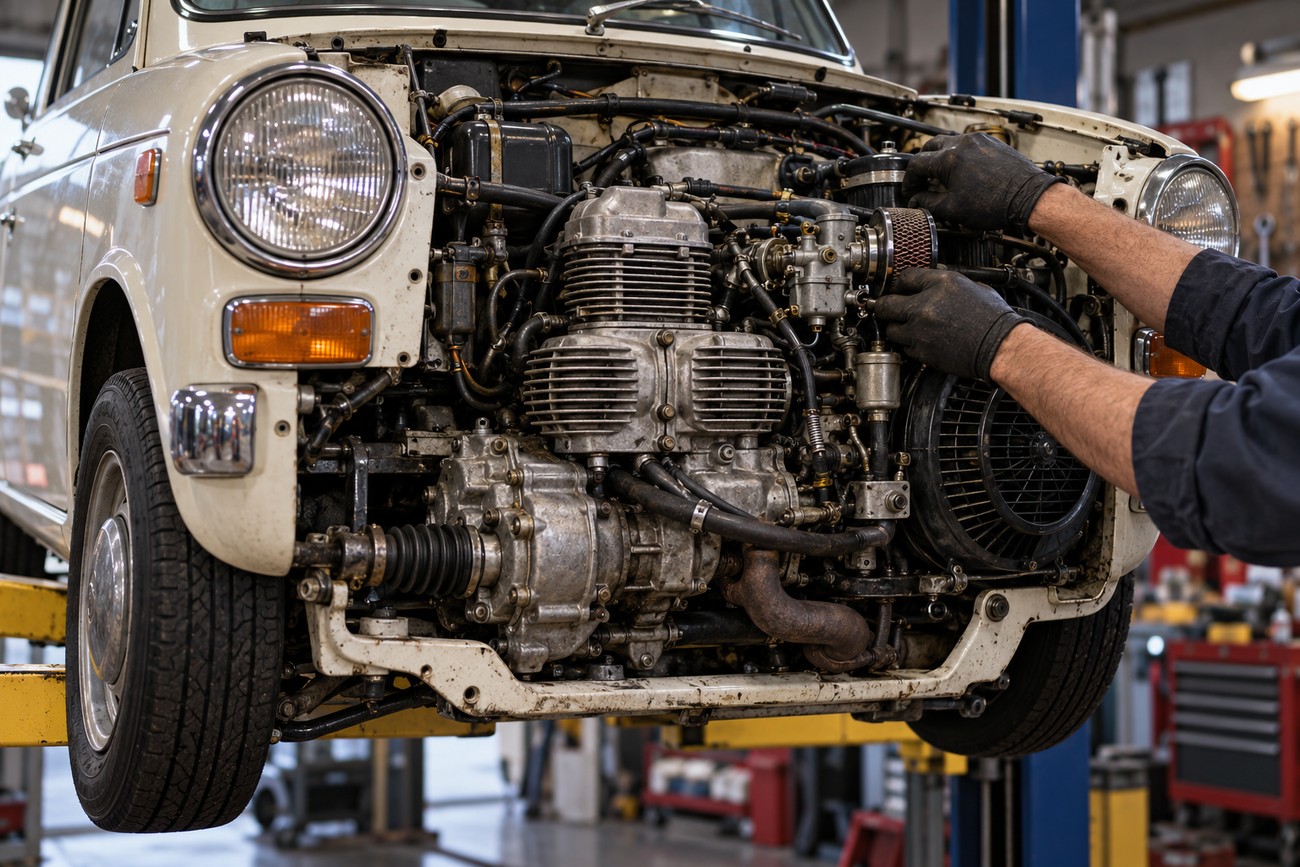
The American N600 was more than an N360 carrying a larger badge. Its 598–599 cc air-cooled SOHC inline-two used an aluminum block and provided the extra displacement needed for American traffic. The engine remained compact and mechanically distinctive, yet its cooling and fueling systems demanded careful attention because there was no liquid coolant to absorb mistakes in mixture, airflow, or maintenance.
Front-wheel drive helped preserve cabin and cargo space within a body approximately 122–126 inches long and about 52 inches wide. A predominantly four-speed manual transmission suited the engine’s modest output and kept the driver involved in maintaining momentum. The gearbox has synchronizes, although age and wear can make its shift quality quite different from that of a modern manual transmission.
Independent front suspension gave the small car a more controlled response over ordinary roads, while the rear used a beam axle on leaf springs. The layout was simple and space-efficient, with a light body that made the N600 feel alert at urban speeds. Its size also meant that road ruts, crosswinds, and abrupt steering inputs were more noticeable than they would be in a heavier modern car.
Power-assisted front disc brakes and rear drums were unusually serious equipment for an inexpensive small car of the period. The discs are a genuine strength when the calipers, hoses, and dual-circuit hydraulic system are healthy. A seized caliper or deteriorated hose can erase that advantage, leaving a driver with a car whose period specification looks reassuring while its actual braking system is unsafe.
Honda N600 specifications: why the numbers disagree
Published specifications describe different years, markets, versions, and measurement standards. The figures below are best read as reported ranges and source-specific claims rather than a single universal specification.
| Item | Reported figure | Context and caution |
|---|---|---|
| Engine output | 36 hp | Appears in some U. S. specifications. |
| Engine output | 42 hp | Listed in some professional catalogs. |
| Engine output | 45 SAE hp | Reported in Honda materials; the measurement standard and referenced version matter. |
| Weight | Approximately 1,220–1,355 lb | Differences can reflect the referenced version, equipment, and source method. |
| Top speed | Approximately 75–85 mph | Reported values vary with specification, condition, and testing method. |
| Fuel economy | Up to 40 mpg | Honda promotional material; this does not guarantee the result from a surviving car. |
The horsepower figures are not interchangeable. A reference to 36 hp, 42 hp, or 45 SAE hp can be accurate within its own source context, while still being misleading when applied to every American N600. The same caution applies to weight and speed: approximately 1,220–1,355 pounds and 75–85 mph cover the cited versions and sources, rather than defining one exact car.
Fuel economy is especially sensitive to carburetor adjustment, engine condition, tire pressure, driving speed, and traffic. Honda’s “up to 40 mpg” claim describes promotional conditions and a correctly functioning car. It should serve as historical context, not as a restoration target that excuses a weak engine or poorly tuned fuel system.
What an N600 feels like in modern traffic
A healthy N600 feels lively because its controls operate a very small, light car. In town, the compact dimensions make positioning easy, and the manual gearbox allows the driver to keep the air-cooled twin working in its useful range. The experience is involving precisely because there is little mass to isolate the driver from the road.
Reported top speed varies from approximately 75–85 mph, but that figure says little about present-day highway suitability. Crosswinds can move a narrow, lightweight car, while narrow tires and a short wheelbase make ruts and sudden corrections more consequential. Modern traffic also leaves less margin around a vehicle with limited passive protection.
Braking performance depends on condition rather than the presence of a specification line in an old brochure. Power-assisted front discs are valuable only when the calipers release correctly, the hoses remain sound, and the dual-circuit hydraulics function as intended. A car that pulls to one side or develops a hot wheel needs mechanical investigation before any serious road use.
A maintained N600 and a neglected survivor are different propositions. Fresh rubber components, reliable ignition, correctly adjusted carburetion, sound suspension, and properly serviced brakes can make the car usable for suitable local trips. Age-related deterioration can turn the same trip into a poor test of the model’s design, especially if the driver mistakes its historical top speed for a recommendation to mix with modern highway traffic.
Buying and restoring one: inspect beyond the first start
Begin with the structure and the car’s completeness. Inspect the sills, underbody, suspension mounting areas, floor sections, and other structural zones for concealed corrosion before judging paint quality. Attractive cosmetics can hide expensive metalwork, while missing trim, interior pieces, brake components, or original mechanical parts may be harder to replace than the buyer expects.
A running engine proves only that combustion is occurring. Check compression, oil pressure, timing-chain noise, and the condition of the cooling fins. The air-cooled twin can continue to run with obstructed fins or an incorrect mixture, yet sustained heat can damage an engine before the driver receives an obvious warning.
Before tuning a replacement carburetor, clear the cooling fins and verify the mixture. An air-cooled twin can run convincingly while still operating in a condition that risks overheating.
Carburetor faults are a recurring source of hesitation, lean running, and stalling. The timing chain can wear enough to disturb valve timing, producing misfires and unstable operation. A replacement carburetor or ignition system must be matched and adjusted to the engine; a modern-looking component installed without that work can create new problems instead of solving the old ones.
Inspect the front brakes for sticking calipers, uneven operation, and deteriorated hoses. Worn front struts can cause knocks, a harsh ride, and vague control. Tires, fuel lines, seals, wiring, and other rubber or age-sensitive parts deserve the same scrutiny because their condition affects safe use more directly than the car’s original performance claims.
Parts identification requires discipline. Verify the year, market, production details, and whether the component belongs to an N600 sedan or a Z600 before ordering. A factory parts or service manual, supported by specialist catalogs and careful comparison of markings or dimensions, is more reliable than a universal online listing labeled simply “Honda N600 parts.”
The N600’s legacy—and the limits of its rarity
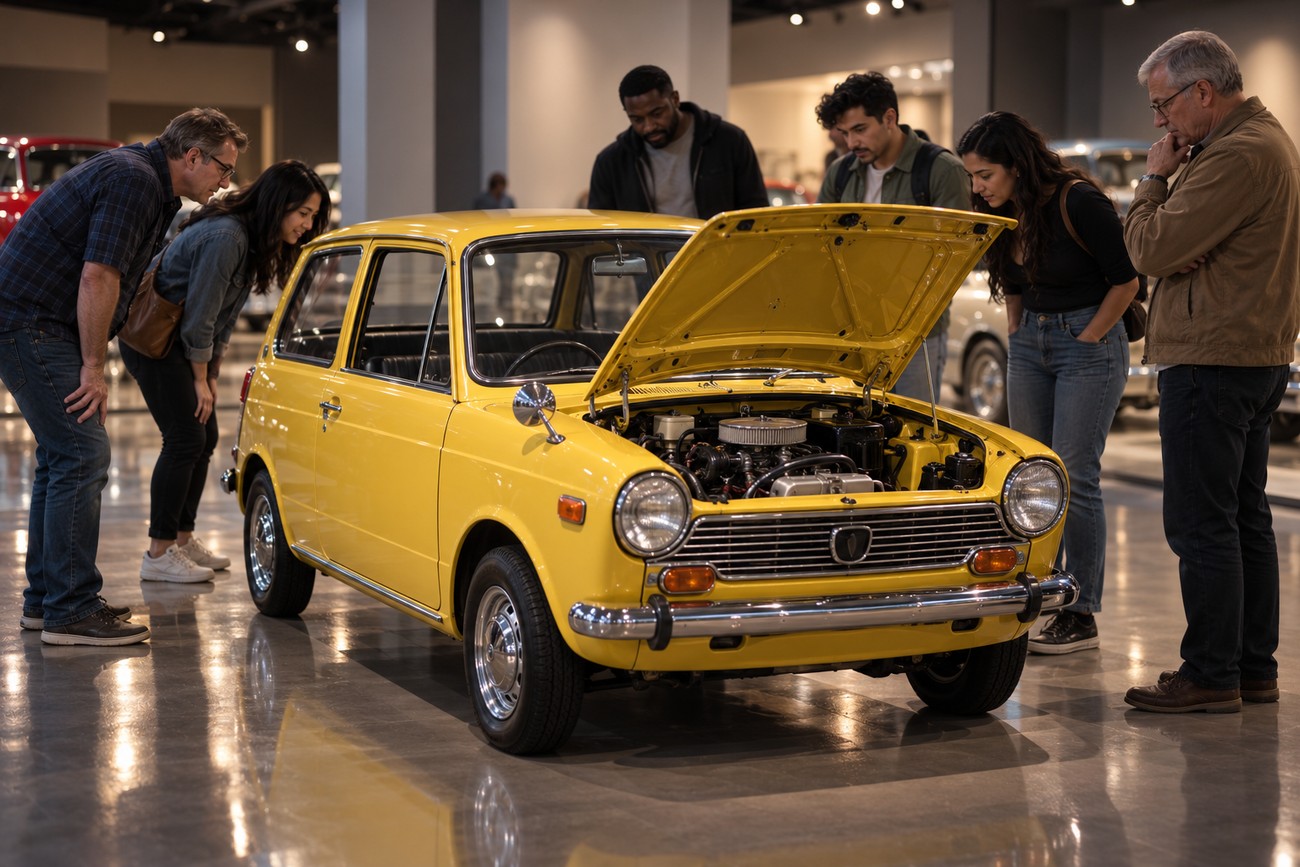
The N600 established an official Honda car presence in the United States, and that achievement gave the model a place in automotive history beyond its size. It introduced American buyers to Honda’s compact engineering at a time when the company was still building its reputation as a car manufacturer. Later Honda products benefited from that early lesson in local distribution, service, and customer expectations.
U. S. N600 sales during 1970–1972 were just over 34,000. That figure must remain separate from broader North American estimates. One Honda Fact Book estimate cites approximately 35,000 sedans and 15,500 Z Coupes for North America, while an alternative combined sedan-and-coupe estimate is 40,852; neither figure should be substituted for U. S. N600 sales.
The Z Coupe is a separate body and model identity, even though it belongs to the same wider family and may appear in the same historical discussions. Treating every sedan-and-coupe total as an N600 sedan count obscures both production history and parts research. It can also lead a restorer to assume interchangeability that has not been established.
Rarity alone does not make a car a sound investment. Severe rust, missing components, and an incomplete interior can overwhelm the value created by historical significance. The most meaningful N600 is usually the individual car with a solid body, complete equipment, credible documentation, and mechanical systems that can be restored without guesswork.
Frequently asked questions
What is the average price of a Honda N600?
No reliable average sale price follows from the available historical and technical figures. N600 values vary sharply with structural rust, completeness, documentation, restoration quality, originality, and whether the car needs a full mechanical rebuild.
Compare recent completed sales rather than asking prices. Group cars by condition, then account for missing trim, non-running engines, brake work, body repairs, and the quality of any restoration. A rare project with serious corrosion may represent a larger financial commitment than a more expensive, complete car that is already structurally sound.
How can I confirm that a replacement part fits my N600?
Start with the factory parts or service manual and confirm the car’s year, market, production details, and body type. Check the original part number, casting marks, dimensions, connector locations, and photographs against the proposed replacement. N600 sedan and Z600 components should not be assumed interchangeable simply because the model names are related.
Before completing the purchase, ask the seller to confirm those details in writing and review the return terms. This is especially important for brake, suspension, carburetor, and interior parts, where a visually similar item may still require unsafe or impractical modification.
How should I prepare an N600 for occasional use and storage?
Use fresh, suitable fuel and inspect the fuel system for leaks before driving. Maintain the battery with appropriate care, check tire condition and pressure, and look for oil, fuel, or brake-fluid leaks after the car has stood. Keep cooling fins clear and confirm that the brakes release evenly before the first road test.
After storage, allow time for a return-to-service inspection rather than driving immediately. Check the battery, hoses, tires, fluid levels, brake pedal feel, and calipers, then make a short low-speed test before extending the trip. Age-related condition matters more than the original top-speed claim.
What should I check when insuring an N600 as a classic car?
Ask the insurer how the policy defines the car’s value. Agreed value and ordinary coverage are different arrangements, and the settlement basis should be clear before a claim occurs. Keep photographs, identification details, restoration records, and receipts that support the vehicle’s condition and stated value.
Verify the permitted use, storage requirements, mileage restrictions, and any limits on commuting or regular travel. Classic-car policies differ, so confirm the actual terms with the insurer instead of assuming that every historic vehicle policy offers the same protection.







