
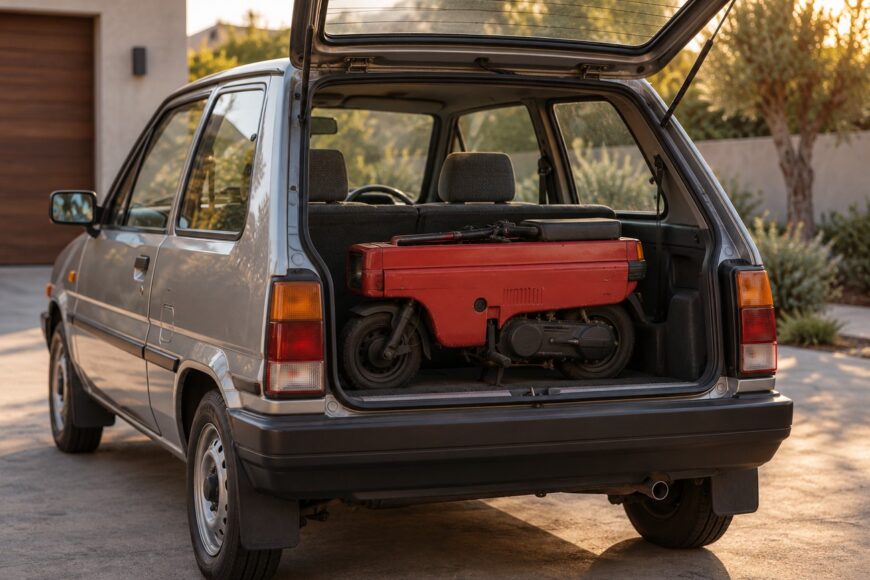
The appeal of carrying a scooter in a car is easy to grasp: park, unload, and continue a short journey on two wheels. Honda gave that idea a production form with the Motocompo, a scooter designed to fold into a compact, box-like package for the first-generation City.
Its small footprint tells only part of the story. A Motocompo is heavy enough to make loading it a deliberate task, and owning one today can involve scarce parts and unusual mechanisms. Those compromises make more sense when the scooter is seen as one half of Honda’s original car-and-scooter pairing, rather than as a miniature machine expected to do everything on its own.
- Why Honda built a scooter for the City
- How the Motocompo folds and fits in a car
- What riding one is actually like
- The portability compromise advertisements cannot show
- Buying a Motocompo without inheriting a costly project
- Why the idea outlasted the scooter
- Frequently asked questions
- How rare is a Honda Motocompo?
- How much does a Honda Motocompacto cost?
- What was the Honda Motocompo designed for?
Why Honda built a scooter for the City
Honda conceived the Motocompo as a luggage-compartment companion to the first-generation Honda City. The intended journey began in the car: drive to a suitable place, unload the scooter, and use it for a shorter local trip. Folding made that arrangement possible without carrying a full-size scooter or attaching a carrier to the car.
The Honda Motocompo was a production folding scooter manufactured from 1981 to 1983. Its connection to the City was also part of Honda’s commercial strategy, which helps explain the unusually close attention paid to its stowed shape. Calling it a concept or a publicity prop misses the fact that customers could buy and ride one.
The pairing did, however, ask something of its owner. A useful destination had to justify unloading the scooter, then loading it again for the return journey. For someone whose trips rarely followed that pattern, a compact machine in the luggage compartment offered less practical value than the original idea suggested.
How the Motocompo folds and fits in a car
The Motocompo changes from a rideable scooter into a long, narrow package by folding away its protruding controls and seating arrangement. Its folded dimensions are commonly cited as 1,185 × 240 × 540 mm. That box-like form matters more than its resemblance to a conventional scooter: it was shaped to occupy luggage space in the first-generation Honda City.
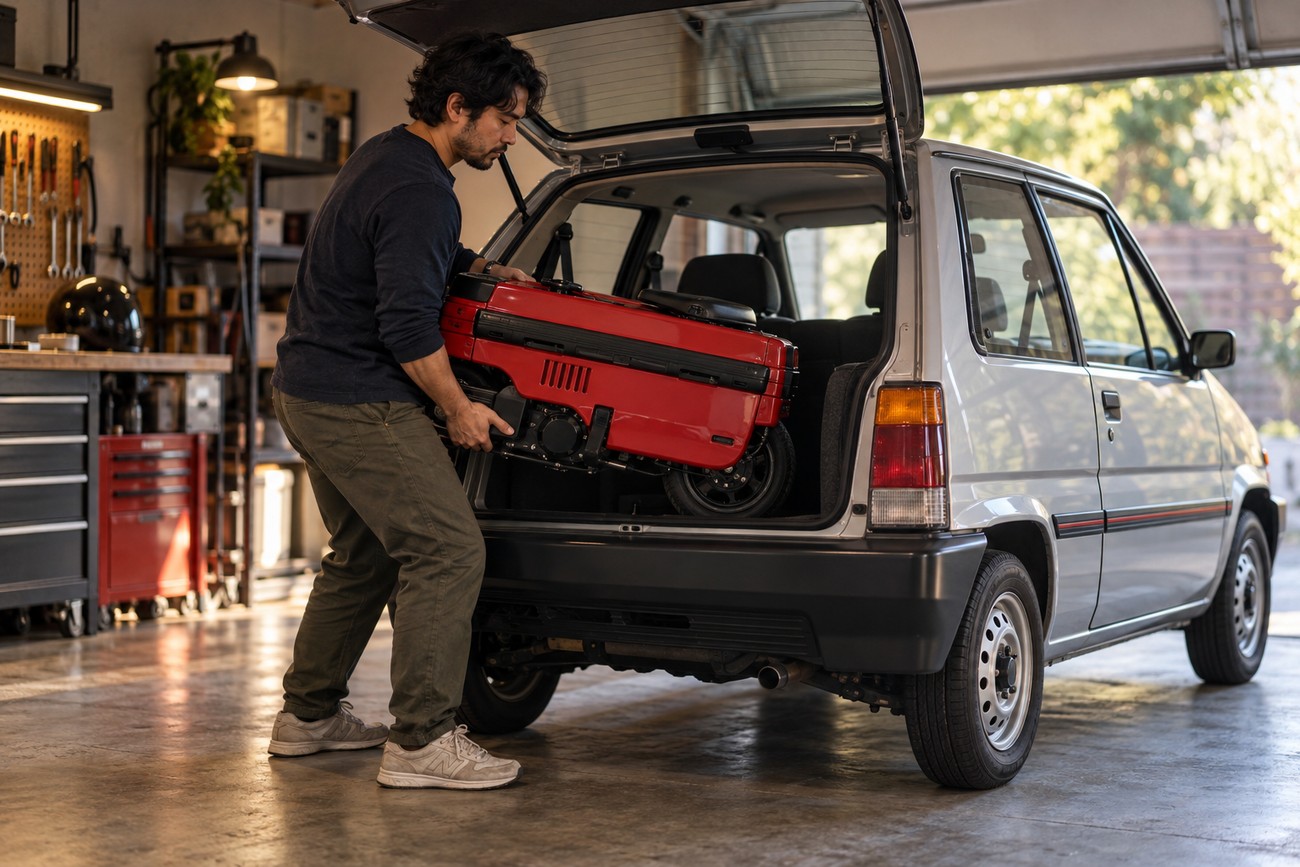
The folding happens before the scooter goes into the car, not while it is inside. A photograph of a Motocompo stowed in a City also does not establish that it will fit a particular modern car. The opening, loading height, and usable floor space all matter, so a prospective owner should measure the actual vehicle rather than rely on the word “folding.”
Published weights are approximately 42 kg dry and 45 kg in operating condition, though sources sometimes label the figures differently. Either way, the compact package is a substantial lift. Getting it over a high luggage lip or turning it in a confined space can be awkward for one person, even when the scooter’s shape makes storage straightforward.
What riding one is actually like

The Motocompo uses a 49 cc, air-cooled, single-cylinder two-stroke rated at 2.5 hp at 5,000 rpm. Those figures suit the City-companion brief: this was transport for a short continuation of a car journey. Judged as a substitute for a conventional scooter, its modest output and compact riding layout are more likely to disappoint.
Packaging affects the experience as much as engine size. A scooter built to become a narrow rectangular load has less room to accommodate the rider than one designed solely for riding. Owners’ descriptions of slow, short-trip use are consistent with that purpose, although the condition of an individual machine will also shape how it feels.
The fuel tank holds 2.2 L. Informal range estimates vary, and there is no sound basis here for treating an enthusiast’s mileage claim as an official Honda figure. On a surviving two-stroke, fuel consumption and running quality depend on maintenance, adjustment, and use; the small tank is a reason to plan a trip, not a promise of a particular distance.
The portability compromise advertisements cannot show
Folding and portability solve different problems. At approximately 42 kg dry and 45 kg in operating condition, the Motocompo can take up little space while remaining difficult to carry. Its original role was to be loaded into a car, so anyone considering regular solo lifting should assess the lift itself, not only the folded dimensions.
The parts that make it compact also have to work every time it is used. Check that the folding components move properly, settle into their riding positions, and remain secure. Wear or damage in these areas has a more direct effect on usability than a scuff on a panel, because the scooter must repeatedly change between two forms.
Starting is reported to require the seat to be raised, a detail worth confirming on the individual scooter. If one fails to start, check that operation before drawing conclusions about the engine; equally, the seat condition alone cannot diagnose every starting fault. The unusual arrangement is part of the appeal, but it adds a check that an ordinary used-scooter inspection might overlook.
Buying a Motocompo without inheriting a costly project
Begin with completeness and originality. Compare the scooter with reliable model references and identify missing Motocompo-specific pieces before judging its paint or age. Original parts can be scarce and expensive to replace, and a cheap, incomplete example may cost more to put right than a sound one.
Next, operate the folding arrangement and seat rather than accepting a demonstration of the engine alone. Confirm that each part moves and holds as intended, then ask to see the scooter started with the seat raised, as reportedly required. A machine that runs but cannot be folded, loaded, or set up reliably has lost much of its defining function.
Only then turn to ordinary running condition: look for signs of neglected two-stroke maintenance and assess how the engine starts and runs. A clean exterior cannot establish sound mechanical condition. For a buyer who wants a usable, largely original Motocompo, completeness and function may matter more than whether it comes from the first or last year of production.
Why the idea outlasted the scooter
Honda built the Motocompo from 1981 to 1983, and accounts describe sales as below expectations. Without a verified total, the safest conclusion is narrower: production ended after a short run, despite the clarity of the City-companion idea. An ingenious packaging solution does not, by itself, make the routine of unloading and reloading attractive to every driver.
What endured is the engineering proposition. Honda made a functioning 49 cc scooter that could become a compact load shaped for a particular car. That is more specific, and more interesting, than the claim that it was simply a tiny scooter; its folded form and its intended journey were central to the design.
Surviving examples also appeal as restoration objects, where correct parts and working transformations can matter more than riding performance. The Motocompo remains memorable because Honda took the car-and-scooter pairing into series production. Its history is clearest when that achievement is kept separate from the question of how practical one is to lift, ride, and maintain today.
Frequently asked questions
Two common questions need distinctions that a photograph of a folded scooter cannot supply. One concerns how rare original Motocompos are; the other concerns a similarly named, much newer Honda vehicle.
How rare is a Honda Motocompo?
The Motocompo had a limited production period, from 1981 to 1983, but that does not establish a verified production total or how many survive. Finding any example and finding a complete, original, functioning example are different tasks. If you are shopping for one, judge the availability of the specific parts a candidate lacks before treating its age or an advertised rarity claim as evidence of value.
How much does a Honda Motocompacto cost?
The Motocompacto is Honda’s separate modern electric vehicle, not the original 49 cc two-stroke Motocompo. Check Honda’s current official pricing in your market for the Motocompacto, including local availability and applicable charges. Vintage Motocompo asking prices answer a different question: they reflect the condition and completeness of individual collectible scooters.
What was the Honda Motocompo designed for?
The Honda Motocompo was designed as a folding scooter to travel in the luggage compartment of the first-generation Honda City. The owner could drive to a destination, unload the scooter for a short local journey, and then fold and load it again for the return trip.







