
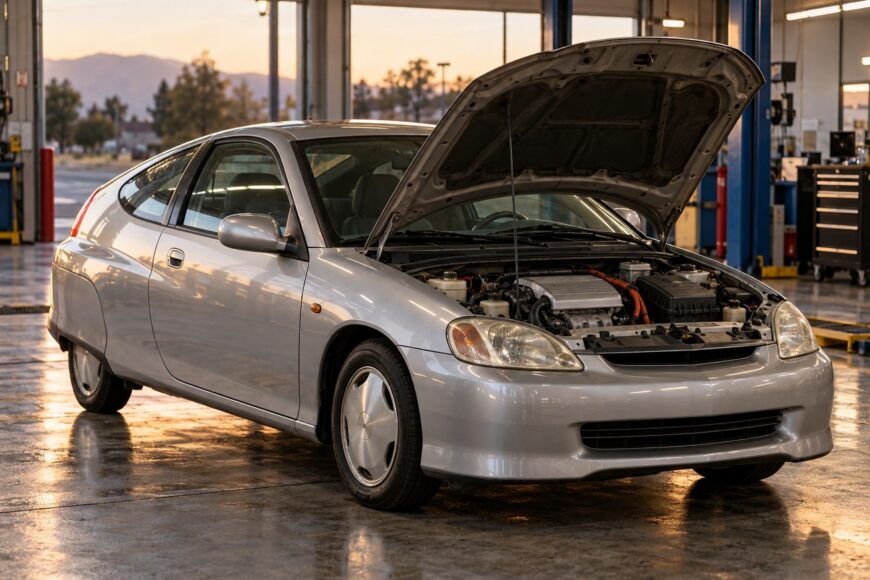
The Honda Insight G1 is an engineering success with unusually severe compromises. Its lightweight aluminum body, narrow tires, aerodynamic shape, and modest hybrid system were designed to reduce avoidable losses. Early specifications put the car at approximately 840 kg, helping explain why its catalog fuel-economy figure could approach 2.9 L/100 km.
That efficiency came with a very small cabin, limited cargo space, low ground clearance, and performance that depends heavily on the condition of the electric assist. The ZE1 is a 3-door hatchback using Honda’s IMA parallel-hybrid system, so the gasoline engine remains the main source of propulsion. The practical question today is whether this remarkable design is still usable and supportable as an aging used car.
- What the Honda Insight G1 Actually Is
- The Engineering Formula: Low Mass, Aerodynamics, and IMA
- Honda Insight G1 Fuel Economy: Catalog Number vs. Real Driving
- Honda Insight G1 Specifications: What Depends on the Version
- The Compromises Owners Notice First
- The Aluminum Body Is an Advantage—and a Repair Risk
- Buying a Used Insight G1 Without Buying the Myth
- Frequently asked questions
- Why are Honda Insight G1 cars so cheap?
- How long will a Honda Insight hybrid last?
- Why did Honda stop making the Insight hybrid?
What the Honda Insight G1 Actually Is
The Honda Insight G1, also designated ZE1, is the first-generation Insight, cataloged as a 1999–2006 model. It is a 3-door hatchback with an aluminum body developed primarily to reduce mass. That construction was central to the car’s efficiency strategy rather than a cosmetic feature.
The hybrid system is Honda’s IMA, or Integrated Motor Assist. It is a parallel hybrid: the 1.0-liter gasoline engine remains the main propulsion source, while an electric motor provides assistance under suitable conditions. This architecture differs from a series hybrid, in which the engine mainly operates as a generator, and from a battery-electric vehicle, which has no gasoline engine driving the wheels.
Descriptions of the seating capacity are inconsistent across catalogs and reviews. Some sources call the car a two-seater, while other listings describe the 3-door hatchback without consistent seating details. A buyer should therefore verify the specific configuration rather than treating one generic description as universal.
The G1 belongs to a narrow engineering category. It was built around low mass, aerodynamic efficiency, and reduced energy losses, so advice about later Honda Insight generations can be misleading. Those cars use different bodies and hybrid arrangements.
The Engineering Formula: Low Mass, Aerodynamics, and IMA
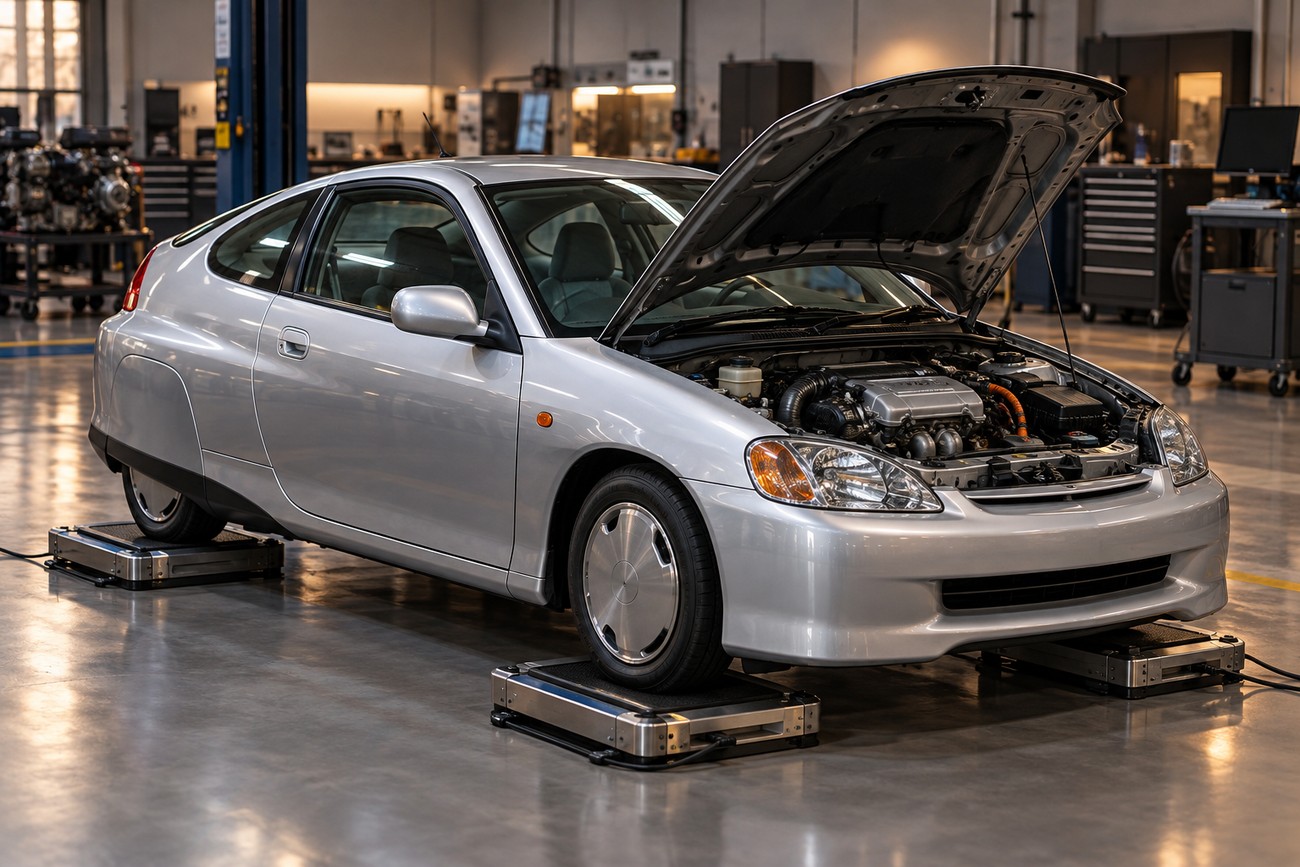
The G1’s efficiency came from minimizing losses rather than maximizing power. Early specifications list a mass of approximately 840 kg, a figure that allowed the small hybrid system to move the car with relatively little energy. The aerodynamic body and narrow tires supported the same objective by reducing drag and rolling resistance.
Power came from a 1.0-liter gasoline engine, with commonly listed figures of approximately 68–76 hp depending on market and modification. Those numbers are modest even for a lightweight car. The IMA motor could add assistance during acceleration, but it did not turn the Insight into a high-performance vehicle.
Because the system is parallel, the gasoline engine remains important in ordinary driving and under sustained load. Electric assistance can reduce the effort required from the engine, but its contribution depends on battery condition, operating conditions, and the control system. A weak or restricted hybrid system can leave the car feeling particularly unhurried.
The unusual lesson is that the body, tires, engine, and hybrid hardware must be considered as one package. Removing any one element from that formula changes the result. The car achieved low consumption through a complete low-loss design, not through a large battery or abundant electric power.
Honda Insight G1 Fuel Economy: Catalog Number vs. Real Driving
Approximately 2.9 L/100 km is best treated as a catalog-oriented reference, not a promise for every journey. Test cycles use defined speeds, temperatures, traffic conditions, and vehicle states. They do not represent every owner’s commute.
Reported real-world tests and practical measurements commonly fall around 4.2–4.6 L/100 km. That range is substantially different from the catalog figure, yet it does not automatically indicate a fault. Highway conditions, gentle acceleration, correct tire pressures, and a healthy IMA system can produce a more favorable result than short urban trips.
City traffic places more demand on acceleration and repeated stops. Winter conditions can also make the catalog number difficult to reproduce because cold operation, road conditions, and heating demands increase energy use. Driving style matters because the G1’s efficiency depends on preserving momentum and avoiding unnecessary load.
Catalog, highway, and real-use figures should therefore be compared only when their test conditions are understood. A used-car buyer should evaluate consumption alongside battery behavior, warning lights, service history, and the actual route the car will cover.
Honda Insight G1 Specifications: What Depends on the Version
The core engineering formula is consistent, while transmission descriptions, power figures, equipment, and seating details can vary by market and version.
| Item | Honda Insight G1 reference |
|---|---|
| Model designation | Honda Insight G1, also designated ZE1 |
| Production period | 1999–2006 |
| Body | 3-door hatchback |
| Body construction | Aluminum body used to reduce mass |
| Mass | Approximately 840 kg in early specifications |
| Engine | 1.0-liter gasoline engine |
| Power | Approximately 68–76 hp, depending on market and modification |
| Hybrid architecture | IMA, or Integrated Motor Assist; a parallel hybrid with the gasoline engine as the main propulsion source |
| Fuel-economy reference | Approximately 2.9 L/100 km in catalog-oriented data; approximately 4.2–4.6 L/100 km in reported tests or practical measurements |
| Transmission | Manual and/or CVT/automated solutions are reported depending on market and version; verify by VIN |
Transmission details, equipment, seating configuration, and the exact drivetrain specification should be verified by VIN and market documentation. Generic listings can combine information from different versions and later Insight generations.
The Compromises Owners Notice First
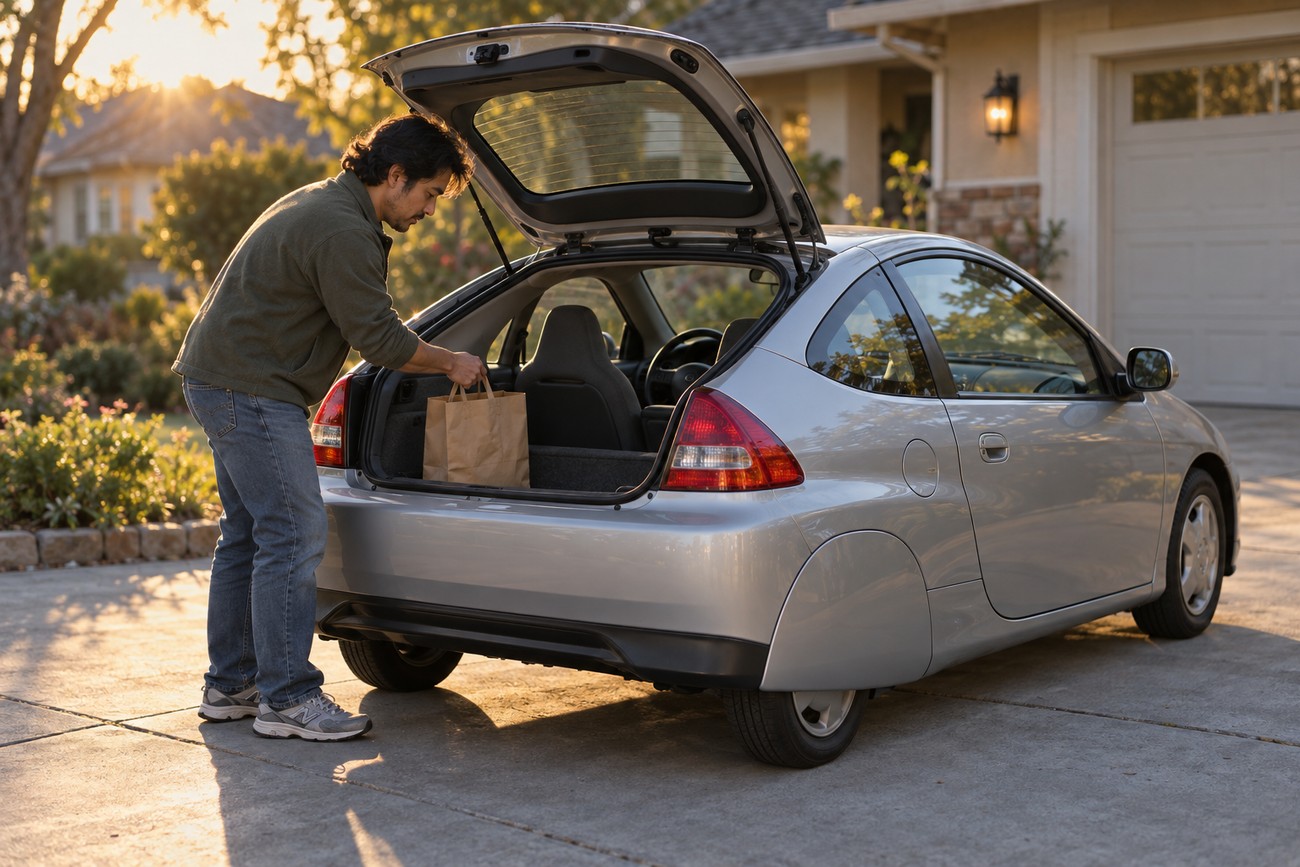
The restricted cabin and luggage area are usually the first practical limitations. The G1’s narrow, lightweight body was optimized for efficiency, leaving little space for passengers or cargo. It suits a specific use case far better than it serves as a general family car.
Performance can also disappoint drivers expecting a conventional Honda with stronger reserve power. When electric assistance is limited, the small engine has to do more work, and acceleration feels deliberate. The car rewards smooth inputs and anticipation rather than frequent hard acceleration.
Low ground clearance further narrows its daily usefulness. Rough roads, steep ramps, and poorly repaired surfaces require care, especially where underbody contact is a regular risk. That limitation matters more than a specification-sheet fuel figure if the vehicle will be used in difficult urban or rural conditions.
Some reviews also mention awkward seating or restricted visibility caused by the aerodynamic body, although those complaints are not documented uniformly. They should be checked during an actual drive, with attention to entry, seat adjustment, rearward visibility, and the driver’s ability to place the car accurately.
The Aluminum Body Is an Advantage—and a Repair Risk
Aluminum helped Honda reduce the G1’s mass, which directly supported its efficiency. It does not make the body immune to age or damage. Accident history, panel alignment, joints, fasteners, and the quality of previous repairs remain central inspection points.
Repairing damaged aluminum structures can require specialized methods and suitable equipment. A poor repair may affect panel fit, corrosion protection, structural integrity, or the ability to diagnose later problems. Restoration can therefore become expensive even when the visible damage appears limited.
Aluminum itself should not be judged as though it were rust-prone steel, but related hardware can deteriorate. Fasteners and joints deserve separate attention, particularly on an old vehicle exposed to moisture or road salt. A clean-looking exterior does not prove that the underlying repair work was correct.
Collision documentation is especially valuable because cosmetic replacement panels can hide more significant structural work. Inspecting panel gaps, fasteners, repaired areas, and the consistency of the body finish is more useful than assuming that an aluminum car is automatically trouble-free.
Buying a Used Insight G1 Without Buying the Myth
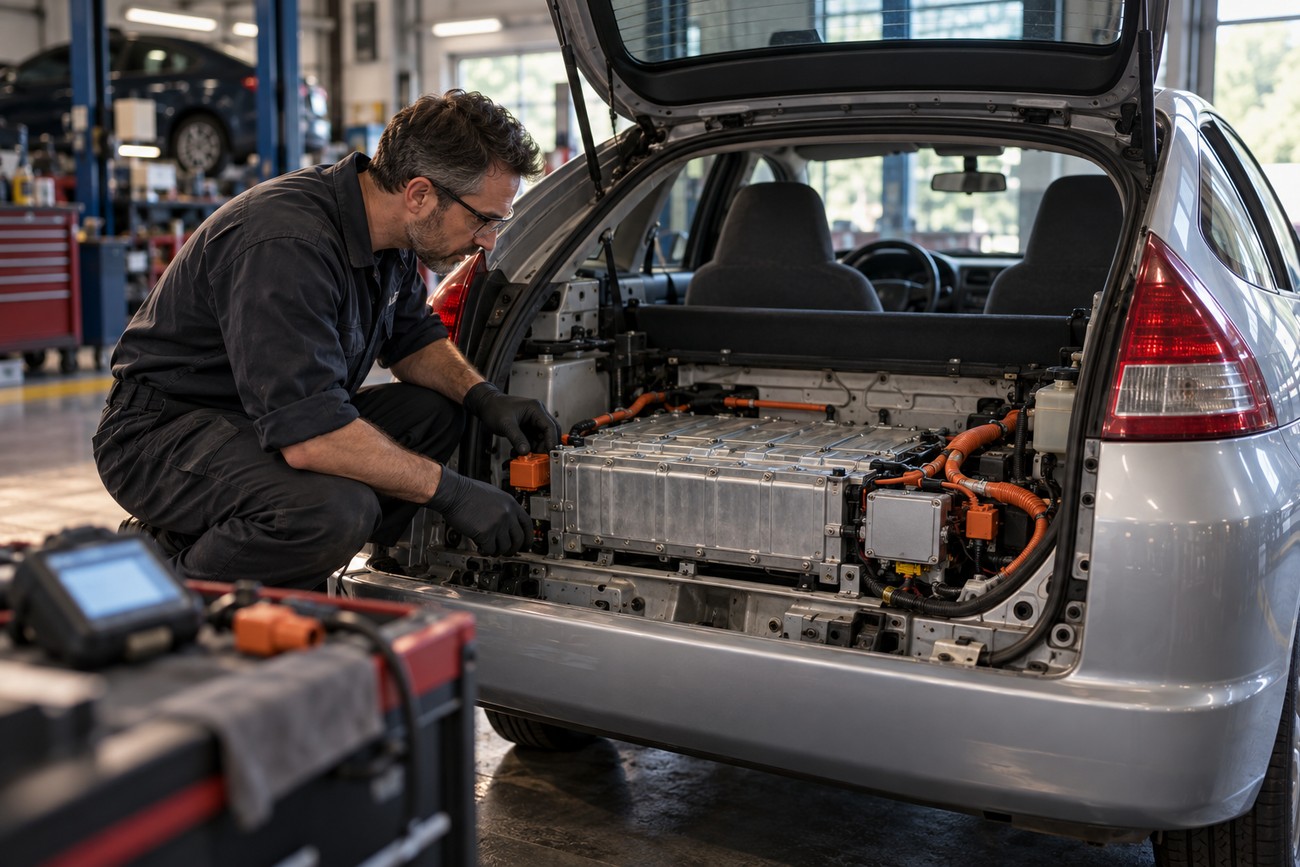
The first priority is a documented inspection of the IMA battery and related electronics. Warning lights, reduced assistance, abnormal charging behavior, or restricted hybrid operation can change the ownership equation quickly. A low odometer reading does not compensate for an unverified hybrid system.
Confirm the exact transmission, market specification, and configuration by VIN. Parts compatibility and service procedures can vary, and the G1 should not be treated as an ordinary Honda with universally interchangeable components. Ask for evidence of maintenance rather than relying on a seller’s description of the model.
Prioritize a documented IMA-system diagnosis and evidence of correct aluminum-body repairs before negotiating over mileage.
Inspect the aluminum panels, fasteners, joints, and previous collision repairs separately from the mechanical inspection. The vehicle may drive well while still carrying expensive bodywork risks. Also assess whether its low clearance, restricted interior, and modest performance suit the roads and loads you expect to use.
Advice for later Honda Insight generations should not be applied automatically. The G1 has a different body and hybrid architecture, and age-related deterioration is now a major ownership factor. The most defensible purchase is the example with verified system condition and realistic parts support, rather than the one with the most attractive mileage figure.
Frequently asked questions
The Honda Insight G1 remains interesting because its technical priorities were unusually focused. Used-car decisions, however, depend on ownership economics as much as on fuel consumption.
Why are Honda Insight G1 cars so cheap?
Prices can be suppressed by age, limited cabin and cargo practicality, niche demand, specialized aluminum repairs, and uncertainty around IMA components. A car designed around extreme efficiency appeals to a smaller group of buyers than a conventional hatchback with easier parts support and more flexible space.
A low purchase price does not guarantee a low total cost of ownership. Hybrid electronics, battery work, collision repairs, and age-sensitive hardware can outweigh the initial saving. That does not mean every inexpensive example is defective; it means the inspection must establish why the car is cheap.
How long will a Honda Insight hybrid last?
There is no reliable universal lifespan figure for a Honda Insight G1. Continued use depends on IMA battery condition, electronics, mechanical maintenance, body repairs, and the availability of suitable parts and service. Mileage alone cannot answer that question.
Separate mechanical longevity from economic viability. An engine and chassis may remain usable while an aging hybrid system or specialized body repair makes further ownership financially unattractive. A documented diagnosis and a realistic repair plan are more useful than a fixed mileage promise.
Why did Honda stop making the Insight hybrid?
The first-generation Insight was cataloged as a 1999–2006 model and occupied a narrow niche built around low mass, aerodynamics, and extreme efficiency. Its limited practicality and specialized construction made it a distinctive concept rather than a broad-market family hatchback.
There is no single supported explanation here that should be presented as the official reason. Later Insight generations used different bodies and hybrid architectures, so the end of the G1 should be understood in the context of its specialized concept and changing model strategy, rather than as proof that the IMA idea itself was abandoned.







