
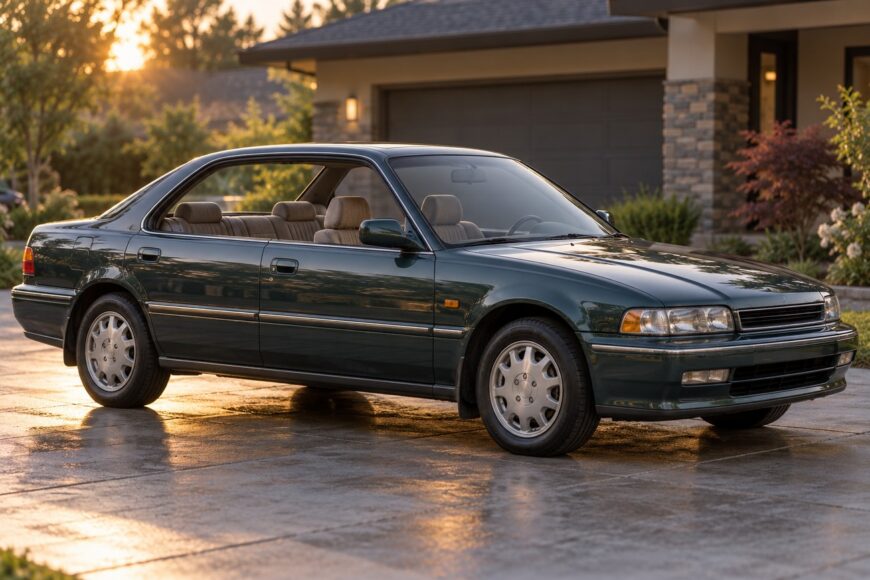
With its windows down, the Honda Ascot Innova has the open-sided profile that made Japanese pillarless hardtops distinctive. The uninterrupted opening between the front and rear doors is the point of the design, and frameless glass keeps that effect when the windows are raised. It also makes door fit and window alignment unusually important on a car now several decades old.
The Innova’s Accord connection is real, but it does not promise interchangeable parts or easy ownership. A shared mechanical family tells you little about whether a replacement seal will match the window or an interior panel will fit. For a prospective buyer, the decisive details are usually visible at the doors, in the condition of the body openings, and in the operation of equipment fitted to the particular car.
- An Accord cousin, not an Accord with its pillars removed
- What the pillarless body changes in everyday use
- Engines, dimensions, and the optional 4WS
- Where Accord parts compatibility ends
- The inspection that matters before you buy
- Warning lights and rough idle are clues, not diagnoses
- Who the Ascot Innova makes sense for
- Frequently asked questions
- Why might a 4WS Ascot Innova have no factory cupholder?
- What should you send a parts supplier besides the model name?
- What paperwork is useful after a repaired door opening?
An Accord cousin, not an Accord with its pillars removed
The Ascot Innova was an early-1990s Japanese four-door pillarless hardtop related to the Accord. That relationship is a useful starting point for understanding its front-wheel-drive layout and engine family. Its body and equipment choices, however, give it a separate identity.
Calling it an Accord with the central pillars removed understates the differences a buyer has to manage. The Innova’s doors, glass, and trim need to be identified as parts for the correct car rather than assumed to fit because another Honda shares mechanical ancestry. This distinction matters most when a worn component is difficult to inspect until a replacement arrives.
Accounts of the model’s relationship with European Accords sometimes go further, claiming that the Innova directly underpinned every European Accord. The supplied factory evidence does not establish that broad claim. “Accord-related” is the more reliable description, and it leaves room for the differences between markets and models that matter in parts catalogues.
What the pillarless body changes in everyday use
Without a fixed central door pillar, the Innova presents a broad opening when both side windows are lowered. With the doors shut, the frameless glass must sit accurately against its weatherstripping to keep out air and water. A small error at the top edge can become a pronounced whistle on the road.
Watch a window as its door closes slowly: the glass should enter the seal cleanly rather than push against its outer edge. Repeat the check from inside, where a gap or displaced rubber may be easier to see. Owner reports of winter wind noise make this a worthwhile test, although noise alone does not establish that the seal needs replacing.
Glass adjustment, sagging hinges, latch position, and door-opening geometry can all affect the seal. Poor collision repair may leave the window difficult to align even with sound rubber. The absence of a central pillar does not, by itself, prove that the shell is weak; corrosion and the quality of past repairs are the more useful concerns on a surviving car.
Engines, dimensions, and the optional 4WS

Honda lists the 2.0i at 4670 × 1695 × 1380 mm, with a 2720 mm wheelbase. Those are figures for the 2.0i, rather than dimensions to assign indiscriminately to every version. They give a clearer sense of the car’s footprint than a broad comparison with an Accord.
The range included F-series 2.0- and 2.3-liter inline-four engines, front-wheel drive, and manual or automatic transmissions. Optional four-wheel steering, or 4WS, adds another distinction between individual cars. Confirming the engine code and fitted equipment is more useful than relying on a model name in a listing.
Published output figures can vary with engine code, year, and market. Discussions cite about 131 hp and 180 Nm for the F20Z1, but those numbers should not be applied to an unverified car or the whole range. Match the engine code to the relevant Japanese factory specification before treating a power figure as a fact.
Where Accord parts compatibility ends
Accord-related mechanical may give an owner useful avenues for parts research, but compatibility has to be established component by component. Body panels, frameless glass, weatherstripping, and interior trim present different fit questions from an engine service part. A listing that says only “Accord” is insufficient evidence for those items.
Start with the Innova’s exact body and engine codes when consulting a parts catalogue. Check the part’s shape and application as well as its number, especially for a seal whose profile must meet the glass correctly. For 4WS cars, rear-steering components need their own compatibility check before parts from a conventional rear suspension are ordered.
Original seals and model-specific trim can be hard to find, and their cost may be substantial relative to the car’s value. That does not mean every service item is unobtainable. It means a missing or damaged unique piece deserves attention before purchase, while there is still time to establish whether a suitable replacement can be sourced.
The inspection that matters before you buy

Begin with the doors before concentrating on the engine bay. Close each one slowly while watching the frameless glass enter its seal, then check the fit from the cabin. Look for consistent gaps, smooth window travel, and latches that hold the doors without forcing them into place.
Follow that static check with a drive at road speed and listen around each window for wind noise. After a wash, look for water at the door edges and inside the cabin. Either symptom calls for investigation; neither identifies a failed seal on its own.
A whistling window calls for a door-fit and glass-travel check before a replacement seal is priced. A new seal cannot reliably correct a door that closes out of position.
Inspect the sills and door openings for corrosion, uneven fit, or signs of poor collision repair. A repaired opening can alter where the door sits and where the glass meets the rubber, making a persistent leak more complicated than a window adjustment. Condition here deserves more weight than tidy paint viewed from a distance.
If the car has 4WS, establish that the system operates as intended at low speed and check for faults rather than accepting the option badge as proof. Its steering hardware and related parts add inspection and repair considerations that an ordinary car does not have. A desirable specification becomes less attractive if its distinctive equipment is inoperative or has been repaired with unverified parts.
Warning lights and rough idle are clues, not diagnoses
Some owners report fluctuating idle, sometimes alongside a blinking S indicator. These are observations to record carefully, not a ready-made diagnosis. Similar visible symptoms can have different causes, particularly where aging electrical connections and an automatic transmission are involved.
A blinking S indicator warrants fault-code retrieval and targeted checks. Dismissing it because the car still drives risks overlooking a fault; replacing sensors indiscriminately can be just as unproductive. Ask what was tested, which codes were found, and whether a claimed repair resolved the symptom.
Idle behavior should likewise be assessed with the engine under relevant operating conditions rather than judged from a brief start-up. For a buying decision, documented diagnosis and a consistent road test carry more weight than a seller’s proposed explanation. The condition of the individual car matters more than its quoted power or the rarity of its specification.
Who the Ascot Innova makes sense for
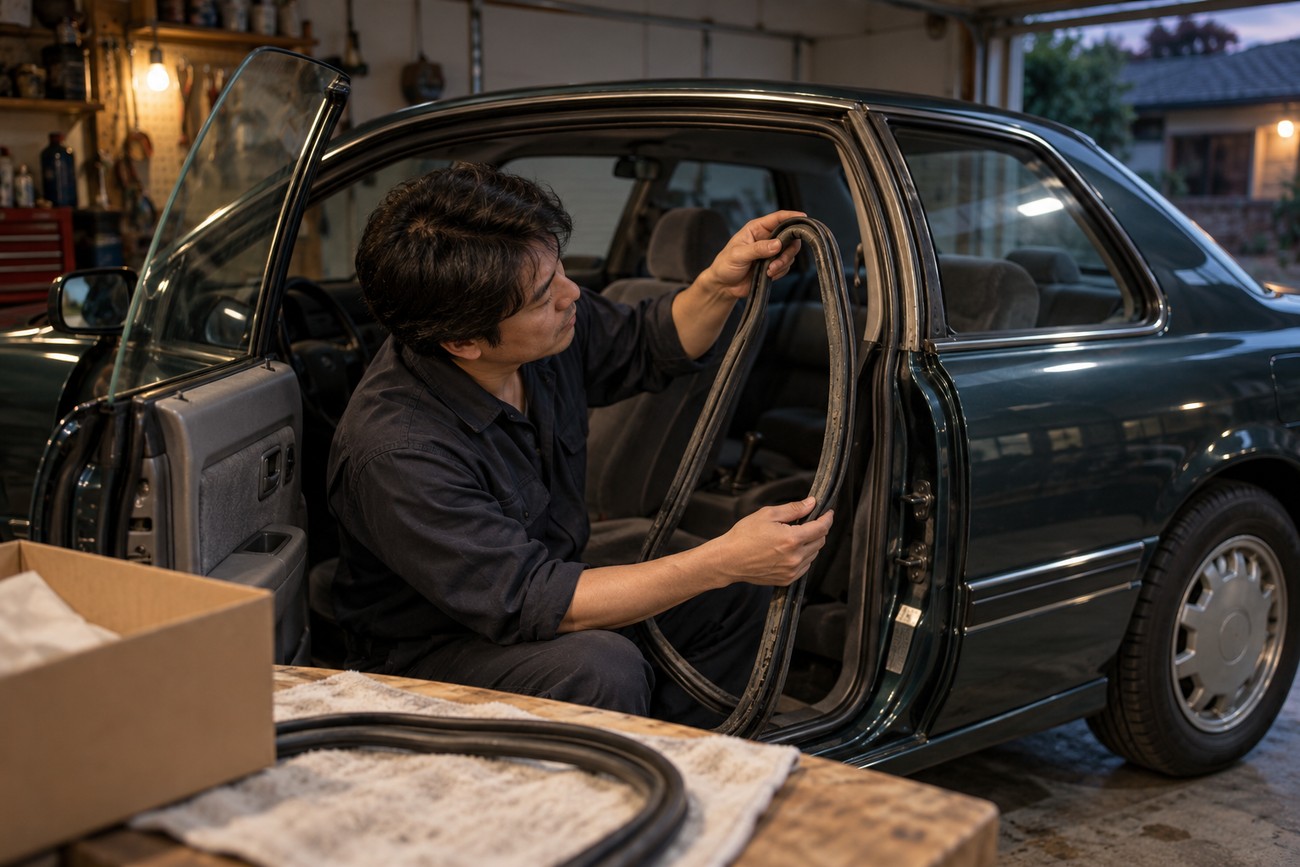
The Ascot Innova suits someone who values its distinct pillarless body and is prepared to research the exact car before ordering parts. Accord-related mechanical offer a useful point of reference, while the body, interior, and optional 4WS require more specific attention. That balance can be rewarding for an involved owner, but it is a poor fit for someone expecting straightforward interchangeability.
Allow for the time involved in tracing seals, trim, and equipment-specific components. A car with neglected doors or questionable opening repairs may demand more work than its otherwise appealing specification suggests. The same caution applies to 4WS: confirm its function and parts support before treating it as a buying advantage.
Favor a sound, well-documented example with correctly fitting glass and functioning equipment over a rarer car with visible compromises. That rule keeps the attraction of the open-sided design in proportion to the work needed to preserve it.
Frequently asked questions
Why might a 4WS Ascot Innova have no factory cupholder?
Honda specified a special center console without the standard cupholder for 4WS cars. Its absence therefore need not mean trim is missing. Check the car’s equipment specification before buying a replacement console that may be intended for a version without 4WS.
What should you send a parts supplier besides the model name?
Send the exact body and engine codes, clear photos of the existing part, its position on the car, and confirmation of whether 4WS is fitted. That information lets the supplier check the relevant application and physical form rather than guessing from “Ascot Innova” or an Accord connection alone.
What paperwork is useful after a repaired door opening?
Request repair invoices, any available body-measurement records, and evidence that door and glass fit were checked after the work. Paperwork cannot replace an inspection, but it helps establish what was repaired and gives a specialist a starting point if a window later whistles or leaks.







